7 Hip Mobility Exercises for Squats
Explore 7 hip mobility exercises for squats with coaching cues, progressions, and timing to improve depth and mechanics safely.

Deep squats don't require one universal stretch. Hip rotation, hip-flexor length, ankle motion, trunk control, strength, and comfort at depth all shape the position you can use. Deep-squat biomechanics research reports average hip flexion of about 124 to 125 degrees, ankle dorsiflexion of about 23.4 to 25.9 degrees, and knee flexion of about 124 degrees in the sample studied, while normal adult hip flexion can reach approximately 130.4 degrees in men aged 20 to 44 and 133.8 degrees in women aged 20 to 44 (deep-squat biomechanics research).
That doesn't mean you should force those angles. It means your mobility work should help you assess what limits your squat, prepare actively before training, use longer holds when appropriate, and gradually practice controlled range under load. The seven hip mobility exercises for squats below follow that sequence, from low-risk preparation to more advanced corrective work. Stop if you feel sharp or escalating pain, and seek qualified guidance if hip symptoms persist, especially after surgery or with suspected impingement.
1. 90/90 Hip Stretch
The 90/90 position gives each hip a different rotational demand. Your front leg works in external rotation, while the rear leg works in internal rotation. That makes it more useful than a generic forward fold when your squat feels restricted through rotation or when one side behaves differently from the other.
Sit on the floor with your front knee bent in front of you and your rear knee bent beside you. Aim for roughly right angles at both knees, but don't force the shape. Keep the rear heel connected to the floor, lengthen your spine, and lean forward over the front shin until you feel a tolerable stretch around the outer or back portion of the hip.
Practical rule: A stretch should give you room to breathe and adjust. If you have to collapse through the lower back or push the knee down, reduce the range.
Start with a small forward fold. As the position becomes familiar, hinge farther from the hips while keeping the front hip heavy and the back heel grounded. Use a yoga block or folded towel beneath the front hip if the position feels too intense. Hold each side for 60 to 90 seconds, repeating 2 to 3 times per leg as a longer mobility session or before squatting. Those timing recommendations come from the planned drill prescription, not a promise of a particular outcome.
A beginner who struggles to keep the knees tracking comfortably during a bodyweight squat can use the 90/90 stretch to explore rotation before practicing a supported squat. If you train at irregular hours, you can also use it during a quieter pre-workout routine. For further guidance on mobility and training support, visit the Empire Athletics training blog.
2. World's Greatest Stretch
The World's Greatest Stretch works well before squats because it combines several positions rather than isolating the hip. You move through a lunge, rotate the upper body, and create space at the front of the rear hip while the front ankle moves through dorsiflexion. That combination reflects the fact that squat depth depends on more than hip range alone.
Begin in a tall standing position. Step one foot forward into a long lunge and place both hands inside the front foot. Keep the rear leg active, gently lower the rear hip, then rotate the arm on the side of the front leg toward the ceiling. Return the hand to the floor, step back, and repeat on the other side.
Perform 5 to 8 controlled repetitions per side as a dynamic warm-up. Move continuously, but don't rush the transitions. Let the front knee travel in the direction of the toes, keep the heel connected when possible, and rotate through the upper back instead of twisting aggressively through the lower back.
Use a shorter stance: Reduce the lunge length if your pelvis tips forward or the rear knee feels strained.
Increase the reach gradually: Reach higher only when you can keep the front foot stable and the breath relaxed.
Film one set: A side view can reveal whether you're losing balance, collapsing the chest, or forcing depth.
A lifter preparing for heavy barbell squats might complete this sequence first, then move into unloaded squat repetitions. It's also practical for a busy professional who wants one efficient movement that prepares the hips, ankles, and trunk without spending the entire warm-up on static stretching.
3. Pigeon Pose Preparation
Pigeon pose can provide a longer, recovery-focused stretch for the outer hip, but it isn't a universal solution for hip discomfort. The position asks for substantial external rotation in the front hip, so it should feel controlled and tolerable rather than like a test of how close you can get to the floor.
Start on all fours. Bring one knee forward and angle the lower leg across your body, then extend the opposite leg behind you. Adjust the front shin to a position that lets you keep the hips as level as possible. If your front hip lifts high from the floor, place a block or cushion underneath it instead of forcing the pelvis down.
Keep the front foot relaxed, brace lightly through the abdomen, and fold forward only as far as you can maintain a steady position. You should feel a broad stretch through the gluteal area or outer hip. Sharp pain, a deep pinch, or nerve-like symptoms are reasons to stop and change the drill, not signs that the stretch is working better.
“More depth” isn't automatically better. A useful position is one you can enter, breathe in, and leave without irritation.
Hold the pose for 90 to 120 seconds per side when using it after training or during a separate recovery session. For pre-squat preparation, choose a shorter, gentler exposure or use the World's Greatest Stretch instead. A sedentary beginner might practice this a few times each week, while an experienced lifter could use it after lower-body training when a longer hold fits the session.
If symptoms resemble sciatic irritation, or if the stretch produces pain rather than a manageable pull, get an assessment from a qualified clinician or trainer before continuing. The hip may need a different position, not a more forceful version of pigeon pose.
4. Couch Stretch for Hip Flexors
A tight or poorly controlled front hip can make you compensate with an exaggerated lower-back arch or a forward torso position. The couch stretch targets the hip flexors and quadriceps while teaching you to keep the pelvis and ribs organized. That can make it easier to practice a squat setup without chasing an artificial upright posture.
Kneel with your back foot against a couch, bench, or padded upright surface. Bring the other foot forward into a lunge. Start with the rear knee far enough from the support that you can maintain a neutral pelvis. Squeeze the rear-side glute, brace gently, and shift the hips forward without arching the lower back.
Hold for 30 to 60 seconds, repeating until you accumulate 2 to 3 minutes per side. Move between holds instead of forcing one long, uncomfortable position. If the rear knee or top of the foot feels pressured, add padding or reduce the height of the support.
Keep the pelvis quiet
The most common mistake is leaning back to create the sensation of a bigger stretch. That increases the lower-back arch and often removes the position you're trying to improve. Think about bringing the belt line and ribs into a stacked position, then moving the pelvis forward from the hip.
This drill suits desk workers, shift workers, and lifters who spend long periods seated. Use it before squatting if you can follow it with dynamic movement, or perform it separately during a mobility session. Cat-cow movements, walking lunges, and easy bodyweight squats can help you transition from the hold into active control.
A useful test is simple. After the stretch, perform a few slow squats and observe whether the pelvis and torso feel more organized. If your symptoms worsen or the front of the hip feels pinched, stop forcing the range and consider a different stance or depth.
5. Goblet Squat Mobility Variation
Mobility has to become usable. The goblet squat provides a bridge between floor-based drills and a barbell because the front-loaded weight can encourage a more upright torso while giving you feedback through the entire squat. It also lets you explore depth without immediately committing to a heavy bar position.
Hold a kettlebell or dumbbell close to your chest with both hands. Stand with a stance that allows your knees to travel naturally over your toes. Take a breath, brace lightly, sit down between the hips, and descend only as far as you can keep the feet grounded and the pelvis controlled.
Pause briefly at the deepest comfortable point. Use the elbows or the weight position as a reminder to keep the chest open, but don't pry the knees outward aggressively. Drive through the whole foot to stand, then reset your breath before the next repetition.
Start light: Choose a load that lets you learn the movement rather than chase fatigue.
Use a target if needed: A box or bench can provide a consistent depth reference without forcing you to touch it heavily.
Progress only with control: Add load after your depth, balance, and torso position remain consistent.
The goblet squat is useful before barbell work as a movement rehearsal, or as an accessory exercise after your main lifts. A beginner might use it to learn how stance width changes the squat, while an experienced lifter can use a pause to assess whether the bottom position is limited by balance, ankle motion, hip comfort, or trunk control. For individualized programming, Empire Athletics personal training can help connect mobility drills to your broader strength plan.
6. Assisted Deep Bodyweight Squat Hold
The assisted squat hold lets you spend time in a deep position without making balance the main challenge. Hold a stable support such as a TRX strap, rack, or strong band, then lower into the deepest squat that feels comfortable. The assistance should let you explore the position, not pull you into a range your joints don't tolerate.
Keep both feet planted and distribute pressure across the whole foot. Let the knees follow the toes, keep the spine relaxed but controlled, and breathe slowly. You can gently shift the hips from side to side or allow the knees to open naturally, but avoid forcing either movement.
Hold for 30 to 60 seconds across 2 to 3 rounds, gradually building toward longer total exposure as your control improves. Beginners can use substantial assistance and reduce it over time. More experienced lifters may use the drill between warm-up sets to rehearse their preferred bottom position.
Assess the position instead of enduring it
Notice where the limitation appears. If the heels lift, ankle motion may be restricting the squat. If the torso folds sharply, you may need better ankle motion, hip control, trunk strength, or a different stance. If you feel a sharp pinch in the front of the hip, lowering farther isn't the answer.
The deep squat research provides a useful benchmark, with average deep-squat hip flexion around 124 to 125 degrees and ankle dorsiflexion around 23.4 to 25.9 degrees (research on joint angles in deep squats). That doesn't prescribe a required depth for every body. It helps you understand why a squat can feel restricted when one joint cannot contribute enough motion.
Practice this hold daily or frequently if it remains comfortable, including during a short break or before loaded training. If you need hands-on assessment, Empire Athletics certified trainers can help you identify whether the issue is mobility, positioning, or control.
7. Banded Distraction Hip Mobility Drill
Banded distraction suits lifters who have warmed up but still feel limited in a particular hip position. A low anchor on a rack or post lets the band apply gentle traction while you move through a supported lunge or squat. The band should guide the thigh, not create a painful pull or push the joint through a pinch.
Loop the band around the upper thigh, close to the hip crease. Step away until you feel light tension drawing the thigh outward or backward, depending on the setup. Hold a stable rack for balance, keep the foot planted, and move slowly through a comfortable lunge or squat range. Keep the pelvis controlled rather than twisting to chase more motion.
Pause at the end of that range for 20 to 30 seconds, then return smoothly. Start with 2 to 3 sets of 5 to 8 repetitions per side, using light tension and steady breathing. For a simple progression, first practice the position without the band, then add the band, and finally test whether the new range remains available in an unloaded squat.
The goal is to explore movement with gentle assistance. A stronger stretch does not automatically produce a better squat position.
Safety first: If the band causes sharp pain, numbness, tingling, or a deep joint pinch, remove it and stop the drill.
Use this drill before goblet squats when a specific hip position remains stubborn after general preparation. Compare your squat before and after the set. If the change does not carry over, the limiting factor may involve ankle motion, trunk angle, strength, stance, or hip structure rather than the hip capsule alone.
Ask a qualified coach to check the setup, especially with a history of hip injury or surgery. Hip shape and femoroacetabular impingement can influence the stance, toe angle, and depth that feel appropriate. A systematic review of hip impingement and squat modifications notes that some individuals may benefit from a wider stance, more toe rotation, a hip-biased trunk position, or avoiding deep squats when impingement risk is present.
Use the following visual guide as a supplement to coaching and pain-free practice.
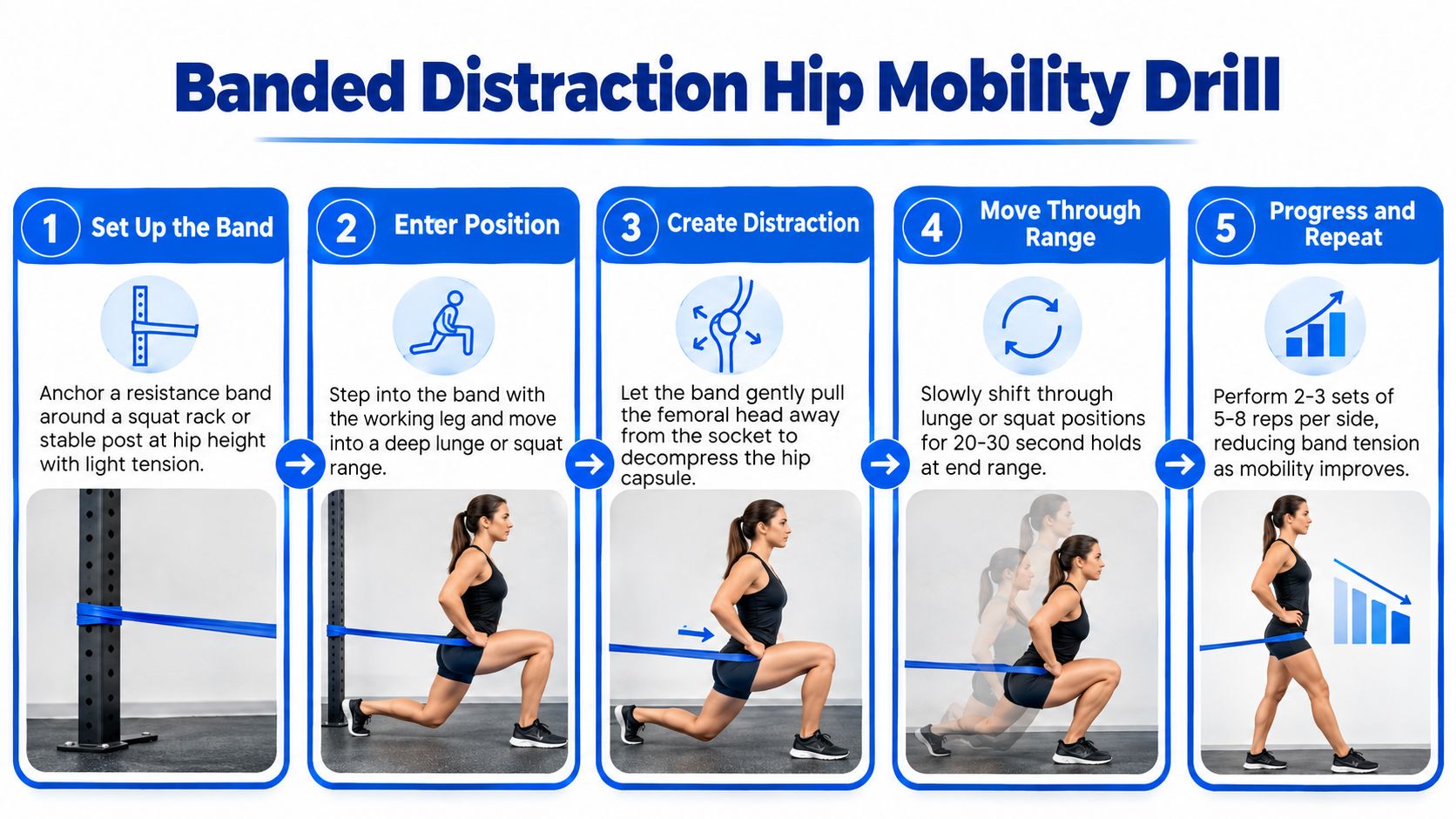
A demonstration clarifies the setup, but it cannot account for your hip structure or symptoms.
7-Exercise Hip Mobility Comparison
Exercise | 🔄 Implementation Complexity | ⚡ Resource Requirements | ⭐ Expected Effectiveness | 📊 Expected Outcomes | 💡 Ideal Use Cases / Key Advantages |
|---|---|---|---|---|---|
90/90 Hip Stretch | Low–Moderate, simple positioning but needs form awareness | Minimal, floor space; optional yoga block | ⭐⭐⭐⭐ | Improved hip external rotation; reduced lumbar compensation | Best for limited external rotation and squat depth; identifies asymmetries; no equipment |
World's Greatest Stretch | Moderate, multi-step fluid sequence needing coordination | Minimal, floor space; no equipment | ⭐⭐⭐⭐ | Broad multi-joint mobilization; increased circulation and neural readiness | Ideal dynamic warm-up for squat days; efficient multi-restriction address |
Pigeon Pose (Eka Pada Prep) | Low–Moderate, straightforward but can be intense | Minimal, floor space; optional blocks | ⭐⭐⭐⭐⭐ | Deep external rotator release; reduced piriformis/sciatic irritation | Best for deep hip rotator tightness and post-workout recovery; high intensity stretch |
Couch Stretch (Hip Flexor Mobilization) | Moderate, requires positioning and knee care | Low, elevated surface (couch/bench); padding recommended | ⭐⭐⭐⭐ | Lengthened hip flexors; improved pelvic alignment and upright torso | Ideal for anterior pelvic tilt and forward-leaning squat issues; fast posture improvements |
Goblet Squat (Mobility-Focused) | Moderate, requires load technique and progression | Equipment, kettlebell or dumbbell | ⭐⭐⭐⭐ | Improved loaded squat depth and upright torso; strength + mobility | Best for transitioning to loaded squats; feedback on depth and posture under load |
Deep Bodyweight Squat Hold (Assisted) | Low, simple hold but requires nervous system adaptation | Minimal, optional band/TRX or stable surface for assistance | ⭐⭐⭐⭐ | Builds comfort at end range; progressive joint mobility across hips/knees/ankles | Foundational for beginners and desk-bound clients; good active recovery drill |
Banded Distraction Hip Mobility Drill | High, setup, band tension, and coaching advised | Moderate, resistance band + stable anchor (rack/post) | ⭐⭐⭐⭐⭐ | Joint capsule decompression; rapid gains past mobility plateaus | Best for advanced corrective work and stubborn restrictions; recommended with trained supervision |
Build a Squat-Ready Mobility Routine
A useful mobility routine doesn't require all seven drills in every session. Match the exercise to the job. Use the World's Greatest Stretch for dynamic preparation, then add assisted deep squat holds to rehearse the position you'll load. If you feel a clear rotational restriction, select the 90/90 stretch. If the front of the hip and pelvis are difficult to organize, use the couch stretch and follow it with active squats.
Reserve pigeon pose for a separate recovery session or the end of training when longer holds make sense. Use goblet squats to connect new range to strength and coordination. Treat banded distraction as advanced practice, particularly if your range has plateaued or your hip feels structurally limited.
Your squat strategy matters too. A 2025 study identified knee-biased, neutral, hip-biased, and high hip-biased strategies, and reported that trunk inclination relative to tibia angle was the primary predictor of hip-versus-knee loading in the patterns examined (2025 squat strategy research). That finding supports a broader coaching approach. Don't assume every depth problem is solved by stretching the hips. Your ankle motion, stance, torso control, and strength may be changing the movement just as much.
Track what you can observe without forcing a number. Note whether your depth feels comfortable, whether your heels stay grounded, whether your torso position changes, and whether one side feels different from the other. If pain appears, modify the stance or depth and seek qualified assessment rather than treating pain as a flexibility challenge.
Empire Athletics offers certified one-on-one coaching, mobility and corrective-exercise support, and modern strength equipment across its Central Massachusetts locations. Its 24/7 access also suits shift workers and busy lifters who need to practice consistently at a time that fits their schedule. A coach can help you turn these drills into a progression that supports your current squat instead of chasing a generic ideal.
Visit Empire Athletics to train with certified coaches, use modern equipment for mobility and strength work, and build a squat-focused plan around your schedule. Whether you're in Leominster, Lunenburg, or Webster, ask about one-on-one guidance for hip mobility, corrective exercise, and safer squat progress.