How Much Is a Gym Membership in 2026?
How much is a gym membership in 2026? Get real U.S. price ranges by gym type, the hidden fees that change your total cost, and tips for the best value.

In the U.S., a gym membership usually runs $50 to $69 per month on average, but budget clubs can start near $10 and premium clubs can climb past $300. By the time you add annual and initiation fees, the first-year cost often lands $39 to $159 above the monthly sticker rate.
That's the part many miss when they stand at the front desk, stare at three flyers, and try to guess which one is cheaper. The monthly number is only the opening line. The core question is what you'll pay over twelve months, and whether the gym fits how you train.
What You Are Really Paying For at the Gym
You're not just buying access to dumbbells and treadmills. You're buying a package made up of posted monthly dues, mandatory fees, and whatever access the club decides to keep behind an upgrade wall. That's why two gyms with the same headline price can land miles apart in real cost.
Start with three numbers every offer should answer plainly: the headline monthly rate, the true monthly rate after fees, and the first-year total. If a gym won't show you all three, that's not a mystery, that's a warning. The published number on the window rarely tells the full story because initiation fees, annual fees, and restricted access can stack on top of it.
Practical rule: If you can't calculate the first year in under a minute, you don't know the price yet.
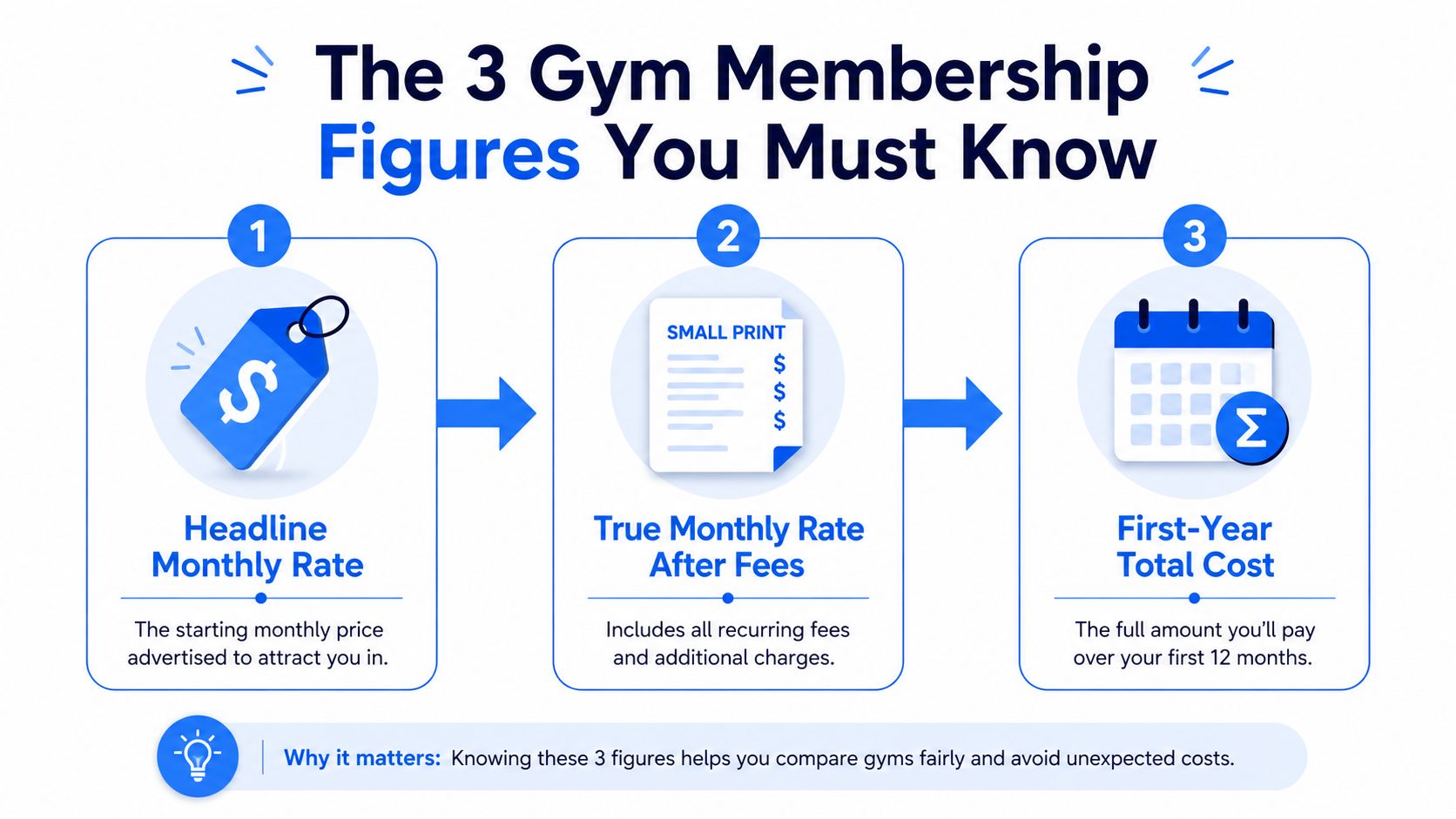
A simple example shows why the flyer rate can fool you. A $29 monthly deal becomes roughly $49 per month once a $99 initiation fee and a $59 annual fee are spread over twelve months. That's the same gym, same access, and a very different bill.
Standardize every quote before you compare
Treat gym shopping the same way you'd treat a car lease. Nobody serious compares leases by the monthly payment alone, because the deal depends on upfront money, term length, and end-of-term charges. Gym offers work the same way.
When you talk to a salesperson, ask for the total first-year cost in writing. Then compare gyms on that number, not the glossy monthly teaser. If one club has a higher sticker but fewer mandatory fees, it can easily be the cheaper option over the year.
Quick checklist for every offer:
Quoted monthly rate. The number in big print.
Required fees. Initiation, annual, card, or locker charges.
Access limits. Hours, class caps, guest rules, or upgrade-only features.
The point isn't to find the cheapest possible gym on paper. The point is to avoid paying a low monthly rate for a club that turns expensive once the billing cycle starts.
The Average Gym Membership Price in 2026
A gym quote can look cheap until you compare it to what you'll pay over the first year. Recent industry summaries place U.S. gym pricing around $58 to $69 per month, while budget clubs can sit near $10 per month and premium clubs can run above $300 per month (average and range data). That spread is the story. The monthly sticker price only tells you where the offer starts.
National averages also blur the gap between headline pricing and what members really see on a contract. According to the linked HFA report, average monthly dues reached $65 in 2023, with a median of $38 (HFA average and median context). A median that low tells you a lot of clubs post rates well under the average, while a smaller group of high-end facilities pulls the average up.
A local market can look very different from the national number, which is why it helps to check gyms in Leominster or your own town before you assume a quoted rate is fair. Rent, staffing, equipment, and service level all change the number you see at the front desk.
Why the average can mislead you
Averages describe the market, not your training plan. If you want a basic cardio floor and a few free weights, you are not shopping for the same product as someone paying for classes, recovery, or premium service. Industry benchmarks also show that commercial gyms often land around $30 to $70 monthly, boutique studios around $50 to $150, and premium clubs around $150 to $300+ (segment spread).
That spread matters because pricing follows what the club includes. Amenities, staffing, and location push a gym out of the commodity range and into a higher-priced tier. Once a club adds coaching, 24/7 access, or recovery services, the higher dues make sense only if you use those extras.
Averages by category
Category | Typical Monthly | Typical First-Year Total | Notes |
|---|---|---|---|
Budget clubs | $10 to $30 | Lower end of the market | Basic access, fewer extras |
Commercial gyms | $30 to $70 | Middle of the market | Broad access, more equipment and classes |
Boutique studios | $50 to $150 | Higher than basic gyms | Coaching and class-driven |
Premium clubs | $150 to $300+ | Highest cost band | More service, more amenities |
The blunt takeaway is simple. Pick the price band that matches how you train, then judge the first-year cost against that use case. The average only helps if it fits your actual gym habits.
Gym Membership Tiers From Budget to Premium
A gym membership is not one product. It's a set of tradeoffs. Budget chains sell access, commercial clubs sell variety, boutique studios sell coaching, and premium clubs sell convenience and service.
What each tier buys
Budget chains sit at the bottom of the pricing ladder because they cut the extras. You get enough machines, enough treadmills, and enough floor space to train. You usually give up a deeper free-weight area, child care, premium lockers, saunas, and guest privileges. That works if you just want a place to lift, walk, or train on your own without paying for services you will not use.
Commercial clubs are the middle ground. They add group classes, pools, kids' clubs, and a broader equipment mix, which makes them a better fit for households with different training needs. If one person lifts and another wants classes or cardio, this tier usually beats paying for two separate specialty gyms.
Boutique studios sell programming, not floor space. Orangetheory, F45, Barry's, and similar models charge for coaching, small class sizes, and a structured workout. You are paying for someone to program the session, keep the pace up, and make the hour efficient.
Premium clubs raise the service level again. Towel service, recovery suites, and less crowding are part of the offer, along with a more polished experience. Price climbs fast because the club is selling comfort and convenience as much as fitness.
Tier | Typical Monthly | Equipment Access | Coaching & Classes | Best Fit |
|---|---|---|---|---|
Budget | $10 to $25 | Basic | Limited | Self-directed members |
Commercial | $35 to $70 | Broad | Good variety | General fitness and households |
Boutique | $150 to $300+ | Limited floor access | High-touch | Class-focused members |
Premium | $200 to $400+ | Strong plus extras | Service-rich | People who value comfort and privacy |
If you want to compare a local option with a more guided setup, a place like Empire Athletics' personal training page is useful to review alongside a standard club membership. It is not the same product as a low-cost chain, and that difference is the point.
How Training Style Changes the Price You Pay
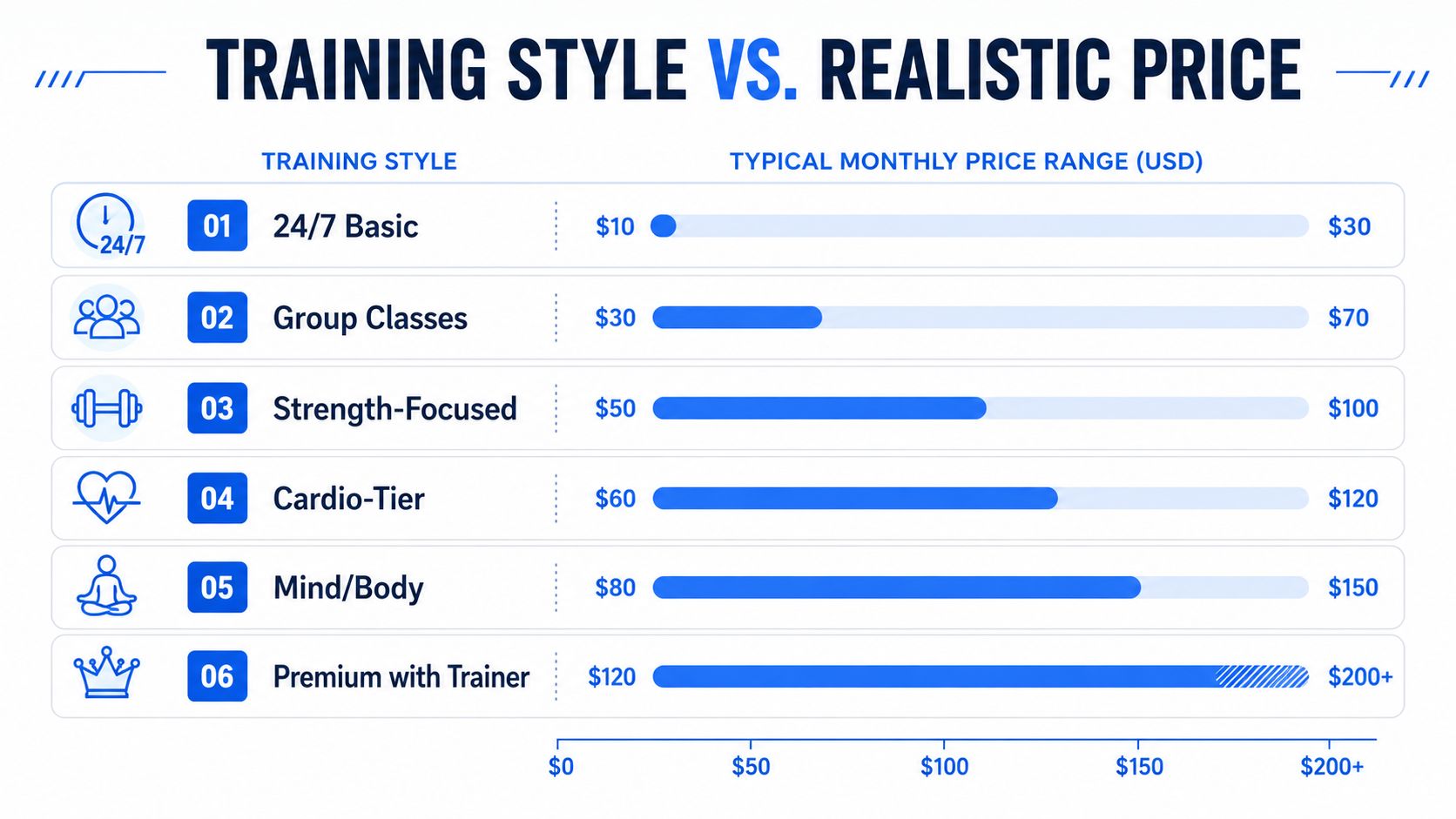
Training style is the fastest way to stop overpaying. A person who needs a squat rack at 5 a.m. is shopping differently from a person who wants a coached class after work. The club should match the habit, not the fantasy.
Match the gym to the way you train
24/7 access gyms usually sit in the $10 to $40 band because they focus on availability and basic strength equipment. That's the right fit for shift workers, early birds, and late-night lifters who care more about access than frills.
Standard commercial clubs usually land around $30 to $70, which buys a wider floor, more cardio, and group classes. If your routine changes week to week, this is usually the safest middle path.
Powerlifting and bodybuilding gyms often run $50 to $120 because specialized bars, competition plates, and platforms cost more to maintain. If you care about serious strength work, the extra charge can be justified by better equipment and less waiting around.
Functional training and coached small-group facilities generally sit around $80 to $180 because programming is part of the offer. You're paying for structure and attention, not just hardware.
Boutique studios like spin, barre, and HIIT can run $120 to $300+ per class pack or membership because the class format is the product. High-touch personal training studios push past that because the coach relationship is the main value.
Sanity-check the value before you sign
Multiply the monthly price by how many times you expect to go in a month, then compare that against a pay-per-session option. If the math looks ugly, it probably is. A high-priced membership that you visit once in a while is a bad buy, no matter how polished the lobby looks.
If you train three times a week, don't buy a membership built for five classes a week.
The useful question is not whether a gym is expensive. The useful question is whether the equipment, access window, and coaching style line up with how you train on an ordinary Tuesday, not just on motivation day.
Hidden Fees That Change the First-Year Cost
The cheapest monthly plan is often the most expensive membership by the end of the year. That is not a sales trick, it is how billing works when clubs stack extra charges onto the deal. Once you add required fees, the actual number can jump fast.
The fees that inflate year one
Start with the initiation or enrollment fee, which can run from $0 to $159 and is often waivable (pricing roundup). Then check the annual maintenance or renewal fee, often around $39 to $79, usually billed near month 11 or 12. Card replacement fees and locker charges can push the total higher too.
Cancellation terms matter just as much. Some contracts carry penalties tied to the remaining value of the agreement, which makes “I'll just cancel later” an expensive assumption. If the front desk cannot explain the exit terms plainly, slow down.
Two offers can look similar and still cost very differently
A $24.99 budget plan can become $474 in year one after a $59 initiation fee and a $59 renewal fee are included. A $49 commercial membership with no initiation fee but a $59 annual fee can land at $647 in year one if the structure is more expensive overall. The monthly number alone does not tell you which one wins.
Membership Type | Quoted Monthly | Initiation Fee | Annual Fee | True Year-One Cost |
|---|---|---|---|---|
Budget plan | $24.99 | $59 | $59 | $474 |
Commercial membership | $49 | $0 | $59 | $647 |
The right audit is simple. Take the quoted monthly price, multiply by 12, add every guaranteed annual fee, and compare that first-year number before you sign. If the gym will not give you those terms in writing, assume the deal is worse than it looks.
Rule to remember: A low monthly rate is only a bargain if the contract does not smuggle in surprise charges.
How to Get the Best Value on a Gym Membership
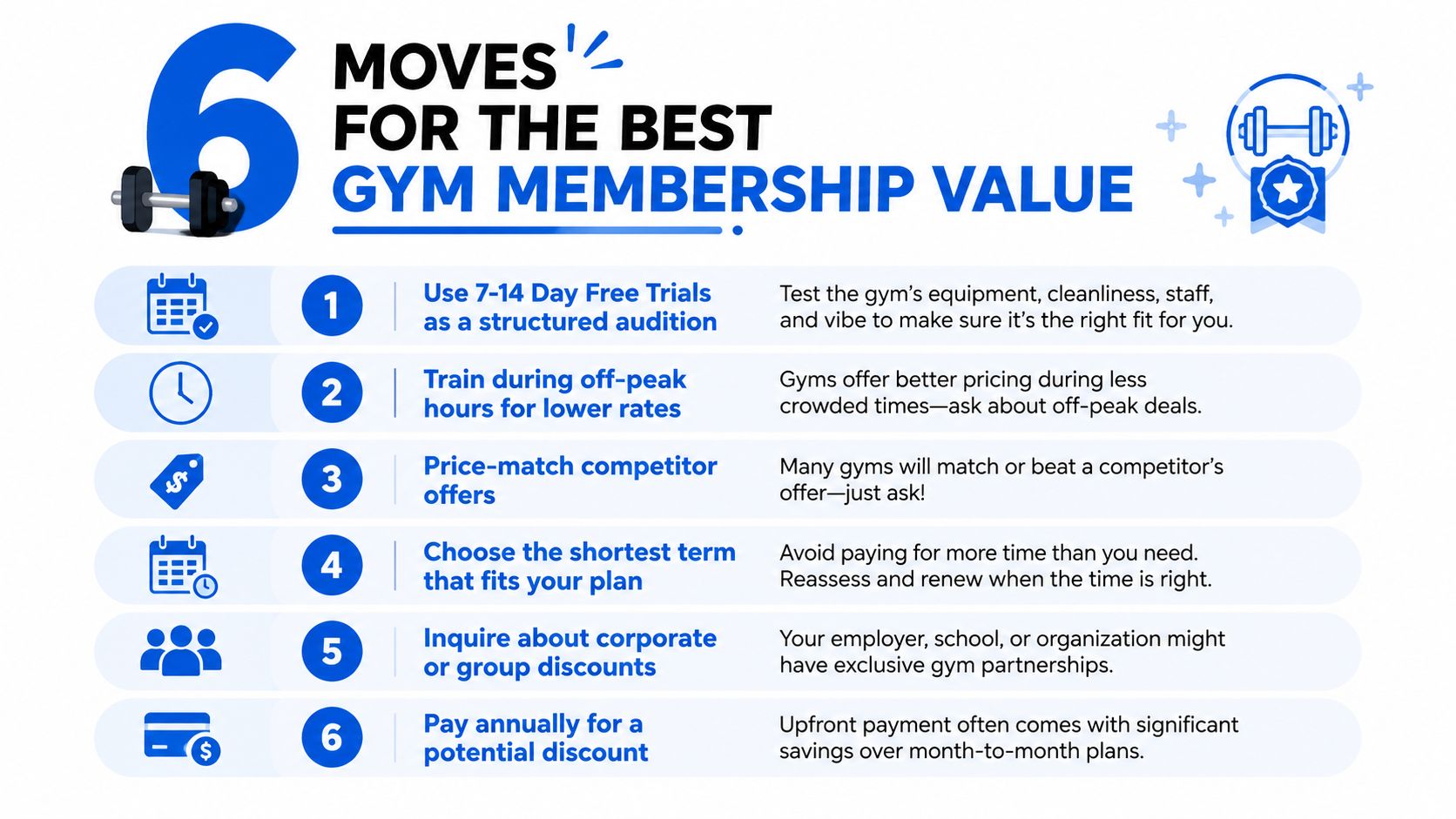
You save money by treating the membership like a year-long purchase, not a cheap monthly line item. The sticker price gets people in the door. The total first-year cost is what decides whether the deal is worth it.
A gym that looks affordable can get expensive fast if you skip the details. Ask direct questions, compare what you will use, and do not let a sales pitch push you into signing before you have the full cost in writing.
The moves that usually cut the cost
Use a 7 to 14 day free trial like an audition. Go at your normal training time, check crowding, test the equipment, and watch how staff handles questions. If the place only feels good when it is empty, that tells you enough.
Shop during off-peak sign-up periods, especially when clubs want to hit yearly targets. Winter usually gives buyers more room than the January rush. Sales teams are more willing to waive fees or trim the upfront hit when they need closes.
Check corporate, insurance, and employer wellness partnerships too. Those discounts can change the math more than people expect. Ask even if you assume you do not qualify.
Prepay only after the math checks out
Annual prepay can make sense, but only when it beats the pay-as-you-go option on the full year. A lower monthly rate on a term contract still loses if the gym stacks fees or limits access in ways you will feel later. Read the contract like a grown-up, not like someone hoping the fine print will be kind.
Use this script before you sign:
What is the total first-year cost?
How long is the contract?
What are the cancellation and freeze terms?
Is this rate promotional, and what happens at month 12?
Are there any mandatory fees I haven't seen yet?
If you want a local example of a gym that pairs access with coaching, Empire Athletics offers 24/7 facilities, certified personal training, and multiple Central Massachusetts locations. That does not make it the right fit for everyone, but it is the kind of setup worth comparing against a basic chain if you need training help.
Choosing the Right Membership for Your Goals
Stop asking only how much is a gym membership and ask what it's worth to your routine. The right answer depends on three filters, fit, schedule, and value. If one of those is off, the membership becomes expensive no matter what the monthly rate says.
A quick self-check before you buy
If you train three times a week for general health, a mid-market commercial gym is usually enough. You want reliable access, enough equipment variety, and a price that won't feel silly on the months you miss a session. If you know you won't use classes or coaching, don't pay for them.
If you're chasing strength, bodybuilding, or sport-specific progress, the cheaper club isn't always the smarter one. Better equipment, fewer bottlenecks, and coaching that keeps your program honest can be worth more than the lowest sticker price. In that case, you're buying progress, not just entry.
If your schedule is messy, 24/7 access matters more than a fancy lobby. That's why shift workers, parents, and early lifters should weigh access first and aesthetics second. A gym you can get into is worth more than a polished one you keep missing.
For readers who want a clearer coaching path, Empire Athletics trainers are part of the decision, not an afterthought. The useful question is whether you'll use that help enough to justify the higher total cost.
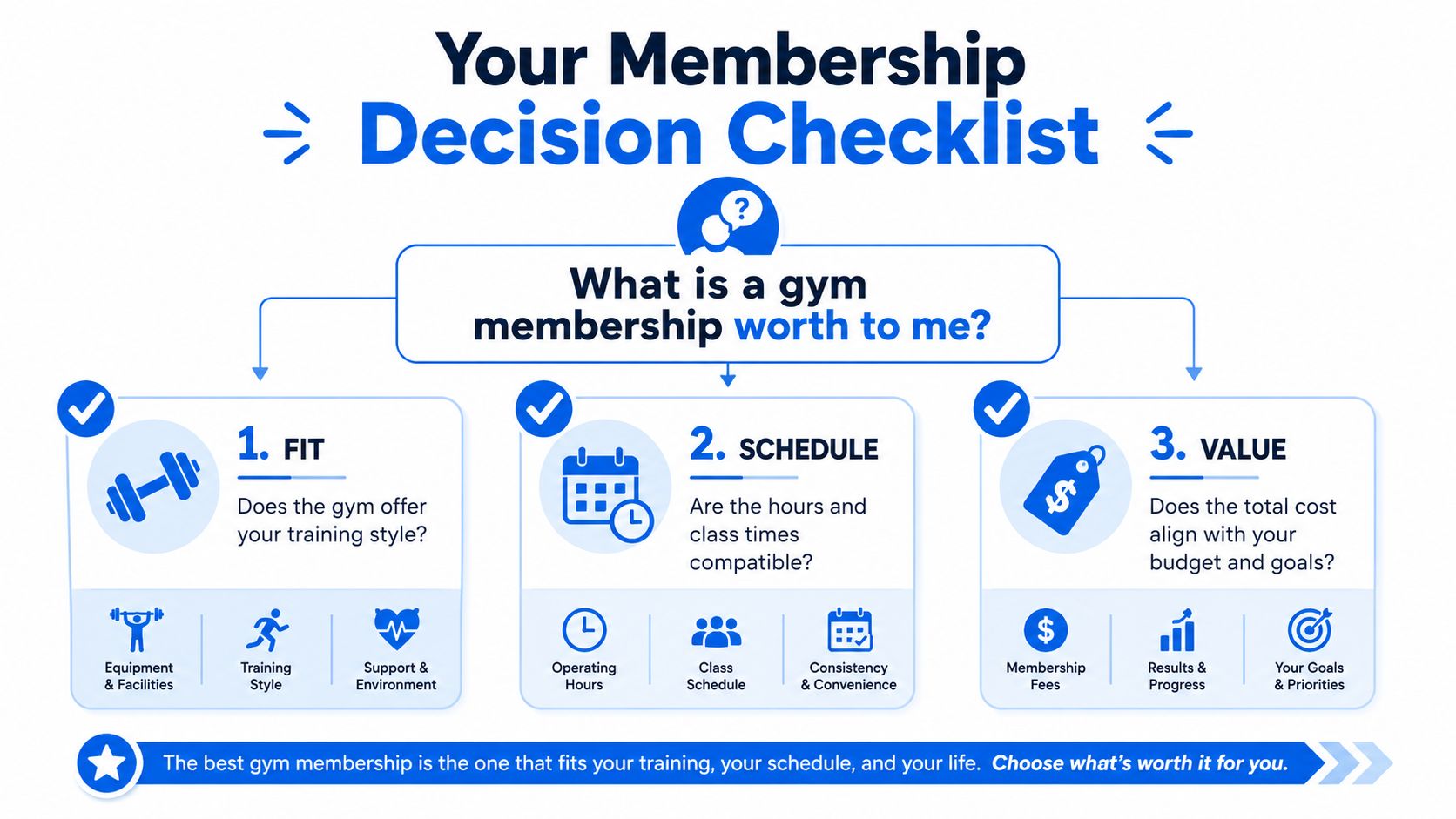
Your best membership is the one you'll use consistently. If you're comparing clubs today, write down the true first-year cost, match it to your actual training style, and choose the place you can see yourself entering three months from now without forcing it.
If you're comparing gyms in Central Massachusetts, visit Empire Athletics and look at the membership options alongside the training style you want. If you need 24/7 access, strength equipment, or guided coaching, that's the kind of fit worth checking in person before you sign anything.