Personal Training Sessions: How One-on-One Coaching Works
Personal training sessions at Empire Athletics: session structure, trainer credentials, goal assessment, programming and how to book one-on-one coaching.

You pay for a gym membership, walk past the squat rack for months, and keep choosing the equipment you already know. You're showing up, but you still don't have a plan or a clear way to tell whether you're improving.
Personal training sessions should replace that uncertainty with decisions you understand: which exercise to do, how hard to work, when to stop, and what to change next. A useful session leaves you better prepared for your next workout, not just tired.
Why People Book One-on-One Coaching
A one-on-one personal training session is an appointment in which a trainer builds the exercise choices, loads, rest periods, and progression around you. In a group class, participants usually follow a shared routine with modifications. In personal training, your response determines what happens next.
People book for different reasons. Beginners want help setting up equipment and learning technique; returning exercisers want a manageable restart. Experienced lifters may need help with a plateau, while athletes want strength work that supports their sport.
According to the Health & Fitness Association's 2025 U.S. Health & Fitness Consumer Report, 22.6% of U.S. fitness-facility members used personal training in 2024. That describes participation, not a recommendation that everyone needs a coach.
Decide what you need help doing
Learn the basics: Get comfortable with lifting, equipment setup, and choosing an appropriate resistance.
Work around limitations: Adapt exercises to your available movement, with medical guidance when needed.
Make training purposeful: Connect workouts to strength, muscle-building, weight-management, or performance goals.
You don't have to assume coaching means an appointment every time you exercise. The Health & Fitness Association's participation figures show that U.S. fitness-facility members averaged 21 personal training sessions in 2024, down from 28 in 2019.
For budgeting, our guide to how much a personal trainer costs explains what to compare. Around Leominster, Lunenburg, and Webster, our facilities offer round-the-clock member access, although coached appointments still require an agreed time.
How a One-on-One Session Unfolds Step by Step
Phase | What the trainer does | What you do |
|---|---|---|
Check-in | Reviews sleep, soreness, new pain, and today's plan | Report new pain, fatigue, or limits honestly |
Warm-up and movement prep | Leads mobility and activation drills matched to the planned lifts | Follow cues and flag anything that feels restricted |
Main working sets | Sets loads and rest, watches technique, and adjusts sets on the spot | Describe effort, confirm the load, and ask questions between sets |
Accessory or conditioning block | Chooses core, carry, or conditioning work for the goal | Follow the agreed pace and report unusual symptoms |
Cooldown and notes | Leads appropriate stretching or breathing, then records performance and feedback | Explain how the session felt and ask about the next appointment |
The order is more important than a rigid timetable. For a hypothetical hour-long appointment, a trainer might allocate minutes 0–5 to checking in, 5–15 to warming up, 15–45 to main exercises, 45–55 to supporting work, and 55–60 to finishing and recording notes. Actual session length and allocation should follow your agreed plan.
What each phase feels like
The check-in is a conversation, not a test of commitment. If you slept poorly or your back feels different from usual, say so before lifting. Your trainer needs that information to decide whether the planned workout is appropriate today.
During preparation, you might practice a bodyweight squat to a bench, rehearse a hip hinge with a dowel, or use a light cable row. These movements help you find the positions you'll need later. You shouldn't have to exhaust yourself before the main exercises begin.
Working sets involve instruction followed by practice. A trainer might adjust the bench angle, demonstrate where to place your feet, and give a short cue such as keeping your ribs over your pelvis. Between sets, you rest while the trainer checks whether the resistance and execution match the intended task.
Practical rule: A useful cue gives you something you can do on the next repetition. If an instruction doesn't make sense, ask for a demonstration or a different explanation.
Supporting work might include a suitcase carry, a cable exercise, or manageable cycling intervals. Conditioning isn't punishment for eating, and every appointment doesn't need a breathless finish.
The cooldown gives you space to settle your breathing and describe any unexpected discomfort. Stretching may be included when appropriate, but it isn't a guarantee against soreness.
Safety and what to bring
At Empire Athletics, members who feel dizzy, faint, unwell, or experience unusual pain must stop exercising and inform a member of staff immediately. Don't finish a set first or assume the feeling is something to push through.
Bring:
Clean, appropriate clothing and footwear: Choose clothes that let you move and shoes suitable for the planned activity.
Water: Keep it accessible rather than leaving it in your locker.
A note of current concerns: Include pain locations, recent changes, and movements you've been advised to avoid.
You don't need to arrive knowing exercise terminology. Describing what you feel is more useful than trying to sound experienced.
How to Judge a Trainer's Credentials
A certificate doesn't guarantee good coaching, but it provides a baseline of assessed knowledge. The ACSM 2023 certification report reported a 63% first-attempt pass rate for its Certified Personal Trainer examination and a 54% repeat-candidate pass rate.
Recognized personal training credentials and what to ask
Credential | Issued by | What it signals | What to ask |
|---|---|---|---|
ACSM-CPT | American College of Sports Medicine | Exercise-science and client-programming knowledge | Can I see your current certificate? |
NASM-CPT | National Academy of Sports Medicine | Preparation involving movement assessment and corrective exercise | How do you screen movement before loading? |
NSCA-CPT | National Strength and Conditioning Association | Strength-training and programming knowledge | How would you progress my strength work? |
ACE-CPT | American Council on Exercise | Individual training and behavior-change coaching | How do you help someone who misses sessions? |
CSCS | National Strength and Conditioning Association | Strength and conditioning preparation for performance | What experience do you have with my sport? |
These descriptions aren't exclusive specialties. A credential's initials don't establish that a trainer has experience with your particular circumstances.
Verify knowledge in conversation
Ask to see the current certificate, then describe your goal and ask how the trainer would approach it. Their explanation should include assessment, exercise selection, and a way to evaluate progress.
Warning signs include guaranteed results, vague programming answers, and no questions about your health history. A trainer should also recognize when a concern requires a healthcare professional.
Our trainer team lists 6+ certified trainers with 20+ years of combined experience. Ask which credential your prospective trainer holds and whether their background fits your needs, whether that's shift work, a sporting event, or returning after an injury.
How Your First Goal Assessment Works
Your first assessment should establish what you want, what you can currently do, and what might affect your training. It shouldn't be an exhausting audition.
This overview shows how intake information becomes a starting program.
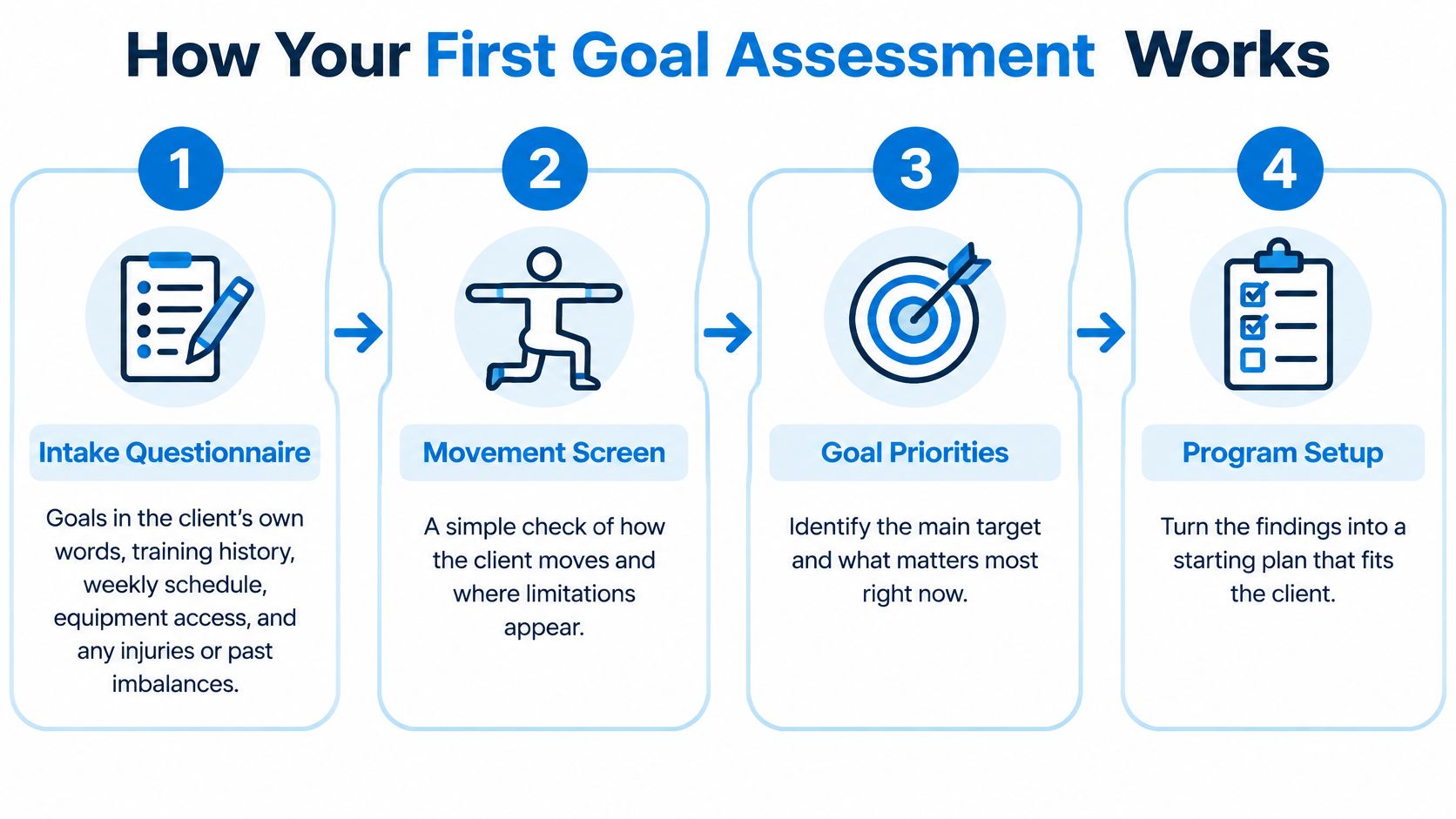
From your history to a workable starting point
Start with your own description of the goal.
Explain what you want to do more comfortably or confidently, rather than trying to choose the correct fitness label. The intake should cover training history, work patterns, equipment access, and past injuries or imbalances. This tells the trainer what's realistic outside the gym as well as inside it.Discuss health and medical history.
Disclose relevant conditions, medications, recent symptoms, and any instructions from your healthcare team. A trainer needs to know when exercise requires modification or medical clearance; they don't diagnose medical conditions. We advise members to obtain regular health and medical screening from their General Practitioner throughout membership.Practice basic movement patterns.
A movement screen may include a squat, hinge, push, pull, lunge, and single-leg balance. The trainer observes your range, control, comfort, and differences between sides. A restricted movement is a reason to investigate or adapt, not proof that something is damaged.Find manageable working resistance.
Submaximal practice helps establish a starting load without asking you to attempt your heaviest possible lift. The trainer watches whether your position changes as effort rises and asks how challenging the exercise feels.Translate the goal into observable markers.
For example, wanting stronger legs could become performing a squat with an agreed resistance and repeatable depth. Wanting better mobility might mean reaching a useful position comfortably. Choose a marker that reflects the activity you care about rather than chasing an arbitrary test score.Agree on the practical arrangement.
Confirm appointment length, a sustainable schedule, and the initial training focus. Also establish what you'll do independently and how you should report concerns between appointments.
Know the boundaries
An assessment is a starting hypothesis about suitable exercise, not a permanent label for your body.
Be cautious if every limitation receives the same explanation or if a trainer promises to fix pain. Exercise coaching can help you practice movement, but medical diagnosis and rehabilitation require the appropriate professional.
Members aren't covered by our club insurance for injury or loss from exercise and may obtain personal insurance at their own expense. If you have an existing condition, consider discussing suitable cover with an insurer.
Expect the initial program to change as the trainer learns how you respond during training and recovery.
How Trainers Turn Your Goals Into a Program
A custom program is more than a list of exercises. The trainer must decide how much work to give you, how challenging it should be, and what would justify changing it.
The conversation should connect your assessment to those decisions.

Choose the dose, not just the exercise
Trainers can organize these decisions using FITT-VP:
Frequency: How often you train, including independent workouts.
Intensity: How hard you work, judged through resistance and perceived effort.
Time: How long the workout and its components take.
Type: Which exercises and activities fit the goal.
Volume: How much total work you perform.
Progression: What changes when you're ready for a greater challenge.
For strength-focused training, ACSM resistance-training guidance gives approximately 80% or more of one-repetition maximum, commonly for 2–3 sets per exercise, as a benchmark, while novice-to-intermediate clients may begin around 60–70%.
One-repetition maximum, or 1RM, means the greatest resistance someone can lift for a single repetition of a particular exercise. These percentages aren't instructions to test your maximum or start heavy without preparation.
Typical starting references by training goal
Goal | Starting load | Sets and reps | Typical weekly frequency |
|---|---|---|---|
Strength | Challenging resistance appropriate to demonstrated skill | Controlled working sets with adequate rest | Space demanding sessions around recovery |
Novice or returning lifter | Manageable resistance that allows practice | Finish before technique deteriorates | Prioritize repeatable practice and recovery |
Bodybuilding and muscle size | Resistance that challenges the target muscles | Accumulate work without losing control | Distribute muscle-group work across available days |
Weight loss and general fitness | Resistance compatible with steady execution | Combine strength work with manageable conditioning | Build around a schedule you can sustain |
Mobility and corrective work | Bodyweight or light resistance through a comfortable range | Controlled repetitions or appropriate holds | Use brief practice without repeatedly aggravating symptoms |
These are starting references, not prescriptions. Your recovery, symptoms, and training history determine the actual arrangement.
Use each workout to decide the next
The diagnostic loop is straightforward: perform, observe, record, adjust. The trainer logs resistance, repetitions, perceived effort, technique, and symptoms, then uses those observations to choose the next session's exercise and dose.
Consider a hypothetical beginner aiming for three sets of eight on a machine press. If the final repetitions require shrugging and arching, the trainer might keep the resistance unchanged and improve setup rather than add weight. If execution remains steady and effort is lower than intended, a small increase may be appropriate.
A weight-management client might alternate a cable row, box squat, and bike effort in a short circuit. Rest should preserve useful movement, not be shortened merely to make the workout feel harder. A returning client might rehearse comfortable mobility holds before introducing loaded movement.
This video provides an additional visual reference for the coaching conversation.
Pain calls for reassessment, not automatic progression. A stall may require less work, more recovery, a different exercise, or clearer instruction rather than greater effort.
Our one-on-one custom plans are built around each member's goals, schedule, and starting point. For shift workers, that can mean organizing workouts around available recovery rather than fixed weekdays; event preparation also needs to account for practice and competition demands.
Understanding what a training split is can help you discuss how coached and independent workouts fit together.
What Progress Looks Like Beyond the Scale
A 2025 systematic review of 12 studies comparing supervised and unsupervised resistance training found a moderate strength advantage with supervision, with a standardized effect of 0.40, but only a trivial body-composition advantage. Coaching can improve the quality and direction of training; it isn't an independent fat-loss mechanism.
The distinction matters if you expect every productive appointment to produce a lower scale reading. Strength, movement skill, and body weight are different outcomes, and they don't necessarily change together.
The image below highlights the kind of exercise observation that supports a meaningful progress review.

Track what you can repeat and use
A useful review includes:
Strength at controlled effort: You move more resistance without needing substantially more strain or assistance.
Repeatable technique: Your setup and movement remain recognizable across working sets.
Usable range of motion: You reach positions needed for training or daily activities with better control.
Comfortable repetitions: You tolerate an appropriate exercise without provoking concerning symptoms.
Independence: You can adjust the machine, select the planned weight, and recognize when to stop without constant prompting.
Confidence and coordination can improve before visible changes appear. Strength development requires repeated training and recovery, but a trainer shouldn't promise a universal deadline.
Being able to complete an appropriate workout without your trainer is a sign that coaching is working.
Muscular effort can feel like local fatigue or a burning sensation during a demanding set. Sharp, sudden, radiating, or unfamiliar pain is different and shouldn't be treated as proof of productive work. Tell the trainer what you feel rather than trying to classify it yourself.
Attendance isn't the whole outcome
Missed appointments don't automatically mean someone lacks motivation. Work, caregiving, cost, and exhaustion can make a poorly matched plan difficult to maintain.
A 2025 randomized study of 188 women with obesity found that in-person, mobile, and combined coaching didn't significantly improve motivation, self-efficacy, perceived social support, or exercise barriers. Adding appointments alone may not resolve the reasons someone struggles to exercise.
A 2025 study of 53 middle-aged and older adults who had maintained personal training for more than six months identified program-design skill, communication, goal setting, trust, achieved benefits, reservation availability, and ease of access among factors supporting adherence.
Ask for an approach you can use during difficult periods: an abbreviated independent workout, clear priorities, and realistic rescheduling expectations. At progress check-ins, ask what improved, what remains limited, and what changes next. Those answers reveal more than an attendance total.
Book Your First Session at Empire Athletics
Start with the problem you want coaching to solve. That might be learning to lift confidently, building strength for a sport, or finding exercises you can perform comfortably.
Then identify the time you can realistically protect. Include travel and recovery, not just the appointment itself, and explain any rotating shifts before agreeing to a schedule.
Make the first conversation specific
Contact the location that fits your routine:
Leominster: 507r Lancaster Street, Leominster, MA 01453.
Lunenburg: 308 Massachusetts Ave, Lunenburg, MA 01462.
Webster: 37 Sutton Rd, Webster, MA 01570.
Ask about the proposed trainer's credential, how the assessment works, and current session and package prices. For any package, confirm how many appointments it includes, the appointment length, the total cost, and the resulting per-session cost.
Also ask whether a single assessment or a short starting block is available. Don't assume training-package rules are the same as membership rules: clarify appointment cancellation, expiration, and rescheduling terms before paying.
Separate access from commitment
Our memberships are month-to-month agreements. The Pay Monthly option requires the registration fee and first month's membership fee in advance; if you're presented with a contract membership, early cancellation requires payment of the remaining contract balance.
Commitment terms before you book
Commitment | What it means | What to check before signing |
|---|---|---|
Month-to-month membership | Renews each billing cycle without a long fixed term | Submit cancellation 30 days before the next billing date |
Pay Monthly option | Registration fee and first month's membership fee are paid upfront | Budget for both charges at signup |
Contract membership | A fixed term applies if agreed at signup | Early cancellation requires paying the remaining contract balance |
To cancel a membership, submit the cancellation by phone at 978-990-3972 or by email at empireathletics247@gmail.com, 30 days before the next billing date. Confirm which agreement you're signing and keep a copy of its terms.
Memberships are available to adults 18 and over. Member access is 24/7, and you must scan your finger to enter on every visit; building access doesn't mean a trainer is available at all hours.
Choose an assessment when you want structured guidance and can make room for the work between appointments. Before committing further, make sure you understand what you'll practice, how the trainer will evaluate it, and what you're paying for.
Empire Athletics offers certified one-on-one coaching for goals including strength, mobility, muscle building, weight loss, and performance. Visit Empire Athletics to explore the locations and discuss an assessment that fits your starting point and schedule.