Best Rep Range for Muscle Growth: Science-Backed Guide
Discover the best rep range for muscle growth backed by science. Learn how to structure sets, loads, and training volume for maximum hypertrophy results.

The best rep range for muscle growth isn't a single number printed on a workout plan. For years, lifters have been told that every productive set must land between 8 and 12 repetitions, as if a set of seven can't build muscle and a set of thirteen suddenly stops working. That rule is useful, but it's far too rigid.
Muscle growth can occur across a much broader loading spectrum when you train with sufficient effort. The more useful questions are: How close did the set come to failure? How much productive work did you complete? Can you recover and progress?
Those questions shift hypertrophy training away from rep-count superstition and toward better programming. You can use heavy work, moderate sets, and lighter isolation training in the same week, each for a specific reason.
Why the Classic 8 to 12 Rule Is Only Half the Story
The classic 8 to 12 prescription became popular because it works well. Moderate loads let you create substantial tension without making every set excessively long or technically demanding. They're also easier to recover from than repeated maximal-strength efforts and usually more comfortable than very high-repetition sets.
The problem starts when a practical guideline becomes a law. The 8 to 12 range isn't uniquely superior for hypertrophy. A major review of resistance-training loading recommendations concluded that this range is a practical way to maximize growth, while also emphasizing that similar whole-muscle growth can occur across a much wider spectrum, including loads at or above roughly 30% of one-repetition maximum, or 1RM, when effort is high (2021 resistance-training review).
That wider spectrum includes heavy sets for strength-focused exercises and lighter sets that continue well beyond twelve repetitions. A set of five challenging repetitions and a set of twenty-five demanding repetitions feel very different, but both can recruit high-threshold motor units as fatigue rises and the set approaches failure.
Why the narrow rule holds lifters back
A fixed rep target can create several unnecessary limitations:
Exercise selection becomes less flexible. Heavy compound lifts may suit lower repetitions, while cable and machine exercises may feel better with more repetitions.
Joint comfort gets ignored. Some lifters tolerate lighter loading and higher repetitions better than repeated heavy sets.
Progress becomes too narrow. Adding load isn't the only way to improve. More repetitions with the same load, better execution, or additional productive work can also represent progress.
Fatigue management suffers. Performing every exercise in the same range can make a workout harder to recover from than necessary.
The central idea is simple: rep count describes the set, but effort determines how much of that set matters for hypertrophy. Moderate repetitions remain an excellent default because they balance stimulus, time, and fatigue. They're a tool, not a biological requirement.
What the Research Actually Says About Rep Ranges and Hypertrophy
The 2021 review provides a more useful interpretation than the familiar “rep continuum.” It concluded that moderate loading, roughly 60% to 80% of 1RM for 8 to 12 repetitions, is practical for maximizing hypertrophic gains, but it also reported that similar muscle growth can occur across a much broader spectrum when sets are performed with sufficient effort (2021 review of loading recommendations).
The same review discussed prior meta-analytic evidence finding no meaningful hypertrophy difference between higher-load training above 60% of 1RM and lower-load training below 60% of 1RM, provided the sets are taken close enough to failure. That finding matters because it separates muscle growth from the other adaptations that happen during resistance training.
Heavy sets are generally efficient for improving strength because they expose you to high force demands with fewer repetitions. Lighter sets can challenge muscular endurance and create more local fatigue. Moderate sets often feel like the easiest compromise. None of those practical differences means the moderate zone has a magical growth effect.
A practical reading of the evidence
Rep range | Load | Hypertrophy outcome | Primary adaptation |
|---|---|---|---|
Heavy, roughly 3 to 6 reps | Higher load, commonly above 60% of 1RM | Can support similar growth when effort and volume are appropriate | Strength and high-force skill |
Moderate, 8 to 12 reps | Roughly 60% to 80% of 1RM | Practical and effective for hypertrophy | Balanced tension, fatigue, and efficiency |
Light, well above 12 reps | Loads at or above roughly 30% of 1RM | Can support similar whole-muscle growth when sets are sufficiently hard | Local fatigue and muscular endurance |
The table shouldn't be read as permission to perform casual, easy sets and expect the same result. The load has to be heavy enough, the set has to create meaningful effort, and the total amount of productive training has to support continued progress.
Why moderate repetitions remain popular
Moderate sets reduce the time cost of each exercise compared with very high repetitions. They also avoid the technical and recovery demands that can come with constant heavy work. That makes them especially useful for secondary compounds, machines, and many free-weight movements.
The best interpretation is not “always use 8 to 12.” It's use 8 to 12 often because it's efficient, then use other ranges when they serve the exercise and the athlete.
How Proximity to Failure Drives Muscle Growth
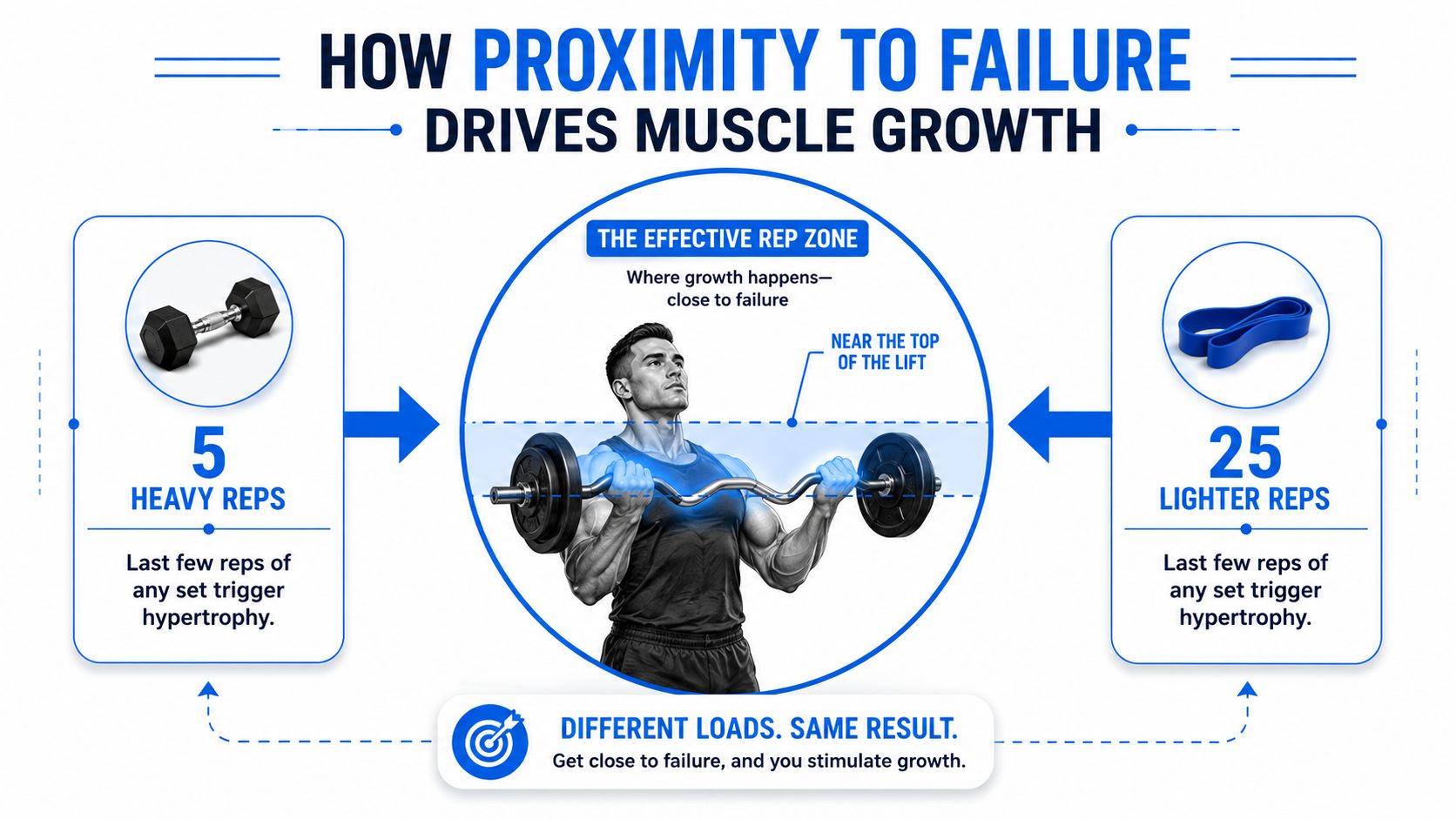
A repetition only matters if it contributes to a challenging set. The early repetitions of a set may feel controlled and relatively easy, while the final repetitions require increasing effort to maintain the same movement. Those final repetitions are where fatigue forces the body to recruit more motor units.
Current summaries describe the final 3 to 5 repetitions before failure as a potentially important hypertrophic stimulus, whether those repetitions occur during a five-repetition set or a thirty-repetition set (summary of the rep-range continuum). That doesn't mean you must reach failure on every set. It means the set needs to come close enough for high effort to accumulate.
Use RIR and RPE to judge effort
Two practical tools make this easier:
RIR, or repetitions in reserve, estimates how many clean repetitions you could perform before failure.
RPE, or rate of perceived exertion, rates how difficult the set felt, with higher ratings representing greater effort.
Suppose you perform eight repetitions of a press and believe you could complete two more with good technique. That's approximately two repetitions in reserve. A set of twenty performed with the same estimated effort can provide a comparable growth-oriented challenge, even though the rep counters look completely different.
Practical rule: Choose a load that lets you finish the set with strong technique while keeping only a small amount of quality work in reserve.
Effort still needs context. A technically broken repetition doesn't become productive just because it's difficult. If your squat depth changes, your shoulder position collapses, or momentum takes over, the target muscle may no longer receive the intended stimulus. Stop when another repetition would require a meaningful loss of control.
The last repetitions also shouldn't dictate every programming decision. Reaching failure repeatedly can create unnecessary fatigue, especially on demanding compound lifts. Training close to failure while preserving technique gives you a better balance between stimulus and recovery.
The following video provides a visual explanation of how different loading strategies can fit into hypertrophy training.
Comparing Low Moderate and High Rep Training
No rep range wins every category. Low, moderate, and high repetitions solve different programming problems, and the best choice depends on the exercise, the load, and the fatigue created by each set. The rep counter is a useful label, not a verdict on muscle-building quality.
Low repetitions
Sets in the 1 to 5 repetition range, often performed with roughly 85% to 100% of 1RM, suit lifters who want strength to remain a major priority. Heavy resistance gives you practice producing force, but it also places greater demands on technique, connective tissue, and recovery. Using this range for every exercise can limit the amount of manageable volume you accumulate.
Low repetitions usually fit early in a workout for squats, deadlifts, presses, and other compound lifts. They are less practical for small isolation exercises, where heavy loading may stress the joints without offering a clear hypertrophy advantage. A heavy set of squats can be a useful anchor, while heavy lateral raises are usually a poor trade.
Moderate repetitions
The 6 to 15 range, commonly associated with approximately 65% to 85% of 1RM, offers a flexible middle ground. You can use enough load to create strong muscular tension without making every set excessively long. Pressing variations, rows, leg presses, pulldowns, and machine exercises often fit comfortably here.
The range is broad enough to suit different movements and lifters. A controlled set of six on a compound exercise and a focused set of fifteen on a machine can both support hypertrophy when the set is challenging and technique remains consistent. Moderate work also makes it easier to accumulate productive volume without turning every set into a maximal strength test.
High repetitions
Sets from 15 to 30 or more repetitions, often using about 30% to 65% of 1RM, can build muscle when they are taken close enough to failure. Their cost is practical rather than automatically physiological. They take longer, create more local burning, and may produce considerable cardiovascular discomfort. That sensation does not prove superior stimulus, but lighter loading can be useful when heavy resistance feels irritating or impractical.
Use higher repetitions for lateral raises, leg extensions, leg curls, cable work, and other isolation movements. They can also preserve a training stimulus when you want less external loading while keeping effort high.
Variable | Low, 1 to 5, about 85% to 100% of 1RM | Moderate, 6 to 15, about 65% to 85% of 1RM | High, 15 to 30+, about 30% to 65% of 1RM |
|---|---|---|---|
Strength emphasis | Strong | Moderate | Limited |
Time per set | Short | Moderate | Long |
Local fatigue | Moderate | Moderate to high | High |
Loading demand | High | Moderate | Lower |
Common use | Heavy compounds | Compounds and machines | Isolation and finishers |
Exercise setup matters, too. If squat mechanics limit you, improving hip and ankle movement can help you use a broader range of exercises and rep targets. These hip mobility exercises for squats can complement, but not replace, sound load selection and technique coaching.
The practical conclusion is that no single range is universally superior. Low repetitions can anchor strength work, moderate repetitions can carry much of the weekly training, and high repetitions can add useful stimulus where lighter loading makes sense. Choose the range that lets the exercise deliver repeatable, technically sound volume.
Building a Weekly Program That Mixes Rep Ranges
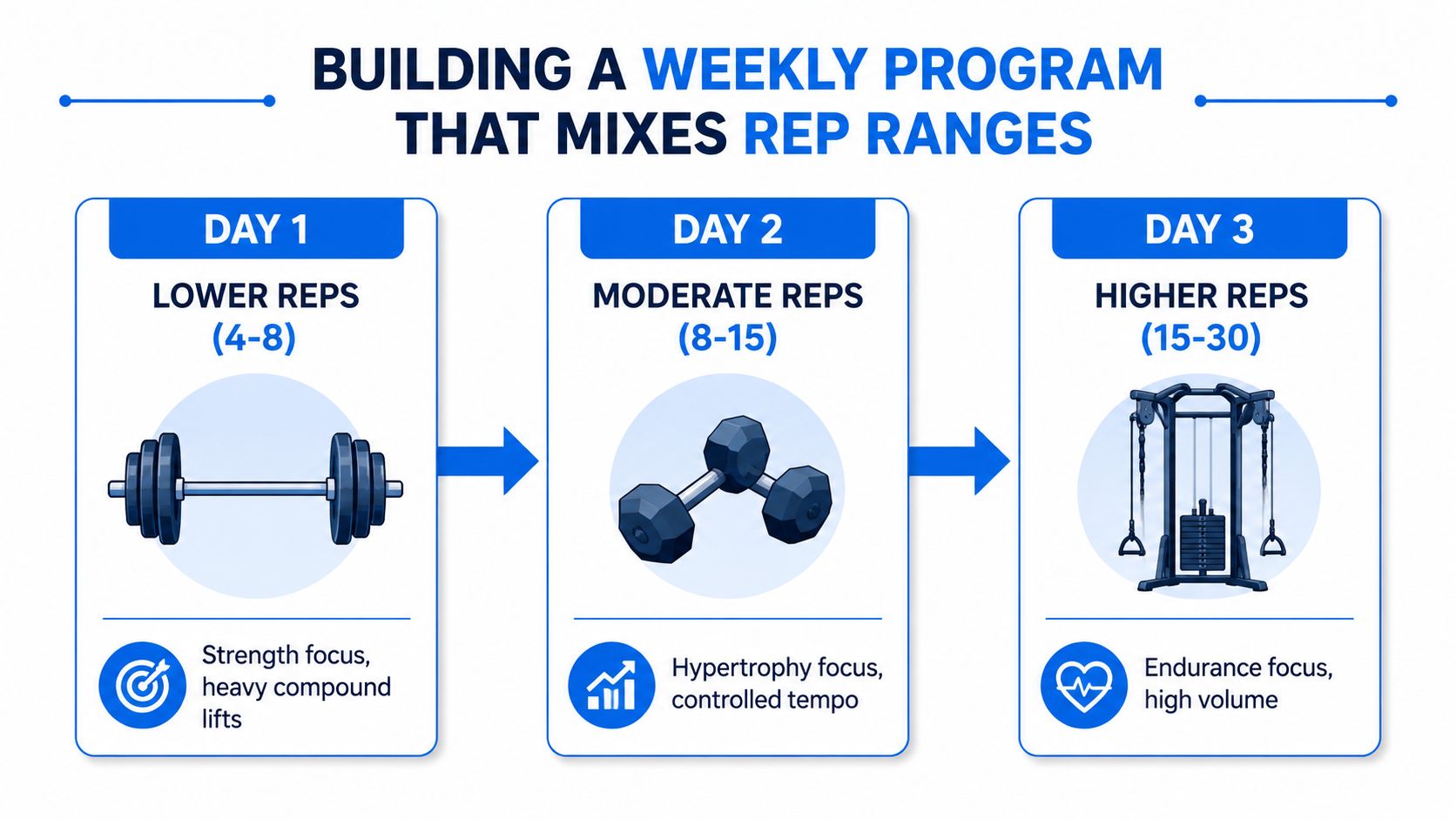
The rep number should serve the exercise, not control the entire workout. A mixed program assigns different jobs across the week: heavier sets develop high-force compound practice, moderate sets build efficient volume, and lighter sets make hard isolation work practical.
A four-day upper and lower split organizes those roles without treating 8 to 12 repetitions as a rule every set must obey.
Day one, lower body strength emphasis
Begin with a squat variation for 4 to 8 repetitions, then perform a hip-hinge movement in a similar range. Use a leg press or another secondary compound for 8 to 15 repetitions. Finish with leg curls, calf work, or another isolation exercise for 15 to 25 repetitions.
Place the most demanding work first, while bracing and coordination are fresh. Higher-repetition work belongs later, especially when fatigue could affect the rest of the session.
Day two, upper body strength emphasis
Open with a bench press or overhead press for 4 to 8 repetitions. Add a row or pulldown for 8 to 15, then use machine presses, cable exercises, curls, and triceps extensions across moderate and higher ranges.
A heavy press asks for more rest and concentration than a cable curl. Matching the rep target to the movement lets you accumulate productive work without turning every exercise into a test of maximal effort.
Day three, lower body hypertrophy emphasis
Use a front squat, hack squat, or similar exercise for 8 to 15 repetitions. Follow with a Romanian deadlift, split squat, or leg press in the same moderate zone. Finish with leg extensions, leg curls, and calves for 15 to 25 repetitions.
This session creates a different stimulus from the first lower-body day while still adding useful weekly volume. Choose exercises that match your mobility, technique, equipment, and recovery capacity.
Day four, upper body hypertrophy emphasis
Choose an incline press, chest-supported row, or pulldown for 8 to 15 repetitions. Add lateral raises, rear-delt work, curls, and triceps exercises for 15 to 25 repetitions.
Record the load, repetitions, and execution. Once you reach the top of a target range with consistent technique, raise the load modestly and work back through the range. If the increase damages form, keep the weight steady and improve the repetitions first.
A member training at an Empire Athletics location in Leominster, Lunenburg, or Webster could use this split, then adjust exercise choices around available equipment and recovery. Empire Athletics personal training can provide individualized guidance for setting up strength and hypertrophy programming.
Common Rep Range Myths That Slow Your Progress
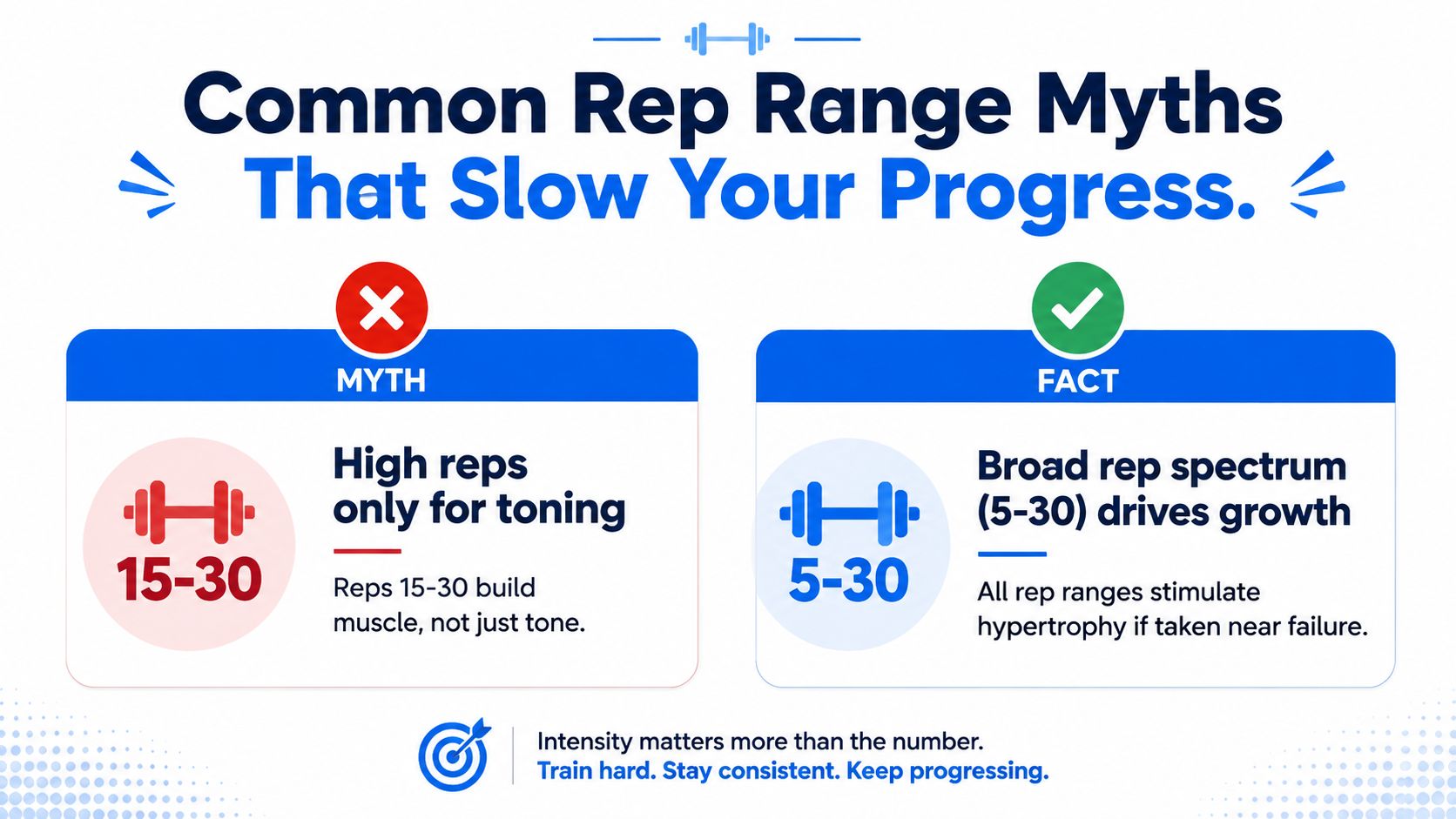
Myth, high repetitions are only for toning.
“Toning” isn't a separate adaptation created by a special rep range. Higher repetitions can support muscle growth when the set is sufficiently challenging. Whether visible definition appears also depends on body composition, which rep selection alone can't determine.
Myth, every set must stay between 8 and 12.
The 2021 review found that moderate repetitions are practical, not uniquely required, and that similar hypertrophy can occur across a wider loading spectrum when effort is sufficient (review of resistance-training loading). Use the range when it fits, but don't force a set of thirteen down to twelve or reject a productive set of six.
Myth, low repetitions only build strength.
Heavy training strongly supports strength, but low-repetition sets can also contribute to muscle growth when you accumulate enough appropriate work and train with high effort. The trade-off is that heavy work may be more demanding to recover from, so it often works best as part of a mixed plan rather than as the only method.
Myth, reaching failure matters more than everything else.
Failure is one way to create high effort, but it isn't the only way. A set stopped close to failure with clean technique may be more useful than a failed set that turns into uncontrolled movement.
The immediate takeaway is to judge your program by effort, productive volume, execution, and progression, not by whether every exercise lands in one traditional range.
Your Action Plan for Smarter Muscle Building
Put the evidence into practice with a simple audit.
Review your current rep habits. If every exercise sits in the same range, identify where a different strategy could improve comfort, performance, or recovery.
Assign ranges by exercise role. Use approximately 5 to 8 repetitions for demanding compound lifts, 8 to 15 for secondary movements, and 15 to 30 for isolation work and finishers. The broader evidence supports growth across this spectrum when sets are taken close enough to failure (rep-range hypertrophy summary).
Track progression everywhere. Add load when technique remains strong, add repetitions within the target range, or add productive work when recovery allows. Don't treat heavier weight as the only valid sign of progress.

Use the rep range that lets you train hard, maintain control, and return ready to perform again. A playlist such as these best songs for the gym can improve the training environment, but your results still come from consistent sessions, sufficient effort, and a plan you can sustain.
There isn't one perfect number. Build your week around varied loading, keep challenging sets close to failure, and let your performance over time guide adjustments.
Empire Athletics offers 24/7 access, modern strength and cardio equipment, and certified one-on-one personal training across its Leominster, Lunenburg, and Webster locations. Visit Empire Athletics to train with a program that matches your goals, schedule, and preferred approach to muscle growth.