Certified Personal Trainer Near Me: How to Choose
Searching for a certified personal trainer near me? Learn how to verify credentials, match expertise to your goals, and find the right local gym fit.

You've opened Google, typed “certified personal trainer near me,” and found a list of trainers, gyms, credentials, reviews, and package options that all look broadly similar. The nearest result isn't automatically the right choice. A trainer only becomes useful when verified expertise, relevant programming, dependable scheduling, and a facility you'll actually use come together.
Treat your search as a vetting process, not a map exercise. You're choosing the person and environment that will shape your training habits, movement quality, and willingness to keep showing up when work, family, fatigue, or an uneven schedule gets in the way.
Why Local Certification Matters for Your Fitness Journey
A local trainer gives you something an online program can't fully reproduce: regular, in-person observation. They can watch your squat, adjust your setup, notice when your movement changes under fatigue, and adapt the session in real time. Proximity makes those interactions practical, but proximity alone says nothing about whether the coach understands exercise programming, biomechanics, or safe progression.
The profession itself is established and expanding. The U.S. had 370,100 fitness trainer and instructor jobs in 2024, and employment is projected to grow 12% from 2024 to 2034, much faster than average, according to the personal trainer industry statistics compiled by Trainerize. That demand gives consumers more local options, but it also makes quality control more important. A crowded search result can include experienced professionals, enthusiastic generalists, and people whose marketing is stronger than their education.
Practical rule: Use distance to narrow the list, then use credentials and coaching fit to make the decision.
Certification is a trust filter
Certification doesn't guarantee that a trainer is a perfect match. It does show that the person has pursued formal education and met the requirements of a recognized credentialing organization. In a peer-reviewed study of personal trainers, 89.0% held a personal training certification, while only 2.9% had neither an exercise-related bachelor's degree nor a personal training certification. The study also recorded certifications from organizations including ACSM, NSCA, NASM, and ACE. You can review those findings in the peer-reviewed study of personal trainer qualifications.
That distinction matters if you're a beginner, returning after time away, managing an old injury, or trying to build strength without aggravating a joint. A certified professional should be able to explain why an exercise is included, how it will progress, and what modification will be used if your current ability doesn't match the original plan.
Local accountability changes the decision
A nearby trainer and gym reduce friction. You don't need to cross a large part of town for every appointment, and the coach can build familiarity with your movement patterns over time. That continuity supports better decisions than constantly switching between generic workouts.
Search for a trainer near your home, workplace, or regular route. Then ask whether the credential is current, whether the trainer has worked with people like you, and whether the facility's hours support your actual life. The best local result isn't just the closest name. It's the professional you can trust and consistently reach.
Verifying Credentials and NCCA Accreditation
Start with the credential, not the trainer's social media presence. A polished profile can show personality and experience, but it can't replace independent validation. The strongest first filter is an NCCA-accredited certification, because accreditation evaluates the certification program rather than relying only on the trainer's own description.
The American College of Sports Medicine explains that independent accreditation provides third-party validation against recognized credentialing standards. Its certification guidebook on NCCA accreditation and ACSM-CPT scope describes NCCA as an independent body that assesses whether a certification distinguishes qualified candidates from unqualified ones. ACSM-CPT is qualified to program exercise for healthy individuals and people with medical clearance, which is different from diagnosing or treating a medical condition.
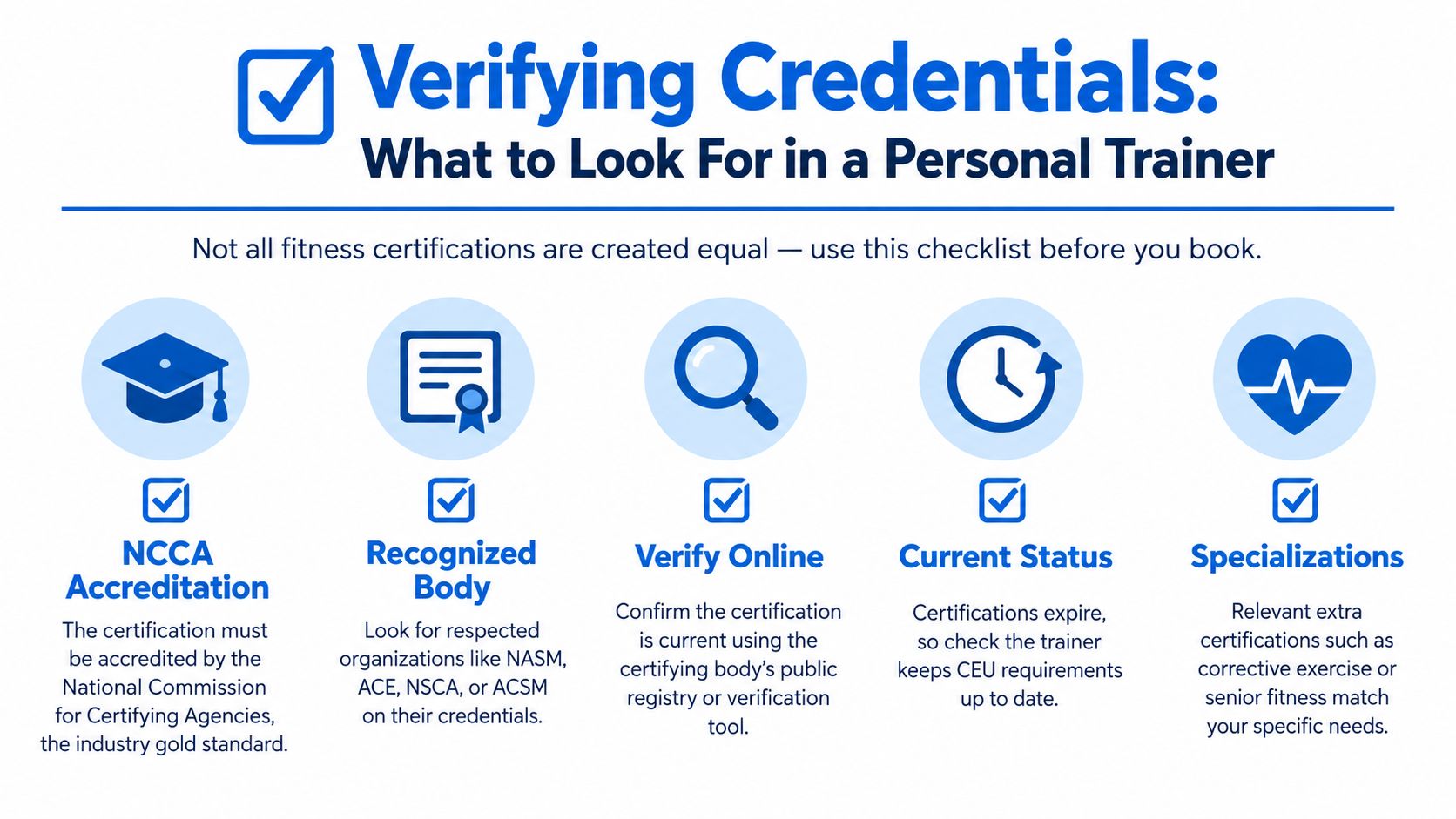
Use this verification checklist
Identify the exact credential. Ask for the full certification name, not just “certified trainer.” Names such as NASM-CPT, ACE-CPT, NSCA-CPT, or ACSM-CPT give you something specific to verify.
Check the accrediting status. Look for confirmation that the certification program is NCCA accredited. Don't assume that every course, workshop, or online certificate carries the same level of independent review.
Confirm current standing. Certifications can require renewal and continuing education. Ask whether the trainer's credential is active and how they maintain it.
Separate scope from specialization. A corrective exercise, senior fitness, mobility, or strength specialization may be useful for your needs, but it doesn't replace a foundational personal training credential.
Ask about boundaries. A responsible trainer will explain when they can modify exercise and when they need medical clearance or another qualified professional.
A 2026 NASM report says NASM-certified trainers earn 22% more than other trainers and that the certification “pays for itself before year one.” Treat that as industry reporting about NASM, not as a promise about your prospective trainer's income or quality. Your concern is simpler: does the trainer hold a current, independently validated credential and know how to apply it to your situation?
Matching Trainer Expertise to Your Specific Goals
A general trainer can help a healthy beginner learn basic movement and establish a routine. A specialist becomes more valuable when your circumstances create specific coaching demands. Don't choose based on the broadest list of services. Choose the trainer whose experience matches the problem you need solved.
Your situation | Look for | Ask during the consultation |
|---|---|---|
New to resistance training | Patient instruction and simple progression | “How do you introduce lifting without overwhelming a beginner?” |
Older adult focused on longevity | Strength, balance, mobility, and conservative progression | “How do you adapt training around balance or joint limitations?” |
Shift worker or busy professional | Flexible scheduling and plans that survive missed sessions | “What happens when my work schedule changes?” |
Post-injury return | Clear scope, communication with medical professionals, and appropriate modifications | “What information do you need before programming for me?” |
Body recomposition or fat loss | Strength programming, realistic habits, and progress tracking | “Which outcomes do you track besides body weight?” |
Experienced lifter | Technical feedback and planned overload | “How will you identify and address a plateau?” |
The fitness industry is opening more niche roles around older-adult strength, mobility and balance, medical fitness, weight-management support, and GLP-1-adjacent training, according to the ISSA fitness hiring report. That shift reflects a practical truth: certification tells you a trainer has met a baseline, but it doesn't tell you whether they're ready for your particular life stage.
Compare generic coaching with tailored programming
A generic coach often starts with a familiar workout and adjusts it only after you struggle. A coach who personalizes the work starts by asking about your schedule, training history, limitations, goals, recovery, and preferences. The difference appears in the details: exercise selection, rest periods, session length, weekly frequency, and the way progress is measured.
For example, a shift worker may need two alternate session formats rather than a fixed weekly schedule. Someone returning from an injury may need controlled range of motion and gradual loading before pursuing heavier training. A bodybuilder may need more precise volume and recovery management than a beginner seeking general fitness.
Use the personal training guidance from Empire Athletics as a reference point when comparing what a local program should address. The right trainer should be able to describe your first phase clearly without pretending that one template works for everyone.
Evaluating Facility Access and Scheduling Flexibility
Your program has to fit your calendar before it can improve your fitness. A trainer may understand exercise science perfectly, but that expertise won't help if appointments are difficult to book, the gym closes before your shift ends, or you can't train independently between coached sessions.
Scheduling difficulty is a common reason clients discontinue training. One 2026 industry compilation reported that 50% of new personal-training clients discontinue within six months, while retention rises to 74% among clients who complete their first 12 sessions. The same personal training retention data identifies scheduling difficulty as a common dropout reason.
Treat the first 12 sessions as a commitment block
Don't evaluate a package only by its price or the trainer's enthusiasm. Ask whether you can realistically complete the first 12 sessions, then examine the obstacles that could interrupt them:
Appointment availability: Can the trainer offer times that match your work, childcare, commute, or sleep schedule?
Independent access: Can you train outside coached sessions when motivation is lower but time is available?
Equipment availability: Will the facility support your plan during the hours you can attend?
Rescheduling rules: What happens when a shift changes or a family obligation appears?
Backup support: If your trainer is unavailable, can you still follow a clear plan safely?
A 24/7 facility is especially useful for shift workers and professionals whose schedules change from week to week. It gives you more chances to train when an appointment isn't possible and removes the false choice between exercising at an inconvenient time and skipping altogether.
Consistency is often a logistics problem before it becomes a motivation problem.
Visit the gym during your likely training hours. Check whether the space feels usable, whether the equipment suits your goals, and whether you can move through the session without unnecessary delays. You're not looking for a theoretical ideal. You're looking for a routine that remains workable on an ordinary, tiring Tuesday.
What to Expect During Your First Trial Session
A trial session should feel like an evaluation on both sides, not a performance designed to make you buy immediately. The trainer should learn enough about your goals and limitations to coach responsibly, while you assess their communication, attention, and professionalism.

You arrive and explain that you want to build strength, but your schedule changes every week and your shoulder sometimes feels uncomfortable overhead. A capable trainer doesn't immediately hand you a demanding circuit. They ask about your training history, medical clearance where relevant, current activity, sleep, and what “success” would look like in practical terms.
Watch how the trainer coaches
During the movement portion, pay attention to what happens between repetitions. Does the trainer explain the purpose of an exercise? Do they demonstrate clearly, watch your setup, and offer a specific correction rather than shouting generic encouragement? Can they scale the movement without making you feel embarrassed?
Ask direct questions:
“How do you build my program over the first few weeks?”
“What will you track to show that I'm progressing?”
“How do you modify an exercise when pain, fatigue, or limited mobility appears?”
“How do you communicate between sessions?”
“What would make you refer me to a physician or physical therapist?”
A strong trainer won't promise a particular body transformation or claim to fix a medical problem. They'll explain the next sensible step, define what falls within their role, and show how they'll make decisions from your feedback and performance.
You can also use a gym free trial at Empire Athletics to assess the wider environment before committing. Notice whether you feel comfortable asking questions, whether the facility supports the way you want to train, and whether the staff treats the trial as an introduction rather than pressure.
Red flags deserve a firm no
Leave if the trainer ignores your stated limitations, refuses to explain the plan, spends the session distracted, or insists that pain is proof the workout is effective. Be cautious when the trainer can't identify their exact certification, guarantees rapid results, or pushes a large package before understanding your needs.
The right trial session leaves you with a clear starting point, realistic expectations, and enough information to decide without pressure.
Finding the Right Fit at Empire Athletics
For residents near Leominster, Lunenburg, and Webster, the practical decision is whether one local training environment can remove enough friction to support long-term attendance. Empire Athletics operates locations at 507r Lancaster Street in Leominster, 308 Massachusetts Avenue in Lunenburg, and 37 Sutton Road in Webster, with consistent 24/7 member access across its facilities.
That combination matters because location and hours solve different problems. A nearby gym reduces travel friction, while around-the-clock access gives busy professionals and shift workers more control over when they train. You still need to verify that the equipment, coaching availability, and atmosphere match your goals, but flexible access gives a structured program more opportunities to survive a changing week.
Match the coaching to the goal
The trainer directory lists professionals with credentials such as ISSA Certified Personal Trainer and NASM Certified Personal Trainer. Use the Empire Athletics trainer directory to identify a potential match, then ask the same verification questions outlined above. A credential is a starting filter, not a substitute for a conversation about your training history and objectives.
The training offer supports one-on-one programming for goals that include mobility, corrective exercise, bodybuilding, weight loss, strength, and general performance. The facilities also provide modern strength and cardio equipment, which gives a coach more options when a client needs to modify an exercise, change training emphasis, or progress beyond beginner movements.
Reduce the small barriers
Long-term adherence depends on more than the workout itself. Empire Athletics includes an on-site Empire Cafe serving coffee, fresh smoothies, and protein shakes, giving members a convenient option before or after training. That won't replace a sound nutrition plan, but it can remove one small decision from a busy training day.
Use the same standard you'd apply anywhere: verify the trainer's current credential, discuss your specific goals, test the schedule, and judge whether the facility fits your routine. The right choice is the one you can repeat consistently, with coaching that respects your starting point and access that works when your calendar gets complicated.
Empire Athletics offers certified one-on-one personal training, custom programming for goals from mobility to bodybuilding, modern strength and cardio equipment, 24/7 access, and locations in Leominster, Lunenburg, and Webster. Visit Empire Athletics to explore the facilities and trainers, then book a conversation that matches your schedule and fitness goals.