Gym Free Trial Guide: Make the Most of Your First Visit
Plan a smart gym free trial with our practical guide. Learn what to test, which questions to ask staff, and how to evaluate before you commit to membership.

You're standing at the front desk with a clipboard in your hand, wondering whether this place is a good fit or just good at selling tours. The lights are bright, the lobby smells like cleaner and coffee, and someone keeps saying “free” like that settles everything. It doesn't. A gym free trial is a test drive, but it's also a sales process, and if you walk in like a customer instead of a prospect, you'll see a lot more.
What a Gym Free Trial Really Gets You
A real gym free trial gives you temporary access to the facility so you can decide whether the place fits your routine, your training style, and your tolerance for the vibe. In plain English, it's a short window to use the gym before you sign a contract. It may include a tour, a quick intro with staff, and access to equipment or classes, but it rarely includes the full membership experience.
That's where people get fooled. A trial can look generous on the surface and still leave out the parts that matter most, like locker rental, towel service, guest privileges, or a full stack of premium classes. Some offers are free only if you never miss a cancellation deadline, never forget the card on file, and never assume “trial” means “no strings.”
Practical rule: If the trial needs a credit card before you've even walked in, treat it like a billing setup with a short grace period, not like a gift.
The biggest trap is the language gyms use around the word free. A trial can still carry a deposit, an automatic conversion, or a refund condition that depends on attendance or paperwork. That doesn't make the offer evil, but it does mean the trial is part of the sales funnel, not a neutral favor.
A smart visitor reads the offer like a contract with a stopwatch. Ask yourself what you can use, what gets excluded, and what happens the minute the trial ends. That mindset turns the visit into an audition in both directions, which is what it is.
Why Gyms Offer Free Trials in the First Place
Gyms don't offer trials because they're feeling generous. They offer them because a free trial is a conversion tool, and the industry knows it. One industry analysis says free trials typically produce a close rate below 30%, so fewer than 3 out of every 10 people who complete a trial sign up, while the same dataset reported an average lead engagement length of 7.8 months across gym businesses that tracked their numbers (Two Brain Business analysis).
That changes how you should interpret the whole experience. The gym is not just giving you access. It's trying to move you from curiosity to commitment while you're on site, inside the building, surrounded by equipment, staff, and momentum. The trial is designed to compress hesitation.
The business logic behind the offer
Gyms spend to get your attention first. They pay for ads, leads, and listing placements, then use the trial to turn a cold lead into a live conversation. Once you're in the building, the environment does part of the selling for them. The machines look better than they do in photos, the staff feels attentive, and the membership pitch comes after you've already pictured yourself coming back.
That's why your job and the gym's job are different. The gym wants the close. You want the truth. So don't think of the trial as a perk. Think of it as a pressure test for the facility, the staff, and the fine print.
If the place is worth joining, the trial will reveal it. If it's mostly marketing, the trial will also reveal that, just faster.
Common Trial Lengths and What They Reveal
Trial length tells you what the gym is trying to prove. A short pass shows off the lobby, the equipment, and the sales floor. A longer one exposes staffing, cleaning habits, and whether the place still feels functional when the novelty wears off. The conversion data backs that up. Fitness software benchmarks cited in industry coverage show 17 to 32 day trials had a median conversion rate of 45.7%, while four-day trials converted at only 26.8% (Zenoti industry coverage). Another fitness operations report summarized conversion at 19% without a structured follow-up process versus 38% with one, and it also cited 7-day trials outperforming 3-day trials, 35% vs. 27% (Rework fitness growth report).
Trial lengths compared
Trial Length | What It Reveals | Conversion Risk | Cancellation Complexity |
|---|---|---|---|
Single-day pass | First impression, equipment quality, lobby culture | Low, but limited data | Usually lower, but read the card policy |
3-day window | Weekend atmosphere, front desk tone, basic flow | Moderate, because it's short and easy to forget | Moderate if payment info is collected |
7-day trial | Staff consistency, cleaning routine, class access | Higher, because you get more exposure | Higher if the offer auto-rolls into billing |
17 to 32 day trial | Habit formation, scheduling reality, repeated staff contact | Highest, because inertia kicks in | Highest, especially if auto-renewal language is buried |
A day pass tells you whether the equipment is usable and whether the place feels welcoming. It hides weekday crowding and the class schedule. A 3-day pass gives you a slightly better look at traffic patterns, but it still skips enough of the week to leave gaps.
A 7-day trial is the first version that can expose consistency. You can see whether the gym stays clean, whether the staff stays present, and whether the experience changes when the place gets busy. The longer 17 to 32 day version gives you the deepest look, but it also creates the strongest chance of signing up because the gym has more time to nudge you toward inertia.
Short version: shorter trials are easier to escape, longer trials reveal more of the operation, and the longest trials are where cancellation discipline matters most.
Your On-Site Evaluation Checklist
Walk in with a plan or you'll leave with a vibe and no useful answer. Use the trial to spot friction, starting with the floor, then the locker room, then the staff, then the noise and crowd pattern. If you remember one rule, keep this one close, if the trial needs a credit card before you've walked in, treat it as a billing setup with a grace period.

Start with the equipment
Check whether the gym matches how you train. If you live on free weights, don't get distracted by a polished row of treadmills while the dumbbell area is tight or the rack setup looks cramped. If you depend on cables, machines, or functional space, inspect those first.
Look at the floor like someone who plans to return. Frayed cables, sticky buttons, rust, and machines with out-of-order signs tell you more than the sales pitch does. A place that can't keep one machine working reliably usually has other operational problems hiding behind the front desk.
Then watch the room, not just the racks
Go at the time you would normally train, not when the place is empty and flattering. Crowding changes everything, from access to equipment to patience with staff. A gym that feels smooth at noon can feel unusable after work.
Cleanliness reflects management discipline. Check the locker room, restrooms, floors, mirrors, and any shared surfaces. If the bathrooms are sloppy, assume the rest of the operation is equally loose.
Use this quick scan
Equipment condition: Look for broken attachments, rust, and machines that sit unused for days.
Traffic pattern: Notice whether the area you need is available when people are training.
Locker room standard: Check for odors, damp floors, stocked wipes, and working fixtures.
Front desk energy: See whether staff look alert, rushed, or disengaged.
Trainer presence: Note whether coaches are visible on the floor or hidden in offices.
Music and noise: Decide whether the atmosphere helps your focus or wrecks it.
Towel and amenity policy: Ask what's included, then verify it on the floor.
Class booking flow: See whether people look confused or smooth about sign-up.
Broken equipment response: Ask how quickly issues are fixed, then listen to the answer.
Member behavior: Watch whether people rerack weights and respect space.
Parking or entry stress: Pay attention to the part of the visit before you even start training.
Overall flow: Ask yourself whether the place makes working out easier or more annoying.
For a clearer sense of how cardio areas are usually arranged, the layout in Empire Athletics' cardio workout equipment guide gives useful context while you compare machine variety and usage patterns. That's the level of detail you should demand from any trial, because vague impressions don't tell you whether you'll still want to come back in month three.
Smart Questions to Ask the Staff
Don't waste the visit asking about the cheapest intro rate. Ask about the things that affect your actual usage, because the sales desk can always find a way to make the first month look painless. A gym free trial is only useful if you leave with answers about scheduling, access, and the hidden rules that shape the experience.
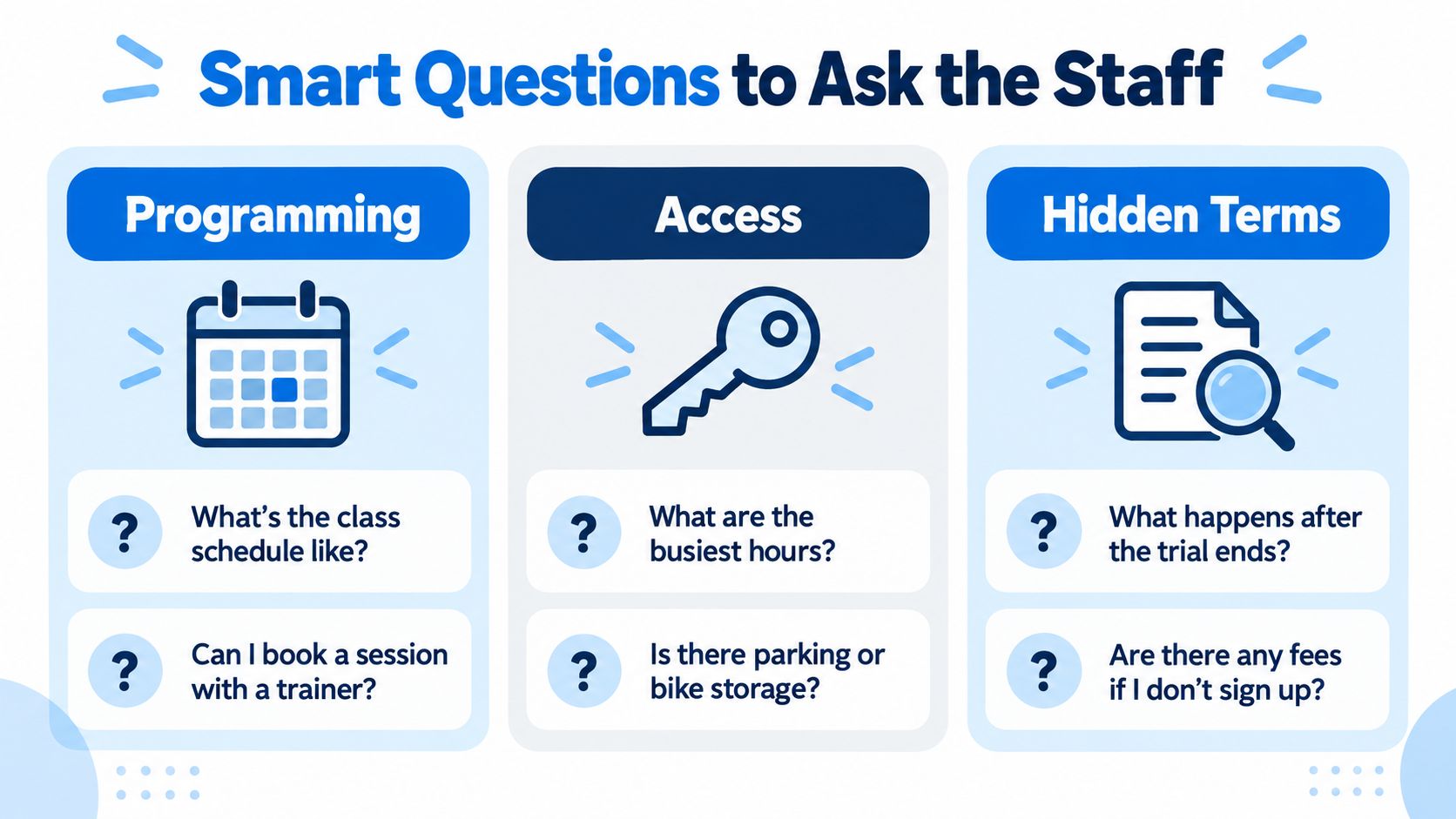
Ask about programming
Start with the classes and coaching rhythm. Ask, “What's the class schedule like during peak hours and off-peak hours?” Ask whether classes fill up for non-members, because some gyms market access they don't make easy to use. If you want structured coaching, ask whether an intro session with a trainer is included or sold separately.
If you care about personal training, don't assume “orientation” means real coaching. Ask who leads the sessions, what credentials they hold, and whether beginners get hands-on instruction or a quick welcome tour. If the answer sounds vague, it probably is.
Ask about access
Access matters more than people admit. Ask, “What are the busiest hours?” and “Is there parking or bike storage?” If the answer on parking sounds slippery, your future consistency will pay for it.
You should also ask about guest passes, holiday hours, and what happens during maintenance closures. A serious operator can explain how they handle disruptions without making you chase three different people.
Practical rule: if the answer comes with a shrug, a promise to “check with management,” or a vague email offer, assume the policy is not member-friendly.
Ask about hidden terms
Now ask the questions most brochures skip. “What happens after the trial ends?” matters more than the smooth tour. “Are there any fees if I don't sign up?” matters too, because some offers hide the cost in paperwork, deposits, or automatic conversion language.
For a broader view of what good coaching should look like, this personal training guide from Empire Athletics can help you judge whether the staff is talking about real programming or just stacking sessions. Ask about freezes, billing dates, and cancellation paths while you're there. A staff member who answers directly is showing you the kind of operation they run.
Cancellation Rules Worth Reading Twice
This is the section trial articles usually gloss over, and that is a mistake. The transition from trial to billing is where a gym free trial turns expensive. FTC litigation says gym operators have been accused of using deceptive free-trial or low-cost offers while failing to provide a simple cancellation mechanism, and a 2026 FTC complaint summary also highlights burdensome cancellation paths that force in-person visits, printed forms, or certified mail (FTC litigation status report).
That is the part worth reading twice.
Read the conversion language, not just the offer
Some trials collect payment details up front, then roll into membership when the window ends unless you cancel inside a narrow timeframe. The paperwork usually tells you everything you need to know. The difference between “trial” and “membership” may be one date and one checkbox.
Look for words that create friction. Auto-renew, recurring billing, notice period, written cancellation, and billing anniversary all matter. If the contract says you must cancel in person, by certified mail, or through a notarized letter, the gym is making the exit harder on purpose.
Freeze is not cancel
Gyms love to blur these terms. A freeze pauses access, but it does not always stop billing, and a canceled membership can still charge if the deadline was missed or the request went to the wrong place. Read the section that explains how the account ends, not just how it pauses.
If you want a plain-English comparison point, Empire Athletics' cancellation guide shows the kind of steps a gym may require before it lets you out. Use that as a reference against the trial terms before you hand over payment details.
Read the fine print like a person who expects the gym to enforce it, because they usually will. Before signing, make sure you can explain the cancellation process in one sentence; if you can't, keep reading.
What Happens After You Book
Booking the trial isn't the same as showing up. That gap is where a lot of people lose the visit entirely, especially shift workers, caregivers, and anyone whose schedule gets rearranged by real life. New 2025 to 2026 industry research on gym no-shows describes the “after the booking is made, but never attended” phase as a missed opportunity and tracks 248 trial/tour journeys across 75 operators (Keepme no-show research).
That blind spot matters because intention is cheap. Attending is the hard part.
What good follow-up looks like
A real operator confirms the visit clearly. Email, SMS, an app reminder, and a front-desk call can all be normal, but the message should be specific, not generic. If they send a generic marketing blast instead of a real appointment reminder, that's a sign they care more about lead capture than attendance.
Some chains now require a credit card or pre-authorization at booking, which turns the “free” trial into a soft financial commitment. You should know that before you book, not after you're surprised by it. If the gym asks for a card, ask whether it's for identity verification, no-show protection, or automatic conversion.
How to keep a trial from disappearing
Put the visit on your calendar the second you book it. Not later, not after work, right away. If you want a specific trainer or class, lock that request in so the time has teeth.
Ask about the reschedule window before you leave the booking page. If a missed slot voids the trial, you need that information upfront. For people with irregular schedules, the booking process itself is part of the evaluation, because a good gym makes attendance easy instead of fragile.
Deciding Whether to Sign Up
Don't sign up because the salesperson is energetic, the towel stack looks clean, or the offer expires in ten minutes. Sign up because the gym fits your life. That means proximity, equipment fit, schedule alignment, and staff quality. Everything else is noise.
The wrong reasons are easier to spot. A low intro price can mask a bad commute. A polished pitch can hide overcrowding. A discount can distract you from the fact that you'll hate coming back.
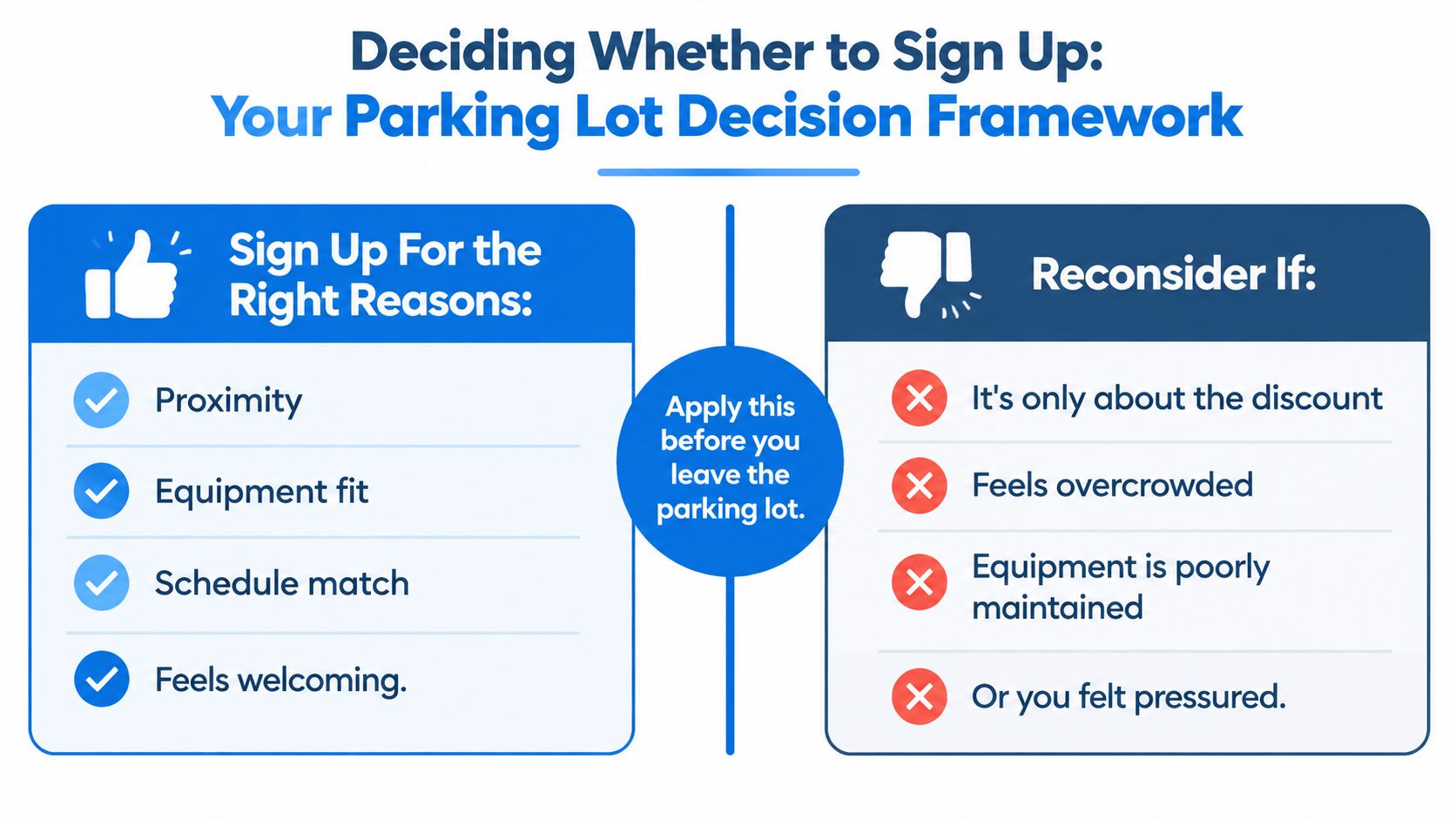
Use this parking lot filter
Sign up if: the gym is close enough that you'll go, the equipment matches your training, the hours work for your life, and the staff feels straightforward.
Reconsider if: the place only feels appealing because of the discount, the floor was crowded in the time slot you care about, the equipment looked tired, or you felt pushed.
Pause if: the contract is longer than you expected, the billing language is unclear, or you're being rushed to sign before reading the cancellation section.
Give yourself a 48-hour cooling-off window before activating any paid membership. That pause protects you from signing under pressure and gives you time to reread the contract with a clear head. If the deal is good, it will still be good tomorrow.
Annual prepaid terms deserve a second opinion. So do bundled personal-training packages and anything longer than 12 months. Those structures can be fine for the right person, but they shouldn't be signed because someone handed you a clipboard and a deadline.
If the gym wins the conversation but loses your trust, you already have your answer.
Empire Athletics runs 24/7 access across its Central Massachusetts locations, with modern strength and cardio equipment, certified one-on-one personal training, and an on-site cafe for coffee, smoothies, and shakes. If you want to compare a straightforward local gym setup against the kind of trial tactics described here, visit Empire Athletics and look at the facilities before you let any membership pitch make the decision for you.