Getting Back to Working Out: Your 12-Week Plan
Getting back to working out requires a smart strategy. Follow this 12-week phased plan, mobility routine, and habit guide to rebuild your fitness safely.

You're standing outside the gym with your old training plan open on your phone. Part of you expects to feel excited. Another part remembers how much weight you used to lift, how easily you used to run, or how consistently you used to show up, and wonders whether starting again means starting from zero.
It doesn't. Getting back to working out is a re-entry problem, not a character test. Your current capacity has changed, but your training history still matters. The smart approach is to reduce the load, rebuild tolerance, and let your body regain coordination before asking it to perform like your previous self.
Physical inactivity is common worldwide. The World Health Organization's physical activity guidance reports that 31% of adults, about 1.8 billion people, did not meet recommended activity levels in 2022, meaning they fell short of at least 150 minutes of moderate-intensity activity per week. That context matters. If you've taken a long break, you're dealing with a widespread physiological and behavioral challenge, not a personal failure.
The Reality of Detraining and Muscle Memory
Walking back into the gym after months away can produce an unpleasant surprise. The warm-up feels harder, familiar weights move slowly, and movements that once required little thought suddenly demand concentration. Many people respond by trying to prove that their old fitness is still there. That usually creates excessive soreness, poor technique, or a second break.
Detraining changes your current performance, but it doesn't erase your training history. Cardiovascular tolerance, work capacity, coordination, and strength expression can decline when regular training stops. Your first sessions may feel disproportionately difficult because your nervous system, connective tissues, and energy systems aren't yet synchronized with your old workload.
Why muscle memory changes the restart
Muscle memory isn't a motivational slogan. Previous training creates adaptations that can make retraining more efficient than initial training. A 2026 summary of exercise science from Trainwell's guide to easing back into exercise describes emerging evidence that, after a 10-week break from resistance training, participants needed about five weeks of retraining to return to prior levels. Treat that finding as useful context, not a guarantee. Your result will depend on training history, age, sleep, nutrition, injury status, and how much capacity you lost during the break.
The practical implication is encouraging. You don't need to recreate your entire former routine immediately. You need to provide a manageable stimulus often enough for your body to re-adapt. Your previous experience can help you learn movements faster and regain confidence, but it doesn't protect you from doing too much too soon.
Practical rule: Your old numbers are historical information, not week-one targets.
Global inactivity also shows why a gradual return matters. A pooled analysis of physical activity surveys found that insufficient activity rose from 23.4% in 2000 to 31.3% in 2022, with 34.7% projected for 2030 if stronger action isn't taken. The issue isn't solved by one heroic workout. It's solved by repeatedly tolerable sessions that fit real life.
What to do with that information
Start by separating three questions:
Can you perform the movement? Use a light load and assess control.
Can you recover from the session? Monitor soreness, sleep, energy, and joint response.
Can you repeat the session? A plan that leaves you unable to train again isn't a successful restart.
Your first objective is not to demonstrate what you used to do. It's to establish a baseline you can build on. The body usually responds better to a conservative return followed by steady progression than to a dramatic test followed by forced rest.
A Phased 12-Week Progression Framework
The first twelve weeks should move from tolerance and coordination toward meaningful strength and performance. That doesn't mean every person should follow the same exercises or train at the same frequency. It means the demands should rise in an order your body can absorb.
The return-to-training guidance from Greatist recommends beginning at about 50% or less of your previous volume and intensity for the first 2 weeks, alongside low-intensity sessions lasting 20 to 30 minutes. Use that as the ceiling for your opening phase, not as a challenge to exceed.
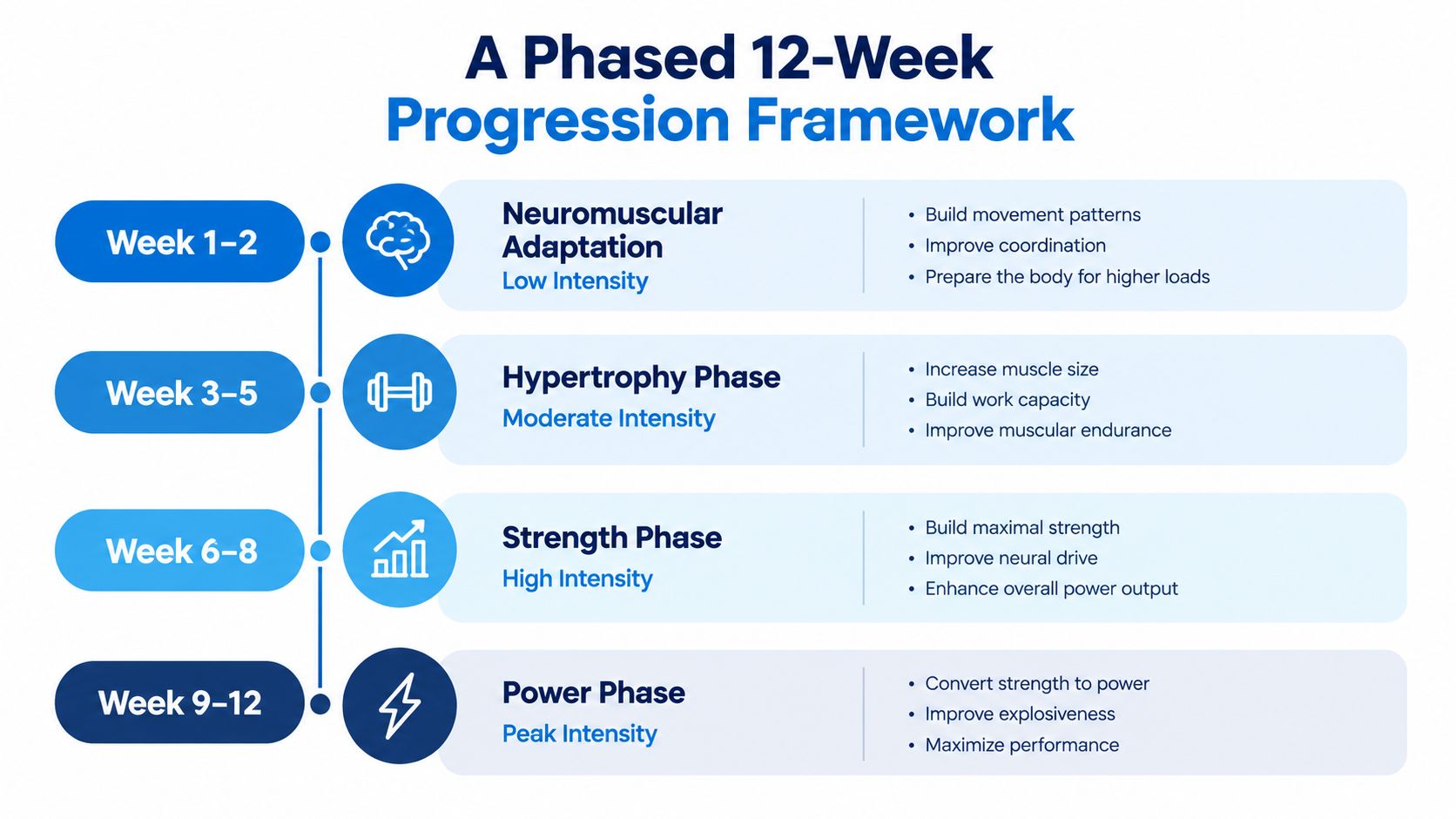
Weeks 1 through 4 build tolerance
During weeks 1 and 2, train with loads that leave several controlled repetitions in reserve. Keep sets technically clean, stop before grinding, and use simple movements you can repeat consistently. A full-body session might include a squat pattern, a horizontal push, a row, a hip hinge, and an easy conditioning exercise.
For weeks 3 and 4, add a small amount of work only if recovery has been predictable. You might add a set to selected exercises, extend a walk, or increase resistance modestly. Don't increase every variable at once.
Use RPE, or Rate of Perceived Exertion, to regulate effort:
RPE 5 to 6: You could perform several more good repetitions.
RPE 7: You have a few controlled repetitions left.
RPE 8 or higher: The set is demanding and shouldn't dominate early comeback training.
If a session reaches your target RPE but your technique deteriorates, the load is too high. If your joints hurt during the movement, change the exercise or stop and seek qualified assessment rather than trying to push through.
Weeks 5 through 8 rebuild muscle and stamina
Once movement quality and recovery are stable, use moderate repetition ranges and gradually expand training volume. Keep most working sets submaximal. Your goal is to expose your muscles and cardiovascular system to enough work to adapt, while preserving the ability to train again on schedule.
A practical session structure could include:
One primary lower-body movement.
One primary upper-body push or pull.
Two or three accessory movements.
A short, controlled conditioning block.
A brief cooldown or easy walk.
At this stage, don't chase soreness. Soreness measures novelty more reliably than progress. A productive session may leave you feeling worked without interfering with the next session, your job, or your sleep.
Weeks 9 through 12 develop strength and performance
In the final phase, you can place more emphasis on heavier compound movements, sport-specific work, or faster but technically controlled actions. The word progression doesn't mean testing a one-repetition maximum. It can mean adding resistance while maintaining form, completing the same work with less fatigue, or moving through a larger range of motion.
Sports-medicine guidance from the National Athletic Trainers' Association detraining resource advises a rapid return after detraining with low-volume, high-intensity work limited to 1 to 2 times per week initially, supported by cross-training, followed by gradual increases in duration, intensity, and specificity over roughly 15 days. If you're returning from an injury, that timeline should never override your clinician's rehabilitation plan.
Keep a simple log with the exercise, load, repetitions, RPE, and next-day response. When the numbers and symptoms disagree, symptoms win. A slower progression that you can repeat beats an impressive session that resets your plan.
Customizing Templates for Your Starting Point
A former intermediate lifter, a complete beginner, and someone returning from an injury may all describe themselves as “out of shape,” but they don't need the same first workout. Your template should reflect movement experience, current tolerance, and medical restrictions, not the identity you had before the break.
Start with an honest audit. Can you walk comfortably? Can you squat to a pain-free depth? Can you brace your trunk without holding your breath excessively? Can you perform a light pushing and pulling movement with stable joints? If you can't answer confidently, choose the more conservative option.
For broader programming terminology, review this explanation of what a training split means, but don't assume your previous split is automatically appropriate now.
Week 1 Training Templates by Starting Point
Profile | Focus | Sets x Reps | Rest |
|---|---|---|---|
Complete beginner | Learn fundamental patterns with stable, accessible exercises | 1 to 2 x 8 to 12 | Comfortable rest between sets |
Detrained intermediate | Rehearse familiar lifts with reduced loading and controlled tempo | 2 x 6 to 10 | Enough rest to preserve technique |
Injury-rehabilitation restart | Use clinician-approved pain-free variations and prioritize control | Prescribed by clinician, often low volume | Full recovery between efforts |
The complete beginner should favor machines, supported dumbbell work, bodyweight patterns, and walking. The priority is not exercise variety. It's learning how to brace, breathe, control range of motion, and finish the session feeling capable of returning.
The detrained intermediate can usually use more familiar patterns, but the old working weights don't belong in week one. Choose variations that expose technical errors without punishing them. For example, a goblet squat may be a better first step than immediately loading a barbell, even if barbell squats were once a staple.
The injury-rehabilitation restart requires the most restraint. Pain that is sharp, escalating, or associated with weakness, instability, altered sensation, or loss of function deserves professional evaluation. A trainer can help organize a session, but a qualified medical professional should define restrictions and progression when an injury is involved.
Match the template to the day
Your starting profile isn't permanent. A trained lifter who slept poorly, has a painful joint, or hasn't eaten may need the beginner template for that session. A beginner who has built excellent movement control may progress sooner than expected. Use the least demanding option that allows high-quality practice.
Don't confuse confidence with readiness. The right template should make you feel that another session is realistic, not that you survived an ordeal.
Prioritizing Mobility and Post-Workout Recovery
A workout supplies the stimulus. Recovery determines whether you can absorb it and repeat it. Returning adults often focus on the main lifts while skipping the preparation that helps them move well, then treat post-workout nutrition and sleep as optional extras.
Begin with a 10-minute dynamic mobility sequence. Keep the movements controlled and avoid forcing end ranges. The purpose is to raise temperature, explore motion, and prepare the positions your session requires.
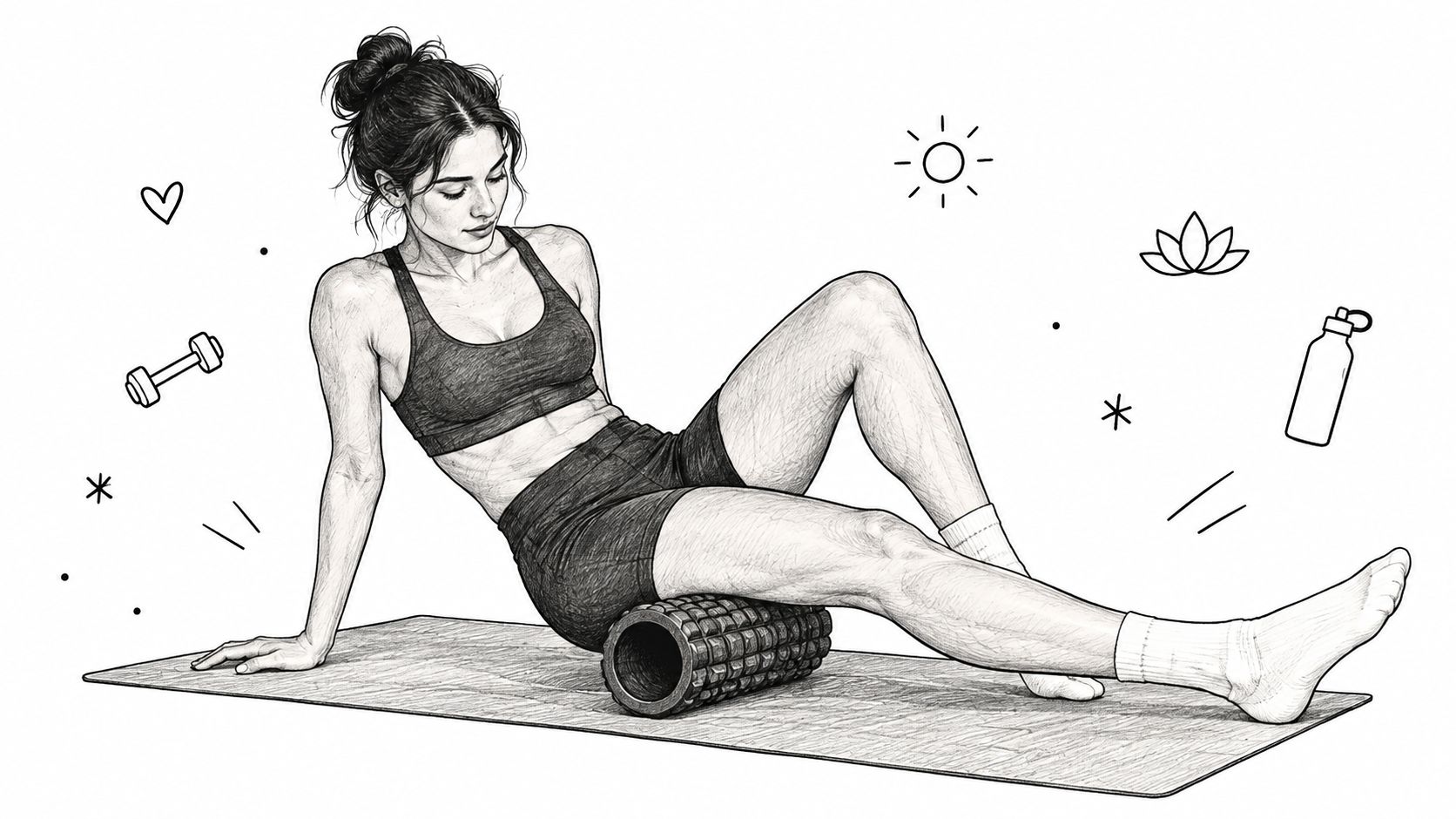
A practical pre-training flow
Spend roughly equal attention on the areas that commonly become stiff during desk work:
Hip flexor mobility: Use a half-kneeling position with a gentle posterior pelvic tilt, then add a controlled reach.
Thoracic extension: Place your upper back over a foam roller or use a wall-supported extension drill without cranking through your neck.
Ankle dorsiflexion: Perform a knee-to-wall movement while keeping the heel down.
General pattern rehearsal: Follow with unloaded squats, hinges, arm circles, and light versions of your first exercise.
For more ideas, use this guide to hip mobility exercises for squats. Mobility should improve the position you need for training, not become an exhausting flexibility workout before you lift.
Foam rolling can feel useful for temporarily changing how a tight area feels, but it doesn't replace strength, movement practice, or clinical care. Use it as a comfort and preparation tool, not as permission to train through pain.
A short demonstration can help you see the difference between controlled preparation and aggressive stretching:
Recovery that removes friction
After training, eat in a way you can repeat. A meal or snack containing protein and carbohydrates can support replenishment, but the perfect timing matters less than your overall consistency. If meal preparation is the reason you skip post-workout food, an on-site option such as a freshly prepared protein shake or smoothie from the Empire Cafe can make the routine easier to execute.
Sleep, hydration, and low-intensity movement also influence how the next session feels. A gentle walk may help you stay active without adding another demanding stimulus. If soreness changes your movement or lasts long enough to disrupt normal activity, reduce the next session's volume and intensity.
The best recovery plan is the one you can perform on an ordinary workday, not only on an ideal Sunday.
Engineering Habits Around 24/7 Access
Motivation is useful for starting, but it's unreliable as a scheduling system. It rises and falls with stress, sleep, work demands, and your perception of progress. If your routine requires feeling motivated at one specific hour, a busy week can break it before the habit becomes stable.
A better approach is to lower the number of decisions between your intention and your first warm-up set. A 24/7 gym can help because shift workers, parents, and professionals don't have to force training into a single crowded window. You can choose the time when your energy and schedule cooperate.
Turn access into a practical system
Start with one consistent training anchor. That might be after a morning commute, immediately after a late shift, or during a predictable midday gap. If that anchor fails, use a backup window rather than treating the missed time as a missed day.
Try this setup:
Pack at night: Put shoes, clothes, headphones, and your training log together before bed.
Preselect the session: Write down the exercises and starting loads so you don't wander between machines.
Use a minimum version: If time collapses, complete the warm-up and one or two key movements instead of abandoning the routine.
Choose a low-pressure window: An empty gym early in the morning or late at night can make the first weeks feel less exposed.
Leave a visible cue: Keep your gym bag near the door or place your training shoes beside your work clothes.
The point isn't to make every session convenient. It's to make starting easier than negotiating with yourself. An all-or-nothing mindset turns a shortened workout into a skipped week. A flexible system lets a shorter session preserve the habit while your full schedule returns.
Build habit-stacks that survive disruption
Attach training to something already happening. After brushing your teeth, check the day's session. After finishing work, change before sitting down. After arriving home, prepare the next day's bag immediately. The existing behavior becomes the cue, and the workout becomes the next action.
Don't use access as an excuse to train harder or more often than you can recover from. Flexible hours solve a scheduling barrier, not a tissue-capacity problem. Your program still needs rest, manageable effort, and gradual progression.
The goal is to make attendance ordinary. Once showing up stops requiring a daily debate, motivation becomes a bonus rather than the foundation.
Accelerating Progress with Professional Guidance
A self-directed plan can work well when your movements are pain-free, your goals are straightforward, and you can adjust effort appropriately. Coaching becomes more valuable when you can't tell whether discomfort is acceptable, when your lifts stop progressing, or when fear keeps you from loading a previously injured area.
Psychological readiness deserves attention. Research on sports rehabilitation has linked greater psychological readiness with lower kinesiophobia, or fear of movement, after ACL reconstruction, while reviews have identified substantial fear of reinjury in some injured-athlete groups. The 2025 sports rehabilitation study supports a point I see often: physical healing and confidence don't always return at the same pace.

Know when to bring in a coach
Book an assessment with a certified trainer when:
Pain remains unclear: A professional can modify positions, range of motion, and loading, while medical concerns should go to a clinician.
Technique has deteriorated: Video feedback or in-person observation can reveal bracing, balance, and control issues you can't feel.
Your plan has stalled: A plateau may reflect poor recovery, excessive fatigue, unsuitable exercise selection, or insufficient progression.
Fear controls your choices: Gradual exposure, clear boundaries, and objective progress markers can make movement feel safer.
You keep restarting: Repeatedly abandoning plans suggests the structure doesn't fit your schedule or current capacity.
One-on-one training isn't only for advanced lifters. A good coach can simplify exercise selection, record your baseline, and give you rules for adjusting a session when sleep, pain, or workload changes. To compare coaching considerations, read this guide on how much a personal trainer costs, then evaluate the trainer's credentials, assessment process, communication style, and experience with your situation.
Audit your first month
At the end of your first month, ask:
Can you complete sessions without escalating pain?
Are you recovering well enough to repeat your schedule?
Has your technique become more consistent?
Are you using effort rather than ego to select loads?
Do you have a backup plan for disrupted days?
Is fear shrinking, staying the same, or becoming more limiting?
Do you know exactly what will change in the next training block?
If the answers are mostly positive, continue the progression. If not, reduce the demand or seek help instead of adding intensity. A permanent return is built from repeatable decisions, not from one dramatic comeback workout.
Empire Athletics offers 24/7 access, strength and cardio equipment, certified one-on-one personal training, and an on-site cafe with coffee, smoothies, and protein shakes at locations in Leominster, Lunenburg, and Webster. Visit Empire Athletics to choose a facility and build a return-to-training routine that fits your schedule and starting point.