Cardio Workout Equipment Guide for Every Fitness Goal
Explore top cardio workout equipment from treadmills to rowers. Learn pros, cons, and how to use each machine for weight loss, endurance, and strength goals.

You're standing on the cardio floor, trying to pick a machine before your warm-up cools off. The treadmill looks familiar, the bike looks safe, the rower looks serious, and the elliptical looks like the one everybody can use without thinking too hard. That choice matters more than many realize, because cardio workout equipment isn't interchangeable, it changes how hard your heart works, how your joints feel, and which muscles carry the load.
A good pick matches the stimulus to the job. A bad pick can beat up your knees, make recovery harder than it needs to be, or leave you bored enough to quit after two weeks. Gym members usually aren't asking, “Which machine is best?” They're really asking, “Which machine will help me train the way I need to train, without wrecking the rest of my week?”
Why Choosing the Right Cardio Machine Matters
The first mistake many individuals make is treating the cardio line like a row of identical options. A new member steps onto the gym floor, glances at the treadmills, bikes, rowers, and ellipticals, then picks whatever is open. That works for a random sweat session, but it's not a smart way to train.
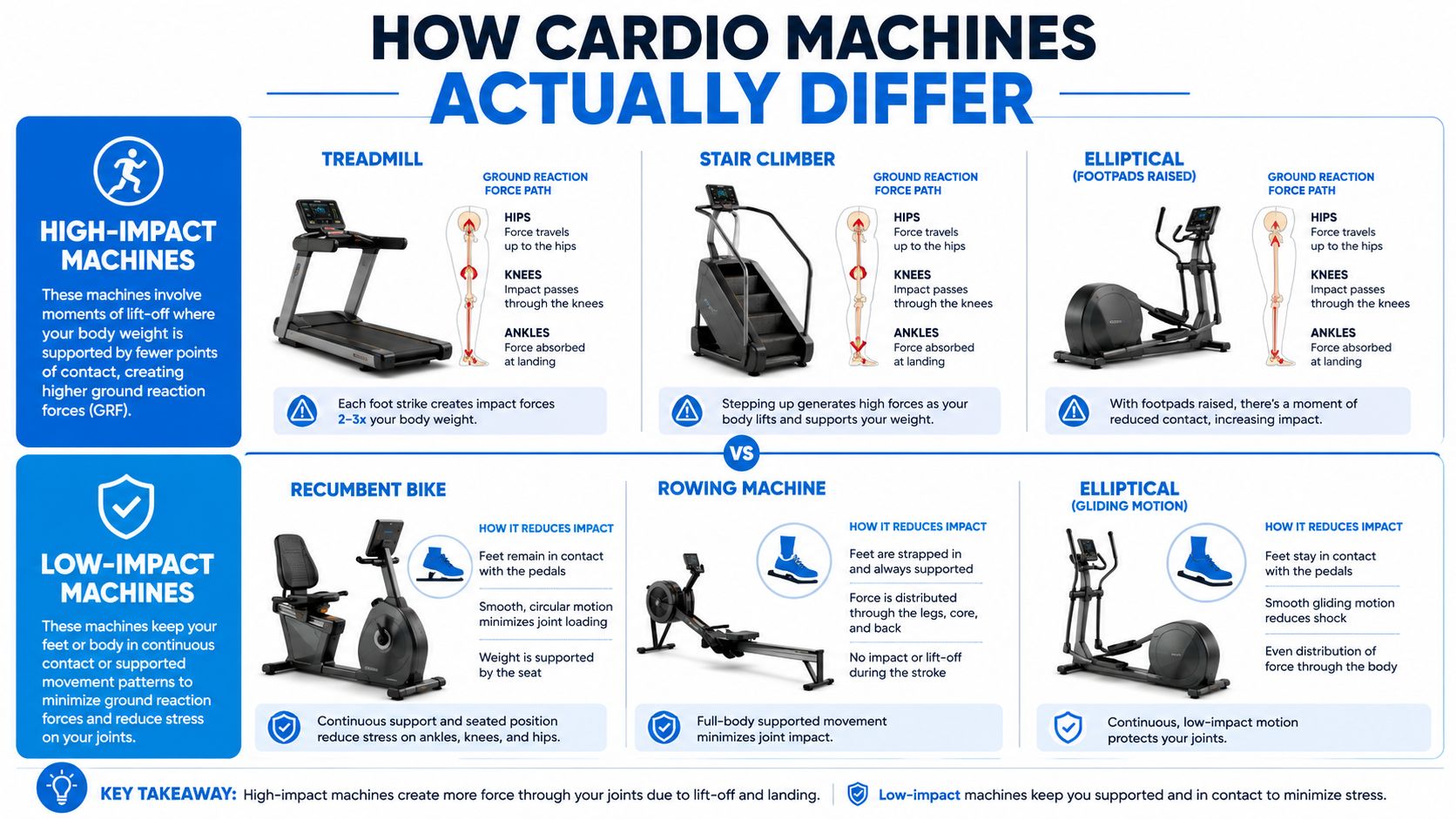
The better question is simple, what kind of stress do you want the session to create? Impact, muscle recruitment, and energy cost all change from one machine to the next. A treadmill feels close to natural running or brisk walking, but it also sends ground forces through the ankles, knees, and hips. A bike feels smoother and easier on the joints, but it shifts most of the work to the lower body. A rower adds the upper body and trunk, so the effort feels more global. An elliptical lands somewhere between running and cycling, with less impact than a treadmill but more whole-body involvement than a bike.
That's why “best” is the wrong starting point. The right machine depends on whether you want to protect sore joints, challenge conditioning, fit cardio around lifting, or build a habit you can consistently keep. Cardio only helps if you can repeat it consistently.
Practical rule: pick the machine that lets you train hard enough to matter, but not so hard that you dread coming back.
There's also a long-term angle. The cardio equipment market is a multi-billion-dollar category with durable demand from both commercial gyms and home users, with estimates ranging from USD 14.86 billion in 2024 to USD 24.93 billion by 2035 and from USD 17.85 billion in 2024 to USD 28.90 billion by 2032 (Market Research Future). In plain language, these machines aren't trendy accessories, they're core training tools that keep getting replaced, upgraded, and improved.
How Cardio Machines Actually Differ
Impact changes the cost to your joints
The biggest divider is whether the machine puts you in repeated contact with the ground. On a treadmill, every step creates impact that travels through the foot, ankle, knee, and hip. That's not bad, it's just a different stress profile. It's the reason treadmills feel more like real running or walking and why they can feel rough on sore joints or a deconditioned lower body.
Bikes, rowers, and most ellipticals reduce that pounding. You still work hard, sometimes very hard, but the movement stays smoother and the landing forces are lower. That matters if your knees are cranky, if you're coming back from a layoff, or if you want cardio that doesn't fight your strength training.
Muscle recruitment changes what gets tired first
The second divider is which muscles do the work. A bike is mostly a lower-body tool. Your quads, glutes, and calves take the lead, while your upper body stays mostly along for the ride. A stair climber also leans heavily on the legs, especially the quads and glutes.
A rower and many ellipticals ask more from the whole system. On the rower, the legs drive, the back and arms finish the stroke, and the trunk keeps you organized. The elliptical uses the arms and legs together too, though the feel is less forceful than rowing. That means the machine doesn't just train “cardio,” it decides whether you're also loading the upper body and core.
The treadmill sits in its own category because it can be adjusted to either walk or run, steady or hard, flat or incline. A controlled comparison of 10 indoor cardio machines found that treadmill and stepmill work produced the highest heart-rate responses at matched perceived exertion, while the elliptical sat in the next tier, and heart rate varied by as much as 46 bpm at the same RPE across devices (Core Health & Fitness). That's the clearest proof that two sessions can feel similarly hard and still deliver very different cardiovascular loads.
The Five Core Machines Worth Knowing
Treadmill
The treadmill feels the most natural if you already walk, jog, or run outside. It's easy to understand, easy to measure, and easy to progress with speed or incline. That's why it's such a reliable choice for beginners who want a direct carryover to outdoor running or brisk walking.
The downside is impact. The body has to absorb repeated footstrike, so treadmill work can feel demanding on the ankles, knees, and hips, especially if the stride gets sloppy or the speed gets ahead of technique. It's also not the best machine for casual sprinting unless the user understands how to control the belt and keep posture stable.
Bike
A stationary bike is the safest bet for many people who want steady work without joint pounding. Upright bikes feel more like a standard gym ride, while recumbent bikes give you a backrest and a more supported position. Both let you push the heart and legs without the same landing stress as a treadmill.
The tradeoff is that the bike is less versatile. It mainly trains the lower body, and upright models can tempt people into poor posture if the seat or handlebar setup is off. Still, for controlled aerobic work, the bike is hard to beat.
Rower
The rower is the machine many underestimate. It looks simple, but a good stroke asks the legs, hips, back, arms, and trunk to work in sequence. When the technique clicks, it feels powerful and efficient. When it doesn't, it can expose fatigue fast.
That's also the rower's biggest caution. Poor mechanics can annoy the lower back, and the machine rewards good rhythm more than brute force. For members who want a serious conditioning hit without jumping, it's one of the strongest options on the floor.
Elliptical
The elliptical lands in the “harder than it looks” category. It feels smooth and joint-friendly, which makes it welcoming for beginners, returning trainees, and people who don't want impact. The gliding path also helps people keep moving longer without the repeated collision of running.
The catch is that it can underwhelm athletes who want to produce more force. Because the motion is guided, it may not feel as demanding as it is until the breathing rate climbs. That's useful for recovery sessions, but less exciting for people chasing maximal power output.
Stair Climber
The stair climber is brutally honest. It biases the quads and glutes, keeps the upper body out of the way, and makes your breathing work fast. For anyone who wants lower-body conditioning without running, it delivers.
The tradeoff is obvious once you've used it. It feels intense quickly, and the limited upper-body involvement means it's not a whole-body conditioning tool in the same way a rower is. It's a great fit for focused leg endurance, but not everyone wants that kind of burn.
Cardio Machine Comparison: Pros, Cons, and Best Fit | |||
|---|---|---|---|
Machine | Muscle Focus | Joint Impact | Best For |
Treadmill | Legs, especially calves, quads, glutes | Higher | Walking, running, incline work, familiar gait practice |
Bike | Quads, glutes, calves | Low | Joint-friendly steady work, intervals, recovery days |
Rower | Legs, back, arms, core | Low to moderate | Full-body conditioning, compact hard sessions |
Elliptical | Legs with arm involvement | Low | Beginner-friendly cardio, longer smooth sessions |
Stair Climber | Quads, glutes | Moderate to high | Lower-body conditioning and climbing-specific work |
Coach's note: the machine that feels easiest at minute one isn't always the one that recovers best for minute thirty.
Matching Equipment to Your Training Goal
Weight loss is about the right kind of demand
If the goal is fat loss, the machine has to create enough work to matter without burning you out so badly that you stop showing up. Treadmills and rowers usually do that well because they can raise breathing and heart rate quickly when you're honest about pace and resistance. The point isn't a magical calorie number, it's repeatable effort that you can sustain across weeks.
A practical cue is simple. Work at a pace where talking is possible, but just a little broken up, then let the machine settings do the work. On a treadmill that might mean incline. On a rower, it might mean stroke rate. On a bike, it's resistance.
Endurance, recovery, and concurrent lifting need different tools
For endurance, treadmills and bikes are easy to pace because speed and resistance are straightforward to monitor. Steady work on those machines translates well to heart-rate-based training and longer aerobic sessions. If you're building an engine while still lifting, bikes and ellipticals usually interfere less with the legs than hard treadmill work.
Recovery sessions should feel like work, but not like punishment. Low-impact machines are the right fit here because they let blood move, breathing settle, and joints stay quiet. The effort should stay controlled enough that you leave better than you arrived.
Simple intensity guide: easy zones should let you talk in short sentences, harder aerobic work should push past that comfort, and threshold work should use controlled ramps of effort rather than a sudden sprint.
The best machine is the one that supports the goal without stealing from the next one. A lifter who wants conditioning before squats usually needs less leg fatigue, not more. A person who wants general endurance can use more treadmill and bike work because the pacing is easier to manage.
Cardio Machine Match by Training Goal | ||||
|---|---|---|---|---|
Goal | Primary Machine | Secondary Option | Stimulus | Joint Impact |
Weight loss | Rower | Treadmill | Higher breathing demand and sustained effort | Low to moderate |
Endurance | Treadmill | Bike | Steady pace control and repeatable heart-rate work | Moderate |
Recovery | Bike | Elliptical | Light circulation and low strain | Low |
Joint-friendly training | Bike | Seated rower | Cardio without repeated footstrike | Low |
Concurrent strength | Elliptical | Bike | Conditioning with less leg fatigue before lifts | Low |
Building a Weekly Cardio Program Around Strength Training
A smart week puts the hard work where it does the least damage to the next session. If lower-body lifting matters, don't bury your squats under hard stair-climber intervals the night before. Put easier cardio after lifting, or on separate days, so your legs can recover.
A clean template looks like this. Monday pairs a lower-body lift with an easy bike cooldown. Tuesday uses 25 minutes of treadmill work at a steady pace. Wednesday stays upper-body only. Thursday becomes a rower interval day with hard efforts and equal recovery. Friday is full rest. Saturday combines a compound lift with an elliptical finisher. Sunday stays open for walking or mobility.
The order matters because fatigue follows the legs. Hard leg-dominant cardio before squats tends to flatten depth, reduce bar speed, and make the session feel heavier than it should. Post-lift cycling is useful because it lets you move without adding extra pounding.
The week below keeps the stimulus clear:
Monday: lower-body lifting, then an easy bike cooldown
Tuesday: steady treadmill work
Wednesday: upper-body lifting only
Thursday: rower intervals
Friday: full rest
Saturday: compound lift, then elliptical finisher
Sunday: optional walk or mobility
For the interval day, keep the hard efforts short and controlled. For threshold work, use a 3 to 5 minute ramp-and-hold pattern instead of jumping straight to top speed. For aerobic power, 60 to 90 second hard efforts make sense because they're long enough to matter without turning into sloppy survival mode.
If strength training is part of the plan, the logic behind that setup is even clearer when you look at why consistency in lifting matters. Cardio works best when it supports, not competes with, the rest of the week.
Tradeoffs Most Cardio Guides Skip Over
A machine can be perfect on paper and still be wrong for the room it lives in. That's why noise, footprint, maintenance, and power draw deserve attention before the purchase. People who live upstairs, share walls, or train early in the morning learn this fast.
Recent buyer guidance puts stationary bikes around 40 to 55 dB, ellipticals around 50 to 60 dB, magnetic rowers around 55 to 65 dB, and treadmills often above 70 dB because footstrike adds structural noise (GymPros). The difference isn't just annoying, it changes whether the machine gets used consistently. A loud treadmill in an apartment usually sees less real-world use than a quieter bike.
Ownership costs show up in more than the sticker price
Maintenance matters too. Belts, decks, flywheels, leveling, and lubrication aren't glamorous, but they determine whether the machine still feels good a year later. Touchscreens and streaming apps can make a machine feel premium, but they don't automatically make it more durable. Heavy frames and commercial-grade parts usually cost more up front and tend to be easier to trust over time.
Energy use is another overlooked piece. Treadmills can draw much more power under load than bikes, which is one reason they're the most demanding machines to own in a home setting. Warranties also deserve a close read, because a long frame warranty doesn't mean the electronics are covered for very long.
If you want a broader discussion of equipment tradeoffs and buying priorities, the same logic applies in this guide to kettlebell selection and fat-loss work. The tool has to fit the room, the budget, and the way you train.
Cardio Equipment Tradeoffs Comparison | |||||
|---|---|---|---|---|---|
Equipment | Avg Noise (dB) | Footprint | Maintenance | Energy Use | Notable Tradeoff |
Treadmill | Often above 70 | Large | Belt and deck care | High under load | Great training carryover, loud and space-hungry |
Bike | 40 to 55 | Smaller | Seat, resistance, and drive checks | Lower | Quiet and joint-friendly, less whole-body work |
Elliptical | 50 to 60 | Medium to large | Moving arms, rails, and pedals | Moderate | Smooth motion, but can feel less forceful |
Rower | 55 to 65 | Medium | Chain, rail, and handle care | Lower | Full-body training, technique matters more |
Stair Climber | Varies, often moderate | Large | Steps and motor system | Moderate to high | Big leg stimulus, can be intimidating and bulky |
Your Next Step on the Gym Floor
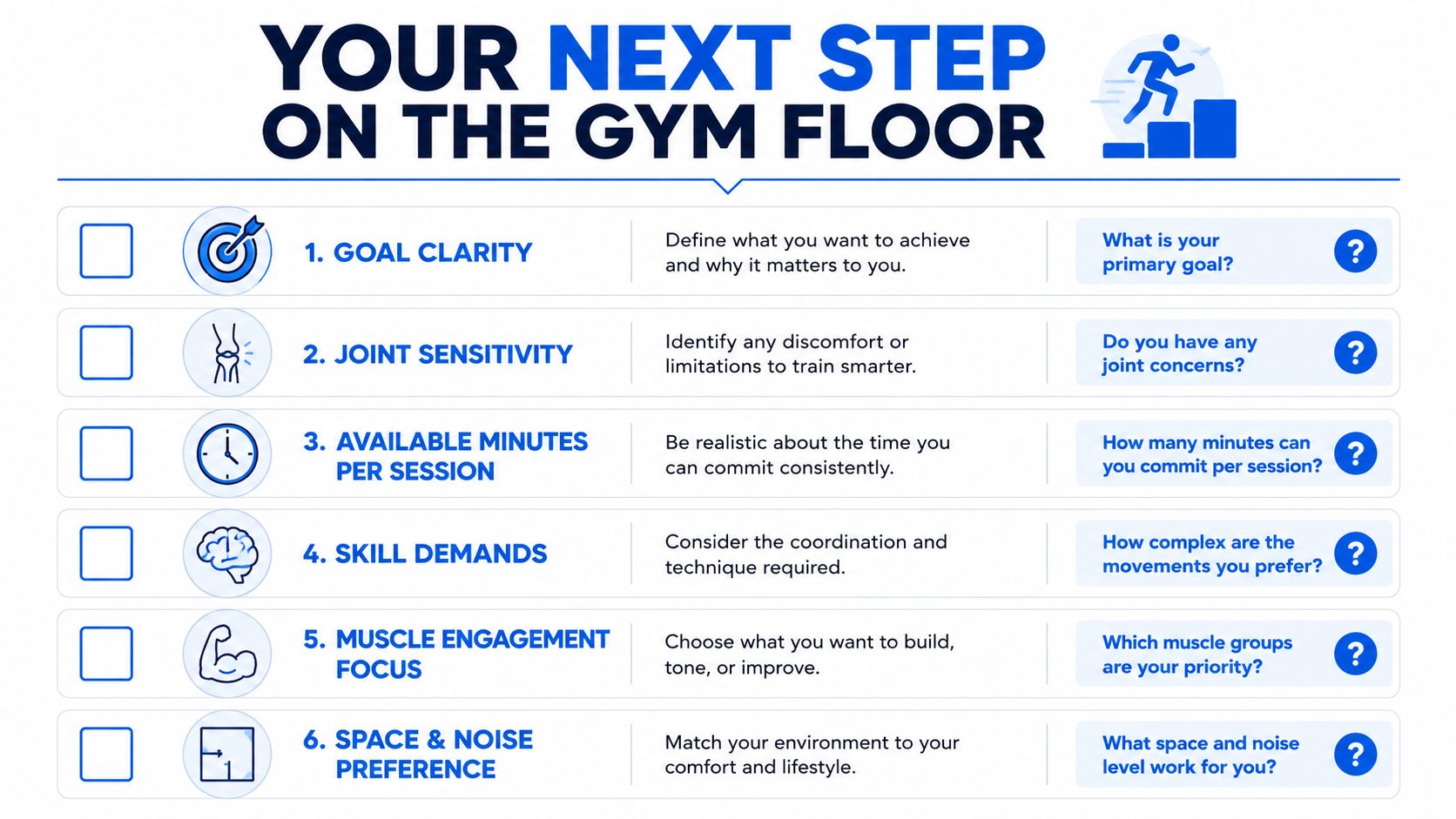
A good decision comes from testing, not guessing. Walk onto the gym floor with a short checklist and try at least three machines before you decide which one deserves a slot in your week. Adjust the seat height, stride length, or damper setting before judging the machine itself, because bad setup can make a good machine feel wrong.
Use this six-point filter:
Goal clarity. What are you trying to improve, fat loss, endurance, recovery, or conditioning around lifting?
Joint sensitivity. Does impact bother your knees, hips, ankles, or back?
Available minutes per session. Do you need a fast burst or a longer steady session?
Skill demands. Can you row well enough to keep the back happy?
Muscle engagement focus. Do you want legs only or more whole-body work?
Space and noise preference. Will this machine live in a home, apartment, or busy gym?
Track heart rate or perceived exertion during each trial so you compare effort fairly. If you're buying for home, photograph the display and footprint before you forget what felt comfortable. If the rower feels promising but awkward, ask a staff member for a five-minute orientation and try again one week later.
For a little motivation before your next session, pair the trial with songs that actually help the gym feel easier to start. Then leave with a ranked shortlist, not a random guess.
If you're in Central Massachusetts and want cardio equipment, strength training, and coaching that help you choose the right stimulus instead of just chasing sweat, visit Empire Athletics and take a look around. You can train on your schedule, get guidance that fits your goals, and use a gym setup built for real progress.