Gym Membership No Contract: What to Check Before You Sign
Gym membership no contract explained: month-to-month terms, hidden fees, cancellation rules, break-even costs, and how to compare 24/7 gyms.

Most guides tell you to skip the contract. Pick a gym membership no contract, they say, and you can walk away whenever you want. That advice stops one sentence too early. The label describes how long you are committed, not how you leave, and not whether the higher monthly price pays for itself.
If you train all year on a steady schedule, a cheaper fixed term can cost less. If your hours swing, or you are still testing a gym, flexibility can be the better buy, but only after you run the numbers and read the cancellation rules. Treat the signup sheet the way you would a phone bill. The monthly price is the headline. The notice rule and the next charge date are the part that decides what you owe.
What No-Contract Gym Membership Really Means
A no-contract gym membership can still be difficult to leave. The label describes the length of your commitment, not the cancellation process or the cost of using the gym. Usually, you pay each billing cycle, often monthly, and the membership continues until you cancel. There is no signed minimum term, such as six or twelve months.
The distinction is like the difference between a phone plan billed month by month and a device contract that commits you for a set period. In both cases, stopping use does not automatically stop the charges. A gym may require advance notice, a written cancellation request, or cancellation before a billing cutoff, so a missed deadline could trigger another payment.
“ No annual commitment,” “month-to-month billing,” “no initiation fee,” and “no cancellation penalty” describe different terms. A gym can offer one without offering the others. Check each promise in the agreement rather than treating “no contract” as a guarantee that cancellation is immediate or free.
What happened to the FTC's Click-to-Cancel rule
The Federal Trade Commission issued its Click-to-Cancel rule in October 2024. It covered many negative-option programs, where a membership or service continues billing unless the customer cancels, as described on the FTC Negative Option Rule page. The rule addressed disclosures, consent, misleading claims, and cancellation methods. However, the Eighth Circuit vacated it in July 2025, so it is not currently in force.
For a gym membership, use the signed contract and applicable state rules to understand your rights and duties. The FTC can also enforce the general FTC Act against unfair or deceptive practices, but the vacated rule should not be treated as a current cancellation requirement. The practical takeaway is to read the gym's actual terms and keep a copy of what you agreed to.
A true month-to-month plan generally continues until you cancel under its stated process. A fixed-term agreement may require payment for the agreed period even if you stop going. The terms below help separate commitment length from other charges and access rules.
Term | What It Means | What to Confirm |
|---|---|---|
Minimum term | No signed term longer than one billing cycle | Whether any 6- or 12-month term exists |
Month-to-month billing | Charges repeat each cycle until you cancel | Billing date and renewal rules |
Initiation fee | One-time charge to join | Whether it is waived or charged at signup |
Cancellation fee | Charge for ending the membership | Whether a fee applies to this plan |
Membership freeze | Pause billing during travel or injury | Maximum length and whether a fee applies |
24/7 access | Entry at any hour | Whether access covers every location |
Practical rule: Match each row to the paperwork before signing. Ask the gym to confirm the billing date, renewal rule, and any fees in writing. If one is missing, request clarification before you join.
No-Contract Versus Fixed-Term Plans Side by Side
Plan Type | Commitment | Typical Joining Cost | If You Leave Early | Best Fit |
|---|---|---|---|---|
Month-to-month | Ends when you cancel | Often none, or a low one-time fee | Ends after notice, before the next billing date | Irregular schedules and testing a gym |
6-month fixed term | Locked for six months | Varies by gym; get the fee in writing | Payments usually continue to the end of the term | Committed users who want a lower rate |
12-month fixed term | Locked for 12 months | Often a one-time enrollment fee | Payments usually continue, and extra fees may apply | Year-round daily users |
Day or visit pass | Pay per visit | None | Nothing to cancel | Travelers and occasional visits |
The "if you leave early" column matters more than the monthly sticker. A lower rate only saves money if you stay long enough to collect the discount. Leave early on a fixed term and you can keep paying for months you never use.
Why the flexible rate costs more
Hotels do this every weekend. A room you can cancel for free costs more per night than a non-refundable rate. You are paying the hotel for the option to change your mind. Month-to-month gym plans work the same way. The gym gives up a year of predictable dues, so it charges a premium for the right to leave on short notice.
Fixed-term plans flip that trade. You accept a locked window, often six or twelve months, and the monthly price drops. Payments usually continue through the agreed period. An early-exit fee can sit on top of those remaining dues. Auto-renewal is a separate trap. Some agreements roll into another term unless you cancel inside a narrow window, which is why the renewal sentence belongs on your checklist even when the headline says "no contract."
A day pass sits outside both models. You pay for the visit, and there is no membership to end. It is the right tool for a trip or a single trial workout. It gets expensive fast if you train several times a week, because each visit stands alone.
Where a gym won't publish joining costs, treat the blank as a question for the front desk, not as a zero. Ask for the full fee list before you compare two monthly prices that aren't actually comparable.
Pros and Cons of Month-to-Month Gym Memberships
A month-to-month plan can be easier to leave than a year-long commitment, but the label alone does not make cancellation simple. It describes how long you agree to pay, not what steps you must take to stop the next payment. Check the exit process as carefully as the monthly price.

A 2008 Consumer Reports survey asked gym users about their experiences, including billing, facilities, staff, and cancellation. The release reports that members of independent gyms were more satisfied than members of most large health-club chains. It also describes problems consumers encountered with gym memberships, including billing and cancellation concerns. The survey is historical, and it does not show that every month-to-month plan avoids those problems. The Federal Trade Commission's cancellation cases, discussed below, offer a more recent look at why the exit process still deserves attention. 2008 Consumer Reports gym survey release
What you gain
No lock-in: If work, family, or a move changes your routine, you are not committed to paying for the rest of a long term.
A real test: A month or two can show whether the location, equipment, crowd, and hours fit your life before you take on a longer commitment.
A clearer pause option: If the gym offers a membership freeze, check its rules and fee. A stated pause process can make travel or an injury easier to manage.
Room for changing schedules: Flexible access may suit shift workers whose training times change from week to week.
What you give up
A higher monthly rate: A flexible plan often costs more each month than the same gym's lowest fixed-term rate.
Promotions with conditions: A waived joining fee may come with a notice deadline or other requirement. Read the terms before signing.
A cancellation task: You may still need to give notice in a specific way or by a particular date. Missing that window can trigger another billing cycle.
Less structure: A long commitment can encourage regular attendance. A flexible plan leaves that choice with you.
The practical test is whether you can explain the exit steps before you join. Ask how to cancel, when notice is due, and when billing stops. These details determine whether the plan's flexibility works when your schedule changes.
Someone who benefits from outside structure may prefer a committed training block or scheduled sessions. A flexible membership can help manage costs when your routine is uncertain, but it cannot supply the routine itself.
When a No-Contract Plan Costs Less Over a Year
A no-contract label describes how long you commit, not how easy it is to leave. Compare the cancellation rules alongside the price: a plan that charges month by month may still require notice, while a fixed term may keep billing after you stop going. The worksheet below shows how usage and cancellation terms shape the total.
Use sample prices, then replace them with written quotes. Here, the no-contract plan costs $40 per month. The 12-month plan costs $30 per month plus a $99 enrollment fee. These are examples, not quotes from a specific club.
Scenario | Calculation | Total Cost |
|---|---|---|
Month-to-month, all 12 months | 12 × $40 | $480 |
12-month fixed term, full use | (12 × $30) + $99 | $459 |
12-month fixed term, stopped after 4 months | Payments continue through the term | $459 |
Month-to-month, 4 high-use months only | 4 × $40 | $160 |

Where the two plans meet
The fixed plan's $459 equals about 11.5 months at the flexible rate: 11.5 × $40 is $460. Use the gym for nearly the full year, and the fixed plan is cheaper by $21, at $459 versus $480. If you stop after four months, however, the fixed-term total can remain $459, while four months on the flexible plan cost $160. Your actual break-even point depends on how many months you pay, not just the monthly rate.
Joining only during the months you train gives a simple calculation: multiply the monthly rate by months used. Check the cancellation notice period before treating unused months as savings. A notice rule may add another billing cycle, and a freeze may still carry a fee or continue dues. Add those charges to the comparison. Keep personal training and café purchases separate from membership costs.
Who should run this worksheet
The figures offer market context, not evidence about why members choose multiple facilities. U.S. facility memberships reached 104.7 million in 2024, up 3.9% from the year before, and 27.3% of members held memberships at more than one facility type, according to the Health & Fitness Business buyers guide. Those numbers do not show which plan saves a particular person money.
Test your own months of use. At these sample prices, the flexible total is lower when you pay for fewer than about 11.5 months. At 12 months, the fixed plan costs less, assuming its stated fees and terms apply. Before deciding, compare written quotes and use a gym membership cost breakdown to check which joining charges are included.
How to Cancel a No-Contract Membership Safely
“No contract” describes the commitment, not how easily you can leave. The cancellation process and your final billing date determine whether the flexibility saves money or creates another charge. In August 2025, the Federal Trade Commission sued gym operators, alleging that they made cancellation difficult by requiring in-person or mail requests, limiting in-person cancellations to specific employees, and continuing charges after customers tried to cancel. The allegations are detailed in the FTC's August 2025 announcement.

If you are a Massachusetts resident, check the state's current health-club cancellation rules before relying on a gym's general policy. Keep your agreement and any state guidance together, and follow the written cancellation instructions that apply to your membership. A deadline is easiest to meet when you mark it on your calendar as soon as you join.
Six steps that close the account
Find the billing date and notice period in your signup paperwork. The cutoff, not your last workout, determines whether another billing cycle starts.
Check the required cancellation channel. Your agreement may accept an online form or email, or require mail or an in-person request. Follow its instructions and keep a copy.
Send notice before the cutoff. Save a screenshot, sent email, or mailing receipt. A phone call is difficult to prove if there is a later dispute.
Request written confirmation that gives your final billing date. A message confirming receipt is not the same as confirmation that billing will end on a specific date.
Keep the agreement, cancellation notice, and confirmation together. They document what you agreed to and when you requested cancellation.
Review your next statements. If a charge appears after the confirmed end date, contact your card issuer to dispute it and provide your records. Replacing the card may not prevent a recurring charge, so do not treat it as proof that the membership ended.
The safest time to check the exit process is before signing. Ask which channel to use, when notice is due, and how the gym confirms cancellation. If the answer is unclear, get the policy in writing. This guide to how to cancel a gym membership can help you prepare, but your own agreement sets the steps for your account.
The clip below shows a member discussing cancellation. Use it to rehearse what to ask, then follow the terms in your contract.
Comparing Local 24/7 Gyms in Central Massachusetts
Run the same checklist on every gym on your shortlist. Empire Athletics is one Central Massachusetts example, with locations in Leominster, Lunenburg, and Webster. The cells below reflect what the operator publishes. Blanks mean the public materials don't settle the point, so ask for it in writing before you sign.
Criterion | What to Check | Empire Athletics (per its site) |
|---|---|---|
Access hours | Whether 24/7 access covers every location | 24/7 member access at all three locations |
Locations | Distance from home, work, or the commute | Leominster, Lunenburg, and Webster |
Equipment | Strength and cardio mix for your goals | Modern strength and cardio equipment |
Coaching | Whether trainers are included or billed extra | Certified one-on-one personal training; session pricing not listed, so ask |
On-site nutrition | Food options before or after workouts | Empire Cafe with coffee, smoothies, and protein shakes |
Member rating | Independent reviews, not only the gym's own site | Site cites 4.7/5; confirm that against outside reviews |
Monthly price and joining fee | Whether no-contract terms apply | Not confirmed in this comparison; request written terms |
Freeze or pause policy | Length allowed and any cost during an absence | Not confirmed here; request the written policy |
Cancellation method | Written, online, or in-person requirement | Not confirmed here; request the method and the notice period |
Rows that change the decision
Shift workers and busy professionals should start with the access row. Around-the-clock entry only helps if it covers the building you can reach after a late shift. Beginners should start with the coaching row. Certified one-on-one training is useful only if you know whether sessions are included or billed on top of dues. The site also cites more than 20 years of combined trainer experience. That figure comes from the operator itself, so weigh it alongside independent reviews rather than instead of them.
Price, freeze rules, and the cancellation method are the gaps. A polished floor plan doesn't answer them. Ask for a one-page summary that names the monthly rate, any joining fee, the freeze length and fee, and the exact way you cancel. Then run this same table on a second gym. Two columns beat one sales conversation. If you are sorting options around the Leominster commute, a local look at gyms in Leominster gives you a second list to score with the same questions.
Choose the Plan That Fits Your Schedule
The right plan follows your calendar, not the boldest discount on the rate card.
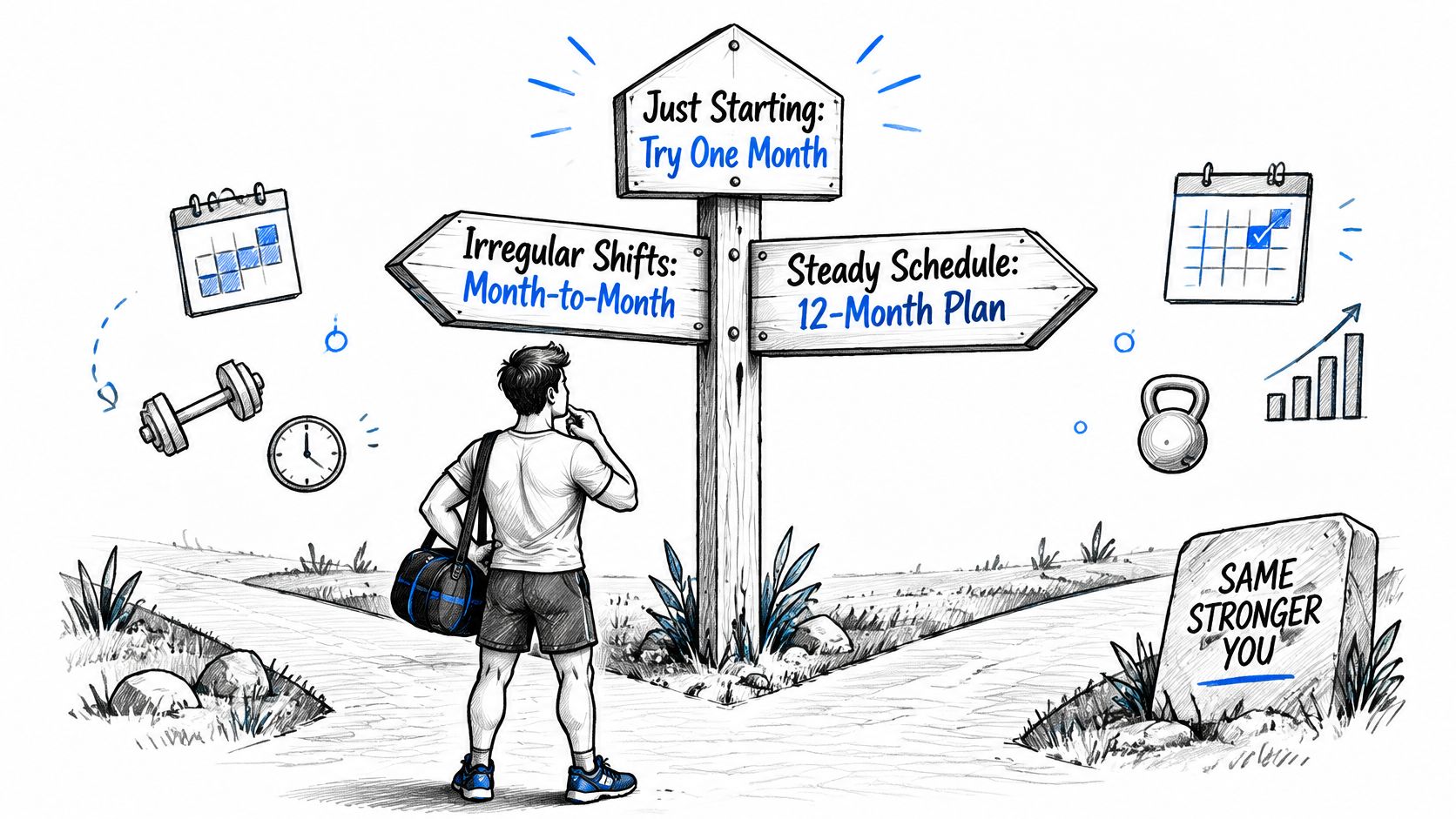
Irregular or shift schedule: Stay month to month, and favor 24/7 access. You pay while you attend, and you stop when the rotation changes.
Beginner testing consistency: Give it two or three months before you consider anything longer. You are buying information about your own habits.
Year-round daily user: Take a fixed term only when its annual total beats the flexible total. In the sample worksheet, that crossover sat near 11.5 months.
Seasonal or temporary stay: Use month to month, or a day pass, and get any freeze terms in writing before you leave town.
Needs outside accountability: Pair a no-contract membership with a set number of trainer sessions. You get a schedule without a year-long dues lock.
A short list you can finish this week
Shortlist two gyms you can reach from home or from work, not five you might visit someday.
Request written pricing, including joining fees, freeze rules, and the cancellation method.
Run one trial month at the hours you would usually train, including a late or early visit if that is your real schedule.
Put the billing date and the cancellation deadline in your calendar the day you join.
If the second gym won't put the exit rule in writing, you already learned something, and it didn't cost you a year.
Do that sequence before you compare slogans. The plan that fits is the one whose total, and whose exit, you can explain without opening the brochure.
Empire Athletics runs 24/7 gyms in Leominster, Lunenburg, and Webster, with strength and cardio equipment, certified one-on-one training, and an on-site cafe for coffee, smoothies, and protein shakes. If you are weighing a month-to-month membership against a longer term, ask for the billing date, the freeze rule, and the cancellation steps in writing before you decide. Visit Empire Athletics to check locations and request those terms.