How Long Does It Take to See Gym Results: Realistic Timeline
How long does it take to see gym results? Here's a realistic timeline based on your fitness level and training frequency.

Strength can improve within 2–4 weeks, visible muscle changes generally take about 2–3 months, and fat loss depends heavily on nutrition, so there's no single deadline for gym results. Treat promises of a complete six-week transformation as marketing, not a personalized training forecast.
The better question is whether you're improving at the outcome you care about. Lifting more, changing your waist measurement, and moving comfortably aren't interchangeable achievements. You need a different yardstick for each.
Why One Universal Gym Timeline Does Not Exist
A fixed results date sounds reassuring until you ask what's supposed to happen by then. A heavier squat? More defined shoulders? Less effort climbing stairs? A smaller waist?
Those goals require different adaptations. Strength, muscle size, body composition, endurance, and mobility aren't the same result, even when you train for several together. Judging all of them by a bathroom mirror makes useful progress easy to miss.
Choose the result before choosing the deadline
Start with a goal you can describe without saying “get in shape.” That phrase doesn't tell you what to train, what to record, or whether your program is working.
Instead, choose a primary outcome and a supporting measure:
Strength: Improve a familiar lift while maintaining the same range of motion and technique.
Muscle development: Look for sustained changes in shape and circumference, rather than how you look immediately after training.
Fat loss: Evaluate body-weight trends alongside waist measurements and food habits.
Endurance: Compare how you perform a repeatable cardio session.
Mobility: Track comfortable, controlled movement in a specific task.
You can pursue more than one goal. Just don't change the definition of success whenever a different measurement disappoints you.
Practical rule: Decide what counts as progress before you start checking for it.
Don't confuse effort with evidence
Sweating, soreness, and exhaustion aren't the measurements I'd use to judge a beginner's program. I'd rather see a record showing what you did and whether you performed it better.
That approach also gives you a sensible way to make adjustments. If lifting performance improves but your waist measurement doesn't change, you haven't proved the entire program failed. You've identified which outcome needs closer attention.
Ask, “How long does it take to see gym results?” only after finishing this sentence: “The result I want most is…” Your answer determines both the timeline and the evidence worth collecting.
How the Body Actually Changes in the First Three Months
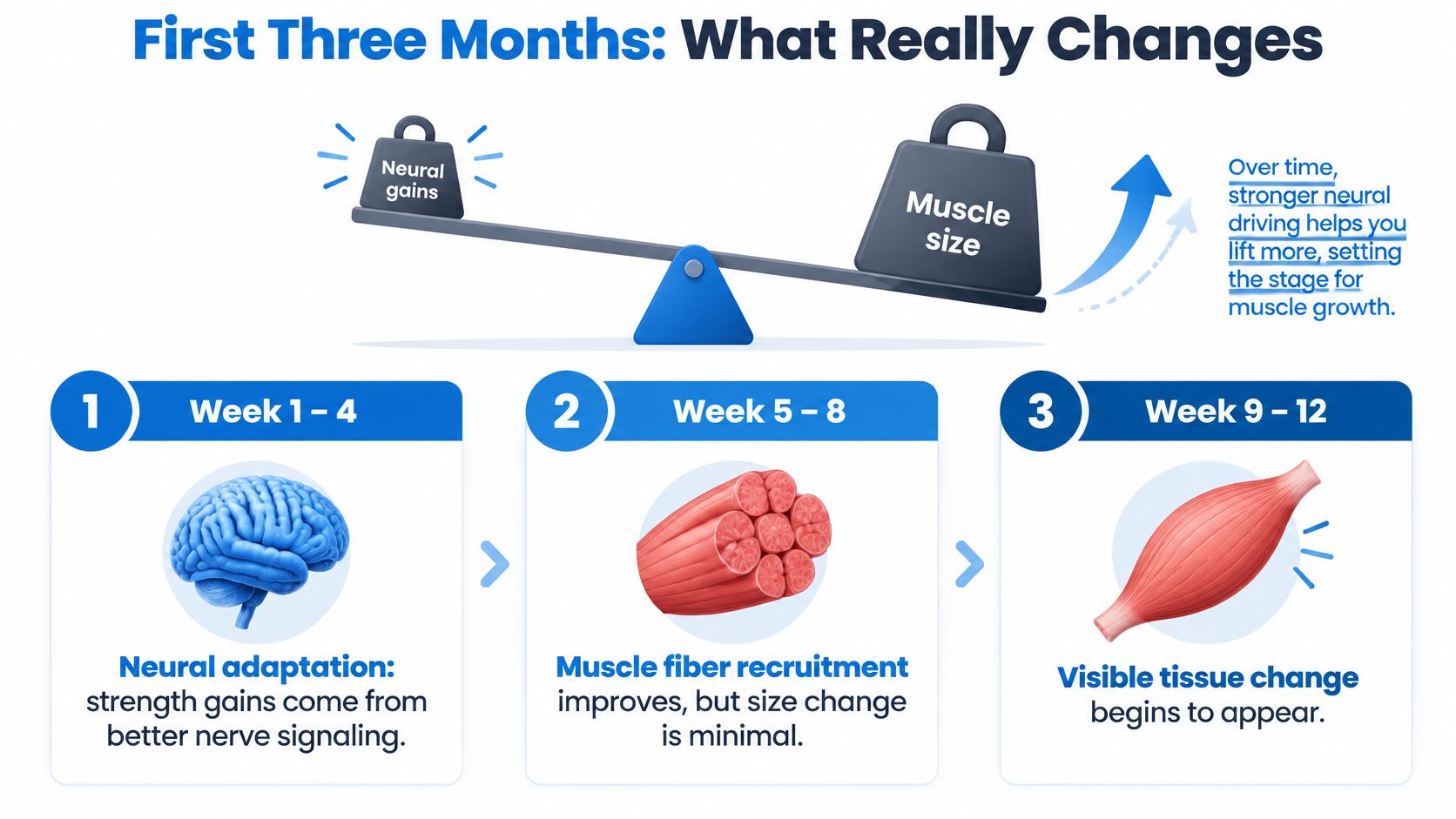
Your body can become better at an exercise before it becomes visibly more muscular. That's the distinction beginners need before judging an early training block.
During the first 2–4 weeks, strength improvements are primarily associated with neural adaptations, including better motor-unit recruitment and changes in recruitment thresholds and discharge rates, as described in this review of early neuromuscular adaptations to resistance training. In plain English, your nervous system gets better at using the muscle you already have.
Better operation before a bigger engine
Think of lifting as operating a lever. Learning where to place your hands, how to brace, and how to coordinate the movement can make the same load easier to move. You haven't necessarily built a larger machine; you've become a more capable operator.
That improvement is real. Don't dismiss it because it doesn't photograph well.
The distinction between early performance gains and later size changes is illustrated below.
In a 16-week study, previously untrained older adults completed three 40-minute resistance-training sessions weekly, with average upper-body strength increasing 39% and lower-body strength 167%; statistically significant improvements were detectable at the 4-week assessment in the resistance-training study of older adults.
Those results aren't a personal forecast. They came from a specific population, training intervention, and measurement method. Their practical value is that they demonstrate why performance can improve before appearance changes.
Tissue change needs a different assessment window
A review of resistance-training adaptations describes early changes as predominantly neural and places measurable morphological adaptations at approximately 8–12 weeks, treating 8 weeks as a reasonable minimum for evaluating hypertrophy.
That doesn't mean your body follows a switch-flipping schedule. It means you shouldn't use an early photograph to dismiss a process that needs a longer evaluation period.
Keep the movement comparable: A heavier lift with shortened range of motion isn't a clean comparison.
Recognize the temporary pump: Looking fuller after training isn't proof of lasting muscle growth.
Separate skill from size: Better exercise execution is worthwhile even before you can establish hypertrophy.
Patience isn't permission to train aimlessly. It's permission to assess the right adaptation at the right time.
Realistic Milestones for Strength, Muscle, Fat Loss, Endurance, and Mobility
Use timelines as assessment windows, not delivery dates. Your program still has to match the outcome, and attendance alone doesn't tell you whether the training provides an appropriate challenge.
The table below deliberately leaves some deadlines open. A precise-looking number isn't helpful when there isn't adequate support for it.
Expected Gym Results by Goal
Outcome | First Noticeable Change | Meaningful Change | Key Measurement |
|---|---|---|---|
Strength | Better control and improving exercise performance | Sustained progress across comparable sessions | Load, repetitions, technique |
Muscle | Subtle changes in fullness or definition | Persistent shape or circumference changes | Standardized photos and measurements |
Fat loss | A sustained downward trend, not an isolated weigh-in | Progress toward an individualized weight-management goal | Weight trend and waist circumference |
Endurance | Familiar activity feels more manageable | Better performance at comparable effort | Repeatable cardio task |
Mobility | More comfortable control in a chosen movement | Greater usable movement that carries into training or daily tasks | Consistent movement assessment |
Strength requires repeatable practice. Keep enough exercises stable to learn them and evaluate them. Constantly replacing movements makes it difficult to distinguish improved strength from differences between exercises.
Muscle development requires more than heavier numbers. Use the tissue-change window established earlier, then look for changes that remain apparent outside the immediate post-workout period. Don't demand that a circumference measurement identify exactly how much new muscle you've built.
Give fat loss its own target
The verified guidance from the U.S. National Institute of Diabetes and Digestive and Kidney Diseases recommends targeting 5–10% of starting body weight over 6 months. That's a weight-management framework, not a promise that every pound lost will be body fat or that exercise alone will produce the target.
For that goal, food intake needs the same attention as gym attendance. If you track workouts carefully but leave eating habits completely unexamined, you're evaluating only part of the plan.
Don't invent deadlines for endurance or mobility
For endurance, use a familiar cardio task and compare performance under similar conditions. For mobility, choose a specific limitation, such as comfortable squat depth or a controlled overhead reach, rather than a vague intention to become flexible.
There isn't a defensible universal mobility deadline in the evidence presented here. Record what changes instead of borrowing an unsupported week range.
A useful milestone tells you what improved and how you know. A deadline without a measurement is just a date.
Choose a sustainable training schedule with the help of this guide to how many days a week you should lift weights. Then judge the schedule by completed, purposeful sessions, not by how ambitious it looked when you wrote it.
The Factors That Speed Up or Stall Your Progress
Before adding more training, check whether your existing routine is coherent. My recommendation is to fix inconsistent execution before chasing a more demanding program.
Use the comparison below as a reminder to examine your whole routine, not as a judgment about anyone's appearance.

Make your training repeatable and challenging
A productive routine should let you answer straightforward questions. Which exercises are you practicing? What makes them appropriately challenging? When will you increase the demand?
Compare these approaches:
Planned progression: You record the work and adjust when you can perform it with consistent technique.
Random difficulty: You choose whatever feels exhausting and have no clear basis for the next session.
Sustainable attendance: You schedule training around obligations you have.
All-or-nothing attendance: You abandon the week because your preferred workout wasn't possible.
For a busy parent or shift worker, the sustainable option may look less impressive on paper. I'd still choose it over a demanding schedule that repeatedly collapses.
Match food and recovery habits to the goal
Review protein intake and total food intake together. If muscle development is the priority, don't treat nutrition as an afterthought. If fat loss is the priority, don't assume a difficult workout settles every food decision.
Use this guide to how much protein you need to build muscle to make your eating plan more deliberate rather than improvising after training.
Also record sleep quality, unusual stress, and how recovered you feel. I recommend using that context when interpreting a poor session, rather than immediately deciding you need a new program.
The following video is an additional resource alongside your written training plan.
Your starting point matters, too. Previous training experience, age, and current capabilities belong in the programming discussion, not in a comparison with someone else's progress photo.
Adjust the routine to your life before blaming your body. That means choosing manageable session lengths, keeping useful records, and asking for coaching when you can't identify the reason for a stall.
How to Measure Progress When the Mirror Has Not Changed
Cleveland Clinic describes a layered timeline: performance and endurance may improve within 3–4 weeks, slight definition may appear after 2–3 months, and obvious frame changes may take 4–6 months, according to its guide to how long building muscle takes. That's a reason to collect different kinds of evidence, not to turn each range into a guarantee.
Use a notebook, a phone spreadsheet, or a training app you'll maintain. The tool matters less than recording comparable information.
Match the measurement to the claim
The checklist below helps standardize your observations.

For strength: Record load, repetitions, range of motion, and exercise setup. Note whether the final repetitions stayed controlled.
For appearance: Keep lighting, camera position, posture, clothing, and timing consistent. Don't compare a relaxed baseline photo with a posed post-workout image.
For circumference: Measure the same anatomical location with the same tape placement. Avoid pulling the tape tighter to produce a preferred result.
For body weight: Use consistent conditions and examine the trend. A single reading can't establish a change in body fat.
Record function separately from appearance
For endurance, repeat a familiar cardio task and note both performance and perceived effort. Changing the machine, resistance, and task every time weakens the comparison.
For mobility, document the same movement from the same position. Record comfort and control as well as range; reaching farther through compensation isn't the same as improving the movement you intended to assess.
Measurement check: Ask what the observation proves, and what it doesn't. A smaller waist doesn't quantify muscle gain, and a heavier lift doesn't establish fat loss.
Keep subjective energy in a separate field. It's useful context, but it shouldn't replace performance records or be forced into a body-composition claim.
The aim isn't to collect endless data. It's to collect enough reliable information that you can make a sensible decision instead of reacting to today's reflection.
What Actually Happens When Consistency Breaks
Consider a hypothetical shift worker who builds a dependable routine, then faces a work crunch and misses training. They return worried that every previous session has been wasted.
I wouldn't begin by asking them to prove they can still lift their old working weights. I'd ask what changed during the interruption, how they feel now, and which movements they can perform confidently.
A break isn't evidence that every benefit disappeared
A 2025 report in European Heart Journal Supplements found that body-composition improvements after a resistance-training intervention were no longer statistically significant at one year, while improvements in strength, mobility, and balance remained significant, according to the report on longer-term resistance-training outcomes.
That finding doesn't tell an individual exactly what they retained. It does challenge the assumption that every benefit disappears together or at the same rate.
For our hypothetical returning member, I'd separate the questions:
Current strength: What can you lift with sound technique today?
Current function: Which movements still feel controlled and comfortable?
Current body composition: What do comparable measurements show?
Current capacity to train: What routine fits the schedule you have now?
Restart without turning the session into a test
My recommendation is to reduce initial loads, restore movement quality, and allow a re-entry phase before pursuing previous personal records. Don't use disappointment as a programming method.
Keep the first returning sessions familiar. You need useful information about current capability, not an exhausting demonstration of how committed you feel.
For disrupted weeks, build a fallback routine in advance. That might mean a shorter session built around familiar movements or moving training to an available time rather than cancelling it outright.
Around-the-clock access can help when standard gym hours don't fit your work. It's one scheduling option, alongside home-based sessions or a simplified routine. The aim is continuity that you can maintain, not a perfect attendance streak.
A break calls for reassessment. It doesn't justify treating yourself as either unchanged or back at the beginning.
Your 90-Day Assessment Plan and Next Steps
Use this as a coaching protocol, not a promise that every outcome will arrive by the final checkpoint. Establish your baseline before training begins, then make each review answer a different question.
Record your primary goal, exercise starting points, standardized photos, and relevant measurements. Include your likely scheduling barriers so the plan reflects your real week.
Give each checkpoint a job
The assessment sequence below keeps you from judging every outcome at every check-in.

Day 30, review performance: Compare familiar exercises with baseline. Check technique, completed sessions, and whether your records show a clear progression.
Day 60, review appearance and measurements: Retake comparable photos and circumference measurements. Interpret them alongside the work you completed.
Day 90, review the whole plan: Compare strength, physical measurements, endurance, mobility, and adherence against your chosen goal.
Change the part that isn't working
If performance is improving but appearance hasn't changed clearly, don't automatically replace the training. Review whether you've given that goal an appropriate evaluation window.
If nothing measurable is improving, inspect execution, attendance, nutrition, and recovery before adding more complexity. Adjust the clearest problem, then keep recording the outcome.
A structured 12-week workout program can provide a starting framework. A certified trainer can then tailor exercise selection, progression, and scheduling to your capabilities.
Book an individual assessment if you're unsure what to change. Bring your records rather than relying on memory, and discuss practical pre- and post-workout food options, including convenient cafe choices when available.
Your target is measurable progress toward your goal, not compliance with someone else's transformation deadline.
Empire Athletics offers 24/7 gym access, strength and cardio equipment, and certified one-on-one training in Leominster, Lunenburg, and Webster, making it one option for building a routine around your schedule. Visit Empire Athletics to arrange an assessment, bring your baseline records, and ask about on-site cafe smoothies and protein shakes that fit your nutrition plan.