How Much Protein Do You Need to Build Muscle: A Guide
How much protein do you need to build muscle - Learn how much protein you need to build muscle based on your weight, activity level, and goals in this

For most resistance-trained adults, roughly 1.6 grams of protein per kilogram of body weight per day is a strong target for building muscle. The practical challenge is turning that daily number into meals you can eat, especially when work shifts and training times keep changing.
You may be checking your food log after a hard session and finding that breakfast was mostly coffee, lunch was rushed, and dinner carried nearly all your protein. Or you may be staring at a half-empty tub of powder after chest day, wondering whether your current intake is enough. The answer becomes much simpler once you separate the daily target from the way you distribute it.
Where Most Lifters Start and Why It Often Falls Short
A new lifter often begins with the number printed on a nutrition label or mentioned in a general health class: 0.8 grams of protein per kilogram of body weight per day. That recommendation serves as a general adult baseline, but it isn't designed specifically for someone creating a repeated resistance-training stimulus and trying to add muscle.
A lifter eating at that baseline may avoid a basic shortfall while still giving their body less protein than it can usefully draw on for muscle repair and growth. Training changes the context. Your muscles aren't only maintaining ordinary tissue; they're responding to a deliberate workload that needs recovery resources.
The modern muscle-building target sits higher. The ISSN position stand on protein and exercise recommends about 1.4 to 2.0 g/kg/day for most exercising adults, and the evidence base has increasingly centered around roughly 1.6 g/kg/day for resistance-trained people.
Start with one useful number
Use this as your first working target:
Practical rule: Multiply your body weight in kilograms by 1.6 to get a sensible daily protein goal.
That number isn't a magical threshold. It gives you a clear starting point that fits the evidence and is easy to adjust as your training, calorie intake, and preferences change.
The rest of the process has three parts:
Calculate the total: Turn your scale weight into grams per day.
Distribute the intake: Divide those grams across several protein feedings instead of saving them all for dinner.
Build convenient meals: Use whole foods, shakes, and cafe options when cooking doesn't fit your schedule.
A protein tub can help, but it isn't the plan by itself. Your results depend on the daily pattern you can repeat, alongside progressive resistance training, adequate energy intake, and sleep.
The Science Behind Muscle-Building Protein Targets
A lifter finishing a hard session may eat a chicken sandwich, drink a shake, and still wonder whether the total is enough. The answer starts with body weight, training demands, and the difference between a broad research range and a useful daily target.
Earlier strength-training reviews placed recommendations between about 1.2 and 2.2 g/kg/day, because researchers had not yet established a narrower range for trained people. That history appears in this review of protein requirements for strength training. It explains why older advice can seem inconsistent: different recommendations were addressing different populations and levels of evidence.
Later research made the practical choice clearer. A meta-analysis found that protein supplementation during resistance training produced sufficient results at about 1.6 g/kg/day, with no clear additional hypertrophy benefit above that level for many healthy adults. Intake near 2.2 g/kg/day can still make sense in specific situations, such as a demanding training phase or a calorie deficit.
Why the training context changes the target
Resistance training gives muscle a reason to adapt. Protein provides amino acids, including leucine, that support the cellular processes involved in muscle protein synthesis. One meal can stimulate that process, but adding more protein indefinitely does not create an equal increase in muscle growth.
For exercising adults, the ISSN exercise and sports nutrition review places a practical range around 1.4 to 2.0 g/kg/day. A separate Meta-analytic review supports about 1.6 g/kg/day as a strong central target for resistance-trained adults, with potential value in going somewhat higher for lean body mass.
Population | Recommended range | Evidence source |
|---|---|---|
General exercising adults | 1.4 to 2.0 g/kg/day | ISSN exercise and sports nutrition review |
Resistance-trained adults | Around 1.6 g/kg/day, with possible benefit higher | |
Healthy adults preserving or improving lean mass | About 1.2 to 1.6 g/kg/day suggested in later review evidence | Later review evidence |
These figures are starting points, not compulsory scores. A shift worker might reach the target with eggs and yogurt from an on-site cafe before work, a chicken wrap during the break, and a shake after training. A busy professional may use cottage cheese, a tuna sandwich, or a ready-to-drink option when an unpredictable schedule leaves no time for cooking.
What changes during a calorie deficit
Eating fewer calories makes preserving lean tissue harder. Choosing the upper part of the evidence-based range can help, especially when resistance training remains challenging. Protein supports the plan, but it cannot replace progressive lifting, sufficient recovery, or enough total food.
A beginner using the central target can make strong progress without forcing down the highest possible intake. Excess protein may crowd out carbohydrates, fats, vegetables, and enjoyable meals, making the routine harder to maintain.
Match the nutrition target to a resistance program suited to your experience, including guidance on the best rep range for muscle growth.
How to Calculate Your Personal Protein Number
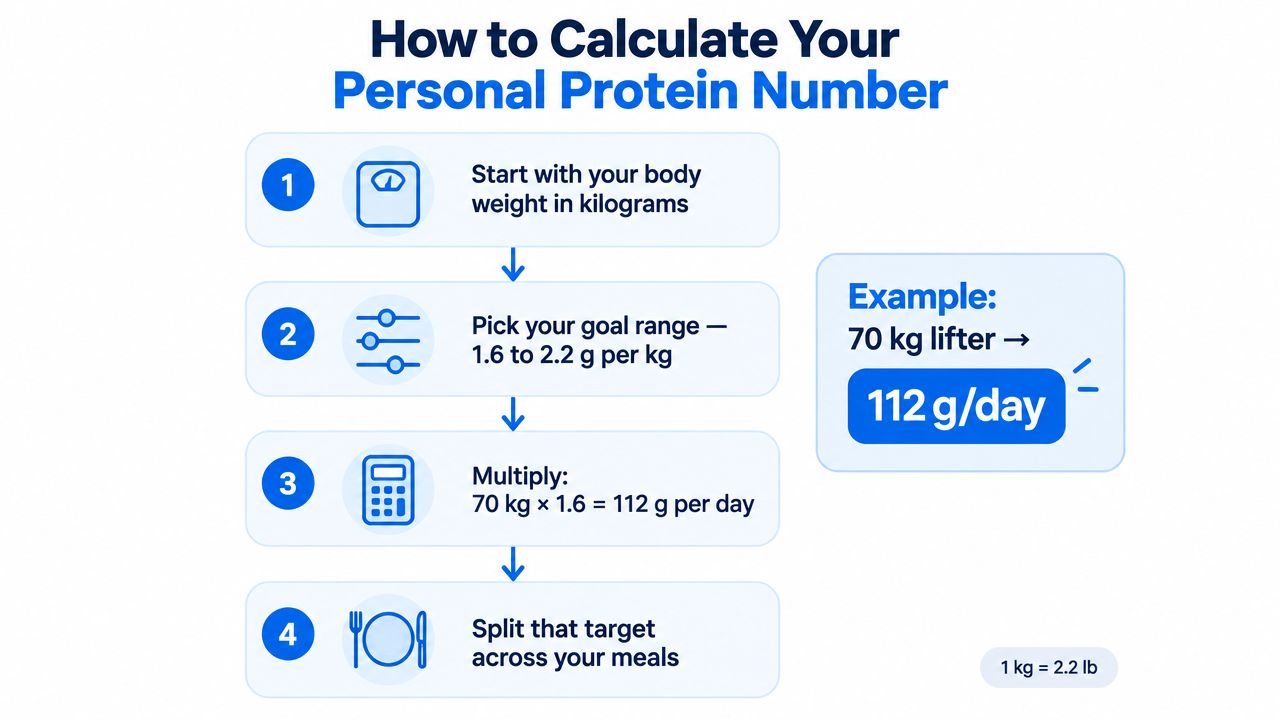
Suppose you weigh 70 kg and choose 1.6 g/kg as your starting target. The calculation is straightforward:
Formula: body weight in kilograms × protein target in g/kg = daily protein target in grams
70 × 1.6 = 112 g of protein per day
The result is 112 grams of protein, not 112 grams of chicken, yogurt, or protein powder. Food weight and protein weight measure different things. A chicken breast may weigh far more than the protein it provides, so compare your intake with the protein value on a label or nutrition database, not only the number on your kitchen scale.
Choose the target that matches the situation
Scale weight gives many lifters a useful starting point. You can set a practical goal without first obtaining a laboratory estimate of lean mass.
Steady beginner training: Start near 1.6 g/kg/day.
Higher-volume, experienced training: Consider moving toward 1.8 to 2.2 g/kg/day, within the range supported by the ISSN position stand.
Calorie deficit: Use the higher end of your chosen range when preserving lean mass is a priority.
Here are three examples using 1.6 g/kg/day:
Body weight | Calculation | Daily target |
|---|---|---|
60 kg | 60 × 1.6 | 96 g |
70 kg | 70 × 1.6 | 112 g |
80 kg | 80 × 1.6 | 128 g |
Use ounces if that helps you plan portions, but an ounce of food is not an ounce of protein. Build meals that each provide a meaningful contribution, then check nutrition information for the exact amount.
A shift worker could combine eggs and yogurt from an on-site cafe, a chicken wrap during a break, and a shake after training. A busy professional might rely on cottage cheese, a tuna sandwich, or a ready-to-drink option when cooking is not possible.
The calculation gives you a destination. Your meal pattern determines whether you arrive there without forcing dinner to do all the work.
Why Protein Distribution Across the Day Matters
A shift worker may start with coffee, grab a small lunch between tasks, train after work, and face one oversized dinner as the only substantial protein meal. A busy professional can end up in the same pattern when meetings replace breakfast and training times change. The daily total still matters most, but dividing that total gives your muscles more regular access to amino acids.
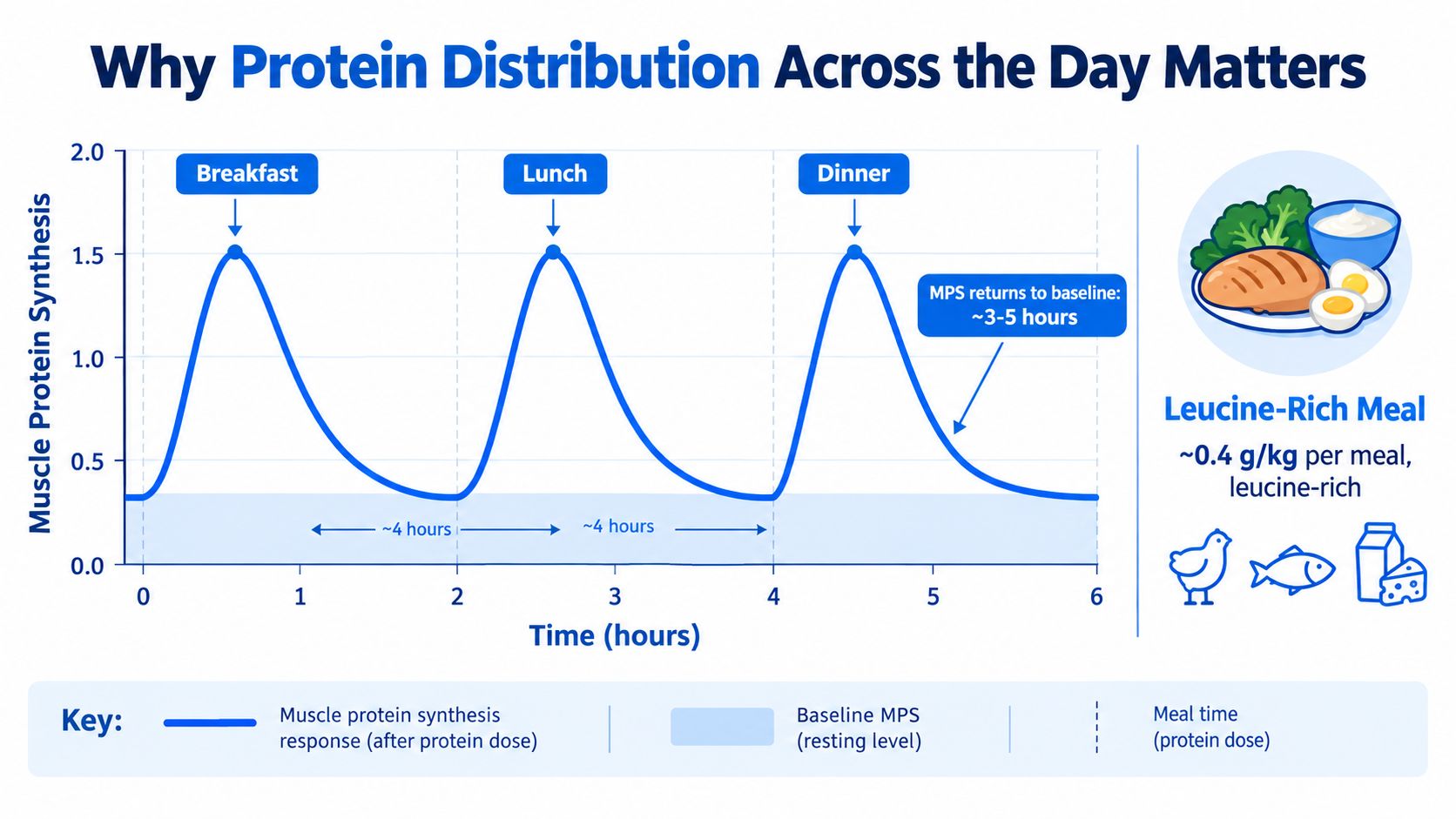
A practical target is about 0.3 g/kg every 4 to 6 hours, which often works out to roughly 20 to 40 grams of high-quality protein per meal. The review of protein distribution and muscle anabolism describes this meal-by-meal approach. It is a planning guide, not a rule that makes a meal ineffective if it falls slightly outside the range.
After a leucine-rich serving, muscle protein synthesis rises and later returns toward baseline. Recovery does not stop at that point, and you do not need to chase a precise minute on the clock. Spreading protein across the day creates several useful opportunities to support muscle building instead of placing the entire target in one sitting.
Compare two common schedules
One person skips breakfast, eats a light lunch, trains, and consumes a very large dinner. Another has protein at breakfast, lunch, around training, and dinner. Both may reach a similar daily total, but the second pattern distributes the work more evenly and avoids relying on one late meal.
A useful structure is straightforward:
Breakfast: Eggs, Greek yogurt, or another substantial serving instead of coffee alone.
Lunch: A complete meal with chicken, tuna, tofu, or another clear protein anchor.
Training window: A meal or shake that fits the schedule.
Dinner: A normal serving, rather than an attempt to repair the entire day.
A 2024 review noted that about 3.0 g of leucine is roughly equivalent to 30 to 35 g of high-quality protein and recommended at least 30 g at breakfast. This makes the first meal a useful checkpoint, particularly for shift workers who can combine eggs and yogurt from an on-site cafe.
You do not need to force a shake the moment your last set ends. A protein-rich meal before or after training can fit well, and this protein shake timing guide provides more context. Consistency across the day matters more than anxiety about a narrow post-workout window.
Real Food and Shake Examples to Hit Your Target
Numbers become easier when you can see them on a plate. A meal built around Greek yogurt, whey, chicken, eggs, cottage cheese, tuna, tofu, or another substantial protein source can move you toward your target without requiring every meal to look like a bodybuilding contest plate.
For example, 200 g of Greek yogurt with two tablespoons of whey provides about 40 g of protein, while a 120 g cooked chicken breast provides about 35 g. A large whole egg plus three egg whites provides about 20 g. These are practical estimates for meal planning, so use the label on your specific product when precision matters.
A sample day for an 80 kg trainee
An 80 kg trainee using 2.0 g/kg/day would target 160 g per day. Four meals of about 40 g create a simple structure that works for someone who trains before work, during a lunch break, or after a shift.
Meal | Food example | Approx. protein |
|---|---|---|
Breakfast | Greek yogurt with whey and fruit | 40 g |
Lunch | Chicken breast, quinoa, vegetables | 40 g |
Pre-workout | Banana and whey espresso smoothie | 30 g |
Dinner | Salmon or lean meat with potatoes and vegetables | 50 g |
Daily total | 160 g |
The meal doesn't have to be identical every day. A tuna wrap, cottage-cheese toast, eggs with yogurt, or a ready-to-drink shake can fill the same role when your kitchen isn't available. Convenience matters because a theoretically perfect plan fails if you can't carry it through a workday.
Shift-friendly cafe options
An on-site cafe can solve the gap between a work shift and a training session. An Empire Cafe-style menu might include a banana-whey espresso smoothie with about 30 g of protein, a chocolate recovery shake with oats and creatine with about 40 g, or a chicken-and-quinoa bowl with about 45 g. Those amounts should be confirmed from the recipe or nutrition label rather than assumed.
Use the option that matches your schedule. A smoothie can be easier before training, a shake can work after a late session, and a bowl can serve as a complete lunch when you have no time to cook. For post-training meal ideas beyond a shake, see this guide to what to eat after lifting weights.
Common Protein Myths That Hold Lifters Back
A late shift ends, training starts soon, and a lifter wonders whether missing a perfect protein window has ruined the session. That worry comes from turning useful guidance into rigid rules. Muscle gain depends more on a suitable daily intake, regular meaningful servings, productive training, and recovery than on a flawless supplement routine.
Myth one, more is always better
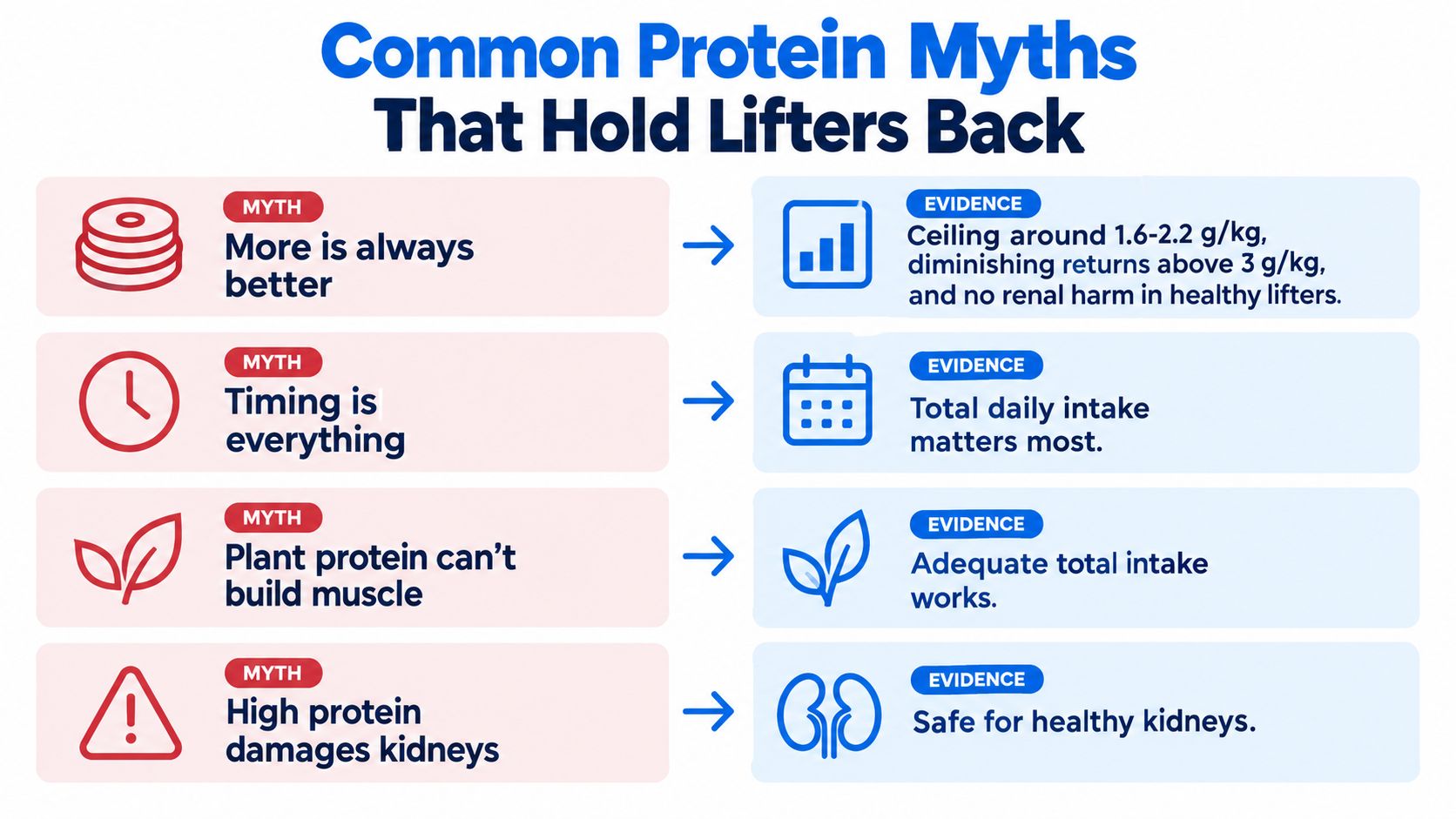
Higher protein intake does not guarantee more muscle. Evidence for resistance-trained adults centers around 1.6 g/kg/day, with useful intake commonly extending toward 2.2 g/kg/day for certain goals. As noted earlier, many healthy adults see no clear additional hypertrophy benefit above the central target.
A larger protein serving can also crowd out carbohydrates and fats that support training energy, hormones, fullness, and dietary variety. For a healthy person, more protein is not automatically dangerous, but it is not automatically productive. A lifter working a long shift may gain more from a balanced cafe meal than from adding another scoop to an already adequate day.
Myth two, you have only a short anabolic window
Protein does not have to be consumed the instant a workout ends. A serving before or after resistance exercise can support the day's intake, but total protein and a practical distribution matter more than racing against a rigid clock. If training finishes after a cafe closes, a meal before the session and a normal dinner afterward can still fit the plan.
Myth three, plant protein can't build muscle
Plant-based eating can support muscle growth. Soy, pea, rice blends, tofu, tempeh, beans, and other foods can help reach the daily target, although their protein quality and amino acid density differ. Someone relying heavily on plant sources may use larger servings, combine foods across the day, or choose a shake when work leaves little time for a full meal.
Myth four, protein is automatically dangerous
Healthy people should not treat a higher protein target as inherently damaging. Anyone with diagnosed kidney disease or another relevant medical condition needs individualized advice from a qualified clinician. Set the target alongside your health history instead of applying one rule to every lifter.
Useful filter: If a protein strategy makes you ignore calories, training quality, food variety, or recovery, simplify it until it supports the whole plan.
Your Simple Daily Protein Action Plan
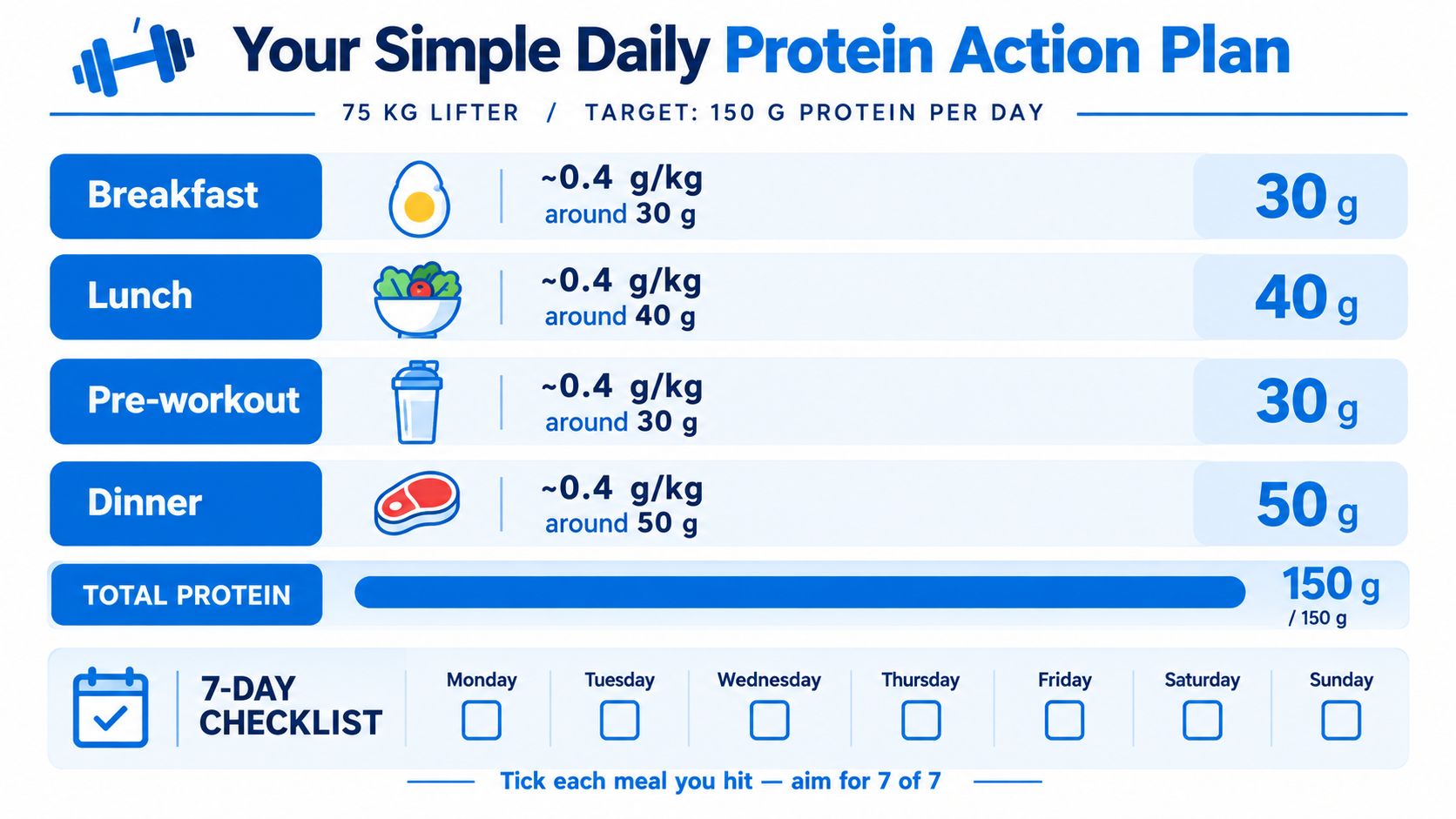
Take the calculation you made earlier and turn it into four decisions. A 75 kg lifter using 2.0 g/kg/day would target 150 g per day, which can be arranged across breakfast, lunch, a training-window meal, and dinner.
Use this four-meal template
Breakfast: Aim for about 30 g from eggs and yogurt, a whey smoothie, or another substantial source.
Lunch: Build toward about 40 g with chicken, fish, lean meat, tofu, or a legume-based combination.
Pre-workout: Set aside about 30 g in a shake, yogurt bowl, or portable meal if your shift makes a sit-down lunch difficult.
Dinner: Finish with about 50 g from your main protein serving, plus carbohydrates and vegetables.
The exact split doesn't need to be perfect. The purpose is to prevent the common pattern where breakfast contributes almost nothing and dinner has to compensate for the entire day.
Run a seven-day reset
For one week, track protein accurately. Read labels, estimate portions, and note where the shortfalls happen. You don't need to track forever, but a short reset can show whether the problem is an undersized lunch, a missed breakfast, or an overreliance on an evening meal.
After that reset:
Check your body weight: Use a consistent weekly weigh-in rather than reacting to every daily fluctuation.
Set your target: Keep your chosen grams per day visible in your phone or training log.
Plan the difficult meal: Prepare the workday option first, whether that's a packed tuna wrap, yogurt and whey, or a cafe shake.
Review progress: Look for upward trends in compound-lift strength, changes in sleeve or waistband fit, more visible upper-back and shoulder development, and stable recovery between sessions.
Adjust only when needed: If progress and recovery are steady, don't keep changing the target.
Do a 30-second self-audit
Ask yourself:
Did I reach my daily protein target most days?
Did breakfast and lunch contain meaningful protein?
Am I missing meals because of work, or am I just guessing portions?
Is my training progressing, and am I eating enough total food to support it?
Am I chasing a higher number instead of improving consistency?
The one number to remember is 1.6 g/kg/day, spread across three to five feedings as a practical starting pattern. On your next training day, choose a labeled protein option from the Empire Cafe or prepare an equivalent meal before your shift so your target is decided before hunger and fatigue make the decision for you.
Empire Athletics offers 24/7 gym access, certified one-on-one personal training, and an on-site cafe with coffee, smoothies, and protein shakes prepared for pre- and post-workout routines. Visit Empire Athletics to explore the Leominster, Lunenburg, and Webster locations and find a schedule that fits your training and protein plan.