Creating a Judgment Free Zone at the Gym
Learn what a judgment free zone really means at a gym, why it improves retention, and how Empire Athletics builds a welcoming 24/7 training culture

You may be standing outside a gym right now, trying to decide whether to go in. You've got comfortable clothes on, but you're unsure where to check in, whether you'll know how to use the machines, or if other people will notice that you're new. Those aren't silly worries. They're practical questions about what the first visit will feel like.
A welcoming gym doesn't expect you to arrive already confident. It makes it clear where to start, gives you room to learn, and treats questions as a normal part of training. That's the difference between printing “judgment free” on a sign and making it part of the way people behave.
What It Feels Like to Walk Into a Gym for the First Time
You open the door and pause just inside. Someone is moving between machines with practiced ease, another person is setting up a barbell, and you're trying to work out whether you should head to the front desk or wait to be greeted. You may wonder if your clothes are right, where to put your things, or whether you're using a machine incorrectly before you've even touched it.
That first visit can feel exposed because you don't know the routine yet. You might not know how to adjust a seat, what weight to choose, or whether it's fine to ask someone for help. A good gym doesn't treat that uncertainty as a personal failing. Staff make it easier to find your bearings, and members give one another space to learn.
Make the first steps predictable
Start with the check-in point. Tell the staff member you're new, and ask what happens next. If you're not sure how to use a piece of equipment, asking for a quick orientation is more useful than guessing or avoiding it altogether. You don't have to perform confidence before you've had a chance to build it.
You can also take a little time to observe the room. Notice where equipment is stored, which areas are intended for different exercises, and whether there's a trainer you can approach. If you're looking at gyms in Leominster, compare more than equipment and opening hours. Consider whether the gym makes it easy to ask questions, get oriented, and train at your own pace.
A judgment-free experience begins with small, ordinary interactions: a clear greeting, a straightforward explanation, and a respectful answer when you ask for help. This article answers four questions that can make the choice and the first visit easier: what the phrase means, why psychological comfort matters to participation, how a gym can build that culture into daily operations, and what you can do when you arrive.
What a Judgment Free Zone Actually Means
A judgment-free zone isn't a promise that nobody will notice you or that nobody will ever offer feedback. It means people aren't mocked, shamed, or treated as less deserving of space because of their body, age, experience, or goals. It's a standard for how people treat one another, not a ban on coaching.
The phrase has a commercial history as well as a wider social meaning. Planet Fitness, a U.S. fitness company founded in 1992 in Dover, New Hampshire, began using “judgment-free” as a formal brand slogan in 1997 to signal a welcoming environment for people intimidated by traditional fitness clubs (background on Planet Fitness and the slogan). By 2011, the company had expanded to more than 400 clubs across 40 states and reported more than 2.5 million members, showing how widely its positioning had been adopted in the U.S. fitness market.
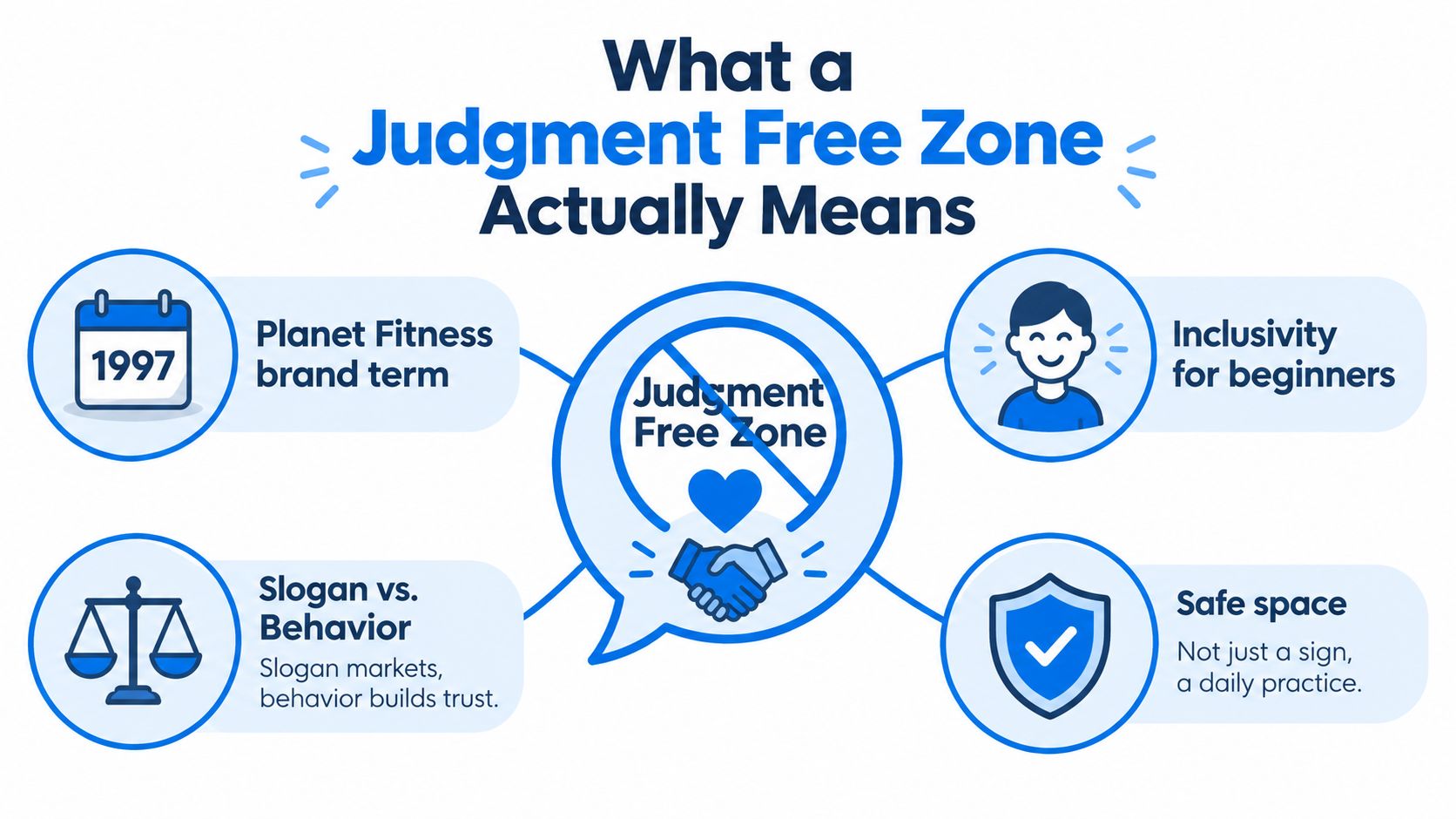
The idea has also moved beyond gyms. “Judgment-free” can describe a conversation where someone feels able to disclose a concern without being ridiculed or dismissed. For a new member, that might mean saying they've been inactive, mentioning an old injury, or admitting that they don't understand how to adjust a machine. Such a disclosure is useful information for safe, appropriate guidance, not an invitation to criticize.
Look for behavior, not just a slogan
A gym's promise becomes meaningful when its practices match its language. Does a trainer explain a movement without making the member feel foolish? Can someone ask a basic question without being brushed off? Are different goals and levels of experience treated with respect?
The practical distinction: standards tell people how to train and share the space safely; judgment targets a person's worth, appearance, or right to be there.
A welcoming culture doesn't require lowering expectations or avoiding correction. It requires delivering feedback as coaching, not as a personal put-down. At a facility with round-the-clock access and certified trainers, that distinction should hold whether someone is following a plan with a coach or training independently.
Why Psychological Safety Changes Member Outcomes
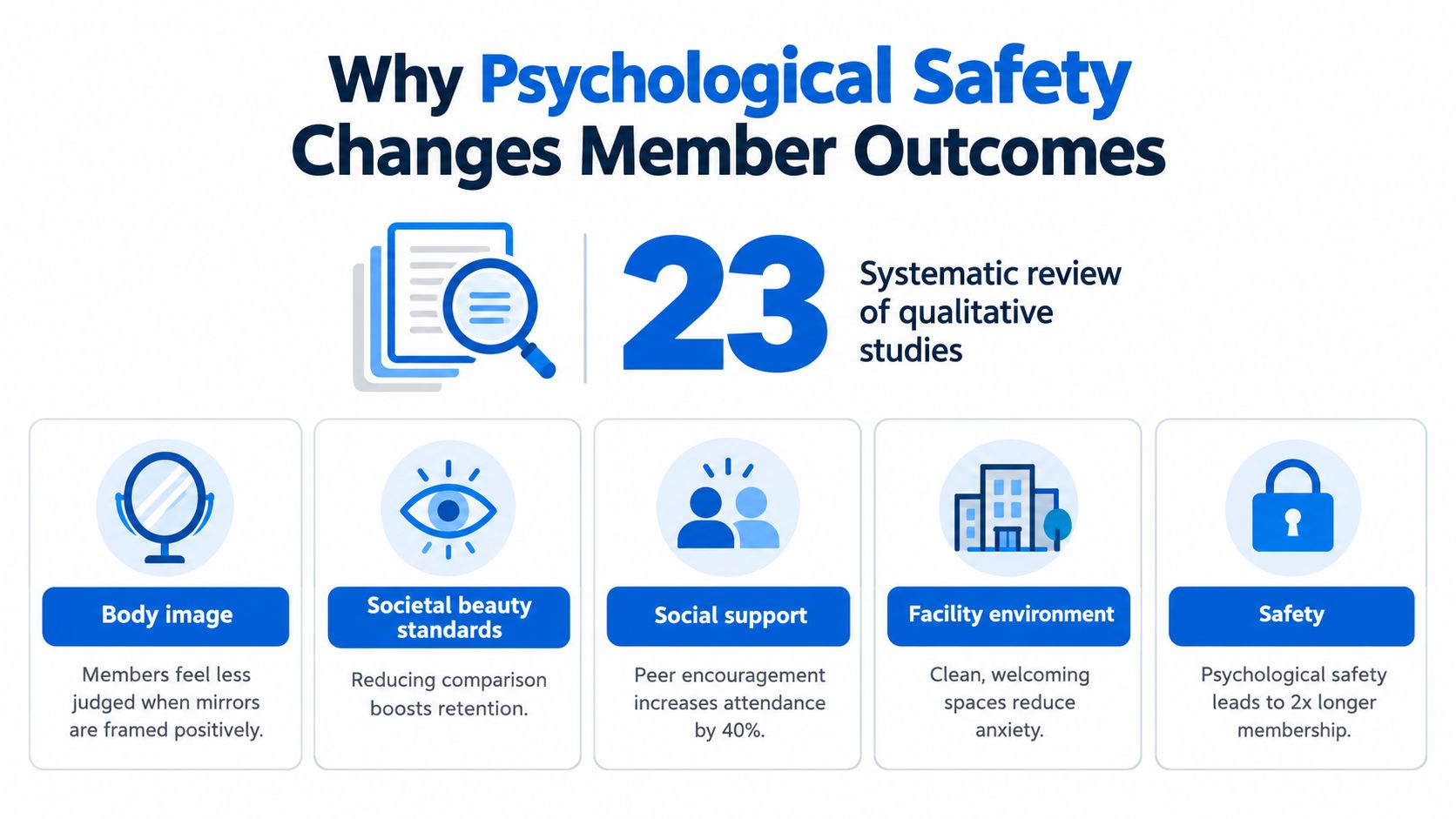
A member who's worried about being watched may avoid asking for help, skip unfamiliar equipment, or delay coming back. That matters because participation depends on more than motivation. A systematic review of 23 qualitative studies identified body image, societal beauty standards, social support, facility environment, and safety as recurring influences on physical-activity participation among adults aged 18–40 (systematic review of participation factors).
The review describes how anticipated judgment can make people feel anxious or self-conscious, particularly when they've experienced weight stigma or embarrassment. A gym can't control every feeling a new member brings through the door, but it can avoid adding avoidable pressure. Staff can use inclusive language, explain equipment clearly, offer a private coaching conversation, and avoid unsolicited comments about appearance.
Turn comfort into a routine
Psychological safety is about whether people feel able to participate without risking ridicule or a loss of standing. A systematic review and concept analysis drawing together 67 sport-related studies treats psychological safety as a meaningful feature of participation environments (review of psychological safety in sport). In a gym, that can look like a trainer welcoming questions, a correction given privately and clearly, or a member being able to modify an exercise without attracting negative attention.
Recent research on gym membership barriers also reports that 47% of surveyed non-gym members felt uncomfortable about joining, 32% expected negative judgment, and 17% feared harassment or intimidation (research on gym-joining discomfort and anticipated judgment). Those concerns aren't solved by telling someone to be confident. People need to know what happens at check-in, whether they can get help using equipment, and how staff respond to intimidating conduct.
That's why retention is partly a behavior question. Do new members return, attend introductory sessions, and feel more comfortable asking for guidance as they get familiar with the space? Those signs are more useful than a slogan alone. If you're weighing whether one-on-one coaching would help you begin, this guide to personal training can help you think through what to expect.
How Empire Athletics Builds the Culture Day to Day
Culture isn't created by a sign at the entrance. Members experience it in the way a trainer responds when they say, “I haven't done this before,” or when they need to change an exercise because it doesn't feel right. A consistent approach makes asking for help part of training rather than a moment that sets someone apart.
At Empire Athletics, certified personal trainers provide one-on-one plans shaped around a member's goals and starting point. The team has 20+ years of combined experience, and coaching can address areas such as mobility, corrective exercise, strength, bodybuilding, weight loss, and performance. For a beginner, that might mean learning a machine's setup before adding weight. For someone returning after a long break, it may mean choosing a manageable starting level and adjusting as they learn how their body responds.

Give members choice and support
A facility with 24/7 access gives members flexibility to choose when they train. That can be useful for shift workers, busy parents, and people who feel more comfortable exercising when the gym is quieter. But access at any hour doesn't automatically mean a trainer is present at every hour, so members should know how to arrange coaching and where to find guidance when they're training independently.
A trainer's job isn't to rank members or make them feel watched. It's to help them understand what they're doing and adjust it to their needs. Good coaching keeps the focus on the movement: where to place your feet, how to set the machine, or when to use a lighter weight. If a correction needs a more private conversation, the coach can move it away from the center of the floor.
Member behavior matters, too. A greeting can help someone feel seen without putting them on the spot. Returning equipment after use and giving others room to move make shared areas easier to manage. These ordinary actions reinforce the same expectations as respectful coaching.
The on-site Empire Cafe, which serves coffee, smoothies, and protein shakes, provides another convenient part of the visit. Someone might stop in before a workout or have a shake afterward without needing to leave the facility. The point isn't that every member needs the same routine. It's that a gym can make different routines easier to follow.
Your First Visit Without the Stress
You don't need a complicated plan for your first session. It helps to know what to say, where to ask, and what you're allowed to change. A good visit can start with one small task, such as getting checked in and learning how to use a single machine.
Check in and explain what you need. Say that it's your first visit and ask where to begin. You can also ask how to arrange an equipment orientation before starting a workout.
Ask directly about a machine. Try, “Can you show me how this works?” You don't need to apologize for asking. Learning the setup helps you use the equipment with more confidence.
Choose a comfortable pace. Start with an exercise you understand. If the movement feels awkward or too difficult, stop and ask for a change rather than pushing through to avoid attention.
Tell the trainer what may affect your session. “I'm coming back from an injury” gives a coach relevant context. You can also say, “I need to switch to a lighter weight.” You don't need to share details you're uncomfortable discussing in public.
Know how support works at the time you visit. With 24/7 access, staff availability can depend on when you train. Ask about scheduled trainer support, posted equipment guidance, and how to reach staff if you have a concern while working independently. At the Empire Cafe, cafe staff may be a human touchpoint during your visit, but they aren't a substitute for a trainer or the gym's process for getting help.
If you'd rather get familiar with the space before committing, check whether a gym free trial is available. Use your visit to notice how check-in works and whether it feels comfortable to ask questions.
A first session doesn't have to prove anything. It only needs to help you feel a little more oriented than when you arrived.
Welcoming Does Not Mean Easy
A judgment-free gym isn't a gym without standards. Members still need to respect shared equipment, follow safety guidance, and listen when a trainer gives technical feedback. The difference is that expectations apply to behavior and movement, not to whether someone looks experienced enough to belong.
Beginners and advanced lifters can share a training floor when coaching stays specific. “Move the pin down one setting” or “try this with a lighter weight” gives someone a clear action. A remark about their body or ability doesn't. Technical feedback helps people improve while leaving their dignity intact.
Different members may be working on mobility, corrective exercise, bodybuilding, weight loss, strength, or performance. They don't need identical workouts or the same definition of progress. They do need room to ask for help, train at a suitable pace, and be treated respectfully.
A useful test: Can a member ask a basic question, modify an exercise, or mention an injury without feeling that they've lost status?
When the answer is yes, inclusion and serious training can support each other. Members can pursue demanding goals without turning the gym into a place where newcomers have to earn the right to participate.
Quick Do's and Don'ts for Members and Staff
A judgment-free culture is maintained through repeatable actions, not good intentions alone.
Do greet new faces without putting them on the spot.
Do reset your station and return equipment after use.
Do ask before filming so other members can protect their privacy.
Do offer help respectfully and wait for someone to accept it.
Do report harassment or intimidation through the gym's established process.
Don't comment on bodies, stare, or treat a slower pace as a problem.
Don't take over shared equipment or give unsolicited critiques.
Staff should normalize questions, correct members respectfully, and explain how to raise concerns.
A 4.7/5 member rating is referenced on the business site, but a rating doesn't maintain a welcoming environment by itself. Members and staff protect the standard through everyday choices. Each person who walks in can help make the next person's first visit easier, or harder.
Empire Athletics offers 24/7 access, modern strength and cardio equipment, certified one-on-one personal training, and an on-site cafe at its Central Massachusetts locations. If you're looking for a place to begin or continue training with room to ask questions and work toward your own goals, visit Empire Athletics and plan your first visit.