Upper Body Strength Training: Build Muscle and Power
Master upper body strength training with proven techniques, progressive overload principles, and guided programs at Empire Athletics. Start building muscle

Adults should perform muscle-strengthening activity for all major muscle groups at least 2 days per week, and upper-body strength training is a practical part of meeting that standard. A structured plan built around progressive overload, balanced pushing and pulling, and appropriate loading will build strength more reliably than random workouts.
You may already know the scene. You walk into the gym, look at the bench press, cable station, and pull-up bar, then wonder where to begin. You don't want to choose the wrong exercise, use too much weight, or spend months repeating the same workout without seeing progress.
The solution isn't a longer list of exercises. It's a clear system. Train the major movement patterns, record what you do, increase the challenge gradually, and adjust the plan when performance or recovery changes. That approach works for a beginner learning to press a dumbbell and for an experienced lifter trying to improve a heavy bench press.
Why Upper Body Strength Training Matters
You walk into the gym, see the bench, cable station, and pull-up bar, and hesitate. The goal may be broader shoulders or stronger arms, but the true payoff is learning to press, pull, brace, and carry with control. Those abilities support daily tasks, physical independence, and confidence as you age.
The World Health Organization's physical activity guidance recommends moderate- or vigorous-intensity muscle-strengthening work for all major muscle groups on at least 2 days per week, alongside weekly aerobic activity. The chest, back, shoulders, and arms all belong in that work. Upper-body training therefore supports general fitness rather than serving only appearance-focused goals.
A beginner who feels intimidated by the bench does not need to start with a barbell. A coach might use a machine chest press, supported row, and light cable press to establish stable positions, controlled repetitions, and a repeatable rhythm. Once those skills are consistent, load can increase with less guesswork.
Strength supports ordinary movement
Upper-body strength helps with lifting a child, placing luggage overhead, carrying shopping bags, and pushing open a heavy door. Pulling strength also improves control when you draw an object toward your body or stabilize yourself during sport and recreation.
Balanced programming determines whether those gains transfer well. Pressing without enough pulling can leave a lifter struggling to control the upper back, while pulling alone does not build the force required for horizontal or overhead pressing. Give both movement directions regular attention, and let technique determine the load rather than ego.
The public-health gap matters
Many adults do not perform enough structured physical activity. Even in a region with established public-health infrastructure, such as the WHO European Region, 27.5% of adults were classified as insufficiently physically active, including 23.4% of men and 31.7% of women, according to the same WHO fact sheet cited above. In the European Union, only 13.6% of adults met both aerobic and muscle-strengthening recommendations in 2019, as reported in that source.
These European figures are a wider public-health illustration, not a direct measure of activity in Central Massachusetts. For a local beginner, the practical lesson remains clear: a manageable routine can create regular practice without demanding an extreme schedule.
One-on-one coaching can speed that process by selecting an appropriate starting variation, correcting technique, and adjusting the challenge when recovery or performance changes. The result is a clearer path from cautious first repetitions to dependable strength.
Practical rule: If your program helps you press, pull, carry, and brace with improving control, it is doing more for you than a collection of exhausting exercises chosen at random.
Understanding Progressive Overload
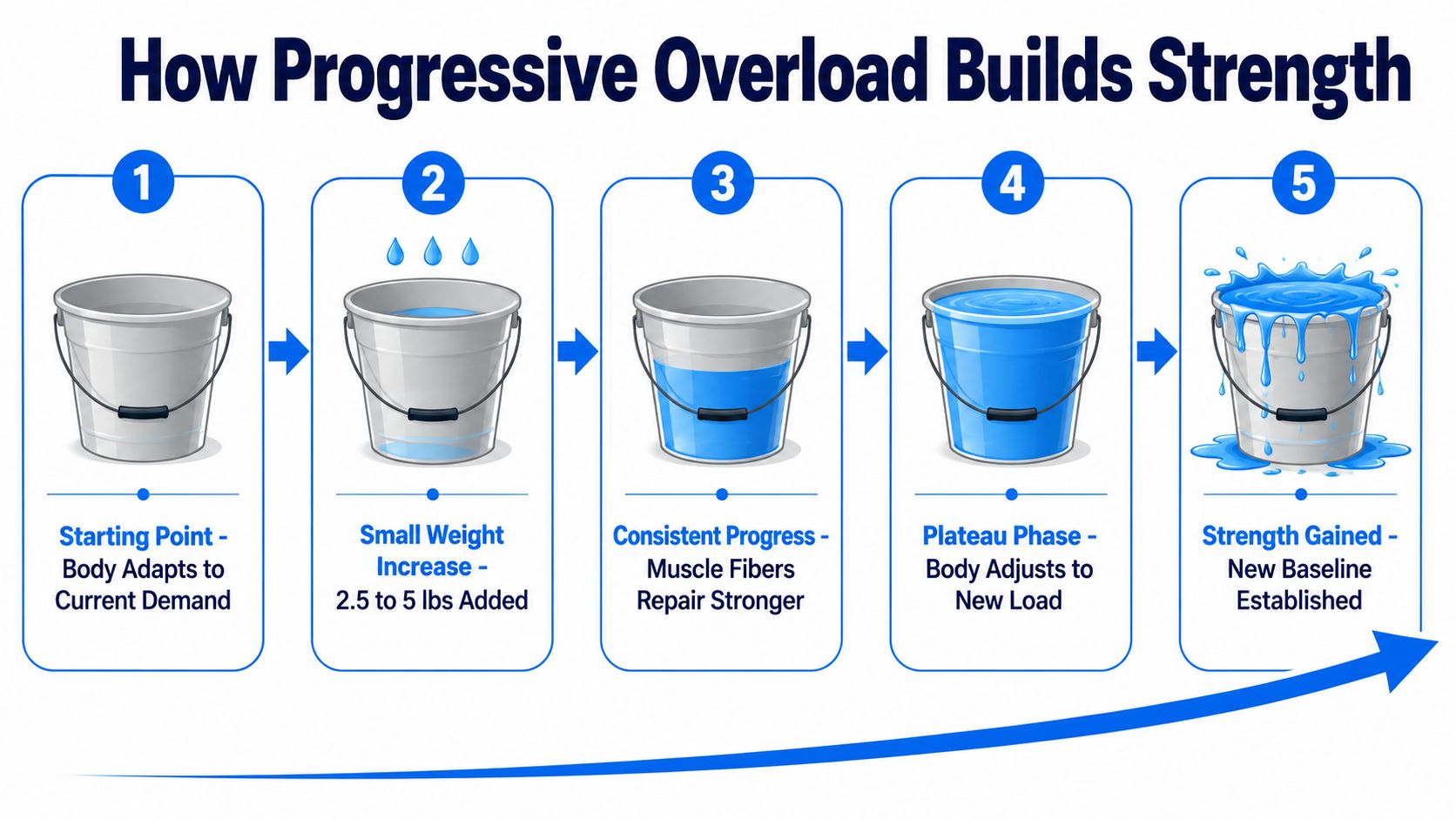
Your muscles adapt to the demands you repeatedly place on them. Once a weight becomes familiar, repeating the same sets forever may maintain your ability, but it gives your body less reason to improve. Progressive overload means increasing the training challenge in a controlled way so the body has to respond.
Think of a bucket filled one drop at a time. One small increase may feel insignificant, but consistent additions eventually establish a new baseline. In the gym, the drops can be an extra repetition, a small weight increase, more completed sets, better range of motion, or cleaner technique with the same load.
Use a simple progression system
Start by choosing a repetition range you can perform with consistent form. If you complete every planned set while keeping one or two good repetitions in reserve, add a small amount of weight at the next session. If your final repetitions become unstable, keep the load and try to improve execution before increasing it.
Track four things:
Load: Record the weight used for each exercise.
Repetitions: Note the repetitions completed in every set.
Hard sets: Count the sets that meaningfully challenge you.
Technique: Mark whether range of motion and control stayed consistent.
A training log prevents memory from turning effort into fiction. It also shows whether a plateau comes from insufficient challenge, inconsistent attendance, poor recovery, or a jump in load that was too aggressive.
Manipulate one variable at a time
You don't need to add weight every workout. Smaller plates may be unavailable, or your shoulders may need more time to adapt. In that case, add a repetition within the planned range, improve the pause, or use the same load with cleaner control.
For a practical explanation of how repetitions relate to muscle-building goals, see this guide to the best rep range for muscle growth. Strength work still needs specificity, so choose progressions that resemble the result you want.
Progressive overload isn't permission to chase fatigue at any cost. If your back lifts from the bench, your elbows flare unpredictably, or you shorten every repetition to move a heavier load, the number on the stack is no longer a useful measure of progress.
Breaking Down Major Upper Body Muscle Groups
Upper-body programming becomes easier when you organize it by movement pattern instead of treating every muscle as a separate project. A horizontal press trains the chest, front shoulders, and triceps together. A row develops the upper back, rear shoulders, and elbow flexors. That approach gives you a balanced structure without requiring a different exercise for every anatomical label.

Push patterns
Horizontal pushing includes the bench press, dumbbell press, push-up, and machine chest press. Keep your feet planted, create a stable upper-back position, and lower the weight under control. Your elbows don't need to be pinned to your sides, but they shouldn't flare wildly as the load becomes difficult.
Vertical pushing includes the overhead press and landmine press. Brace your trunk before moving your arms, keep the ribs from lifting excessively, and finish with the weight stacked over the shoulders rather than drifting forward.
These patterns emphasize the chest, shoulders, and triceps. Use a machine or dumbbells if a barbell setup feels unstable. The best variation is the one that lets you train the intended pattern repeatedly without pain or compensatory movement.
Pull patterns
Horizontal pulling includes cable rows, chest-supported rows, dumbbell rows, and barbell rows. Start by setting the shoulder blades and pulling the handle toward the lower ribs or torso, depending on the variation. Don't turn every row into a lower-back swing.
Vertical pulling includes pulldowns, assisted pull-ups, and pull-ups. Begin with your shoulders controlled rather than hanging passively into a painful position. Pull your elbows down toward your sides, then lower the resistance through a full range you can own.
Build balance across planes
A useful upper-body session usually includes at least one press and one pull, then adds vertical or horizontal work according to your goal. You might pair a dumbbell bench press with a chest-supported row, then use a landmine press and assisted pull-up as secondary patterns.
Arms and rear delts can receive direct work after the larger movements. Curls and triceps extensions are useful, but they shouldn't replace the pressing and pulling patterns that create a stronger foundation.
Training Frequency and Loading Strategies
The right training frequency depends on how much work you can recover from and how well you can perform it. A twice-weekly upper-body plan may suit someone with limited time. Three shorter sessions may work better for a lifter who wants more technical practice without making any single workout excessively long.
A systematic review of well-trained populations found no clear difference in upper-body maximal-strength development between different frequencies over 6 to 12 weeks when total volume was equated. The frequency comparison produced a trivial effect, g = 0.088, p = 0.505, in the published review and meta-analysis. The practical message is simple. More sessions don't automatically create more strength if they merely add fatigue.
Choose the load for the outcome
Strength is specific to the demands you practice. A 2023 Bayesian network meta-analysis found that loads above 80% of 1RM produced the greatest improvements in tested maximal strength, with higher-load, multiset training performed three times weekly ranking highest against no training. The result was a standardized mean difference of 1.60, with a 95% credible interval of 1.38 to 1.82, according to the British Journal of Sports Medicine analysis.
That doesn't mean every set should be heavy. A practical strength block might use multiple sets of roughly 3 to 6 repetitions for the bench press, overhead press, row, or weighted pull-up, provided technique stays stable. Moderate loads remain useful for building muscle and practicing patterns with less joint and nervous-system demand.
Match frequency to recovery
Use frequency to distribute your work:
Schedule | Useful when | Main risk |
|---|---|---|
Two upper-body sessions | You need a simple, repeatable routine | Sessions may become crowded |
Three shorter sessions | You want more technical practice | Extra days can add fatigue |
Full-body sessions | You also train the lower body regularly | Upper-body volume may be limited per workout |
The American College of Sports Medicine recommendations summarized in resistance-training research generally place beginners around 8 to 12 repetitions, training 2 to 3 days per week, while experienced lifters can use heavier work around 1 to 6 repetitions for strength-focused training.
Track completed hard sets and performance on key lifts. Add a session only when it improves exercise quality, recovery, or practice. Otherwise, it may be more effective to keep the same frequency and make the existing work more consistent.
Sample Programs for Every Level
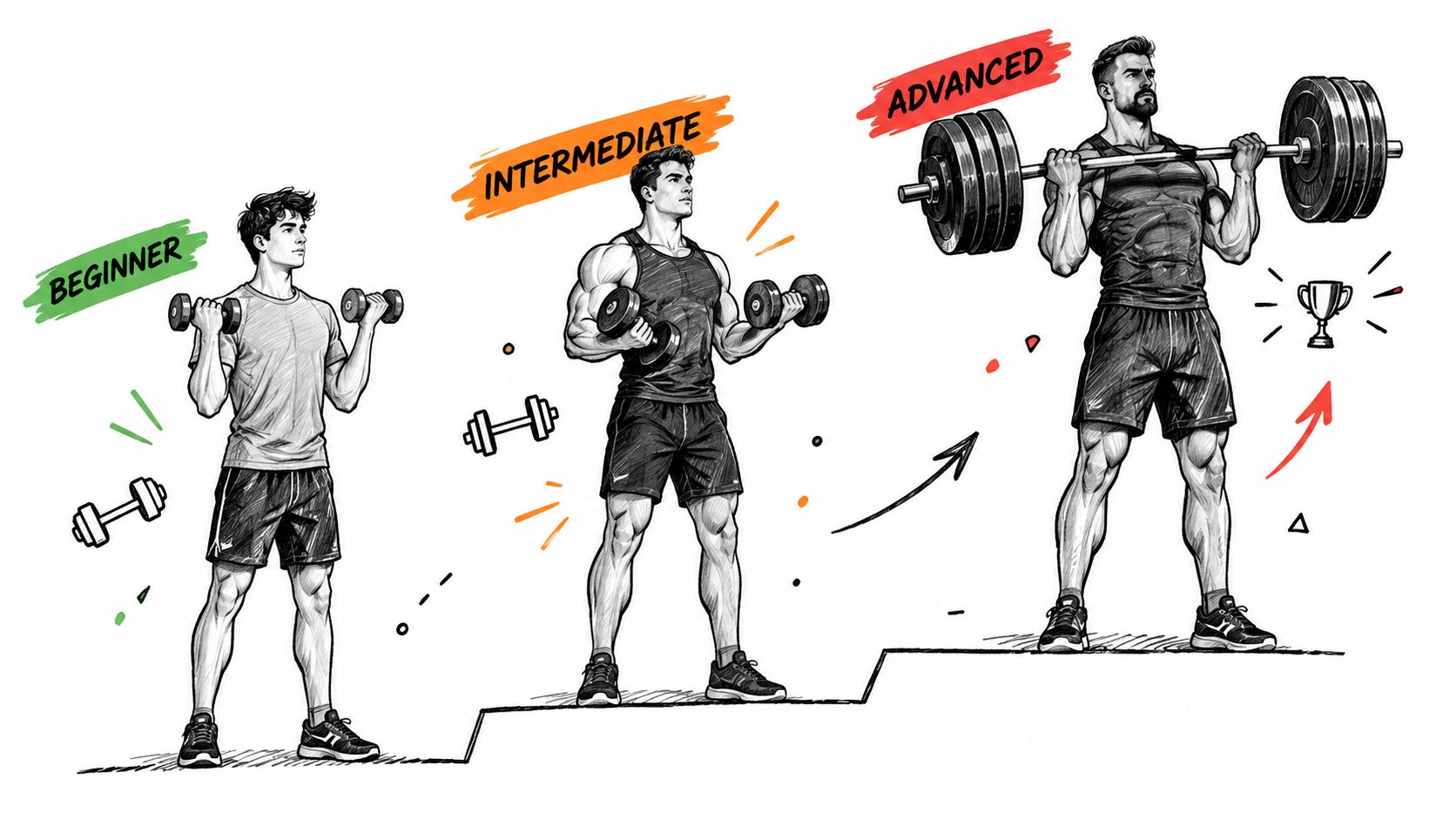
A program should tell you what to do when the workout feels easy, average, or difficult. The templates below use the same core principles, but the exercise demands change with experience. Beginners need confidence and repeatable positions. Intermediate lifters need more loading options. Advanced trainees need enough variation to keep progressing without turning every session into a test.
Beginner plan
Train twice weekly, leaving at least a rest day between sessions.
Workout A
Machine chest press, 3 sets of 8 to 12
Seated cable row, 3 sets of 8 to 12
Dumbbell shoulder press, 2 sets of 8 to 12
Lat pulldown, 2 sets of 8 to 12
Cable curl, 2 sets of 10 to 12
Rope triceps pressdown, 2 sets of 10 to 12
Workout B
Incline dumbbell press, 3 sets of 8 to 12
Chest-supported row, 3 sets of 8 to 12
Landmine press, 2 sets of 8 to 12
Assisted pull-up, 2 sets of controlled repetitions
Dumbbell curl, 2 sets of 10 to 12
Cable triceps extension, 2 sets of 10 to 12
Rest long enough to repeat good technique. When you reach the top of the range on every set, increase the load slightly next time.
For a more focused press-and-arm session, use this chest and tricep workout routine as a reference, then adjust the difficulty to your current level.
Intermediate plan
Train three times weekly, alternating the emphasis.
Day 1, strength: Bench press, 4 sets of 4 to 6; chest-supported row, 4 sets of 6 to 8; overhead press, 3 sets of 5 to 8; pulldown, 3 sets of 8.
Day 2, volume: Incline dumbbell press, 3 sets of 8 to 10; cable row, 3 sets of 8 to 10; lateral raise, 3 sets of 10 to 12; curl and pressdown, 3 sets each.
Day 3, balanced strength: Close-grip bench press, 3 sets of 5 to 8; pull-up or assisted pull-up, 4 sets; one-arm dumbbell row, 3 sets of 8; landmine press, 3 sets of 8.
Use a lighter training week when performance drops across several sessions, joints remain irritated, or fatigue changes your technique. A deload is a strategic reduction in stress, not a failure to train.
The following video can help you review movement setup before applying the plan:
Advanced plan
Advanced lifters can use a simple wave across three weekly sessions:
Week 1: Main press and pull for 4 sets of 6
Week 2: Main press and pull for 5 sets of 4
Week 3: Main press and pull for 6 sets of 3
Week 4: Reduce load and volume while keeping the movements sharp
Use secondary exercises at moderate repetitions, then rotate variations when a joint or weak point needs attention. Don't turn every week into a maximal test. The purpose of periodization is to organize stress so you can express strength after building it.
The Momentum Misconception in Upper Body Training
Many lifters are taught that any momentum makes an exercise useless. That rule is too crude. A controlled change in body position can help an experienced lifter extend a set after strict repetitions, but uncontrolled swinging usually signals that the load is too heavy or the target muscle is no longer doing enough of the work.
A 2025 controlled study of 30 young adults compared strict repetitions with externally assisted momentum during biceps curls and triceps pushdowns. After 8 weeks of training twice weekly, both approaches produced similar increases in muscle thickness and circumference, while the momentum condition created substantially greater volume load, as reported in the study published through PubMed.
That finding doesn't turn sloppy curls into smart programming. The study's useful lesson is that momentum deserves context. It can change how much work a muscle experiences, but it can also shift stress, reduce stability, and make it harder to know whether the intended muscle is still being trained effectively.
Use momentum only when the exercise permits it
A deliberate final repetition on a curl may involve a small amount of controlled body movement after strict repetitions have reached their limit. The setup should remain stable, the range should stay meaningful, and the lifter should stop before the movement becomes a full-body heave.
Presses, rows, and overhead exercises deserve more restraint. Momentum in a technical press can disturb the shoulder position. Momentum in a row can turn the movement into a back extension. If you need to swing from the first repetition, reduce the load.
Set clear stop criteria
Use repetitions in reserve to decide when a set ends. Stop when the next repetition would require a major change in torso position, grip, range of motion, or joint alignment. A coach can also judge whether a limited cheat is extending productive work or merely hiding weak load control.
The useful distinction: Controlled momentum is a planned overload tool. Sloppy momentum is a programming error.
How One-on-One Training Accelerates Progress
A written program can't see whether your bench press setup is unstable, whether your shoulder shifts during a row, or whether your chosen load leaves no room for progression. One-on-one coaching supplies that missing feedback while the exercise is happening.
A qualified trainer can adjust the movement to your starting point. A beginner might use a machine press while learning bracing and range of motion. Someone with a previous shoulder limitation may need a neutral-grip dumbbell press, landmine variation, or cable pattern instead of forcing a barbell position that doesn't fit.
Coaching turns principles into decisions
A coach can help you determine:
What to change: Add weight, add repetitions, repeat the load, or modify the exercise.
When to stop: Use technique, speed, and repetitions in reserve rather than emotion.
How to balance work: Pair pressing and pulling without burying recovery.
When to reduce stress: Recognize fatigue before it becomes an injury or a long plateau.
Accountability also matters. People often skip the less enjoyable work, change exercises too quickly, or add load because the previous session felt easy. Regular feedback creates a more stable process, which is especially useful for beginners, busy adults, and lifters returning after time away.

Empire Athletics offers certified one-on-one personal training, modern strength equipment, and 24/7 access across locations in Leominster, Lunenburg, and Webster, Massachusetts. Its personal training service is one option for people who want individualized programming and live technique guidance rather than trying to interpret every training decision alone.
Your Next Steps in Upper Body Strength
Start with two weekly sessions if you're new, and build each around one press, one row, one vertical pattern, and modest direct arm work. Choose loads that let you repeat stable technique, record every set, and progress one variable at a time.
If you already train consistently, review your log before adding more exercises. Check whether your main lifts are improving, whether pressing and pulling are balanced, and whether fatigue is limiting performance. If the answers aren't clear, a coach can audit your technique and turn your existing effort into a more precise plan.
Use this checklist for your next session:
Select: One horizontal press, one horizontal pull, and one vertical movement.
Record: Load, repetitions, sets, and technique quality.
Progress: Add a small challenge only after you complete the planned work cleanly.
Adjust: Change frequency or exercise selection when recovery or comfort deteriorates.
Empire Athletics provides 24/7 gym access, modern strength equipment, and certified one-on-one personal training for lifters developing upper-body strength at different starting points. Visit Empire Athletics to explore the facilities and request guidance for building a structured plan.