24/7 Gym Access: What It Means and How to Use It
Learn how 24/7 gym access works, which safety systems protect members at night, and how to train well at 5 a.m. or 2 a.m.

You've finished a warehouse shift that ran from late evening until morning. You'd like to train before heading home to sleep, but your gym closes while you're still at work. A different opening schedule could help, provided the workout doesn't cost you the rest you need.
That's the useful way to think about 24/7 gym access: not permission to train at any cost, but a way to fit exercise around work, recovery, and a clear safety plan.
What 24/7 Gym Access Actually Means
24/7 gym access means members can enter at any hour using their own credential, rather than only during staffed opening times. It doesn't necessarily mean a receptionist, trainer, or manager is available whenever you arrive.
The model developed around that scheduling problem. According to the Los Angeles Times, Mark Mastrov founded 24 Hour Nautilus in San Leandro, California, in 1983, after noticing members arriving before opening and staying until closing, and the club began operating around the clock.
For members today, the important distinction is between building access and staff availability. An open door doesn't tell you whether someone can explain a machine, resolve an account problem, or help during an incident.
Common gym access models compared
Access model | Typical hours | Staffing | Entry method |
|---|---|---|---|
Staffed hours only | Fixed daytime and evening opening times | Staff present throughout opening hours | Front desk check-in |
Extended hours | Early opening to late closing, no overnight access | Staff present during opening hours | Card or front desk entry |
24/7 with limited overnight staff | Around the clock | Few or no staff overnight; relies on access control and surveillance | Biometric or key-fob entry linked to membership |
Empire Athletics | Around the clock at all three locations | Confirm overnight staff availability with reception before your visit | Finger scan on every visit |
At Empire Athletics, our locations in Leominster, Lunenburg, and Webster provide around-the-clock member access. You must scan your finger on every visit, and memberships are available only to adults aged 18 or over.
Your credential identifies you as the person requesting entry. It isn't a shared household pass, and another member entering ahead of you isn't a substitute for your own check-in.
Access is not supervision. Plan an overnight workout around what you can safely do without immediate coaching.
Before choosing any gym that advertises continuous access, get clear answers to these questions:
Who's on site overnight? Establish whether staff are present during your intended training window.
How is entry verified? Know which credential you need and what to do if it fails.
How do you report an emergency? Locate the emergency instructions before you need them.
Those answers tell you more about usable access than the opening-hours sign alone.
Matching Your Workout Time to Your Shift
The best training time depends on your shift, chronotype, and sleep goal. Chronotype means your natural tendency to feel more alert earlier or later. A free hour isn't automatically a good workout hour if using it delays essential sleep.
A 2025 review summarized by Harvard Health reported that intense exercise within roughly an hour of bedtime may impair sleep, while afternoon and evening exercise can improve some cardiovascular markers more than morning exercise. That's a reason to consider intensity and bedtime together, not a rule that everyone should train in the evening.
Use the relationship between work, alertness, and sleep as your starting point.
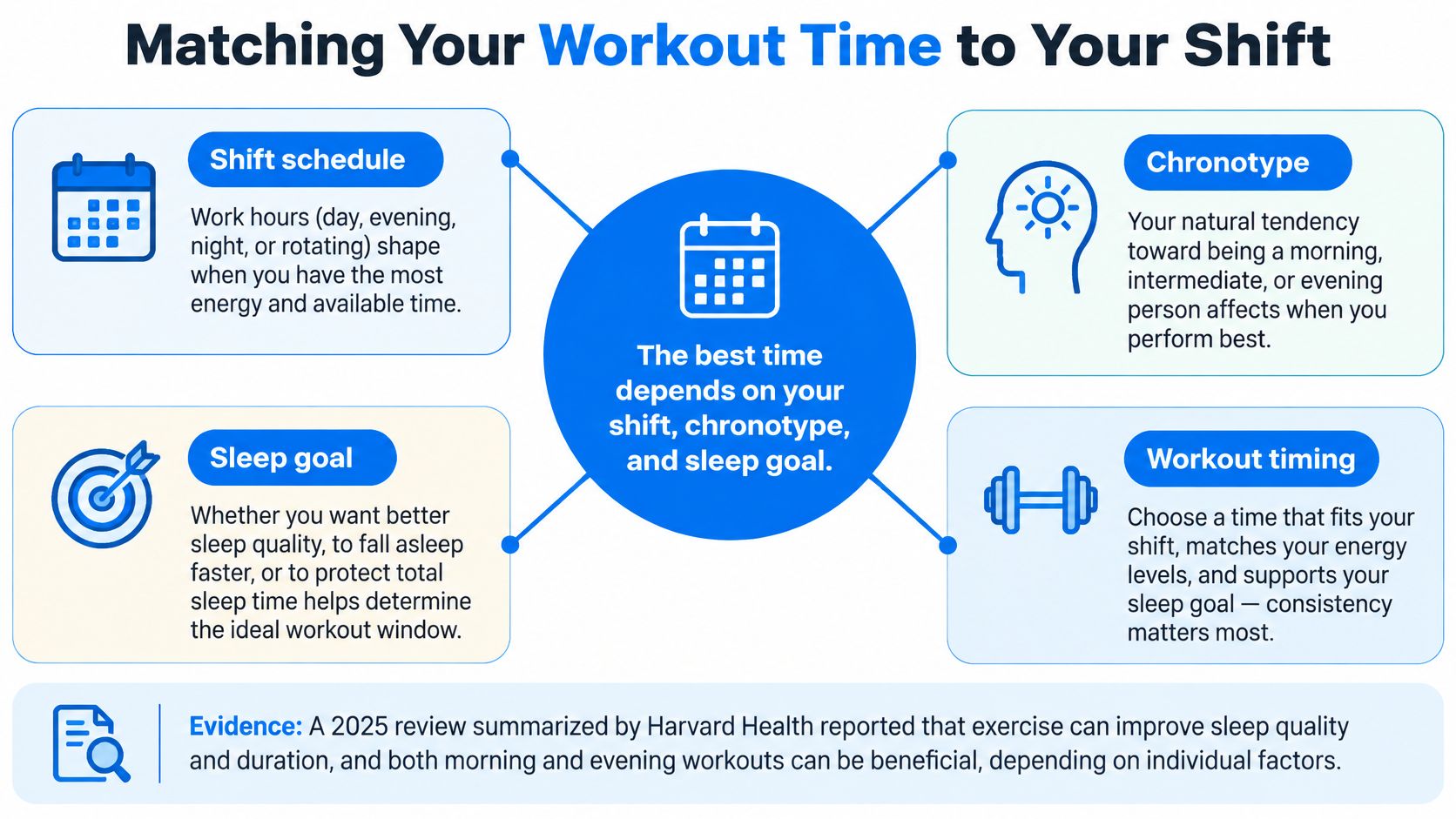
Training window and session type by shift pattern
These are starting options to test, not individually prescribed exercise plans. Evidence about pre-shift and post-shift training remains preliminary, so your sleep response should guide adjustments.
Schedule | Best training window to test | Session type | Why it fits |
|---|---|---|---|
Permanent day shift | Late afternoon, leaving recovery time before bed | Strength plus moderate cardio | Separates demanding exercise from bedtime |
Permanent night shift, after work | After the shift, only if it preserves sleep | Moderate aerobic exercise | A sleep-focused option, with preliminary timing evidence |
Permanent night shift, before work | After waking, before the shift starts | Progressive strength at a moderate load | Lets you attempt demanding work while more alert |
Rotating shifts | A repeatable window on the most stable days | Moderate aerobic exercise | Offers an anchor without forcing the same clock time |
Split shift with a long break | During the break, allowing time to change and recover | Short mobility session or light circuit | Fits movement into the day without exhausting you |
Resistance training, moderate cardio, and high-intensity intervals aren't interchangeable. You might tolerate an easy bike session after work but feel overstimulated after hard intervals. A technically demanding lift also deserves a different decision from gentle mobility work.
For another perspective on exercise timing, consider the following video.
Test the window against your sleep
Keep a simple log of workout timing, effort, bedtime, sleep quality, and energy during your next shift. Compare several workdays and days off rather than judging the schedule after an unusually good or bad night.
When comparing gyms in Leominster, include travel time in that test. A convenient workout window can disappear if the journey pushes your bedtime back.
Move or shorten the session if sleep worsens or work-time alertness drops. Exercise doesn't replace sleep, so protect your main sleep block first.
Why Round-the-Clock Access Helps Shift Workers and Busy Members
Say a nurse finishes an overnight shift and feels alert enough for a modest workout on the way home. With flexible access, that session can fit the day without requiring a return journey after waking. On a more exhausting morning, the same member can go home and choose another window.
That freedom matters because a rigid appointment can turn a disrupted day into a missed workout. Flexible access gives you alternatives without requiring you to abandon the training plan.

Before early shifts: Train before work when that fits your waking routine, rather than relying on energy afterward.
After late shifts: Use a suitable post-work window instead of racing a closing desk.
Outside busy periods: Choose quieter hours if waiting for equipment disrupts your session, while checking actual attendance patterns.
On irregular days off: Keep exercise available even when your free days move around.
Without a fixed class timetable: Follow a repeatable workout when scheduled classes don't match your roster.
Flexibility works best with an anchor
A controlled study of 2,508 employees, described by Harvard Business School Working Knowledge, compared flexible exercise with rewards restricted to a personally selected two-hour weekday window; attendance was similar during the four-week intervention, but after incentives ended, weekly attendance likelihood fell by 10 percentage points in the rigid group compared with 5 points in the flexible group.
That finding supports flexibility, but it doesn't mean having no routine is best. The practical approach is to keep a default appointment and a fallback window.
For example, make your preferred session follow waking on a workday. If a family obligation interrupts it, use a shorter session on a suitable day off rather than treating the entire week as lost.
Keep the training intention steady while allowing the appointment to move.
A progressive program supplies the other part of the structure. Record your exercises, loads, and how the session felt, then use a realistic weekly attendance target to judge consistency rather than expecting every day to unfold identically.
Access creates an opportunity, not a complete training system. It doesn't supply technique instruction, supervision, or a decision about what to do next. Beginners who need that structure should arrange guidance during an available appointment rather than expect it to appear during an overnight visit.
Security Systems That Make Unstaffed Access Work
A 24/7 gym should be a controlled facility, not an open room. The entry system, member records, doors, cameras, and emergency procedures each serve a different purpose.
The Army MWR 24-hour fitness facility operating procedure illustrates this approach through credentialed entry, surveillance, emergency arrangements, and entry-and-exit recording for occupancy control. These are useful operating principles, not a claim that every gym uses identical equipment.

What each control needs to accomplish
Credentialed entry establishes accountability. A finger scan, card, or key fob should identify the member entering. Don't admit someone behind you who hasn't completed their own authorized check-in.
Membership status determines permission to enter. At Empire Athletics, your membership must be valid, in date, and in credit. Anyone with an amount due cannot enter; a missed monthly payment is resubmitted, and access remains denied until payment is received.
Access records help operators understand occupancy. Where a facility requires both entry and exit scans, complete both. An unrecorded departure can leave the system treating someone as still inside and incorrectly blocking later entry.
Cameras support verification and investigation. Coverage at entrances and circulation areas can help establish who entered and what happened. Cameras aren't a substitute for a person responding to a medical emergency.
Doors must secure the boundary. Self-closing doors only work if members allow them to close. Propping a door open defeats the credential check for everyone who follows.
What to check inside
Security also includes the condition of the space, not just admission. An unattended area needs usable walkways, secured equipment where feasible, and a way to report hazards.
Clear circulation routes: Keep bags, plates, and attachments out of walking areas.
Spill and equipment reporting: Stop using an affected area or machine and report the problem rather than leaving it for another member.
Visible emergency instructions: Know how to summon help and identify your location before starting.
A clear exit route: Check that you can leave without retracing your steps through equipment.
Emergency communication needs to work when the reception desk isn't occupied. Confirm the overnight procedure directly rather than assuming someone monitors a general inbox continuously.
For accidents, incidents, or service problems at Empire Athletics, ask the Duty Manager at the reception desk upstairs, or email empireathletics247@gmail.com in confidence. That reporting route doesn't replace calling emergency services when someone needs urgent help.
Staying Safe When You Train Alone at Night
Round-the-clock entry removes a scheduling barrier. It doesn't make every solo workout appropriate. Your fatigue, familiarity with the equipment, and ability to get help matter more than whether the door opens.
In a U.S. analysis of 33,983 adults, regular night-shift workers had 13% higher leisure-time inactivity after adjustment than regular day workers. That finding concerns activity patterns, not gym injury risk, but it helps explain why accessible exercise options matter for this group.
The answer isn't to push through every tired night. It's to make training available while keeping permission to modify or postpone it.
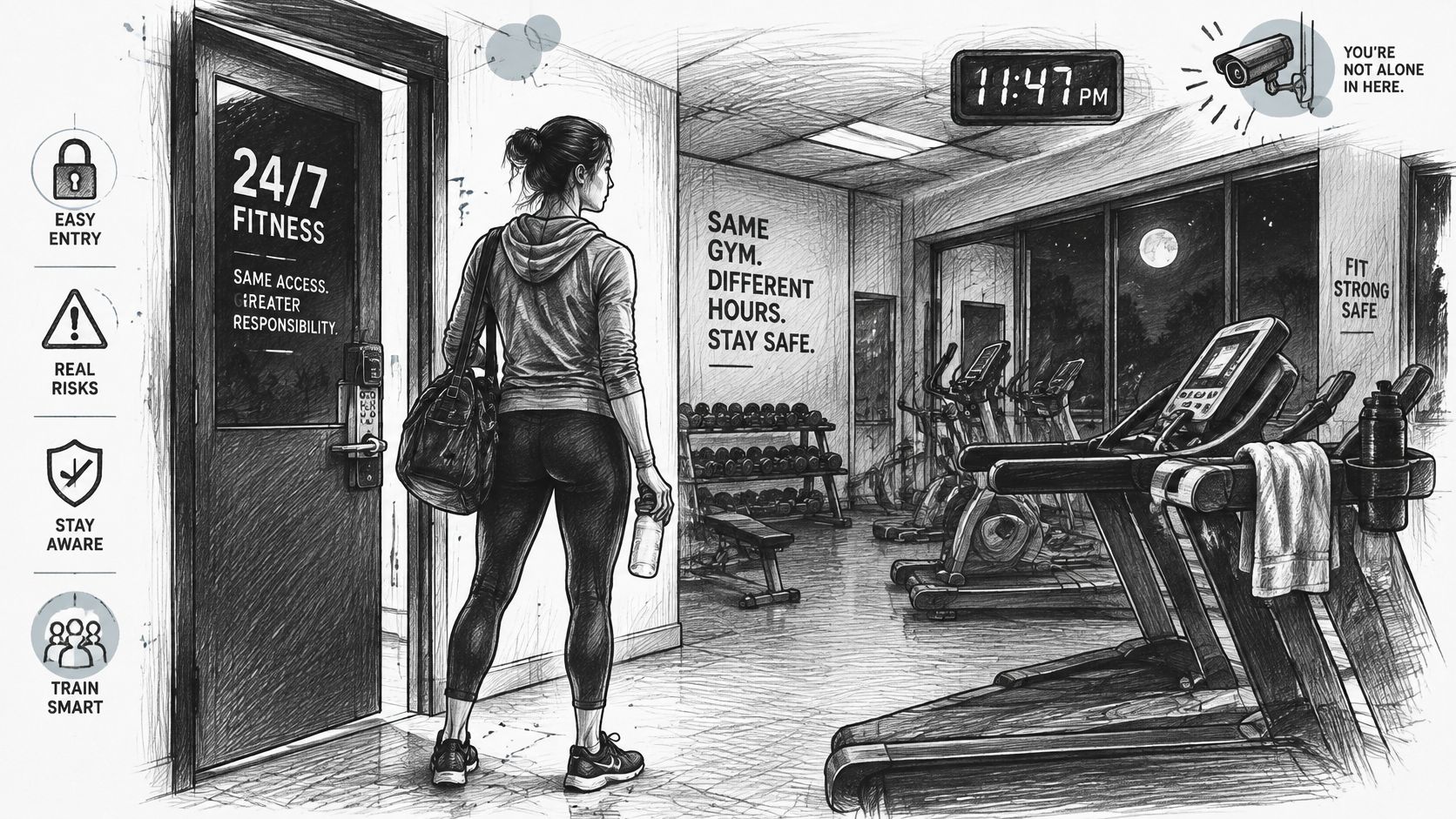
Make the session easier to manage
Share your plan: Tell someone outside the gym when you're training and when you expect to finish. Arrange a check-in, especially when you're unfamiliar with the site.
Prepare for an emergency: Save the appropriate emergency contact information on your phone and locate the nearest usable exit. Know the facility address so you can give it clearly.
Inspect before loading: Check collars, adjustment pins, bench settings, and visible cable condition. Don't use equipment with damage, loose fittings, or an attachment you can't secure.
Choose good visibility: Use a well-lit training area and check the route between the entrance and your parking spot. If that route feels unsafe, change the plan.
Take your belongings home: Our lockers may not be used overnight, and contents left overnight may be removed.
For a new exercise or unfamiliar machine, arrange instruction before attempting it alone. A training partner can help with communication and observation, but isn't a replacement for understanding the equipment.
Let fatigue change the workout
If you're struggling to concentrate, avoid heavy or technically demanding lifts. Choose a familiar machine, reduce the load, or leave instead of trying to rescue the session through effort alone.
Practical rule: If you can't reliably check your setup and control the movement, don't add weight.
Use our guidance on exercising when tired to think through that decision before you arrive. After poor sleep or illness, skipping the session may be the sensible choice.
Empire Athletics advises regular health and medical screening with your General Practitioner throughout membership. Discuss symptoms or health concerns with your clinician rather than using a workout to test whether they're serious.
Members aren't covered by club insurance for injury or loss from exercise. Consider obtaining personal insurance at your own expense, and check what the policy covers before relying on it.
Confirm Access Terms and Plan Your First Night Session
Our access model applies across Leominster, Lunenburg, and Webster, but continuous member access isn't a promise that every area will always be available. Maintenance and operational needs can affect a planned visit.
Empire Athletics may vary opening hours as needed for the proper operation of the centre. We may also withdraw use of all or part of the club for maintenance or other necessary work for a maximum of seven working days.
Check the site before making the journey
Call reception before a session that could coincide with maintenance. Confirm whether the building is accessible and whether the area you intend to use is available, particularly if your workout relies on a specific training space.
If you travel between towns, identify a backup location and confirm its availability too. Don't assume a notice affecting one site describes the status of the others, or that an alternative site will fit your journey without changing your sleep plan.
If you're still deciding whether the environment suits you, review our gym free-trial guidance and confirm the arrangements before arriving overnight. Don't assume member entry procedures also apply to a first-time visitor.
A practical first-session plan
Confirm your account is ready. Check that your membership is active and in credit before leaving home. Resolve outstanding account issues rather than expecting to sort them out at an unattended entrance.
Check closures and choose a backup. Confirm the intended site is available and decide what you'll do if access fails. Going home should remain an acceptable fallback, especially when another journey would cut into sleep.
Choose a suitable training window. Use your shift pattern, alertness, and intended bedtime to pick the visit. Keep the first workout straightforward so you can assess the timing without also testing an unfamiliar program.
Warm up gradually. Start with light cardio and mobility relevant to your planned exercises, then use lighter preparation sets. Increase effort only when you feel coordinated and ready, rather than following the working weight written in your log automatically.
Wipe down equipment after use. This is required at Empire Athletics. Leave benches, handles, and other contact surfaces ready for the next member.
Wear clean, appropriate attire and footwear. Our gym and studio rules require both. Choose clothing that won't catch on equipment and footwear suited to the movements you're planning.
Record how the visit affects recovery. Note your energy before training, how the session felt, and your subsequent sleep. Keep the workout modest while you establish whether this window is repeatable.
Resolve access questions with us directly. Call 978-990-3972 or email empireathletics247@gmail.com before the visit. Ask about your credential, overnight staffing, and the emergency procedure for your chosen location.
Treat the first night session as a test of the whole arrangement: the journey, entry, workout, and return home. You don't need a demanding session to learn whether the schedule works. Confirm access before your first visit, then adjust the training around what you learn.
Empire Athletics offers around-the-clock member access in Leominster, Lunenburg, and Webster, with strength and cardio equipment and individualized training support available by arrangement. Visit Empire Athletics to explore your local location, then contact us to confirm entry arrangements before planning your first overnight workout.