Exercising When Tired: A Practical Guide to Safe Training
Learn how to keep exercising when tired without sacrificing form or safety. Practical strategies for assessing readiness and modifying sessions that work.

You're sitting on the edge of the bed at 10 p.m., one gym shoe in your hand and the remote in the other. The shift was brutal, your eyes feel heavy, and the planned workout is now competing with the strongest urge to lie down. You don't need another motivational speech. You need a decision that protects your training without turning tiredness into an excuse or a risk.
Exercising when tired isn't a yes-or-no question. It's a triage decision. Some low-energy days call for a shortened strength session, some are better suited to a walk, and some demand genuine rest. The useful skill is knowing which situation you're in before you warm up.
Should You Train Tonight? A 60-Second Readiness Check
Start with four questions. Answer each with yes, no, or marginal, and be honest rather than aspirational.
Did you sleep at least five hours? This isn't a target. It's a basic screen for whether a demanding session is sensible. If your sleep was severely restricted, your decision should move toward recovery work.
Can you stand on one foot for 20 seconds without wobbling? Use a wall or rack for safety, but don't hold on unless you need to. Poor balance doesn't prove you're unfit to move, but it's a warning against heavy, fast, or technically complex training.
Is your resting heart rate within 10 beats of your usual level? Compare it with your own normal reading, not somebody else's. If it's noticeably high and you also feel drained, treat that combination cautiously.
Are you training for a real plan or trying to erase guilt? A scheduled session can be modified. Guilt is not a physiological readiness signal.

How to interpret the pattern
A single marginal answer doesn't automatically cancel training. Look at the cluster.
Mostly no, or you feel ill: skip the workout. Rest, hydrate, eat, and sleep.
Mostly marginal, but you feel stable: walk, use gentle mobility, or perform easy recovery work.
Mostly yes, with no warning signs: train, but modify the session if sleep was short or technique feels different.
The balance test is useful because tiredness can affect coordination before you consciously feel unsafe. The heart-rate question adds context, while the sleep and motivation questions separate physical readiness from emotional pressure.
Practical rule: If you need to convince yourself that you're ready for heavy or explosive work, you probably aren't ready for that version of the session.
This check takes less than a minute. It removes the emotional negotiation that often happens late at night, after a long shift, or during a week of disrupted sleep. You're not deciding whether you're “tough enough.” You're choosing the lowest-risk dose of movement that still serves your goal.
What Fatigue Does to Your Body and Performance
You can finish a tired workout and still have trained poorly. A 2022 systematic review of acute sleep loss and exercise performance found that performance dropped by about 0.4% for every additional hour spent awake after sleep loss. The effect appeared across different exercise tasks, with larger losses often showing up in late-day efforts and after stronger sleep restriction.
Fatigue is not a switch that turns performance off. Pace, power, coordination, and endurance can decline gradually, so a session that usually feels controlled may require more effort and expose technical weaknesses.
Mental fatigue adds another layer. A review of fatigue and physical performance reports that mental fatigue reliably raises perceived exertion while reducing endurance, motor-skill, and cognitive performance. In applied testing, a demanding cognitive task worsened throwing and burpee performance compared with control conditions.
Why form becomes less trustworthy
Tired muscles can still produce force, but the nervous system has less room for error. Slower reactions, reduced attention, and poorer motor control make familiar movements harder to manage. Heavy barbell squats, maximal sprints, and technical Olympic lifts therefore require more caution than a steady bike ride.
Sleep history also changes the risk calculation. A sports-medicine review on sleep and injury risk reported that sleeping 7 hours or less per night for at least 14 days was associated with a 1.7-times greater risk of musculoskeletal injury. The review also reported that athletes sleeping more than 8 hours had injury risk reduced by 61% compared with those sleeping 8 hours or less.
Sleep duration | Reaction time | Strength output | Injury risk |
|---|---|---|---|
Short or restricted sleep | More vulnerable to slower responses and poorer decisions | Output can decline incrementally as wakefulness extends | Higher exposure, especially when coordination and form deteriorate |
Adequate sleep | Better foundation for attention and movement control | More reliable force, pace, and endurance | Lower relative exposure than during sustained short sleep |
More than 8 hours | Supports recovery and readiness | More consistent performance potential | Use the readiness check as confirmation. If your heart rate is still above its usual baseline, treat recovery as incomplete |
One poor night does not require panic or automatic rest. It does require an honest adjustment. If coordination, judgment, or perceived effort has shifted, choose a lower-risk training tier instead of forcing the planned workload.
Three Workout Tiers for Low-Energy Days
Use the 60-second readiness check to choose a tier, then respect that decision. The goal is to match training to your current capacity, not to force the session written in your plan.
Tier 1 for recovery movement
Choose Tier 1 if you failed the check, feel unwell, notice unusual dizziness, or cannot control basic movement comfortably. This means skip or walk, not a disguised hard workout.
A suitable Tier 1 session may include:
An easy walk indoors or outdoors.
Gentle mobility for the hips, shoulders, and spine.
Light stretching without forcing range.
Slow breathing to reduce tension.
A brief movement break, followed by food and rest.
Fever, significant illness symptoms, chest discomfort, faintness, or unexplained weakness are reasons to skip exercise. Do not try to “sweat it out.” Extreme fatigue can signal that your body needs recovery, not another demand.
Tier 2 for steady work
Choose Tier 2 when you passed the screen but feel flat, average, or under-recovered. Keep aerobic work around 60–70% of maximum heart rate and limit the session to about 30–45 minutes when fatigue is significant, following the practical guidance on training while sleep-deprived.
A bike, elliptical, treadmill walk, or easy row lets you control pace without requiring complex decisions. Use a conversational effort. If complete sentences become difficult or your movement gets sloppy, slow down.
A treadmill workout approach for weight loss can also provide a practical low-intensity structure. Keep the pace appropriate for today's readiness rather than chasing the original target.
You may add stable resistance machines after cardio, but keep load and volume modest. Chest press, leg press, seated row, and hamstring curl are easier to control than demanding free-weight movements when attention and coordination are limited.
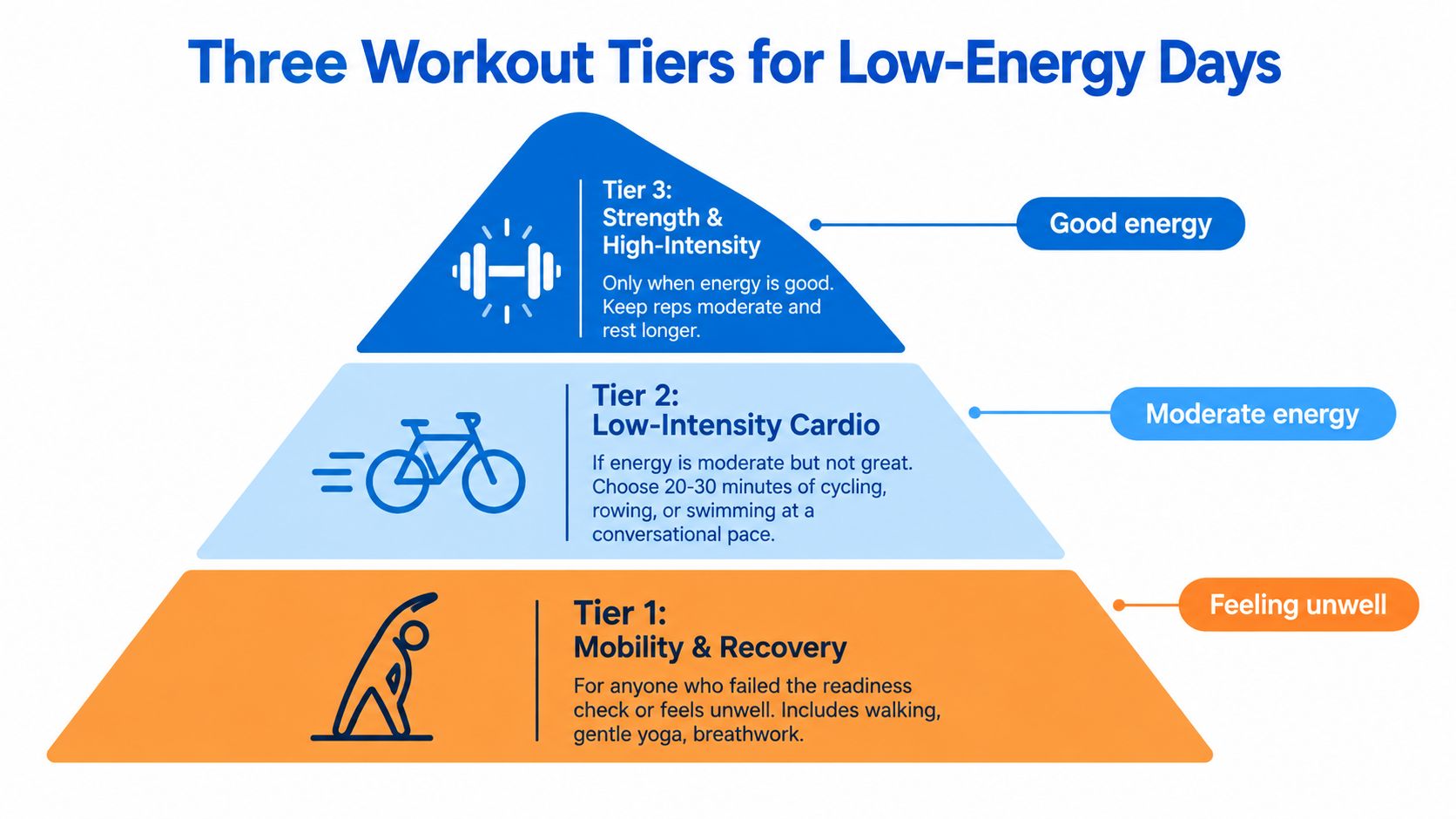
Tier 3 for modified strength
Choose Tier 3 only when you pass the screen, feel physically stable, and can focus on technique. Poor sleep does not turn this into a normal strength day. Reduce resistance by 20–30%, choose stable machines or bodyweight variations, and use fewer total sets.
Swap a barbell back squat for a controlled leg press. Replace unsupported barbell rows with chest-supported rows. Avoid grinders, max attempts, sprint intervals, and any lift where one missed cue could create a serious problem.
A simple decision rule keeps the choice clear:
Failed check: Tier 1, or no training if you feel ill.
Passed check with less than six hours of sleep: Tier 2.
Passed check with six hours or more: Tier 3 may be appropriate, with an intensity cap and a willingness to stop.
Pre-Session Prep When You Are Running on Empty
A tired-day warm-up should reveal whether you can train safely. It shouldn't become a second workout that consumes the energy you have left.
Start with two to three minutes of dynamic mobility. Use cat-cow, a gentle world's greatest stretch, hip openers, arm circles, and band pull-aparts. Move continuously and stay well short of painful range. The aim is to increase awareness and movement quality, not to create fatigue.
Then perform a short activation sequence. Glute bridges, band pull-aparts, and controlled bodyweight squats can help you notice whether your joints and muscles feel coordinated. If your knee, hip, back, or shoulder feels worse as you move, that's useful information. Don't bury that signal under caffeine.
Caffeine needs a boundary
Caffeine may make you feel more alert, but it doesn't restore lost sleep or eliminate the performance effects of fatigue. If you already tolerate it, a modest dose around 100–200 mg about 20 minutes before your first working set may help you feel more ready. Avoid using it to push through illness, dizziness, or systemic exhaustion.
Timing matters for sleep. Anyone training within eight hours of bedtime should be cautious about late caffeine, particularly if a night session is already competing with recovery. A stimulant can turn a tired day into a later night, which makes the next decision harder.
Use a five-minute movement primer
Spend five minutes progressing from easy cycling or rowing to rehearsal movements for the planned session. Start very lightly, then add a few submaximal repetitions. You're checking whether breathing, balance, range of motion, and technique improve.
If you're using an in-gym cafe before training, choose a light snack with quickly digested carbohydrates and a small amount of protein when you haven't eaten. Avoid heavy, fatty meals immediately before exercise because they may sit uncomfortably while you move.

Use the mobility ideas in hip mobility exercises for squats if your hips feel restricted, but don't force a squat pattern that still feels unstable after preparation.
Stop if you develop dizziness, cold sweats, nausea, unusual shortness of breath, chest discomfort, or joint pain. A warm-up can improve readiness, but it can't make a dangerous session safe.
Two Real-World Scenarios That Bring It Together
Maya works night shifts as a nurse. She gets home at 6:30 a.m. after spending the night on her feet and wants to train before sleeping. Her sleep was adequate enough to avoid an automatic skip, her balance is steady, and her resting heart rate is close to normal. Motivation is high, but she feels mentally dull.

Maya chooses the modified strength tier. She reduces her squat working weight by 25%, replaces barbell rows with chest-supported rows, and removes the final accessory circuit. She completes a short warm-up, keeps her rest periods generous, and finishes in 35 minutes. The session maintains her routine without asking a tired nervous system to manage maximal loading or unstable positions.
Her training log records sleep, readiness answers, exercises, load changes, and how technique felt. That information matters more than whether she checked every box on the original program.
Devon has a six-week-old baby and finds a short window during an afternoon nap. He's been waking repeatedly, so the readiness check flags cumulative sleep loss. He can move comfortably, but his energy is low and his attention keeps drifting.
Devon chooses Tier 1. He walks on an incline at an easy Zone 1 effort for 25 minutes, then spends 10 minutes on banded stretches and gentle mobility. He doesn't turn the walk into intervals or add heavy lifting because the available time doesn't change his readiness.
Both trainees trained intelligently, but their sessions look completely different. Maya preserved a reduced strength stimulus. Devon used movement to support routine and mood without adding meaningful recovery demand. The next morning, each checks soreness, resting heart rate, mental clarity, and energy before deciding what comes next.
Recovery and Sleep Habits After a Tired-Day Session
The session is only part of the decision. If you train while under-recovered, the post-workout routine should make the next recovery opportunity easier, not compete with it.
Begin with a five- to ten-minute cool-down. Easy cycling or walking can bring the effort down gradually, followed by relaxed static stretching for the main areas you trained. Keep the stretches comfortable. The purpose is to transition out of the session and assess how you feel once the excitement has faded.
Eat a meal or snack that combines protein and carbohydrates. A practical post-training option might include whey, eggs, or Greek yogurt with fruit, oats, rice, or another carbohydrate source. If you want more meal ideas, what to eat after lifting weights offers options that fit different training goals.
Protect the next sleep opportunity
A tired-day workout shouldn't end with hours of stimulation. Start a wind-down routine, lower the lighting in the evening, keep the bedroom comfortable and cool, and make your wake time as consistent as your schedule allows. Shift workers may need to reverse the clock, but the principle remains the same: create a repeatable transition into sleep.
Avoid using a hard workout as a substitute for sleep. Light movement can temporarily reduce sleepiness and improve alertness, but experimental research on exercise and sleepiness found that the effect can fade within an hour while performance limitations remain.
Read tomorrow's signals
Localized soreness is different from whole-body fatigue. A sore muscle may require a different movement pattern, while brain fog, a raised resting heart rate, unusual weakness, or persistent heaviness suggest that another demanding session is a poor choice.
Signal | What it indicates | Next-session decision |
|---|---|---|
Mild, localized muscle soreness | Normal local recovery demand | Train a different pattern or use an easier tier |
Stiffness that improves with gentle movement | Temporary restriction | Warm up carefully and keep complexity low |
Systemic fatigue or persistent brain fog | Broader under-recovery | Choose Tier 1 or take a full rest day |
Resting heart rate clearly above your normal level with fatigue | Readiness may be reduced | Avoid hard training and reassess later |
Pain that changes movement | Possible injury or irritation | Stop the exercise and seek appropriate assessment |
Your log should help you spot patterns. If every tired-day session leads to worse sleep, heavy soreness, or declining motivation, the issue may be training load rather than discipline.
Quick Decision Card and Common Edge Cases
Save this decision card on your phone:
Sleep: Was your sleep sufficient for the session you planned?
Balance: Can you stand steadily and control basic movement?
Heart rate: Is your resting heart rate close to your usual level?
Reason: Are you training from a plan, or from guilt?
Then choose:
Skip: You failed several checks, feel ill, or have red-flag symptoms.
Walk: You're stable but flat, stressed, or clearly under-recovered.
Modified lift: You passed the check and can focus, but you still cap intensity, reduce complexity, and stop before technique deteriorates.
Common edge cases
Normal tiredness or illness? Fever, swollen glands, chest symptoms, faintness, and significant body aches move the decision toward rest and medical guidance. The familiar “above-the-neck” idea can be useful for mild symptoms, but it isn't permission to train through worsening illness.
What if caffeine is already part of your daily routine? Don't keep increasing the dose to rescue every poor night. Caffeine can improve alertness without restoring coordination, recovery, or sleep. If you need progressively more to complete ordinary sessions, reduce training demand and address sleep.
Can you train after only four hours of sleep? You may be able to move, but that doesn't make a heavy or technical session sensible. Use the readiness check, favor walking or easy steady-state work, and accept that skipping may be the safer training decision.
How long can modifications continue? A modified session can preserve consistency for a while, but repeated low-readiness training shouldn't become your permanent program. Track energy, sleep, soreness, and performance week to week. If the trend keeps falling, schedule recovery rather than stacking another reduced workout.
Plan at least one honest full rest day each week when your life and training load require it. Rest isn't a failure to follow the plan. It's one of the tools that keeps the plan workable.
Empire Athletics provides 24/7 access, modern strength and cardio equipment, certified one-on-one personal training, and an on-site cafe with coffee, smoothies, and shakes across its Central Massachusetts locations. Visit Empire Athletics to find a training setup that can accommodate shift work, low-energy days, and a more deliberate approach to recovery.