5 Day Workout Plan to Build Muscle That Actually Works
Build size faster with this 5 day workout plan to build muscle, featuring proven splits, volume targets, and progression for every level.

A 5 day workout plan to build muscle isn't about a lack of motivation. It's about a lack of structure. You've probably trained hard before, added extra exercises when progress slowed, and ended up with longer sessions, sore joints, and a split that looked serious on paper but didn't deliver much in the mirror.
A good five-day plan fixes a specific problem. It gives you enough training slots to spread hard work across the week so your sets stay productive instead of turning into survival reps at the end of a marathon session. That only works if the plan is built around weekly hard-set distribution and recovery, not just filling five boxes on a calendar.
Why a 5 Day Plan Works for Building Muscle
A five-day split works best for the lifter who wants more muscle, enjoys training often, and can realistically show up most days of the week without rushing every session. That's the key. Five days only helps if five days fits your real life.
I've seen the same pattern over and over. Someone trains three long sessions per week, stalls on presses and rows, and assumes they need more effort. Usually they need better distribution. Instead of trying to cram chest, shoulders, triceps, and extra isolation work into one crushing upper-body day, a five-day structure lets them break that volume into cleaner, higher-quality sessions.
What five days does better than fewer days
The advantage isn't “more days equals more muscle.” The advantage is that you can:
Keep sessions shorter: That makes it easier to train hard without dragging through the last half of the workout.
Improve exercise quality: Your pressing, rowing, squatting, and accessory work all get more attention when they're not stacked into one oversized session.
Use more exercise variety: You can include compounds and targeted isolation work without turning each gym trip into a two-hour block.
Manage local fatigue better: A muscle can get hit again later in the week without relying on one all-or-nothing body-part day.
Practical rule: If your fourth exercise for the same muscle group always feels worse than your first two, your issue probably isn't effort. It's distribution.
Who should use this kind of split
A 5 day workout plan to build muscle usually fits these lifters well:
Busy professionals with flexible training windows: They can train before work, late at night, or during off-peak hours if their schedule changes.
Intermediate lifters: They often need more total work than beginners, but they recover better when that work is spread out.
Lifters with specific weak points: Extra slots in the week make it easier to bring up delts, back, arms, or legs without wrecking recovery.
It's a weaker fit for someone who misses sessions often, struggles with sleep, or still needs to master basic exercise technique. In that case, three or four days often outperforms five because consistency beats ambition.
Where people get it wrong
The mistake is turning a five-day split into five hard days in a row with no thought to overlap. Chest and shoulders on Monday, arms on Tuesday, heavy benching again on Wednesday, then wondering why elbows and front delts ache. The split isn't the problem. The setup is.
That's why flexible training access matters. A gym setup like Empire Athletics, with 24/7 access, modern strength equipment, one-on-one personal training, and an on-site cafe for quick coffee, smoothies, and shakes, makes it easier to place sessions where recovery allows them instead of forcing every workout into the same crowded time slot.
How Volume and Frequency Drive Muscle Growth
Most lifters talk about split selection first. They should talk about weekly volume first.
The current evidence points in a pretty clear direction. A major meta-analysis found that when weekly volume is not matched, training a muscle more often tends to produce better hypertrophy outcomes, with larger effect sizes in studies comparing higher versus lower frequency, and it concluded that training each muscle twice per week generally outperformed once weekly for muscle growth in those conditions (meta-analysis on resistance training frequency and hypertrophy).
That's useful, but it's not the whole story.
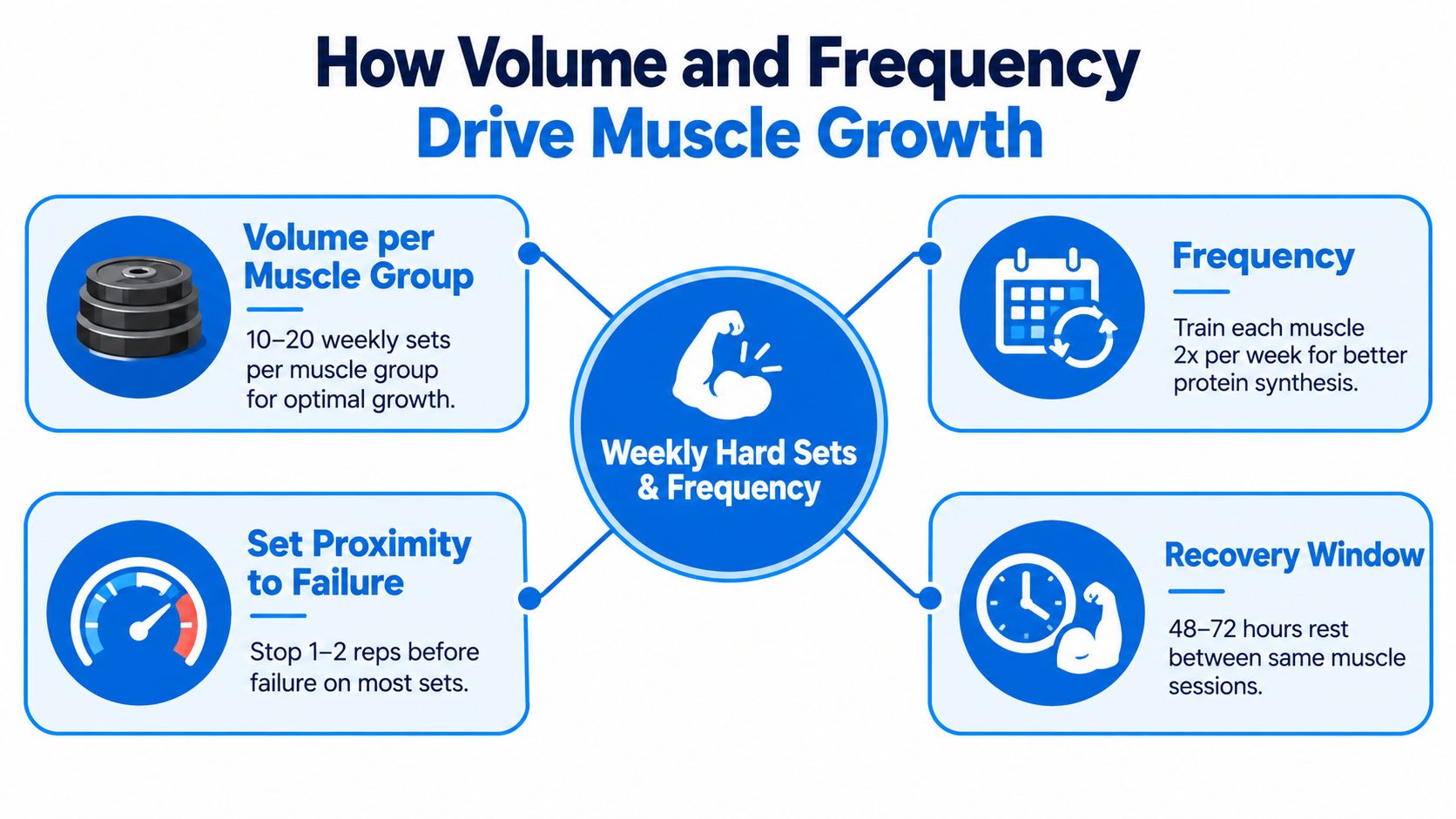
Volume is the main driver
A later systematic review and meta-analysis found that when total training volume is equated, frequency alone does not meaningfully change hypertrophy. The same review concluded that a practical weekly target for muscle growth is about 10 sets per muscle group, and it noted that hypertrophy can be achieved across roughly 30 to 100% of 1RM if sets are taken close to failure (systematic review on volume-equated frequency and hypertrophy).
That changes how you should think about a five-day plan. Five days is not magic. It's just a scheduling tool that can help you place enough hard sets where they'll be effective.
An umbrella review of 178 primary studies strengthened that point. It concluded that weekly training volume is the strongest programming variable for hypertrophy, while frequency did not meaningfully change muscle growth when volume was equated. For practical programming, that review supports aiming for roughly 12 to 20 hard sets per week for each major muscle group and progressing load or reps over time instead of assuming more training days will solve the problem (umbrella review on hypertrophy programming variables).
What that means in the gym
If you train chest on only one day and try to pack all of its weekly work into that session, the first few sets usually look great. Then performance drops. Reps slow down, setup gets sloppier, and the later sets become lower-quality work.
Spreading that work over the week usually solves the problem. That's why many strong five-day hypertrophy plans expose each muscle group more than once per week, but they do it to improve set quality and recovery, not because frequency itself has magical muscle-building powers.
A practical setup looks like this:
Chest: Split weekly work across two sessions instead of one huge chest day.
Back: Use one heavier pull-focused day and one upper or full-body day with rows or pulldowns.
Quads and hamstrings: Hit them hard on leg day, then add secondary work later in the week.
Delts and arms: Recover fast enough that they often respond well to repeated exposure when total work is controlled.
More days should give you better reps, better exercise quality, and better fatigue management. If they only give you more soreness, the plan is poorly built.
Hard sets matter more than calendar loyalty
A productive hard set is one taken close enough to failure that the target muscle has to work. That doesn't mean taking every set to all-out failure. It means avoiding the common mistake of stopping a set so early that it barely counts as growth work.
For most lifters, the most useful question isn't “What split is best?” It's “How do I place enough hard sets across the week so I can repeat strong performance?” If you want a deeper look at rep selection inside those sets, this guide on the best rep range for muscle growth is a useful companion.
Choosing the Right 5 Day Split for Your Goals
Not all five-day splits do the same job. Some are better for balanced development. Some are better for bringing up weak points. Some just create overlap and junk fatigue.
The right choice depends on how well you recover, what body parts need more work, and how much technical skill you have on the big lifts.
The three split structures that make sense
Here are the three versions I use most often for hypertrophy-focused lifters.
Which 5 Day Split Fits You Best | |||
|---|---|---|---|
Split Structure | Muscle Exposures Per Week | Best For | Recovery Demand |
Push Pull Legs plus Upper Lower | Most major muscle groups get repeated exposure across the week | Lifters who want balanced size and good exercise distribution | Moderate to high |
Classic Body-Part Split with Strategic Overlap | Main muscle gets one priority day plus smaller secondary touches elsewhere | Advanced lifters with clear weak-point goals | Moderate |
Upper Lower Push Pull Legs Hybrid | Upper and lower work start the week, then targeted sessions finish it | Lifters who want structure and simpler scheduling | Moderate |
Push Pull Legs plus Upper Lower
This is usually the most effective all-around option for building muscle on five days.
You get your dedicated push, pull, and leg sessions early in the week. Then the upper and lower sessions let you add targeted volume where it belongs. Chest can be trained hard on push day and touched again on upper day. Hamstrings can get direct work on leg day and another smaller dose on lower day.
This split works well because it treats the week like a distribution problem. You aren't trying to “destroy” a body part in one session. You're trying to accumulate enough quality work.
Classic body-part split with overlap
This is the old-school version people think of first. Chest day, back day, shoulder day, leg day, arm day.
It can work, especially for experienced lifters who know how to create secondary stimulus on other days. For example, chest also trains front delts and triceps. Back work also trains biceps and rear delts. If that overlap is intentional, the split can be productive.
If it isn't intentional, people waste time. They hit chest once, annihilate it with too much work, and then wait a full week to train it again. For many non-elite lifters, that's not the best use of five sessions.
A 2025 review summarized in this discussion of five-day split frequency and volume trade-offs reported that hypertrophy differences flatten after about 3 sessions per muscle per week, which supports a more measured approach. More sessions aren't automatically better. Better-placed work is better.
Upper Lower Push Pull Legs hybrid
This version gives you a clean start to the week. One upper session. One lower session. Then more targeted push, pull, and leg work later.
I like this for lifters who want flexibility. If a week gets messy, the first two sessions still cover the whole body in a structured way. The later sessions build on that base rather than making the week feel ruined if one workout moves.
The best five-day split is the one that lets you repeat strong output across the entire week, not the one that looks hardest on a screenshot.
How to choose without overthinking it
Use these decision points:
Pick Push Pull Legs plus Upper Lower if you want the best blend of balance, repeated stimulus, and exercise variety.
Pick the classic body-part split if you're experienced, know your weak points, and can manage overlap deliberately.
Pick the upper lower hybrid if your week changes often and you need the first half of the week to anchor everything.
For most readers trying to build visible muscle, I'd start with the first option. It's easier to control fatigue and easier to assign volume where it belongs.
Your Complete 5 Day Muscle Building Template
Here's the version I'd hand to a lifter who wants a practical 5 day workout plan to build muscle without turning training into guesswork. It uses a Push, Pull, Legs, Upper, and Full Body Accessory structure because that setup makes weekly volume easier to distribute and easier to recover from.
Start by seeing the flow of the week.
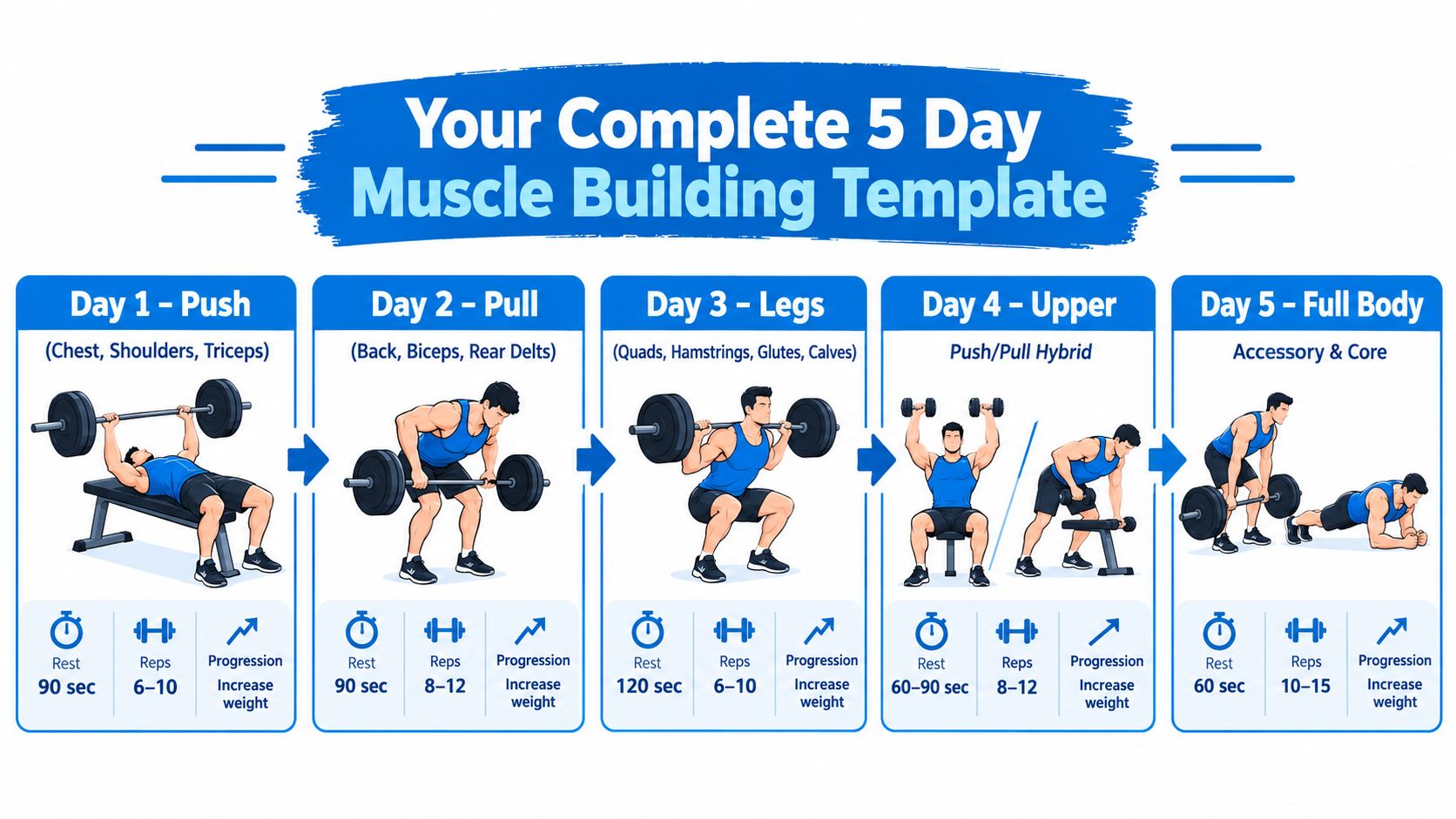
Weekly schedule
A simple layout looks like this:
Day 1: Push
Day 2: Pull
Day 3: Legs
Day 4: Rest or light mobility
Day 5: Upper
Day 6: Full Body Accessory and Core
Day 7: Rest
If your schedule works better with five straight training days, you can do that, but most lifters perform better with a break after legs or before the final two sessions.
Day 1 push
Focus on chest, front delts, side delts, and triceps.
Barbell bench press
Use controlled, hard working sets in a moderate rep range.Incline dumbbell press
Keep the bench angle modest and control the lowering phase.Seated dumbbell shoulder press
Don't turn this into a standing full-body grind.Cable lateral raise
Train side delts with tension, not momentum.Cable fly or pec deck
Use this for chest volume without beating up your shoulders.Triceps pressdown
Smooth reps, full lockout, no body swing.Overhead triceps extension
Good choice for long-head triceps work.
Use lower reps on the first compound and moderate to higher reps on the rest. Rest longer on pressing compounds and shorter on isolation work. If you want more chest-and-triceps exercise ideas, this chest and tricep workout routine pairs well with this setup.
Day 2 pull
Train lats, upper back, rear delts, and biceps.
Start with a row or pulldown that you can load progressively. Then add a second pull from a different angle. After that, bring in rear-delt and biceps work.
A strong sequence looks like this:
Chest-supported row
Lat pulldown or pull-up
Single-arm cable row
Reverse pec deck or rear-delt fly
Barbell curl
Hammer curl
This day shouldn't wreck your lower back. If every pull day turns into spinal fatigue, your exercise selection is off.
Here's a useful benchmark. Rows and pulldowns should feel like back work first. If your forearms and ego take over, reduce load and clean up execution.
Day 3 legs
This is your high-output lower-body day. Build it around one squat pattern, one hinge, and a mix of unilateral and machine-based volume.
A productive leg day often includes:
Back squat or hack squat
Romanian deadlift
Leg press or split squat
Leg curl
Leg extension
Standing or seated calf raise
Keep the first two lifts technically tight. Don't chase exhaustion early and ruin the rest of the session. Quads and hamstrings both need quality work, not just a brutally hard first exercise.
If your leg day leaves you too cooked to train hard again later in the week, cut a little volume from compounds and move some of it to the fifth day.
Take a quick look at the weekly structure before moving on.
Day 4 upper
This session is where a five-day plan starts separating itself from a weaker four-day setup. You can revisit pressing and pulling patterns without repeating the exact same stress.
Use exercises that complement the earlier sessions:
Incline machine press or dumbbell press
Cable row or machine row
Pulldown variation
Machine shoulder press or lateral raise
Chest-supported rear-delt raise
EZ-bar curl
Skull crusher or cable extension
This is not a max-effort day. It's a volume distribution day. The goal is to accumulate more productive work for upper-body muscles with less joint stress than your heavier earlier sessions.
Day 5 full body accessory and core
This final day fills gaps.
Use it to add targeted work for muscles that recover well or lag behind. For most lifters that means delts, arms, calves, abs, and sometimes extra upper-back or hamstring work. You can also include a lighter hinge or machine-based lower-body movement if recovery is good.
A sample setup:
Hip thrust or back extension
Leg curl or calf raise
Cable lateral raise
Cable fly or machine chest press
Straight-arm pulldown or machine pullover
Rope curl
Rope pushdown
Hanging knee raise or cable crunch
Sets reps and progression
The exact number of sets per exercise should serve the bigger goal. You're trying to land enough total weekly work for each muscle group, not make every exercise equally important.
Use this framework:
Primary compounds: moderate reps, harder loading, longer rest
Secondary compounds: moderate reps, controlled tempo
Isolation work: moderate to higher reps, shorter rest, strong muscle tension
For beginners, keep exercise count lower and repeat movements long enough to learn them. For intermediates, add more accessory volume where needed. Advanced lifters can use the fifth day aggressively, but only if joints, sleep, and performance stay stable.
A few execution rules matter more than people think:
Keep compounds early: Do your skill-demanding, loadable lifts first.
Don't rush rest periods: Short rests on heavy compounds usually reduce output, not increase growth.
Track every working set: If you don't know how many hard sets each muscle got, you're guessing.
Leave a little room on most sets: Train hard, but don't turn every exercise into an all-out grinder.
Progression Recovery and Nutrition Tips That Make It Work
A template only builds muscle if you can progress on it. That means your plan needs rules for load, effort, recovery, and food.
Here's the practical side that keeps a five-day split productive instead of draining.
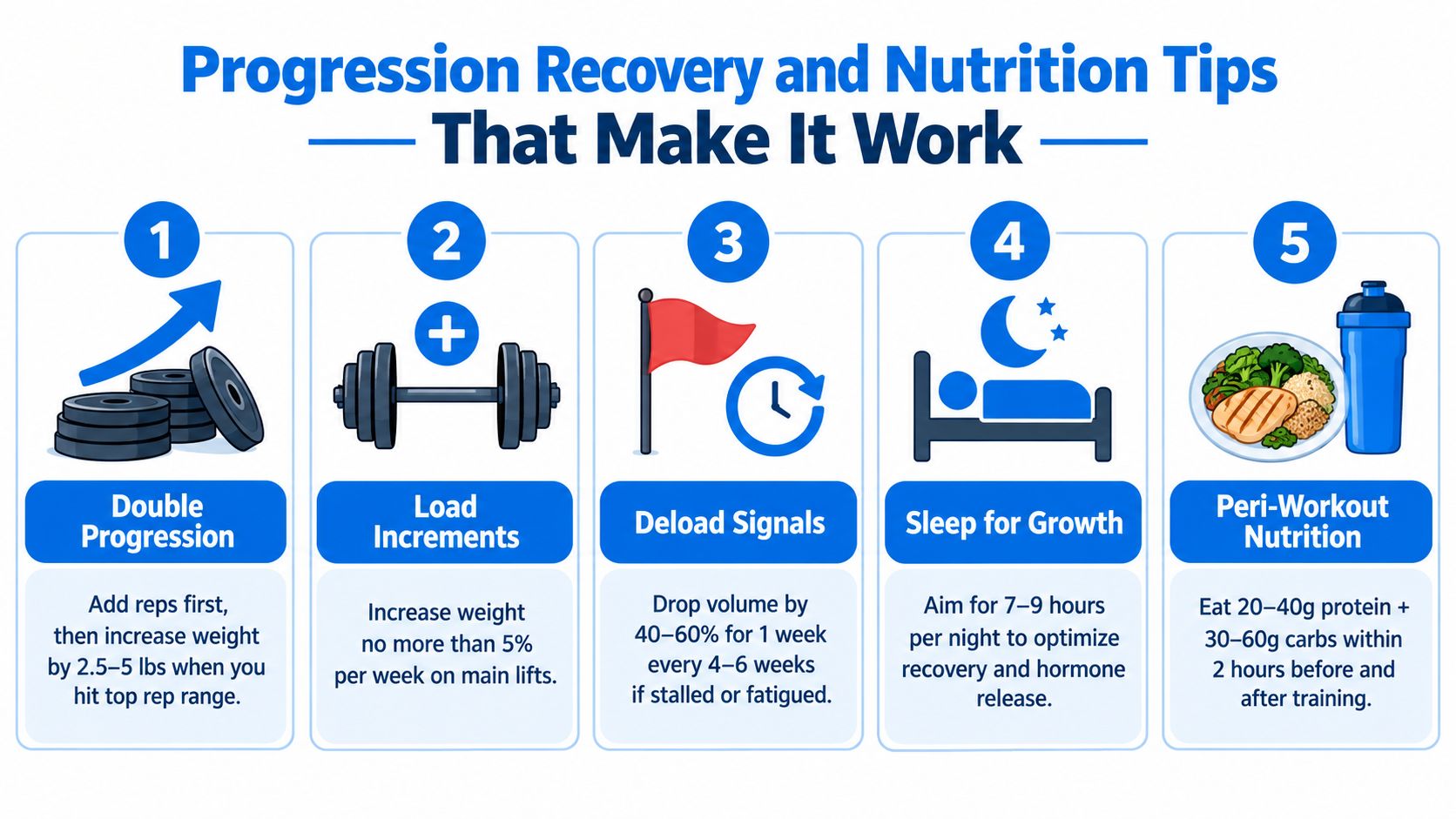
Progress with a repeatable system
The easiest method is double progression.
Pick a rep range for an exercise. Keep the same load until you reach the top of that range across your planned working sets with solid form. Then increase the weight the next time that exercise comes up and build again from the lower end of the range.
That system works because it keeps you honest. You're not adding load just because the week changed. You're adding load because performance improved.
Coaching note: If your form changes more than the number on the bar, you didn't progress. You just changed the rep.
Recover like someone training five days
A five-day plan asks more from your recovery habits than a three-day plan. That doesn't mean recovery has to be complicated. It means it has to be consistent.
Keep these basics in place:
Sleep matters first: If sleep is erratic, your output across the week usually drops before motivation does.
Place hard days intelligently: Don't stack overlapping stress on the same joints and muscle groups without a reason.
Watch performance trends: If lifts stall across several sessions and soreness lingers, reduce fatigue before adding more work.
Use deloads when needed: If everything feels heavy, pumps disappear, and your normal working weights feel flat for too long, pull volume back for a short stretch.
Shift workers and busy professionals usually do better when they stop chasing a perfect weekly calendar. Use the available training windows that let you show up alert, fed, and able to push hard. That's where 24/7 gym access can help because you can place sessions around real recovery instead of squeezing them into the same rushed hour every day.
Eat in a way that supports the plan
Nutrition doesn't need to be fancy, but it does need to match your workload.
Center your eating around these priorities:
Get protein in regularly: Each meal should help support recovery and muscle repair.
Use carbs around training if performance matters: They help a lot on leg day and higher-volume upper sessions.
Don't ignore post-workout convenience: A simple shake or meal you'll have is more useful than an elaborate plan you skip.
For practical post-lifting ideas, this guide on what to eat after lifting weights gives solid options. If you train before work or between obligations, quick coffee, smoothies, or protein shakes from an in-gym cafe can make staying consistent much easier than relying on whatever you find later.
Start Your 5 Day Muscle Building Journey This Week
The lifter who gets the most from a five-day split usually doesn't train the hardest on day one. They train the smartest across the whole week.
That's the shift that matters. Don't judge your plan by how packed each workout looks. Judge it by whether each major muscle gets enough hard work, whether your performance holds up from session to session, and whether recovery lets you repeat that effort next week.
Your first-week checklist
Use this simple launch plan:
Choose one split and keep it: Don't bounce between body-part splits and hybrids every week.
Write down weekly target sets by muscle: Chest, back, delts, quads, hamstrings, glutes, arms, calves.
Build around exercises you can progress: Fancy variation swaps every session make tracking harder.
Leave the gym wanting one more good set: That's a better starting point than burying yourself.
Track sleep, session quality, and sore spots: Recovery data matters as much as load.
Give the plan enough time to work. Stay with one structure long enough to see whether lifts improve, whether muscles are getting enough quality work, and whether your body is recovering from the weekly demand. If five days helps you distribute volume better and train more consistently, it can absolutely outperform a shorter split. If it only adds fatigue, scale the work, not your effort.
Empire Athletics gives Central Massachusetts lifters 24/7 gym access, modern strength equipment, certified one-on-one personal training, and an on-site cafe with coffee, smoothies, and shakes that fit this kind of muscle-building routine. If you want help turning a five-day schedule into a plan that matches your recovery, training age, and goals, visit Empire Athletics.