Why Strength Training Is Important for a Longer Life
Discover why strength training is important for longevity, metabolism, and daily health — with evidence-backed benefits and a practical weekly plan.

Even modest resistance training is associated with a 15% lower risk of all-cause mortality, meaning strength work is a health behavior, not merely a way to change your appearance. It's also linked with lower cardiovascular and cancer mortality risk compared with doing no resistance training.
That finding changes the question. Strength training isn't reserved for bodybuilders, athletes, or people who enjoy spending long evenings in a gym. It's a practical way to build the physical capacity that helps you move, manage glucose, protect independence, and remain capable as you age.
Cardio matters, but it doesn't replace muscle-strengthening work. Walking and cycling challenge your heart and lungs. Resistance training asks your muscles, bones, connective tissue, and nervous system to handle force. You need both forms of fitness for a body that can perform today and keep performing later.
The useful question isn't, “Do I want to look stronger?” It's, “Do I want to stay stronger?”
More Than Muscle, The Real Case for Lifting
The strongest argument for strength training starts with prevention. A 2022 systematic review and meta-analysis found that any amount of resistance training was associated with a 15% lower risk of all-cause mortality, a 19% lower risk of cardiovascular disease mortality, and a 14% lower risk of cancer mortality compared with no resistance training, as reported in the published PubMed review.
Those figures don't mean lifting guarantees a longer life, and they don't prove that resistance training alone caused every difference between groups. They do show a meaningful association across population-level evidence. Strength work belongs in the same health conversation as sleep, nutrition, aerobic activity, and avoiding tobacco.
Muscle is protective infrastructure
Think of muscle as infrastructure, not decoration. Stronger legs help you rise from a chair, climb stairs, and recover your balance. Stronger shoulders and back make it easier to carry groceries or place luggage overhead. Better trunk strength can make everyday movement more controlled and less demanding.
Muscle also acts like a metabolic engine. It produces force, stores energy, and responds to insulin. When you train it, you're improving more than the shape visible in a mirror. You're investing in the machinery that supports movement and metabolic health.
That's why a person can benefit from strength training without wanting larger arms or a lower number on a scale. The outcome may be a more confident walk, an easier time getting off the floor, or the ability to keep living independently.
A health habit with a manageable entry point
The World Health Organization includes muscle-strengthening activity in its guidance for adults, recommending work that involves all major muscle groups on 2 or more days per week. WHO also reports that nearly one third of adults worldwide, about 1.8 billion people, were physically inactive and didn't meet its recommended amount of moderate-intensity activity, as explained in its physical activity fact sheet.
You don't need an athlete's program to begin. You need a repeatable routine that challenges your muscles and fits your life. The evidence, the guidelines, and the practical benefits all point in the same direction: strength is a basic part of long-term health.
What Strength Training Does to Your Body
Strength training gives your body a demand it does not normally face. You lift, push, pull, squat, hinge, or resist movement against an external load. In response, your muscles, nervous system, bones, and connective tissues adjust so they can handle that demand with greater control.
The process resembles adding capacity to a savings account. Each well-managed session deposits a small improvement in force, coordination, or tissue tolerance. Over time, those deposits can support movement and independence, including during the later years when everyday tasks may require more effort.
The adaptation process
Cardio mainly challenges how efficiently your heart, lungs, and circulation deliver and use oxygen over time. Strength training focuses more directly on force production. The two overlap, but their primary adaptations differ.
Resistance exercise can stimulate several changes:
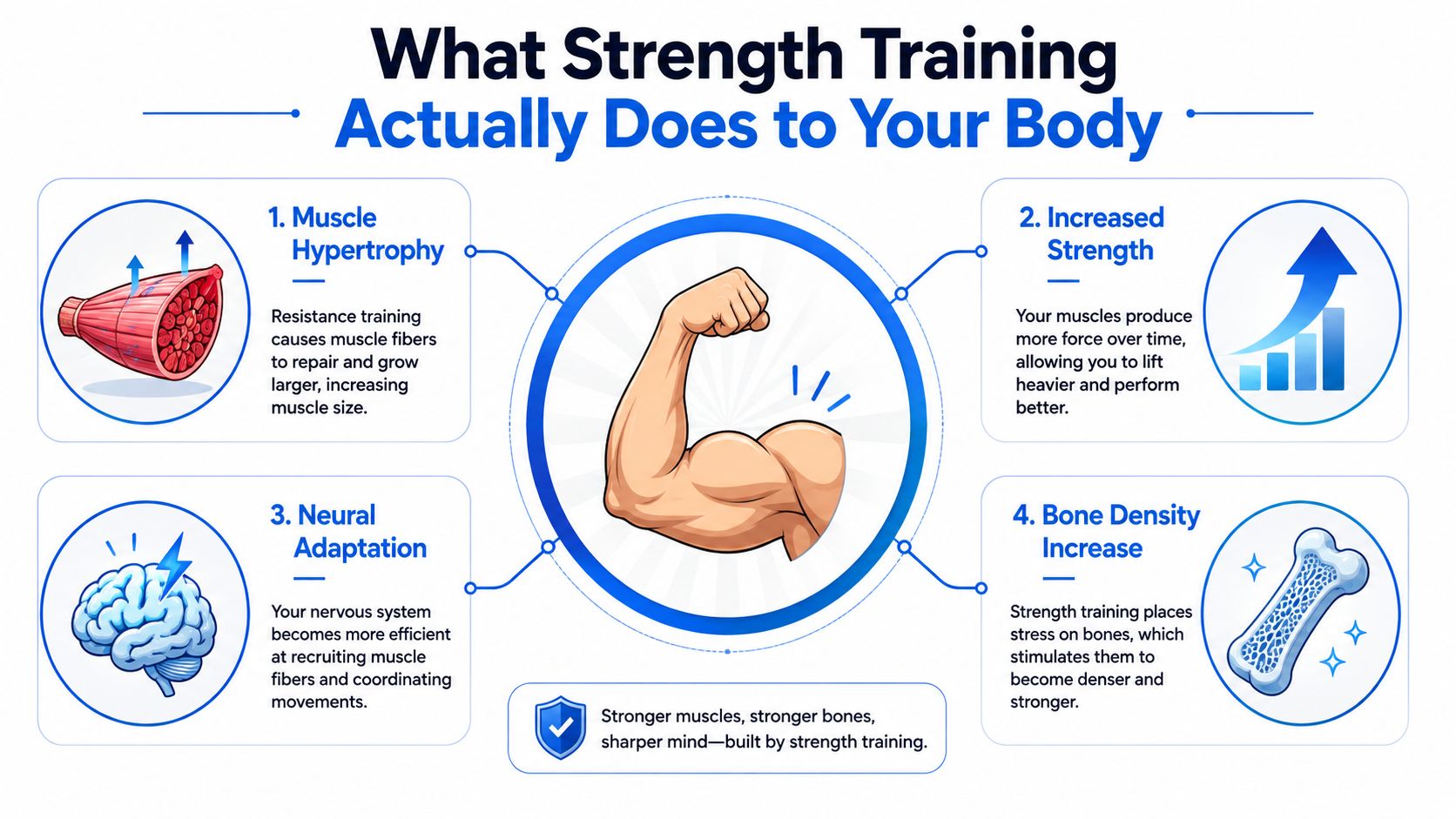
Muscle hypertrophy: Muscle fibers can increase in size when training and recovery provide an appropriate stimulus.
Increased strength: Your body becomes better at producing force against a challenging load.
Neural adaptation: Your nervous system learns to coordinate muscle activity more effectively. Beginners can therefore become stronger before they look visibly different.
Bone and connective-tissue support: Appropriate loading gives bones, tendons, and other supporting tissues a reason to adapt.
Practical rule: The exercise only needs to be difficult enough to require adaptation, not so difficult that you lose control.
Why progressive overload matters
Progressive overload means gradually increasing the challenge. Adding weight is one option, but you can also perform more controlled repetitions, use a longer range of motion, reduce assistance, or improve stability.
Beginners often worry about choosing the perfect routine or rep range. A consistent plan using safe technique matters more at first than fine-tuning every variable. For more context on repetitions and muscle growth, read this guide to the best rep range for muscle growth.
The everyday result is straightforward. A movement that once required maximum effort becomes more manageable because your muscles can produce more force and your nervous system has learned to coordinate it efficiently. Even a modest weekly routine can build useful capacity without requiring bodybuilding-level volume.
The Longevity Evidence Behind Strength Training
Those findings place resistance training alongside established health behaviors, including for people focused on long-term function rather than physique goals. In the 2022 review, people who performed resistance training had a lower observed risk of dying from any cause than those who did none. The comparison included resistance training as a broad activity, not only competitive lifting or extreme programs.
The largest observed risk reduction, 27%, appeared at about 60 minutes per week. That result does not establish a universal prescription, but it challenges the idea that strength training matters only after hours under a barbell. A modest weekly dose can still support long-term health.
Heart health belongs in the conversation
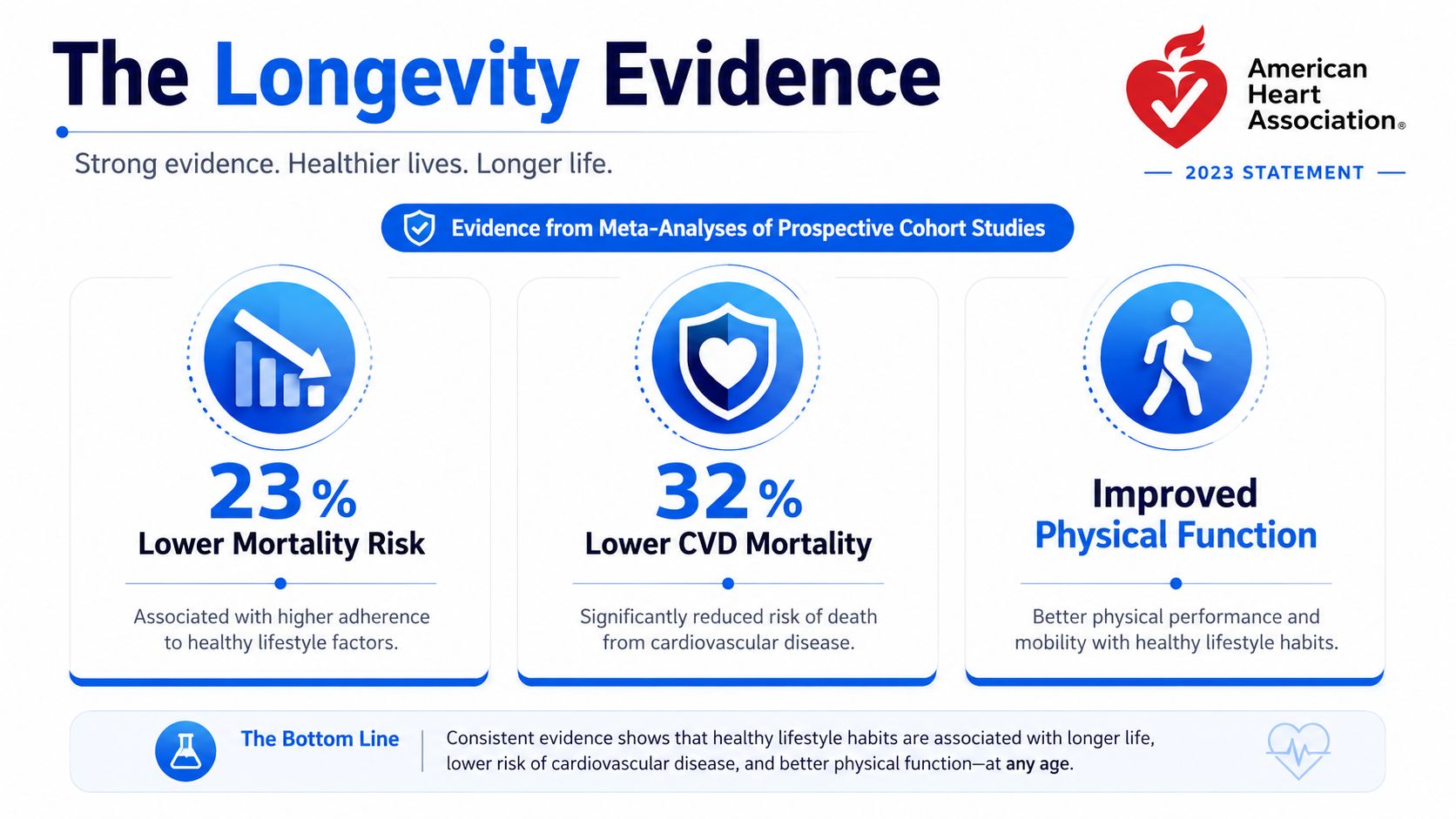
The American Heart Association's 2023 scientific statement reported that adults who performed resistance training had about a 15% lower risk of all-cause mortality and a 17% lower risk of cardiovascular disease than adults who did no resistance training. Strength work therefore belongs in a broader health routine, rather than being treated only as a way to change appearance.
A separate systematic review found that 1 to 2 sessions per week, totaling about 60 to 150 minutes, was linked with approximately 20% to 25% lower all-cause mortality and cardiovascular disease risk, as well as approximately 30% lower type 2 diabetes risk, according to the British Journal of Sports Medicine analysis.
These findings show associations, not guarantees. Outcomes vary with health status, training quality, recovery, and other behaviors. Their consistency still supports a practical conclusion: regular resistance exercise can contribute to the physical reserve needed for a longer, more independent life.
An international recommendation
WHO recommends muscle-strengthening activities involving all major muscle groups on 2 or more days per week. Its guidance also reports that the proportion of inactive adults rose by 5 percentage points between 2010 and 2022 and could reach 35% by 2030 if current trends continue, as described in the WHO guidance.
The practical message is simple. Strength training is part of public-health guidance because maintaining strength gives people more capacity for daily tasks, recovery, and independence as they age. About an hour per week may be a meaningful starting point, even without bodybuilding-level volume.
Your Metabolism and Blood Sugar on Strength Training
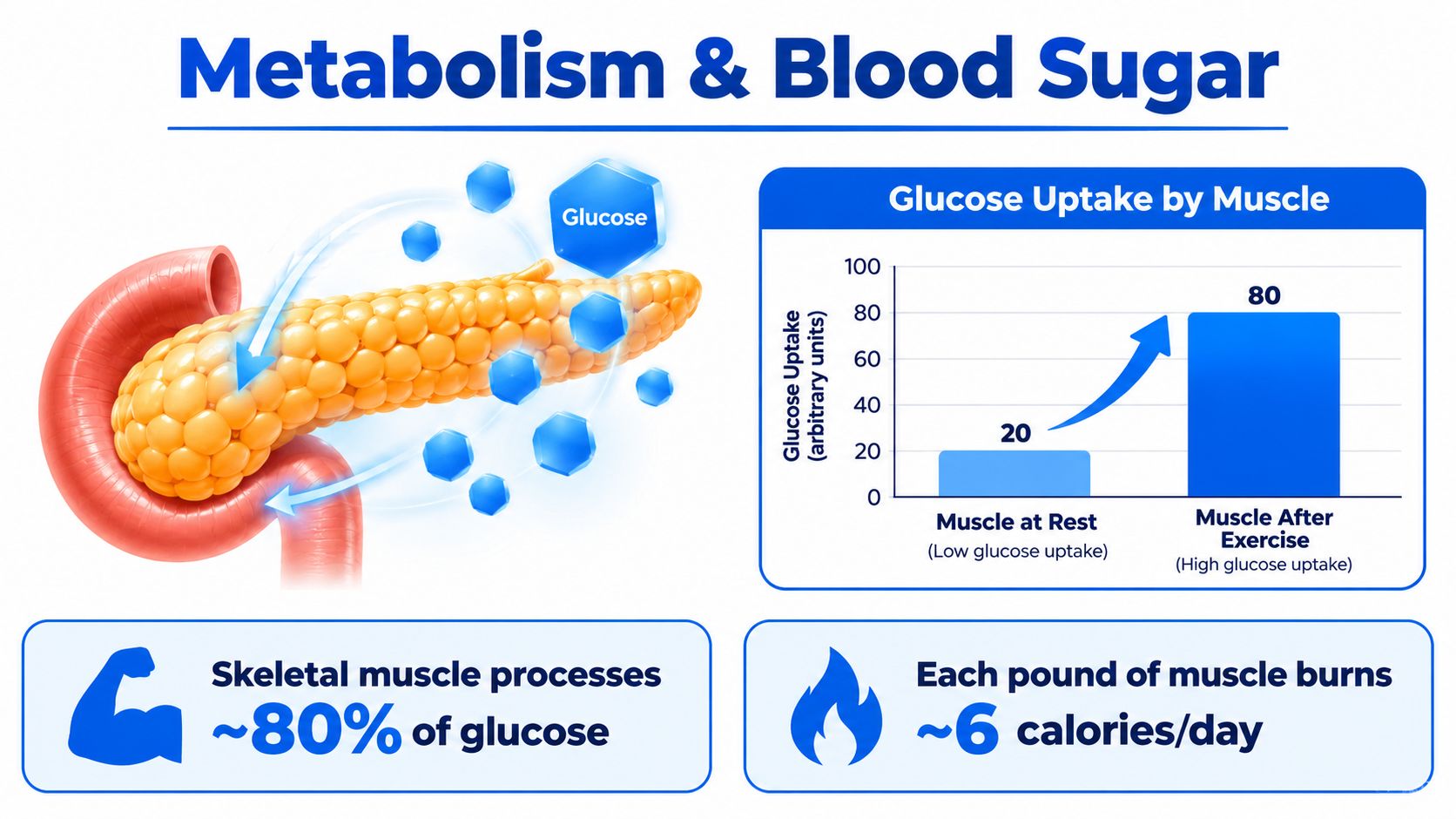
Your muscles aren't passive tissue. They're a major place where your body handles glucose, the fuel circulating in your blood after you eat. When muscles contract, they draw on available energy and can improve the body's ability to manage blood sugar over time.
That's why the “muscle as an engine” analogy matters here. A stronger engine can do more work. It can also become better at handling the fuel required for that work, especially when training is progressive and paired with adequate recovery.
Resistance training and diabetes risk
The systematic review discussed earlier linked 1 to 2 weekly sessions, or about 60 to 150 minutes, with approximately 30% lower type 2 diabetes risk, as reported in the British Journal of Sports Medicine review. The proposed mechanism is that resistance exercise helps increase or preserve skeletal muscle mass and strength, supporting metabolic health and lowering non-communicable disease risk.
That doesn't mean strength training makes nutrition, medication, or medical care irrelevant. For someone with insulin resistance, prediabetes, or type 2 diabetes, training should fit their health status and treatment plan. It does mean muscle is an active target for improving glucose handling, rather than just a visual feature.
What HbA1c findings mean
A meta-analysis of resistance training reported that HbA1c fell by about 0.39 percentage points versus controls, and that larger strength gains were associated with larger HbA1c reductions, according to the Diabetes Research and Clinical Practice analysis.
HbA1c reflects average blood glucose over time. The practical lesson isn't that a specific exercise guarantees a specific laboratory result. It's that improving muscular strength may improve the body's capacity to process glucose, making progressive overload relevant to health as well as performance.
Resistance training can also support body composition, but it shouldn't be sold as a magic calorie-burning shortcut. Its most important metabolic value is the muscle tissue you maintain and develop, and the improved function that tissue can provide.
If you're planning meals around training, this guide to what to eat after lifting weights can help you think about recovery without turning every workout into a nutrition puzzle.
Aging Strong, Independence, Bones, and Mental Health
Strength becomes more valuable when daily life becomes less forgiving. A young person may recover from an awkward lift or a missed step without much consequence. Later in life, the same task can determine whether someone carries their own bags, rises from the floor, or needs help at home.

Muscle-strengthening exercise is associated with improved function in daily life, lower all-cause mortality, better cardiometabolic health, and benefits for depression and anxiety, according to this review of muscle-strengthening activity. For older adults, the payoff often has little to do with appearance. It's about preserving the ability to move through ordinary situations without assistance.
Strength as a savings account
Treat strength like a savings account for old age. Each session is a small deposit into your reserve of force, balance, coordination, and confidence. You may not notice the full value while everything feels easy, but the reserve can matter when illness, inactivity, travel, or an unexpected stumble places extra demands on your body.
Resistance training also loads bones and the tissues that support joints. That loading is one reason strength work is relevant to bone health and physical stability, although anyone with osteoporosis, pain, or a medical condition should seek appropriate professional guidance before starting.
A person in their 50s might train to keep hiking. Someone in their 60s might want to lift a grandchild safely. Someone older might focus on standing from a chair, walking steadily, and maintaining confidence. The exercises can differ, but the goal is shared: keep capability available.
Here's a practical way to connect training with life:
Lower-body strength: Supports standing, stairs, walking, and getting up from the floor.
Upper-body strength: Helps with carrying, pushing doors, lifting luggage, and household tasks.
Trunk control: Helps you transfer force and move with greater stability.
Balance and coordination: Help you respond when your footing changes.
A stronger body can also support mental well-being by making movement feel less threatening and daily tasks less exhausting. Strength doesn't solve every emotional challenge, but it can give people a structured activity, a sense of progress, and more confidence in their physical abilities.
This short video offers a visual example of strength-focused movement:
How Much Strength Training Is Actually Enough
Many people reject strength training before trying it because they assume it requires long workouts, heavy barbells, and a complicated weekly split. Public-health guidance is less demanding. Adults should perform muscle-strengthening activity at least 2 days per week, and one set per exercise can provide health and fitness benefits, as outlined by Mayo Clinic's strength-training guidance.
Recent coverage also points to a possible longevity sweet spot around 90 to 120 minutes per week, suggesting that more training isn't automatically better for every person. The practical priority is a dose you can repeat, recover from, and maintain during busy periods.
Recalibrate the common assumptions
Common Belief | What Evidence and Guidance Say |
|---|---|
More is always better | A modest, consistent weekly dose can provide important health value. |
Only heavy lifting counts | Controlled resistance using appropriate equipment can challenge muscles effectively. |
One set is pointless | One set per exercise can already provide health and fitness benefits. |
You need long gym sessions | Two or three shorter sessions can fit the broader weekly guidance. |
Beginners need advanced programming | A simple full-body routine is enough to build a reliable starting habit. |
The minimum effective dose isn't the maximum possible dose. Experienced lifters may choose more volume for muscle growth or performance, but general health doesn't require everyone to train like a competitive athlete.
Build around consistency
A busy worker may complete a short session before work. A shift worker may train after a late shift when a conventional gym is closed. An older adult may prefer supported machines, lighter resistance, and longer recovery between sessions.
The best plan is the one that respects your starting point. If pain, a chronic condition, or a long period of inactivity affects you, professional guidance can help you choose appropriate exercises and loading. You're not trying to win a lifting contest. You're building a habit that keeps paying dividends.
Getting Started, Your First Weeks of Lifting
Start with two full-body sessions per week. Each session can include a squat pattern, hinge pattern, push, pull, and carry, using machines, dumbbells, resistance bands, or body weight according to your ability.
Choose a load you can control for roughly 8 to 12 repetitions, keep your technique steady, and stop before form breaks down. Progress gradually by adding a small amount of resistance, improving control, or completing another comfortable repetition.
A simple first-week checklist looks like this:
Schedule two sessions before the week begins.
Learn one safe variation for each movement pattern.
Record the exercise, resistance, and repetitions.
Leave enough recovery time between sessions.
Notice how everyday movements feel, not only how much you lift.
Mobility can make certain patterns more comfortable. If squatting feels restricted, review these hip mobility exercises for squats and consider working with a qualified professional on your movement limitations.
Practical barriers have practical solutions. Empire Athletics provides 24/7 access, modern strength and cardio equipment, certified one-on-one personal training, and an on-site cafe with coffee, smoothies, and protein shakes at locations in Leominster, Lunenburg, and Webster. That combination can help beginners who need coaching, busy adults with unpredictable schedules, and experienced lifters who want a structured place to train.
Visit Empire Athletics to explore 24/7 gym access, certified personal training, and strength equipment designed for different starting points and goals. Choose the Central Massachusetts location that fits your routine, then make your first appointment or training visit the next deposit into your long-term strength reserve.