Kettlebells for Fat Loss: Workouts That Actually Work
Explore how kettlebells for fat loss really work, with sample workouts, intensity tips, and how they compare to running, cycling, and dumbbells.

A controlled kettlebell snatch workout averaged 13.6 calories per minute aerobically, or 272 calories over 20 minutes, with an estimated 6.6 additional calories per minute from anaerobic work, for roughly 20.2 calories per minute in total according to the original kettlebell snatch study. That sounds like the perfect fat-loss tool, but it doesn't answer the question most gym members need answered.
Can you use kettlebells consistently, recover from them, and fit them into a week well enough to lose fat?
As a coach, I'm less interested in the biggest calorie number a workout can produce than in whether a regular person can repeat it without pain, dread, or a technique breakdown. Kettlebells can build strength, challenge your cardiovascular system, and make short sessions productive. They also don't magically outperform running, erase a poor diet, or make advanced exercises necessary.
Why People Reach for a Kettlebell When They Want to Lose Fat
A member once walked into the gym with eight weeks before a vacation and a simple request: “Can I swing this instead of running?”
They had two dumbbells, a treadmill, and a kettlebell that had been collecting dust. They'd heard that kettlebells torch calories, liked the idea of a full-body workout in a small space, and wanted a plan that wouldn't consume their evenings. The issue wasn't whether a kettlebell could make them tired. It could. The issue was whether that fatigue would translate into training they could sustain.
That distinction matters. Kettlebells for fat loss appeal to time-pressed people because one tool can cover a hinge, squat, carry, press, and rotationally demanding conditioning pattern. Swings look simple, but they require coordinated hip power, trunk control, grip, and breathing. A well-designed session feels like strength training and cardio occupying the same block of time.
A small footprint also removes practical friction. You don't need a rack of machines, a long treadmill run, or a complicated exercise menu. For someone training in a garage, apartment, hotel room, or busy gym corner, that convenience can determine whether the session happens at all.
Coach's observation: The workout that gets repeated for months is more valuable than the punishing session someone abandons after two attempts.
The comparison still needs to be honest. Running may burn more calories per minute at a matched effort, cycling may be easier on irritated joints, and dumbbell circuits can deliver a similar resistance-training effect. Kettlebells earn their place by combining a meaningful muscular demand with cardiovascular stress while keeping setup simple.
For a deeper explanation of why resistance work belongs in a fat-loss plan, see this guide to why strength training is important. The practical question isn't whether kettlebells are special. It's whether their blend of efficiency, challenge, and convenience makes adherence easier for you.
What Fat Loss Actually Requires From Your Training
Fat loss requires a sustained energy deficit. Your body has to use more energy over time than it receives from food and drink, and no exercise tool can bypass that basic requirement.
Training still matters because it changes what happens while body weight comes down. Resistance work gives your muscles a reason to stay strong, raises your total activity, and improves your capacity to perform demanding work. Cardio can increase energy expenditure and improve fitness. Food choices influence the energy balance that determines whether fat loss continues.
The four pillars that support progress
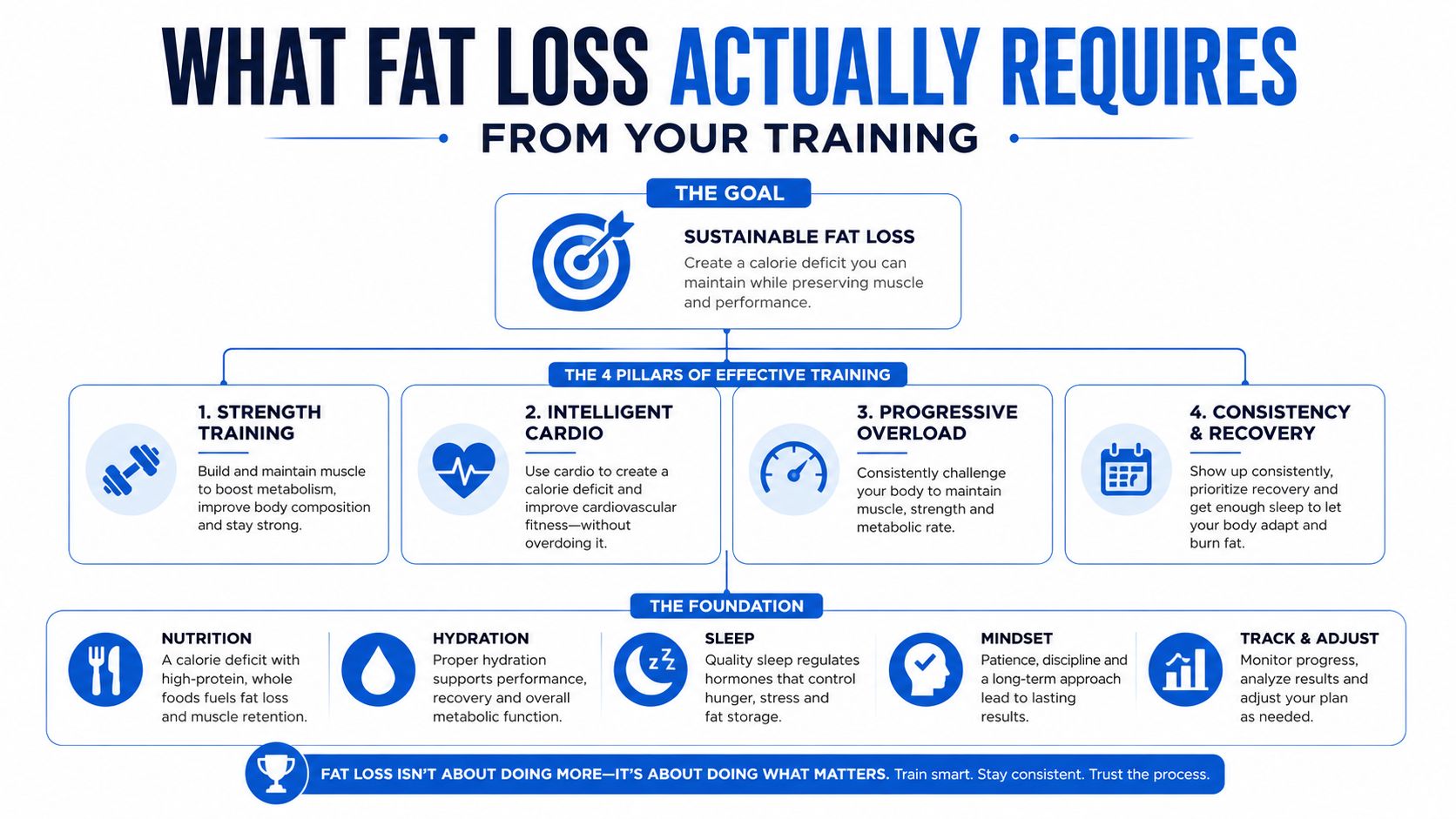
A hard workout can contribute to the deficit, but people often overestimate how much a single session controls the result. A kettlebell circuit may add substantial work, while a little extra walking may add only a modest amount. Both count, but they shouldn't be treated as interchangeable.
Daily movement also affects the outcome. If an exhausting workout leaves you sitting for the rest of the day, the increase in total daily activity may be smaller than expected. If a manageable workout helps you feel capable and active, it may support more movement outside the gym.
The same principle applies to eating after training. You'll want enough food to recover and enough structure to maintain the deficit, rather than treating every demanding session as permission to eat without limits. This guide to what to eat after lifting weights covers the recovery side without turning one workout into a nutritional blank cheque.
A training tool can do four useful things:
Raise energy expenditure: Kettlebell work adds purposeful physical activity.
Preserve lean mass: Squats, presses, carries, and hinges provide resistance that cardio alone may not.
Improve work capacity: Repeated efforts become easier to perform and recover from.
Make adherence easier: Short, simple sessions reduce barriers.
It can't single-handedly compensate for a consistently excessive intake. The best kettlebell plan is the one that supports a sustainable deficit while keeping you strong enough, recovered enough, and motivated enough to continue.
The Case for Kettlebells Backed by Real Research
Kettlebells earn their place in fat-loss training through a practical combination: resistance work and demanding conditioning in one compact session. Their value is less about a special fat-burning effect and more about giving people a repeatable way to train hard, build strength, and fit exercise into a busy week.
The association with weight loss also has a long history. The modern kettlebell traces back to eighteenth-century Russia, while the word girya appeared in a Russian dictionary in 1704 as a market counterweight for weighing grain and goods. By 1913, a Russian fitness magazine described kettlebells as a weight-loss tool, according to this historical account of kettlebell training.
What the calorie research tells us
A snatch study recorded an average of 13.6 aerobic calories per minute and 272 calories over 20 minutes. After estimating the anaerobic contribution, the total reached about 20.2 calories per minute, which the authors compared with running at a six-minute-mile pace. Those figures belong to a specific controlled workout and study context. They should not be treated as a guaranteed result for a beginner or every swing circuit.
Training mode | Calories per minute | Calories per 30 minutes | Typical effort |
|---|---|---|---|
Kettlebell snatch workout | 13.6 aerobic, about 20.2 total estimate | About 408 aerobic, about 606 total estimate if the study rate were maintained | Very demanding |
Treadmill running at matched perceived exertion | 25 to 39% more than kettlebell swings per minute | Not specified in the evidence | Demanding |
Kettlebell swings | Lower than matched treadmill running in the comparison | Not specified in the evidence | High |
Cycling | Not specified | Not specified | Variable |
Dumbbell circuits | Not specified | Not specified | Variable |
That distinction matters for programming. A striking laboratory result can make kettlebells look superior to every other option, but adherence depends on whether a person can repeat the sessions without excessive fatigue, technical breakdown, or lost training days. Independent analysis found that treadmill running burned 25% to 39% more calories per minute than kettlebell swings at matched perceived exertion, despite similar heart-rate and effort ratings, as summarized in this analysis of kettlebell workouts and weight loss evidence.
Why body-composition outcomes still matter
Swings, cleans, and snatches train the hips, legs, trunk, upper back, shoulders, and grip. That broad demand suits intervals, while the resistance component helps make kettlebells more useful during a calorie deficit than conditioning alone.
A 2024 systematic review and meta-analysis found that kettlebell-based resistance training significantly reduced body mass and body fat compared with control groups in the included trials. In one analyzed kettlebell group, body mass fell with a large effect size of d = 1.43, while body fat fell with d = 1.34. The comparison group also changed, with body-mass and body-fat effect sizes of d = 1.07 and d = 1.53, respectively, according to the systematic review and meta-analysis.
The practical conclusion is measured. Kettlebells can support measurable body-composition change, but their strongest advantage is repeatability. They provide a compact resistance-and-conditioning routine that many people can sustain. They do not prove that every kettlebell session burns more energy than running, cycling, or a well-designed dumbbell workout.
How Kettlebells Compare to Running, Cycling, and Dumbbells
Running, cycling, kettlebells, and dumbbells can all support fat loss. The better choice depends on the effort you can sustain, how well you recover, what your joints tolerate, and which activity you will perform consistently.
At matched perceived exertion, treadmill running burned 25% to 39% more calories per minute than kettlebell swings, as noted earlier. That comparison applies to swings, not every kettlebell session, and it does not make running automatically superior. A resistance-based kettlebell workout can provide a different training stimulus, particularly when preserving strength during a calorie deficit matters.
Modality | Estimated calories per 30 minutes | Muscle preservation | Joint impact | Adherence likelihood |
|---|---|---|---|---|
Kettlebell training | Not specified | Strong potential when programmed as resistance training | Moderate, technique-dependent | Often high for people who dislike long cardio |
Treadmill running | Not specified | Limited by itself | Higher impact | High for runners, lower for people who dislike running |
Cycling | Not specified | Depends on resistance and programming | Often lower impact | High when access and comfort are good |
Dumbbell circuits | Not specified | Strong potential | Variable, exercise-dependent | High for people who prefer traditional lifting |
Selectorized machines | Not specified | Strong for trained muscles | Usually controlled | High for beginners who value simplicity |
Running
Running provides a strong cardiovascular stimulus and can work well for fat loss. Its trade-off is impact and local fatigue, especially when weekly volume increases faster than the feet, calves, knees, or hips can tolerate. People who enjoy running and recover well have no reason to replace it with kettlebells. For someone who dislikes running, however, a shorter kettlebell session may be easier to repeat.
Cycling
Cycling offers a lower-impact way to build conditioning. The main limitation is effort control. A comfortable pace can feel productive without placing much demand on the muscles, particularly on a stationary bike set with little resistance. Add resistance or intervals when the goal includes a stronger muscular challenge.
Dumbbell circuits
Dumbbell circuits resemble kettlebell training in several ways. Squats, rows, presses, and lunges can support muscle retention, while familiar loading options make progression straightforward. Dumbbell exercises often separate movements into clearer blocks. Kettlebell sequences can link exercises with quicker transitions, though that speed also demands better technique and grip control.
Machines
Selectorized machines suit beginners, people returning from injury, and anyone who needs a stable setup. They work well for targeted strength training, but a machine session does not automatically produce the whole-body breathing demand of a continuous kettlebell sequence. Machines can still fit a fat-loss week when strength work needs to be controlled and measurable.
Kettlebells occupy a useful middle ground. They do not beat running in every calorie comparison, and they are not automatically better than dumbbell circuits. Their practical advantage is combining resistance work and conditioning in a compact session. That combination can keep training manageable for members who find long treadmill workouts unpleasant. Use kettlebells when the format improves adherence, then place them alongside running, cycling, or traditional lifting according to recovery and preference.
Sample Kettlebell Workouts for Beginner, Intermediate, and Advanced
The right workout starts with movement quality, not exhaustion. Each session below has a different entry point, and none requires you to chase sloppy repetitions to make progress.
Beginner session
Use a 12 kg kettlebell if that load allows controlled squats, swings, and carries. Perform a 20-minute EMOM, completing the listed work at the start of each minute and resting for the remainder.
Minute 1: 8 goblet squats
Minute 2: 10 two-arm swings
Minute 3: Farmer's carry for the available minute, switching hands halfway if needed
Minute 4: Rest
Repeat the four-minute sequence for five rounds.
Keep the bell close during the squat, snap the hips through the swing, and walk tall during the carry. If your grip or breathing deteriorates, reduce repetitions before you lose position. Start with two sessions per week, then add a third only when your legs, back, and hands recover comfortably.

Intermediate session
Choose a bell you can press and row without twisting or leaning. Set a timer for 25 minutes and cycle through the following circuit, resting 30 seconds after each round:
12 two-arm swings
8 goblet squats
6 push presses per side
6 renegade rows per side
Use the legs to assist the push press, keep your ribs stacked over your pelvis, and widen your feet if the renegade row makes you rotate. Aim for three sessions per week. Make two sessions strength-focused and keep the third slightly easier, with cleaner reps and more deliberate rest.
Advanced session
This session is only appropriate if cleans, snatches, and Turkish get-ups are already technically reliable. Work in a 30-minute Tabata-style structure, using 20 seconds of work and 10 seconds of rest for each interval, then take a longer recovery between movement blocks.
Block 1: alternating cleans
Block 2: alternating snatches
Block 3: Turkish get-up practice, switching sides between intervals
Rest between blocks as needed to keep the bell controlled.
For advanced trainees, three to four weekly sessions can work when total lifting, running, and sport volume are accounted for. Keep Turkish get-ups slower than the ballistic movements. They're a control exercise, not a race.
Technique rule: If a movement becomes a contest between speed and position, stop the set. Fat loss doesn't require a heavier bell than your joints and technique can manage.
Programming Intensity and Frequency for Steady Fat Loss
A sustainable kettlebell week should feel challenging without making every day a test of survival. For most regular trainees, three to four sessions per week at an RPE of 7 to 8 is a practical target. That means you're working hard, but you still have enough control to repeat the session and recover for the rest of your life.
Place one or two kettlebell sessions near your strength work so the resistance stimulus supports lean-mass retention. Don't stack every demanding session together. A hard swing workout followed by heavy lower-body lifting can turn a sensible plan into repeated fatigue around the hips and lower back.

A workable weekly template
Monday: Kettlebell strength and conditioning
Tuesday: Zone-2 cycling or walking for 30 to 45 minutes
Wednesday: Traditional strength training with a short kettlebell finisher
Thursday: Recovery walk or complete rest
Friday: Kettlebell circuit at moderate-to-high effort
Saturday: Optional zone-2 cycling or walking for 30 to 45 minutes
Sunday: Rest
The progression rule is simple. First add a round or shorten rest while preserving technique. Only then consider adding weight. This approach lets your work capacity improve before the load increases.
For readers balancing muscle gain with fat loss, the best rep range for muscle growth can help you coordinate resistance work without turning every session into conditioning.
Sleep and recovery influence whether this schedule remains productive. If your performance falls, your resting soreness persists, or you start avoiding sessions, reduce intensity before adding more volume. Consistency is the training variable that matters most over time.
Pros and Cons of Choosing Kettlebells for Fat Loss
Kettlebells are effective because they solve several practical problems at once. They also create specific challenges that become obvious when a beginner starts copying high-repetition videos without coaching.
The advantages
Full-body recruitment: Swings, cleans, squats, presses, and carries involve multiple muscle groups in one session.
Muscle preservation: Resistance-based training gives the body a reason to maintain strength during a calorie deficit.
Low equipment cost: One bell can support a useful home program without a full weight room.
Space efficiency: You need room to hinge, walk, and control the bell, not a large equipment footprint.
Metabolic demand: Ballistic movements can raise breathing and heart rate quickly.
Repeatable sessions: A well-built 20-minute session can be easier to schedule than a long gym visit.

The limitations
The swing and clean have a learning curve. A beginner who squats the swing, lifts with the arms, or lets the bell pull the spine out of position will accumulate fatigue without getting the intended hip-driven movement.
Loading can also be awkward. The bell that challenges your legs may be too heavy for pressing, while the bell that feels comfortable overhead may not provide enough resistance for lower-body work. Stronger athletes may eventually need barbells, heavier dumbbells, or machines for maximal loading.
Social media adds another problem. High-repetition swing workouts often hide poor technique, excessive grip fatigue, bruising, and repetitive-pattern stress. Variety matters, and so does stopping before your form deteriorates.
Kettlebells are a strong primary tool for time-pressed beginners, intermediates returning to training, and people who dislike steady-state cardio. Endurance-focused clients, strong athletes chasing the highest possible calorie expenditure, and runners or cyclists who genuinely enjoy their sport may get equal or better results elsewhere.
The deciding factor is adherence. The modality you can repeat for months beats the theoretically perfect plan you quit after two weeks.
Frequently Asked Questions About Kettlebells and Fat Loss
What kettlebell weight should a beginner buy?
There isn't one correct weight for every exercise or person. A beginner needs a bell that allows controlled goblet squats, hinges, and carries without sacrificing posture, while pressing may require a lighter option. If possible, test the movement with a coach before buying.
How often do I need to train?
Two weekly sessions can establish a useful routine, especially when paired with walking and sensible nutrition. More sessions can help, but only if your technique, recovery, and daily activity remain stable.
Are swings alone enough for full-body fat loss?
Swings train the hinge and conditioning qualities well, but they don't cover every useful pattern. Add squats, carries, presses, rows, and some single-leg work so your program supports broader strength and muscle retention.
Can kettlebells remove belly fat?
No exercise can choose where fat comes off first. Kettlebell training can support overall fat loss, but your body determines how fat distribution changes.
How soon will I see visible changes?
Visible changes depend on your starting point, the size of your calorie deficit, training consistency, sleep, and individual fat distribution. Track more than scale weight, including waist fit, workout performance, and adherence to your routine.
Does diet matter more than the workout?
Diet determines whether you maintain the energy deficit needed for fat loss. Training helps preserve muscle, improve fitness, and make the process more sustainable, so the two work together rather than competing for importance.
Is one kettlebell enough for home training?
One bell is enough to begin and can support a broad range of movements. Over time, a second weight or access to other equipment may make progression easier, particularly for pressing and lower-body strength.
How should I combine kettlebells with running?
Keep the hardest kettlebell and running sessions separated when possible. If you must combine them on the same day, perform the priority session first and keep the other activity easier.
When should I reduce intensity?
Scale back when your technique changes, your grip fails early, pain appears, or fatigue affects normal movement. Muscle effort and heavy breathing are expected, sharp pain and repeated position loss are not.
What should I do when progress stalls?
Review food intake, daily movement, sleep, and training progression before adding punishment. If you've repeated the same sessions without increasing rounds, improving rest, or adjusting load, make one small change and monitor your response.
Empire Athletics offers 24/7 gym access, modern strength and cardio equipment, and certified one-on-one personal training across its Leominster, Lunenburg, and Webster locations, including kettlebell training as part of its coaching services. Visit Empire Athletics to explore a practical training setup that can help you build consistent kettlebell work into your fat-loss week.