Difference Between Barbell and Dumbbell Training
Learn the real difference between barbell and dumbbell training, from stability and range of motion to strength, balance, and programming choices that fit your

You're standing at the rack with your hands on two different tools. The barbell is already loaded, stable, and ready for a heavy set. The dumbbells offer more freedom, but they also make each arm responsible for its own path. Both choices can build strength and muscle, yet the set will feel different from the first inch of the lift.
That's the practical difference between barbell and dumbbell training. The implement changes how you load the movement, how much each limb contributes, how much stabilization you need, and how safely you can finish a difficult rep. The right choice isn't a matter of gym style. It depends on the adaptation you're trying to train today.
Why the Barbell vs Dumbbell Question Matters
A lifter arrives for pressing with two possible routes. The barbell lets both arms contribute to one shared load, making bilateral output easy to measure and progressive loading straightforward. Dumbbells require each arm to control its own weight, which may expose an imbalance that the barbell allows you to work around.
That difference affects more than how heavy the set feels. The implement changes how much each limb contributes, how much independent control the exercise demands, and whether the available equipment suits the lifter's setup and safety needs. The better choice depends on the quality you need to train that day.
Coach's rule: Pick the tool for the quality you need to improve today, whether or not it looks like the serious option on the floor.
The choice changes the training problem
A barbell generally suits high-load bilateral work. Both limbs contribute to one combined effort, so the exercise is efficient when the goal is to produce and measure substantial force through a repeatable pattern. That makes it useful for strength testing, progressive loading, and exercises such as squats, deadlifts, presses, and rows.
Dumbbells create a separate demand for each side. The left and right shoulders, hands, trunk, hips, and scapulae must manage their own positions and movement. The total load may be lower, yet the set can reveal whether one limb is losing control, shortening its range, or contributing less than the other.
Muscle activation findings also show that the implements are not identical in every detail. In a controlled bench-press comparison, barbell pressing produced higher activation of the pectoralis major, anterior deltoid, and triceps brachii across the full movement and most lifting phases, with differences ranging from 8% to 81% depending on the muscle and phase. Dumbbell pressing produced 57% to 86% higher antagonist biceps-brachii activation than barbell pressing in that comparison.
Those results describe one controlled protocol. They do not determine exactly how much muscle a lifter will gain, since load, tempo, range of motion, technique, and training status also shape the result. The practical point is that changing the implement changes the task, the measurable output, and the way each side must contribute.
What beginners often miss
“Barbells are for strength and dumbbells are for balance” can introduce the topic, but it leaves out decisions that affect real training:
Can both sides contribute evenly under a shared load?
Is the goal maximal bilateral output or independent limb control?
Does the lifter have a rack, safeties, enough room, and a reliable way to end the set?
Would a shoulder, elbow, hip, or back problem make one loading path harder to control?
Can the lifter set up and abandon the weights without help?
The answers determine whether the barbell or dumbbells should come first in that session. They also show why equipment choice belongs to the program, the lifter's access, and the quality of movement, rather than to gym tradition.
How Barbells and Dumbbells Move Differently
A barbell connects both hands or shoulders to one external object. In a bench press, both hands follow the same bar path. In a squat, the bar distributes load across the body, allowing the legs and trunk to produce force against one connected resistance.
That connection reduces the need to stabilize two separate implements. A heavy barbell still demands control, but the shared load lets the lifter direct more effort toward producing force in the main movement. It also makes bilateral output easier to measure, since both sides work against the same implement and the bar's movement provides a clear performance reference.
Dumbbells remove that connection. Each hand controls its own arc, each shoulder manages its own position, and the two sides can contribute differently. During a dumbbell bench press, one arm may descend farther, the wrists may rotate independently, or one dumbbell may drift. The lifter must correct those changes while continuing to press.
Pressing demands
The controlled comparison cited earlier found different recruitment patterns. Barbell pressing showed higher activation in the main pressing muscles through much of the movement, while dumbbell pressing increased antagonist biceps activity (bench-press muscle activation study).
The dumbbell press gives the hands a more individual path and demands more control around the shoulder. You will often reach your technical limit before your pressing muscles reach the loading limit available in a bilateral barbell press. That makes dumbbells useful when independent limb control matters, even if the total load is lower.
The same distinction appears in pulling. A barbell row requires both arms to work against one connected implement, which supports coordinated bilateral output. A pair of dumbbell rows lets each shoulder blade move independently. A single-arm row adds a deliberate anti-rotation demand through the trunk and can reveal whether one side is relying on a different path or pace.
Squatting and hinging demands
Barbell squats and deadlifts provide a clear external load that both sides must organize together. This suits training focused on bilateral strength, repeatable loading, and confidence under a predictable resistance.
Dumbbell squats, split squats, lunges, and single-leg hinges shift the limiting factor. Grip, balance, pelvic control, and one leg's ability to produce force may matter more than total lower-body strength. Those demands can expose asymmetry and improve individual limb control, but they can also end a set before the target muscles are fully limited.
More stabilization alone does not guarantee better results. Muscle activation measures one response rather than directly predicting hypertrophy. Choose the barbell when shared force production is the target. Choose dumbbells when independent control, access to the equipment, or a safer loading path for the individual lifter is part of the target.
Side by Side Comparison Across Key Criteria
The most useful comparison isn't “which one builds more muscle?” Both tools can support effective resistance training when the load and execution challenge the target muscles. The better question is which implement gives you the right combination of loading potential, control, range of motion, and repeatability for the current phase.
In one resistance-training study, participants completed 31.2 ± 3.2 total repetitions with dumbbells versus 27.8 ± 4.8 with the barbell under the study's prescribed protocol (resistance-training comparison). That result doesn't establish a universal winner. Repetition totals depend on the protocol and loading method, but they do show that a lower-load dumbbell condition can produce strong performance in a specific task.
Criterion | Barbell | Dumbbell |
|---|---|---|
Stability required | The connected implement provides a more unified path and supports efficient bilateral force production. | Each side stabilizes its own weight, increasing demands on the shoulders, hands, trunk, hips, or feet. |
Range of motion | The bar and grip can constrain hand position and the path of some exercises. | The hands can travel independently, often allowing a more individual arc and movement depth when mobility permits. |
Load capacity | Usually the stronger option for heavy bilateral pressing, squatting, hinging, and pulling. | Total load is commonly limited by independent control, setup, grip, and the weaker limb. |
Activation pattern | The cited bench-press comparison found higher main pressing-muscle activation across much of the movement. | The same comparison found greater antagonist biceps activation, reflecting the extra control requirement. |
Asymmetry exposure | A stronger side can contribute more without the total load revealing exactly how much each side did. | Bilateral dumbbells make side-to-side differences easier to notice, while single-arm work isolates them more directly. |
Learning curve | Requires careful rack setup, bar position, bracing, and bailout awareness. | Often offers more hand-position freedom, but heavy pairs can be awkward to lift into position and return safely. |
Space and access | Often needs a rack, plates, collars, and a clear lifting area. | Works in a smaller area, although a useful range of dumbbell loads can require storage space. |
Best programming role | Primary bilateral strength work and standardized progress tracking. | Moderate-load volume, unilateral correction, stabilization, and accessory work. |
For muscle gain, don't reduce the decision to the size of the dumbbell or the number on the bar. Total hard work, appropriate range of motion, controlled technique, and progression matter more than the implement label. A dumbbell press may provide more freedom and independent control, while a barbell press may let you apply more bilateral load. Both can earn a place in a well-built plan.
For practical programming ideas around volume and exercise selection, use this guide to the best rep range for muscle growth, while keeping the implement decision tied to the movement quality you can maintain.
Fixing Left Right Imbalances With Unilateral Work
A barbell records the combined result. It doesn't tell you whether each side contributed evenly. If the bar tilts, one hip shifts, or one arm takes over near lockout, the total load can still look respectable in your training log.
That makes bilateral barbell work useful as a baseline, not a complete diagnostic. Start with a repeatable lift at a manageable load and record it from the front, back, or side. Look for a consistent bar tilt, a hip shift, a shoulder that rises early, or a sticking point that appears on one side.
Use the barbell to observe
Don't treat one imperfect repetition as proof of a serious imbalance. Fatigue, stance, grip, pain, and camera angle can all change what you see. Look for a pattern across multiple sessions and compare the movement when the load is challenging but still controlled.
A bilateral press can hide a weaker arm because the stronger side helps finish the bar. A squat can hide a hip or leg difference because the lifter shifts toward the side that feels more capable. The barbell is still valuable, because it gives you a consistent movement to retest after you make an adjustment.
Use dumbbells to make each side work
Begin the unilateral exercise with the weaker side. Match the stronger side to the weaker side rather than allowing the stronger side to accumulate extra repetitions or heavier loading. This keeps the stronger limb from widening the gap while the weaker side catches up in control.
Useful options include:
Single-arm dumbbell press: Keep the ribs stacked and resist rotating toward or away from the loaded side.
One-arm dumbbell row: Let the shoulder blade move naturally, but don't twist the torso to finish the repetition.
Dumbbell split squat: Keep the front foot planted and use the rear leg mainly for balance.
Single-leg Romanian deadlift: Reduce the load until the pelvis stays level and the stance leg controls the full range.
The peer-reviewed comparison of bilateral barbell, bilateral dumbbell, and unilateral dumbbell bench pressing found comparable muscle-endurance performance among the conditions in college football players (barbell and dumbbell repetition study). That matters because dumbbells aren't automatically better for every endurance or hypertrophy goal. Their advantage here is specificity, each limb has to produce and control its own share.
A practical correction phase combines a measurable bilateral lift with controlled unilateral accessories. If pain, visible deformity, persistent weakness, or a major movement change accompanies the asymmetry, involve a qualified coach or medical professional rather than trying to load through it. A structured corrective exercise program can help organize that process without turning every difference into a diagnosis.
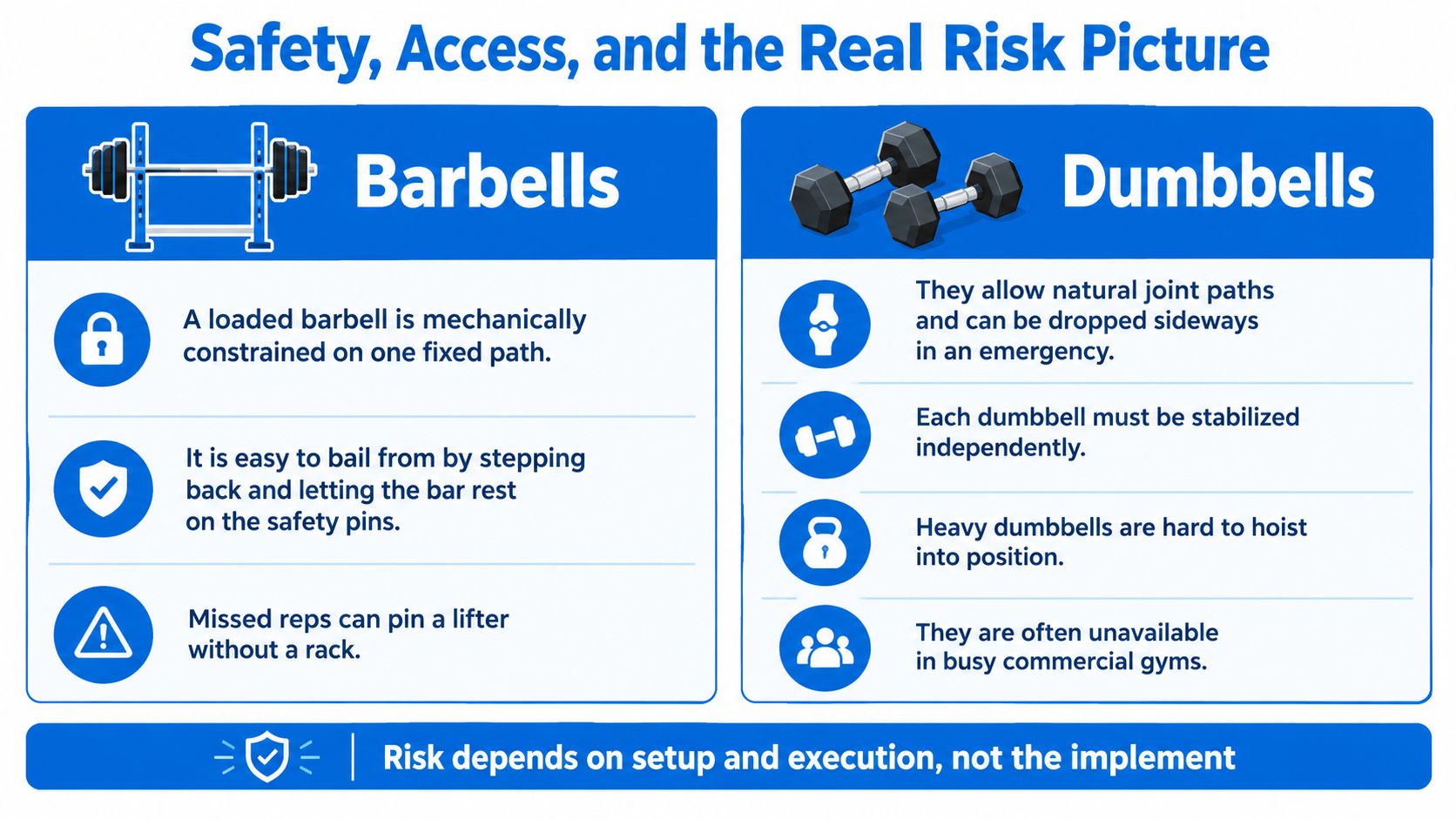
Safety, Access, and the Real Risk Picture
Dumbbells aren't automatically safer than barbells. They give the hands more freedom, but heavy pairs can be difficult to lift into position, stabilize, and return to the floor when a rep fails. A barbell can be mechanically predictable and easier to protect with a rack and correctly positioned safeties, but a missed bench press without those safeguards can leave the lifter trapped.
The equipment changes the failure strategy. The environment often matters more.
Evaluate the setup before the implement
Before a hard set, check four practical points:
Setup: Can you unrack or hoist the weight without losing position?
Control: Can you keep the intended path when fatigue appears?
Failure plan: Can you rerack, lower, or abandon the weight without placing yourself or another person in danger?
Supervision: Is a trained spotter, coach, or reliable safety system available when the set requires it?
A review summary reported that free-weight incidents in its dataset represented 90.4% of recorded injuries, with 65.5% associated with dropped weights. The summary concerns reported injuries and doesn't establish that barbells or dumbbells are intrinsically unsafe (free-weight injury review summary).
That finding points toward a better question than “Which tool is safer?” Ask which tool you can manage in your actual setting. A novice training alone with heavy dumbbells on a bench may face a difficult hoist and a poor exit, while a lighter dumbbell floor press could be straightforward. A barbell squat in a power rack with properly set safeties may offer a controlled bailout, while the same lift outside a rack removes that protection.
Access matters too. A barbell setup normally requires a rack, plates, collars, and clear floor space. Dumbbells simplify storage and can work in a compact area, but a crowded facility may not have the pair you need. Choose the option that makes safe execution repeatable, not the one attached to a blanket safety claim.
Programming Barbells and Dumbbells Into Your Week
A strong week usually gives each tool a defined job. Put the barbell where you need a repeatable bilateral movement and measurable load progression. Put dumbbells where independent control, a freer path, or additional single-limb work solves a limitation that the main lift can't expose.
A simple weekly structure
A beginner can learn both patterns without making every session complicated. Alternate a barbell main lift with a dumbbell main lift, keep the load conservative, and stop a set when technique becomes inconsistent. The goal is to learn how to brace, control the eccentric, and finish safely before chasing heavier numbers.
An intermediate lifter can place the barbell first on the day when strength output matters most, then use dumbbells later in the week for volume or asymmetry work. Recovery should guide the choice. If heavy bilateral work leaves the shoulders, elbows, or lower back fatigued, a supported or single-arm dumbbell variation may provide useful training without repeating the same stress.
Day | Beginner, three full-body sessions | Intermediate, upper-lower split | Home gym, limited load |
|---|---|---|---|
Day 1 | Barbell squat pattern, dumbbell press, row | Barbell squat or deadlift as the primary lower-body lift | Dumbbell squat or split squat, then a controlled press |
Day 2 | Dumbbell split squat, barbell press, simple pulling work | Dumbbell unilateral lower-body work and upper-back accessories | Single-arm rows, floor presses, and loaded carries |
Day 3 | Barbell hinge or squat variation, dumbbell overhead press | Barbell bench or overhead press, followed by single-arm pressing and rows | Repeat key patterns with slower tempo, pauses, or added range where control stays solid |
Rep selection should match the purpose rather than follow a rigid rule. Use lower repetitions and longer rest when the barbell lift is a strength test or a heavy technical practice. Use moderate repetitions with controlled tempo for dumbbell accessories, especially when the goal is volume, side-to-side control, or a stable range of motion.
A useful session order is:
Primary bilateral lift: Perform the barbell movement while concentration and coordination are high.
Independent strength work: Add a dumbbell press, row, split squat, or hinge.
Targeted accessory: Use a supported or single-arm variation to address the weak link.
Conditioning or carries: Finish with a movement that doesn't compromise the next session.
The best split is the one that lets you repeat quality work and recover from it. This training split guide can help you organize the week, but the equipment choice should still follow the goal of each session.
Which Implement Should You Actually Choose
Choose the barbell first if you're a beginner with no obvious side-to-side issue and your main objective is to develop broad, measurable strength. Start with a coached squat, press, or deadlift pattern, use a rack and safeties where appropriate, and add dumbbell work to practice independent control. The essential anchor is a technically sound bilateral lift that you can repeat and track.
If you're an intermediate lifter who consistently shifts, tilts, or feels one side taking over, make dumbbells the priority for the corrective portion of training. Use bilateral barbell work as your reference point, then add single-arm presses, rows, split squats, or single-leg hinges with matched work on both sides. The anchor exercise is the unilateral variation that exposes the specific difference without allowing the stronger limb to hide it.
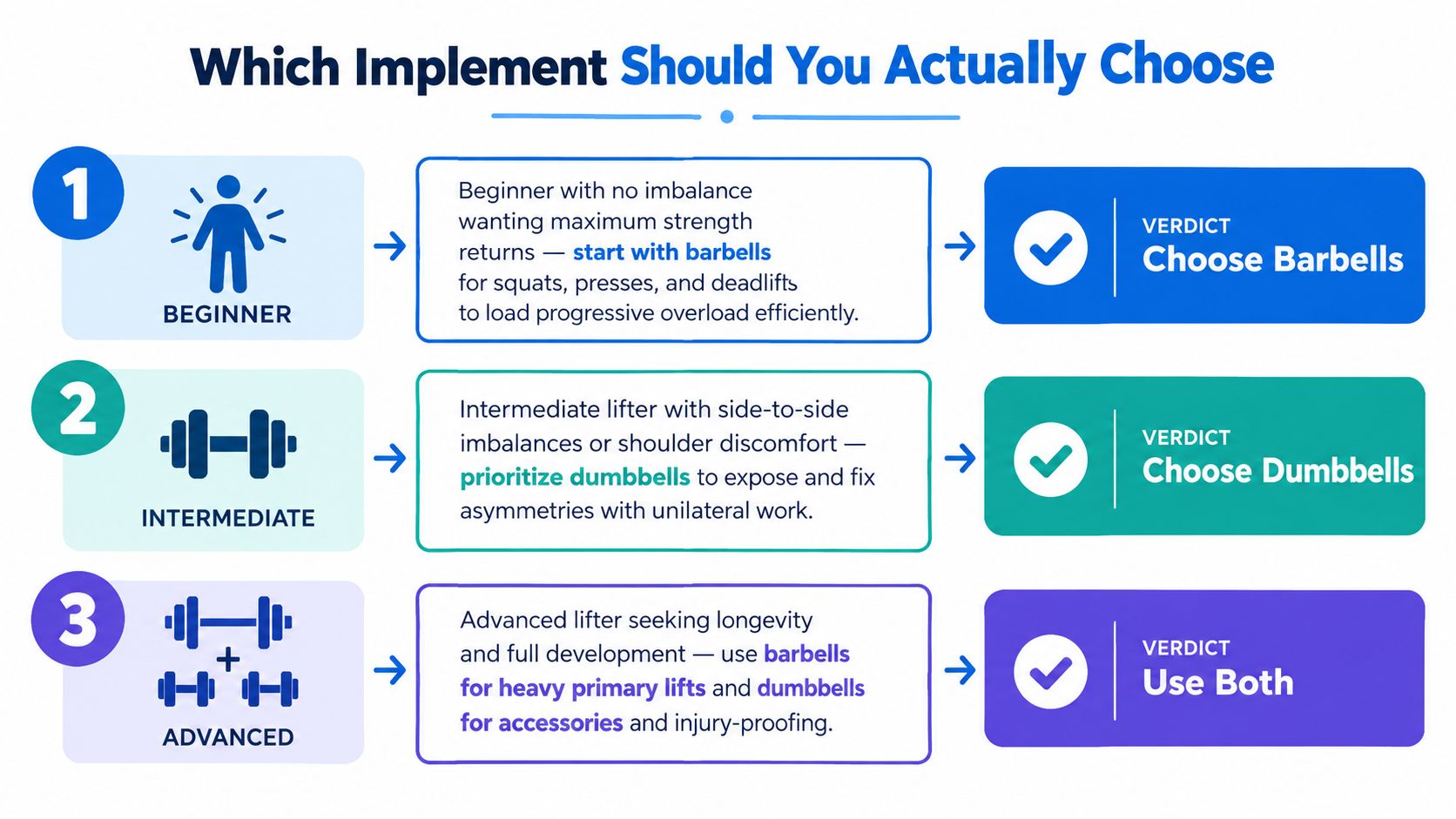
A home trainee with limited load can still build an effective plan around dumbbells. Use presses, rows, split squats, hinges, carries, and controlled tempo to make the available resistance productive. If you later add a barbell and rack, use them for the patterns where bilateral loading is now the limiting factor, rather than replacing every dumbbell exercise automatically.
Shoulder or elbow discomfort can change the recommendation. A neutral dumbbell grip may feel more workable for one person, while another may find the setup and stabilization of heavy dumbbells more irritating than a controlled barbell path. Pain that persists, worsens, or changes your movement deserves assessment instead of a forced equipment choice.
Time can also settle the question. Dumbbells allow efficient circuits when you have limited training time and enough space to move safely. Barbells make more sense when you need focused, standardized sets and can give the setup the attention it requires.
The decision rule is simple: choose the implement that lets you load the pattern you need to improve while keeping each side honest about its own output.
Empire Athletics gives you access to modern strength equipment, certified one-on-one training, and coaches who can help you decide when to use barbells, dumbbells, or both for your current goal. Visit Empire Athletics to train at a 24/7 Central Massachusetts location in Leominster, Lunenburg, or Webster and build a program around safer setup, better control, and measurable progress.