Your First Day at the Gym: A Safe Starter Plan
Plan your first day at the gym with a calm arrival, simple workout, etiquette tips, and how to book a trainer.

You're standing just inside the gym, trying to work out where to go while wondering whether everyone can tell you're new. Maybe you've planned to exercise for a while, but the machines look unfamiliar and you're not sure how hard you're supposed to push. You don't need to prove anything today. Your first day at the gym can be a calm visit to learn the space, test a few movements, and leave with a plan you can repeat.
Why Your First Gym Day Should Feel Easy
A first gym visit isn't a test of fitness. It's an orientation to a new place and the beginning of a longer routine. An easy session can tell you which movements feel comfortable, what equipment you'd like to learn, and when exercise can realistically fit into your week.

The weekly activity guideline gives you a direction to build toward, not a requirement to complete on day one. In the 2024 National Health Interview Survey, 47.2% of U.S. adults aged 18 and older met the federal leisure-time aerobic guideline of at least 150 minutes of moderate activity or 75 minutes of vigorous activity per week. The share was 54.0% among adults aged 18–34, compared with 38.4% among adults aged 65 and older. Men met the guideline at 52.3%, compared with 42.4% of women, according to the CDC's exercise statistics.
Those figures don't tell you what any one person should be able to do. They do show why a beginner's first session should focus on a manageable starting point rather than an exhausting performance. You might be building from very little activity, or adjusting to a routine after a long break. Either way, learning a few machines and choosing a realistic training time are useful progress.
Think beyond today's workout
For someone working shifts, the only available opening this week might be an odd hour between responsibilities. A brief visit at that time still helps you learn the route from the entrance to the cardio machines and identify equipment you can return to. With flexible access, you can work around an unpredictable schedule instead of waiting for a perfect stretch of free time.
Federal guidance also includes muscle-strengthening activity, alongside aerobic movement. You can build toward those recommendations gradually, adding activity as your body and schedule allow. Day one is for finding a starting point, not catching up all at once.
A useful first-day measure: Did you feel comfortable enough to imagine coming back?
Consistency is more valuable than one punishing workout that leaves you reluctant to return. Let your first visit feel easy enough to repeat, and treat flexible timing as a practical tool when the week doesn't cooperate.
Arrive Ready and Learn the Floor

Choose comfortable clothes and supportive shoes that let you move easily. Bring water, a small towel, and your phone or a notebook. A simple note for recording machine settings will save you from having to remember where the seat and weight pin were placed.
When you arrive, follow a low-pressure route. Check in, find the locker or cubby area, and locate the water fountain. Then take a relaxed walk past the cardio machines and selectorized strength equipment before deciding where to start. You don't have to try every station. The point is to reduce the number of unfamiliar choices you'll face next time.
Feeling uncertain around machines is common, not a personal failing. A 2025 survey of 1,000 women reported that 88% experienced gym anxiety, and many connected it to unfamiliar equipment, according to Women's Health South Africa's report on beginner gym tips. Knowing how to ask a simple question can make the floor easier to move around.
Use a short script when you need help
Try: “Could you show me how to adjust the seat and pin before I use this?” Or ask, “Could you check that the pad is in the right position for me?” Staff can explain how a station works, and you can take a moment to write down the settings.
If a machine is occupied, you can ask, “How many sets do you have left?” You can also choose another station and return later. If someone offers a spot and you don't need one, a clear “Thanks, I'm all set” is enough. If you want support, explain what you need before starting the lift.
Think of your first visit as a 20–30-minute floor orientation, not a race through a full workout. Look for two or three stations that seem understandable and ask for help learning to use them. For people with irregular schedules, a quieter window may make that first walkthrough feel less rushed. A facility with around-the-clock access can also make it easier to choose a time that fits work and other commitments.
Once you know the check-in route, where to get water, and how to adjust a familiar machine, the gym may feel less like a puzzle. The short video below offers another look at what a beginner visit can involve.
Leave knowing which stations you'd be willing to use again. That's a useful outcome, even if you haven't touched a weight yet.
Build a Short Starter Workout
Keep the workout short enough that you can pay attention to how each movement feels. A 30–45-minute visit can include an easy warm-up, practice with several basic movements, and a brief cooldown. If you're nervous or short on time, you can use the shorter end of that range and skip anything that doesn't feel comfortable.
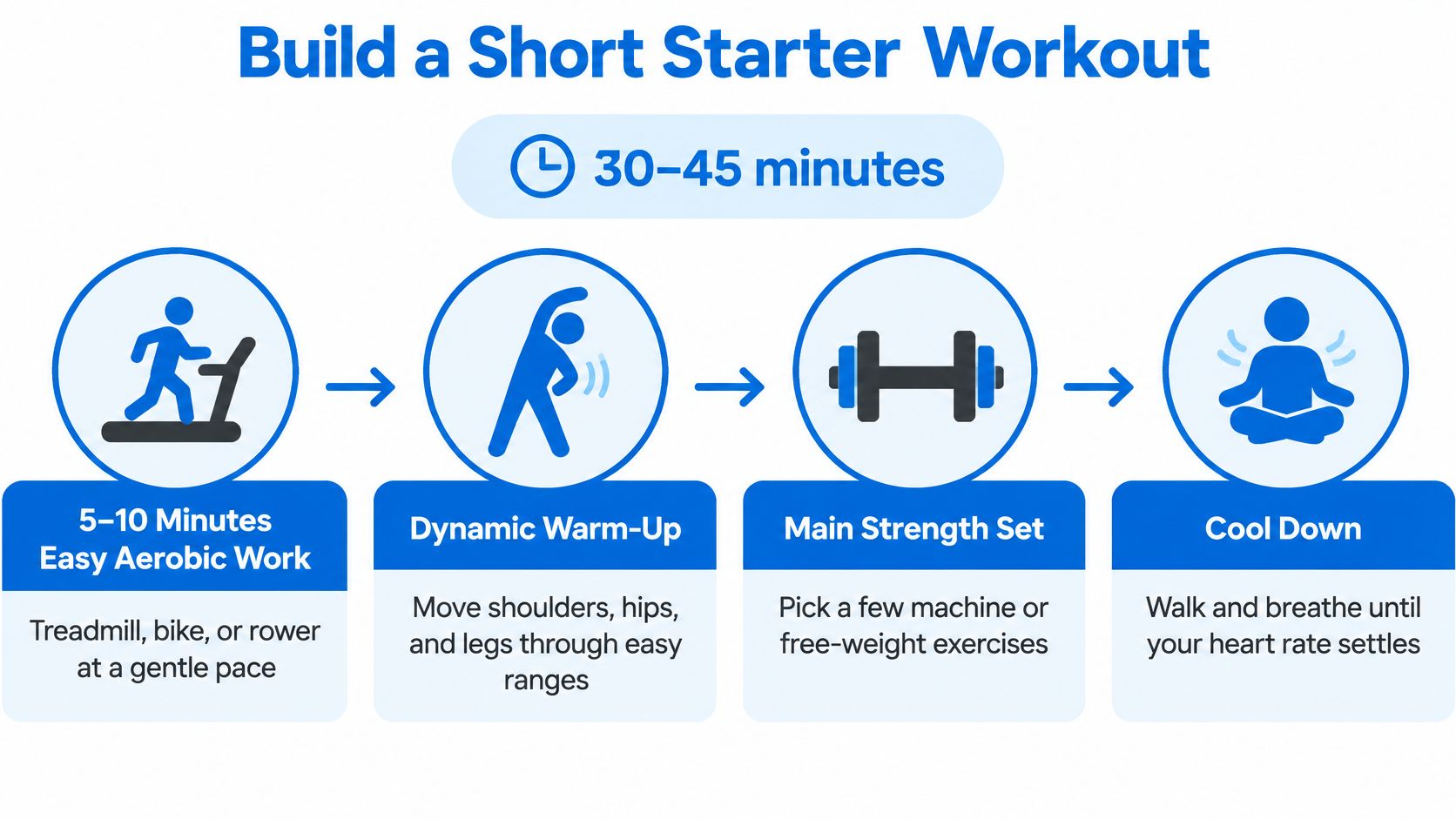
Start with 5–10 minutes of easy aerobic work on a treadmill, bike, or rower. Choose a gentle pace that lets you settle in. Then move your shoulders, hips, and legs through comfortable ranges of motion. These dynamic movements warm up the areas you'll use without turning the warm-up into another workout.
Practice basic movement patterns
Rather than building a long list of exercises, sample a handful of machine-based or bodyweight movements that cover basic patterns: squat, hinge, push, pull, carry, and trunk stability. A leg press can introduce a supported squat pattern. A seated row gives you a controlled way to practice pulling. A light carry can help you explore carrying weight while walking steadily.
Choose a resistance that feels comfortable for about ten repetitions. For the first set, move slowly and stop while your form is still steady. A sound beginner session uses one controlled set of 10–15 repetitions for each movement and increases the load only after you can complete 15 repetitions with stable form, as outlined in WHO guidance on exercise and progression.
For example, sit down at the leg press and check that the seat feels secure before starting. Move through the repetitions without locking into a rushed pace, then pause and note the machine settings and how the effort felt. At the seated row, use a load that lets you pull smoothly without leaning or jerking. For a light carry, select a weight you can hold comfortably and walk with control. Rest when you need it; you don't have to keep pace with anyone else.
Novice resistance training commonly uses an 8–12-repetition range, but that doesn't mean you need to chase the heaviest load you can manage. A cautious progression is to add roughly 5% once you can complete 15 clean repetitions. More generally, an increase of 2–10% may be appropriate when the current workload is easier than the target by one or two repetitions. These are progression guidelines, not day-one targets.
Major muscle groups can be trained 2–3 days a week, with time between sessions rather than an exhausting workout repeated every day. If you want a short session you can revisit, see these 30-minute workout routines.
Finish with a relaxed walk and let your breathing settle. The first workout is practice, not a body-part marathon. Leave with enough energy to feel that another visit is possible.
Read Pain and Adjust the Session
An easy plan is useful only if you're willing to change it when a movement doesn't feel right. For a new exercise, practice the pattern without weights or bands until it feels familiar. If you're unsure how to move, ask a qualified professional to check your technique before adding resistance.
The CDC's physical activity guidance recommends that beginners start with movements they can perform comfortably, warm up with lighter loads, avoid training the same muscle group on consecutive days, and seek professional advice when uncertain about technique or health status. The broad idea is simple: begin at a level you can manage, then build gradually.
Effort, soreness, and warning signs
Muscles working during a set can feel challenging. Mild soreness after an unfamiliar workout can also happen. Neither means you have to push harder next time. Use your notes to decide whether to repeat the same load, reduce it, or leave an exercise out.
Sharp pain, pain focused around a joint, or pain that worsens as you continue isn't a signal to grit your teeth. Stop that movement. Don't keep testing it with more repetitions or extra weight. If the problem doesn't settle or you're unsure what caused it, ask a qualified professional for an assessment.
You can also adapt an exercise instead of forcing a range of motion that doesn't feel comfortable. A supported sit-to-stand from a bench may feel more manageable than a deep squat. A chest-supported row can provide back support while you practice pulling. On a press, use a shorter, comfortable range rather than pushing into discomfort.
If you have a chronic condition, a recent injury, or uncertainty about symptoms, medical advice may belong in your plan before you begin or change your exercise routine. That isn't a reason to assume you can't train. It's a way to make sure your starting point and exercise choices fit your situation.
Mid-session check: Does this feel like manageable effort, or sharp, joint-focused, or worsening pain? If it's the latter, stop and get appropriate advice.
The useful outcome isn't finishing every planned movement. It's knowing how to make a safe adjustment and still leave with a path back to the gym. If mobility or movement quality is a concern, a corrective exercise program can be one way to explore exercises suited to your needs.
Choose Solo Practice or a Trainer
You don't need to make your first visit a formal training session. A self-guided walkthrough can be enough if your main aim is learning where things are and trying familiar equipment at a comfortable pace. A trainer-led session may be a better fit if you're unsure how to choose loads, have a specific goal, or want help adapting around pain or mobility limitations.
Session type | Best when | What you leave with |
|---|---|---|
Self-guided walkthrough | You mainly want to learn the floor and try a few stations | Familiar routes, a few machines to revisit, and notes on their settings |
Trainer-led first session | You want guidance with technique, equipment, or an individualized starting point | Instruction and a plan shaped around your goals and current abilities |
Quiet off-peak visit | You'd prefer fewer distractions while you get oriented | Time to explore the equipment and ask questions without feeling rushed |
A certified one-on-one trainer can help you assess what feels comfortable, practice technique, and tailor a plan to your schedule. That may be useful for someone working on mobility or strength, returning after a break, or managing a past injury. It can also help if you're pursuing bodybuilding, weight loss, or performance goals and aren't sure how to begin safely. If you're weighing that option, learn more about personal training.
What to look for in a local option
For adults near Leominster, Lunenburg, and Webster, Empire Athletics offers 24/7 facility access and modern strength and cardio equipment. Its locations are at 507r Lancaster Street in Leominster, 308 Massachusetts Ave in Lunenburg, and 37 Sutton Rd in Webster. The business also provides certified one-on-one training for goals that include mobility, corrective exercise, bodybuilding, weight loss, strength, and performance.
A trainer can help turn a broad goal into a manageable first session, while the equipment gives you options for practicing familiar movements. The facilities include an on-site cafe serving coffee, smoothies, and shakes. The company describes its certified trainers as having 20+ years of combined experience and references a 4.7/5 member rating on its site.
Choose based on the help you need. If you only want to understand the floor, go in for a walkthrough. If equipment, movement, or health considerations feel uncertain, ask about a trainer-led assessment. If crowds make learning harder, pick a quieter time that works with your routine.
Lock In the Next Two Visits
Before you leave, capture what happened while it's still clear. Record the exercise names, machine settings, load, repetitions, and how difficult each movement felt. Note any pain or adjustment too. Those details help you return to the same starting point instead of guessing at the next session.
Early dropout is a real challenge: an ACSM-published review reports that about 50%–65% of new exercisers discontinue their program within 3–6 months, as referenced in the WHO European physical activity fact sheet. Rather than trying to outwork that risk on day one, give yourself a specific plan for returning. Put your next two visits on the calendar before you leave the building.
Schedule the routine you can keep
Choose times that match real life, not an imaginary week with no interruptions. If you work shifts, that might mean choosing a repeatable window between responsibilities rather than the same time every day. A flexible schedule can make it easier to keep a commitment when your hours change.
Your longer-term aim is to strengthen all major muscle groups on at least two days each week, while building gradually toward 150–300 minutes of moderate aerobic activity or 75–150 minutes of vigorous activity per week. You don't have to meet that target during your first visit. Think of each session as a chance to practice and add activity at a pace you can sustain.
A 30–45-minute visit is enough when you can move with steady technique and finish feeling able to come back. If your first session was longer than you expected, or a movement caused pain, adjust the next one. Repeat the comfortable exercises, reduce the load, or ask for guidance before trying the uncertain movement again.
The most useful exit plan is concrete: a record of what you did, two dates for your next sessions, and a time that fits your actual schedule. If you're ready for a trainer-led assessment, book one at a convenient location; if not, reserve the same quieter window and repeat the movements you've already noted.
Empire Athletics offers 24/7 gym access, modern strength and cardio equipment, and certified one-on-one training for people who want support choosing a comfortable starting plan. Visit Empire Athletics to explore the locations and choose a first visit that fits your schedule.