Gym Workout Routine for Beginners: A 2026 Plan
A gym workout routine for beginners with 3- and 4-day plans, warm-ups, progression rules, and shift-friendly scheduling you can start this week.

You don't need a six-day body-part split to start lifting. You need a gym workout routine for beginners that you can repeat when work runs late, a machine is occupied, or you've only got a short window before your next shift.
Start with full-body sessions, leave some effort unused, and keep a shorter backup workout ready. Your first month isn't a test of how much discomfort you can tolerate. It's practice at choosing equipment, controlling repetitions, and returning without needing to start over.
A Beginner Week You Can Repeat
Pattern | Session | Movements | Sets | Reps and rest |
|---|---|---|---|---|
3-day | Day A full body | Goblet squat or leg press; chest press; seated row; Romanian deadlift or back extension; dead bug | 2 per movement | 8–12 controlled reps; leave 2–3 reps in reserve; rest 90–120 seconds |
3-day | Day B full body | Split squat or leg press; lat pulldown or assisted pull-up; machine shoulder press; hip hinge; side plank | 2 per movement | 8–12 controlled reps; leave 2–3 reps in reserve; rest 90–120 seconds; use a comfortable hold for side planks |
3-day | Day C | Repeat Day A, or the short session if under 30 minutes | 2 or 1 | Same reps and rest; 1 set only on the short session |
4-day | Upper | Chest press; seated row; lat pulldown; light shoulder press; plank | 2 per movement | 8–12 controlled reps; leave 2–3 reps in reserve; rest 90–120 seconds; hold planks only while breathing steadily |
4-day | Lower | Squat or leg press; Romanian deadlift; leg curl; dead bug | 2 per movement | 8–12 controlled reps; leave 2–3 reps in reserve; rest 90–120 seconds |
Short session, under 30 minutes | Any week | Squat or leg press; one push; one pull; one hinge; one core brace | 1 per movement | 8–12 reps; stop 2–3 reps before failure; rest enough to repeat clean technique |
These are sample training prescriptions, not a requirement to lift a particular weight or finish against a stopwatch. For dead bugs, count each controlled limb extension as a repetition. For planks, stop the hold before your hips sag or you have to hold your breath.
Stay with the full-body pattern if you're still learning equipment settings, recovering unevenly, or struggling to protect training time. An upper/lower split isn't a graduation badge. It distributes the work across more visits.
Choose the smallest week you can protect
Use Monday, Wednesday, and Friday, or any nonconsecutive days with a rest day between full-body sessions. If that's too much, complete Day A and Day B and leave Day C out. The World Health Organization's activity recommendations call for muscle-strengthening activity involving all major muscle groups on at least two days weekly, making that a useful foundation rather than a failed version of a larger plan.
Reps in reserve means repetitions you could still perform with the same technique. If you finish a set and could manage another few smooth repetitions, you've left a useful margin. If the next repetition would require twisting, bouncing, or help, the load was too demanding for this starter plan.
Choose the machine when balancing a free weight prevents you from practicing the intended movement. A leg press isn't cheating, and a goblet squat isn't automatically better. Keep your chosen version consistent enough to compare sessions.
Keep the alternatives deliberate
For this example month, consider the four-day option only after two consistent weeks, and only if shorter, more frequent visits better suit your schedule. Run upper, lower, rest, upper, lower. Our explanation of what a training split means can help you distinguish scheduling changes from adding work.
The 25-minute fallback is the short-session row: a single work set of each movement, with warm-up steps 1, 2, and 6 below. Use it when your visit must stay under half an hour. You're choosing less practice that day, not abandoning the routine.
Choose before you arrive: Circle the three-day pattern or, when appropriate, the four-day pattern. If only two full-body visits fit, protect those instead of promising a week you can't repeat.
Warm Up and Mobility Before You Lift
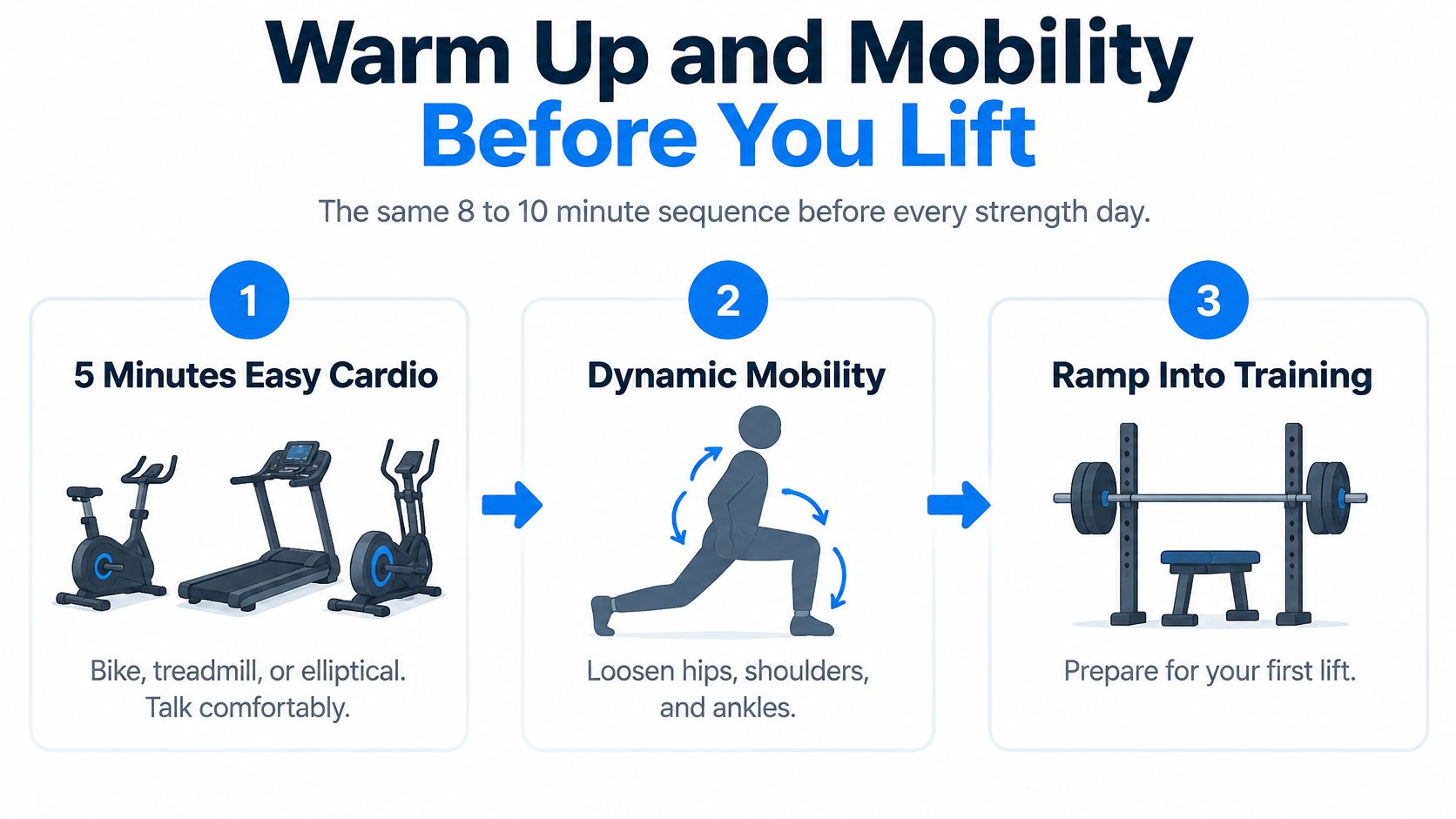
Use the same preparation before each strength day. You don't need a separate mobility routine for every muscle, and you shouldn't feel worn out before touching your working weights.
The following is a sample eight-to-ten-minute sequence. Move between drills without rushing, and shorten any movement that causes discomfort rather than forcing a larger range.
This visual groups the preparation into easy movement, mobility, and rehearsal.
Follow the same preparation sequence
Start with five minutes of easy cardio. Choose a bike, treadmill, or elliptical at a pace where talking feels easy, to get moving without accumulating fatigue.
Perform eight bodyweight squats. Use a comfortable depth and hold a rack if balance is shaky, to rehearse the squat range you can control.
Practice eight hip hinges. Use a dowel or empty bar, soften your knees, and send your hips backward, to distinguish hinging from bending your lower back.
Do eight scapular wall slides or band pull-aparts. Keep the movement comfortable, to practice shoulder-blade control for pressing and rowing.
Brace with a dead bug and side plank. In this example, use a twenty-second dead bug on each side and a twenty-second side plank or knee side plank, to practice breathing while holding your trunk steady.
Rehearse the first lift with light ramp-up sets. Try one or two sets of five repetitions at about half your intended working load, to check the setup before the work begins.
These doses are starting examples, not tests you have to pass. If the empty implement already feels challenging, don't add weight to reach a suggested fraction. The rehearsal should make the first exercise feel more predictable.
Adjust the movement, not your tolerance for pain
If your shoulder is irritable, skip the side plank and use a comfortable dead bug instead. If squatting feels restricted, explore our hip mobility exercises for squats, but don't assume every restriction needs deeper stretching. Changing stance or using a supported variation may make practice more manageable.
For the short-session fallback, keep only steps 1, 2, and 6. Don't compensate by racing through your work sets.
Dress for stable movement. At Empire Athletics, members and guests must wear appropriate, clean attire and footwear in the studio and gym. Choose athletic shoes that feel secure when you press through your feet.
Check health concerns before loading them. We advise regular health and medical screening with your General Practitioner throughout membership. Speak with your GP before returning after illness, chest symptoms, or a long layoff; active or concerning chest symptoms need prompt medical attention.
Your warm-up is finished when you can begin a smooth first work set, not when you're tired.
How to Perform One Gym Session
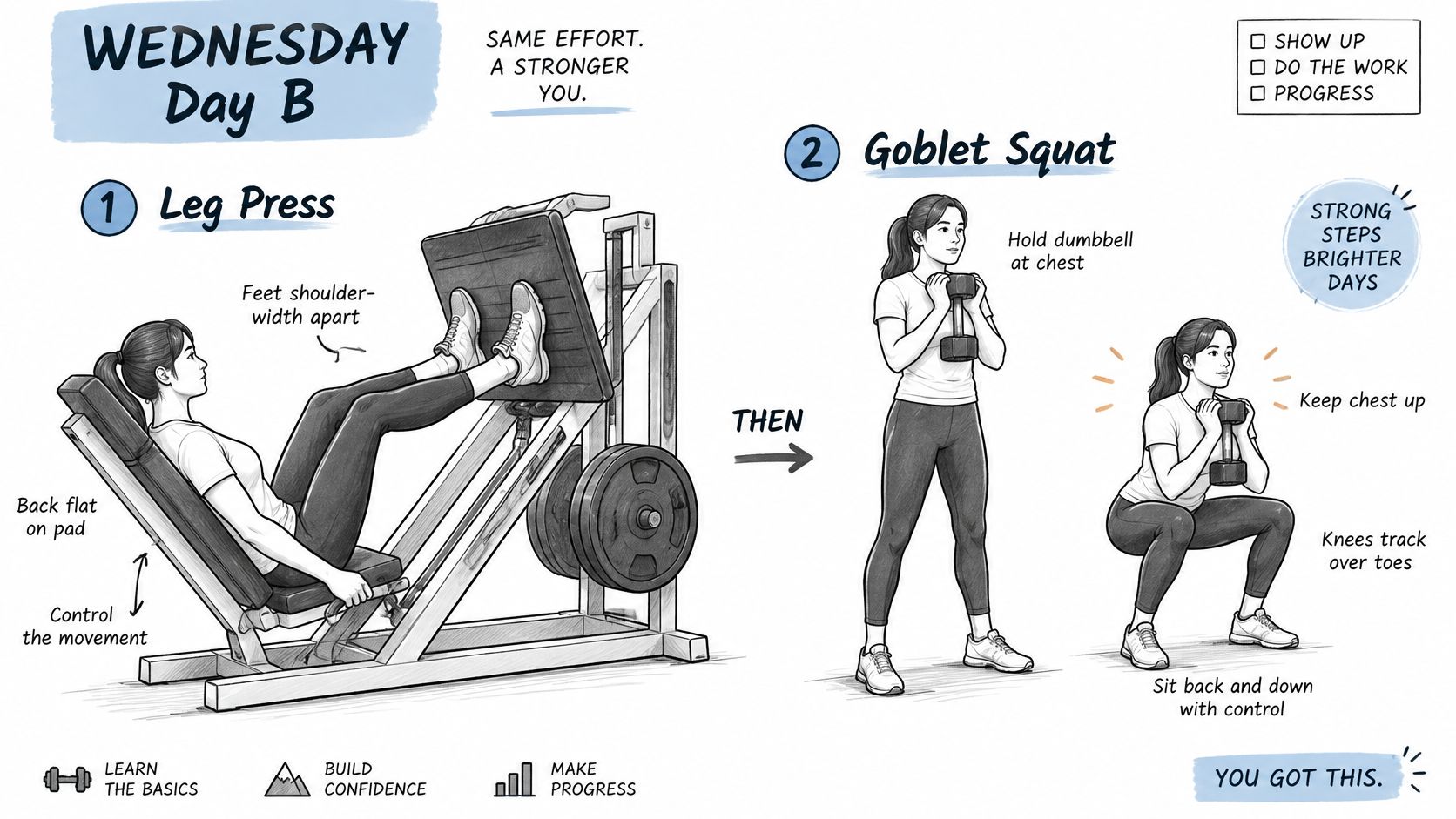
Say it's Wednesday and you're following Day B. After warming up, find the leg press, read its adjustment diagram, and set the seat so you can keep your back supported throughout a comfortable range.
Use the leg press or a controlled squat variation as your opening lower-body movement.
Follow a clear floor order
Begin conservatively. For example, choose a leg-press load that lets you complete ten repetitions while feeling capable of another two or three clean ones. Lower under control, taking roughly two seconds in this example, and don't bounce out of the bottom or let your pelvis roll off the pad.
Next, move to the lat pulldown. Secure your thighs under the pad, keep your torso quiet, and pull toward your upper chest without shrugging. If your shoulder pinches, stop that movement; try a comfortable seated row instead rather than pulling harder through the pinch.
Use the machine shoulder press if dumbbells feel unstable overhead. Adjust the seat so the handles begin at a comfortable shoulder position, and keep your ribs from lifting as you press. An overhead movement that remains painful should be omitted, not forced.
For the hip hinge, hold dumbbells close to your legs and move your hips backward. Use a back extension instead if the deadlift setup is confusing, keeping the movement controlled rather than throwing your torso upward.
Finish strength with a dead bug or side plank. Brace as though drawing your lower ribs toward your hips, but keep breathing. Complete your planned work sets before moving on, and wipe each piece of equipment after use, as required at our gym.
Use the video as an additional movement reference, not a reason to attempt a load you can't control.
Add cardio without making every visit exhausting
The World Health Organization's physical-activity guidelines recommend 150–300 minutes of moderate aerobic activity weekly and emphasize that some activity is better than none. You can build toward that range rather than treating it as an opening-week minimum.
For this sample plan, add twenty to thirty minutes of brisk walking, cycling, or elliptical work after two strength visits. In later weeks, add five to ten minutes to the weekly total only when recovery allows. That's the cardio progression rule; you don't need to increase speed and duration together.
If you feel dizzy, faint, unwell, or experience unusual pain, stop exercising and inform a member of staff immediately. Record each exercise, load, and completed repetitions in a notes app before leaving.
The next morning, mild muscle tiredness can be manageable. Joint pain that changes how you walk isn't a target or evidence of a productive workout.
Add Weight Only After Clean Reps
What happened | Next session | Do not |
|---|---|---|
Both sets hit 12 reps with 2 reps still in reserve and stable form | Add the smallest pin or plate | Jump more than one machine-stack increment |
Form broke or the set went to failure | Repeat the load or, as a sample adjustment, reduce it by about 10 percent | Grind extra reps |
Missed a full week | Repeat last good loads or drop one set for the first session back | Add a fourth day to catch up |
Joint pain changes walking or sleep | Stop the painful lift; consider a machine alternative only if comfortable | Stretch through the pain |
Strength days still feel repeatable | Apply the modest weekly cardio increase described in the session walkthrough | Stack long cardio on every lifting day at the start |
Make the missed week ordinary
Suppose work disrupts your routine and you miss a full week. Your next visit isn't a fitness test. Repeat your last successful loads, or remove a work set from each movement for that first session back.
Don't add make-up days. You haven't created a debt that must be repaid with extra training, and cramming sessions together makes it harder to judge how you're recovering.
A successful return is a workout you can follow with another planned visit, not a punishment for being absent.
The same logic applies when a weight feels harder than expected. Poor sleep, unfamiliar equipment, or a rushed setup can change how a set feels. Check the basics before deciding you need to push harder.
Earn a heavier load with repeatable technique
When you reach the top of the repetition range on both sets and still have the intended reserve, use the smallest available increase. For a hypothetical equipment setup, that might mean an upper-body increase of 2.5–5 pounds, or 5–10 pounds on a leg press. Those are examples, not mandatory jumps; machine increments differ.
If your repetitions remain within the prescribed range but below its upper end, keep the load and try to add a clean repetition next time. If you have to change your movement to finish, you haven't earned an increase yet.
Keep pain separate from effort. A muscle working hard isn't the same as a joint aching during a set. If pain persists into the next day and changes stairs, walking, or sleep, stop the painful lift and seek appropriate clinical guidance; a machine is an option only if it's comfortable, not a treatment.
Use the log to simplify decisions
A systematic review and meta-analysis in the British Journal of Sports Medicine, covering 3,346,723 adults across 32 countries, found that 17.12% met both aerobic and muscle-strengthening recommendations. That finding describes participation, not the effectiveness of this particular routine, but it puts the challenge in perspective: maintaining both kinds of activity deserves attention.
You don't need a complicated spreadsheet. Record enough to distinguish a controlled session from one you barely completed.
Log format: Date, exercise, load, reps, and easy, solid, or messy.
Schedule Sessions Around Rotating Shifts
A day-shift nurse finishes work, eats something manageable, and trains before heading home. A night-shift worker wakes, has time to become alert, and trains before work rather than forcing a workout after an exhausting shift. Both can use the same movement patterns without sharing the same clock.
Choose anchors that reflect when you're realistically awake and available.
Schedule | Anchor sessions | Template |
|---|---|---|
Day-shift nurse off at 3 p.m. | For example, train at 4 p.m. on three nonconsecutive days | 3-day table |
Night-shift worker | Before the shift or after sleep, never both in one wake cycle | Short session when the commute uses the hour |
Rotating schedule | First day off plus a reliable early-morning slot; add another visit only with a suitable rest gap | 3-day table with the final day optional |
Family evening block | For example, two 6 a.m. full sessions plus a lunch-hour short session | 2 full sessions and 1 short session |
Match the example to your actual week
For the nurse, the useful detail isn't the afternoon time itself. It's having a repeatable transition from work to training. Keep the full-body visits nonconsecutive rather than squeezing them into adjacent evenings because the calendar looks tidier.
For the night worker, after sleep and before the shift may be the same training window. Choose it once, not as separate opportunities. When the commute has already consumed most of your available time, use the short session rather than skipping the warm-up or rushing heavy sets.
A rotating worker might protect the first day off and a dependable early-morning slot. In this example, consider a third visit only if there's at least a thirty-six-hour gap and it still preserves a rest day between full-body sessions. That's a scheduling example, not a universal recovery threshold.
For someone with a protected family evening block, early training and a lunch-hour fallback avoid repeatedly negotiating the same conflict. An evening-shift worker can use the same idea by training before work.
The visual shows how different shifts can lead to the same repeatable pattern.

Plan access and recovery together
The WHO guidelines on physical activity and sedentary behaviour advise starting with small amounts and gradually increasing frequency, intensity, and duration. Apply that principle to attendance before expanding your schedule.
At our facilities, members scan their finger on every visit. Early entry still requires a valid, in-date membership that's in credit; an outstanding account balance prevents access.
If you miss a session, your next visit follows the next planned pattern day, not a make-up workout. If the absence becomes a full week, use the missed-week decision in the progression table.
Weekly sketch: Fill in your training time boxes, a backup short-session window, and a full rest day after a night shift when planning this example week. Leave a box empty if filling it would mean sacrificing needed sleep.
Book a First Session and Fuel On Site
A repeatable week matters more than a perfect first workout. Keep the full-body pattern you've chosen, and give yourself a short-session fallback for busy days. If you miss a week, return to the next planned day rather than trying to make up every session at once.
Choose help for a specific obstacle
A first one-on-one session can help when you're unsure how to adjust a machine, choose a movement that suits your mobility, or work around a concern. Tell the trainer what you're experiencing and what your work schedule looks like. Persistent or unexplained pain may need clinical assessment.
Empire Athletics' certified trainers build custom plans around each member's goals, schedule, and starting point. Training can focus on mobility, corrective exercise, bodybuilding, weight loss, strength, or general performance.
Ask the trainer to help you leave with three practical answers:
A usable setup. Learn to adjust the seat, supports, and starting position on the machines you plan to use.
Comfortable exercise choices. Choose squat, push, pull, and hinge variations that suit your current ability.
A realistic schedule. Decide whether two or three full-body days fit your week, without adding more work just because you booked coaching.
To arrange a one-on-one session, contact your chosen Empire Athletics location. Independent gym access requires a valid, in-date membership that is in credit. The Empire Athletics gym access and membership information explains the membership requirements.
Make the local choice practical
Choose the gym you can reach on an ordinary workday. Empire Athletics has locations at 507r Lancaster Street in Leominster, 308 Massachusetts Ave in Lunenburg, and 37 Sutton Rd in Webster.
The on-site cafe serves coffee, smoothies, and protein shakes. A drink may be convenient before or after training, but regular meals can remain the foundation of your food routine.
Membership is available to adults 18 and over. If you feel dizzy, faint, unwell, or have unusual pain while exercising, stop and tell a staff member immediately.
Save your training pattern and put the sessions in your calendar. If a setup or movement still feels uncertain, contact a location to arrange one-on-one guidance.