How Many Sets Per Muscle Group Per Week Explained
How many sets per muscle group per week should you do? Get evidence-based recommendations for beginners, intermediates, and advanced lifters, plus sample weekly

For most lifters, research supports roughly 10 to 20 challenging sets per muscle group per week for hypertrophy, with beginners starting near 10 and more advanced lifters working toward 12 to 20 when recovery allows.
If that range is so widely accepted, why do two people both doing 15 sets often get very different results? Usually because they are not counting the same thing. One counts only direct work, the other logs every warm-up. One trains close to failure, the other stops far short. How many sets per muscle group per week you need depends on what those sets are, how you count them, and whether you are recovering well enough to benefit from them.
The Short Answer to Weekly Set Volume
Start here. For hypertrophy, which is muscle growth, plan on about 10 to 20 challenging sets per muscle group per week. If you're new to lifting, stay near the bottom of that range. If you've trained consistently for a while and you're recovering well, you can gradually work toward the middle or top.
That doesn't mean fewer than 10 sets won't build muscle. It can. The point is that around 10 or more becomes a stronger target when your main goal is to maximize growth rather than just get started or maintain what you have.
Why a Range Instead of One Number
Think of weekly sets like a dose. Too little and the stimulus is weak. More helps, up to a point. After that point, each extra set adds less benefit while adding more fatigue, time, and soreness. That's why honest guidance gives you a range, not a magic number like exactly 14 sets for everyone.
Your position inside the range depends on a few practical factors.
Training experience: Beginners grow from less because almost any hard work is new to their muscles, so they don't need high totals yet.
Set quality: A set taken close to failure with good technique counts for more than an easy set that stops well short.
Recovery: Sleep, work stress, food, and soreness all decide whether you can recover from the work you did.
Exercise overlap: Pressing trains your triceps while it trains your chest, so some muscles get extra work you might not be counting.
Practical rule: Pick a starting total near the low end, hold it steady for several weeks, and only add sets if your performance has stalled and you're recovering well.
That simple rule prevents the most common error, which is adding volume every time progress feels slow. Slow progress doesn't always mean you need more sets. Sometimes it means your sets aren't hard enough, your technique is inconsistent, or you haven't run the plan long enough to judge it.
Counting accurately matters just as much. Count hard working sets only, meaning sets taken close to the point where you couldn't do many more clean reps. Warm-ups and easy technique sets help you prepare, but they don't belong in your weekly total. Once you count consistently, the 10 to 20 range becomes a useful tool instead of a vague slogan.
What the Research Says About Set Volume
The clearest early evidence comes from a 2017 systematic review and meta-analysis of weekly set volume, which examined 15 resistance-training studies comprising 34 treatment groups. It found a statistically significant dose-response relationship between weekly set volume and muscle growth, with p = 0.002. In plain language, as weekly sets went up, muscle growth generally went up too.
The size of that effect was modest per set, which is important to understand. Each additional weekly set per muscle group was associated with an effect-size increase of 0.023, corresponding to an estimated 0.37% greater percentage gain in muscle size in that same analysis. One extra set won't transform your physique. Several extra sets, accumulated week after week, can make a visible difference over time.
When researchers compared higher-volume and lower-volume programs within the same studies, the higher-volume protocols produced an effect-size difference of 0.241, equivalent to approximately 3.9% greater muscle gain. That's the practical headline. Given the same lifter and similar conditions, doing meaningfully more hard work tended to produce meaningfully more growth.
The chart below shows that relationship and why it flattens out at higher totals.

The Diminishing Returns Idea
Volume works like adding seasoning to a recipe. The first additions change the flavor a lot. Later additions change it less and less, and eventually you're just making things harder to handle without improving the result. Muscles respond in a similar way. Going from very few sets to a solid weekly total helps a lot. Going from a solid total to a very high total helps less, and it costs more recovery.
The 2017 analysis also grouped training into categories of fewer than 5, 5 to 9, or at least 10 sets per muscle per week. That three-level comparison showed only a trend, with p = 0.074, so it didn't prove that 10 is a hard threshold you must cross. Don't treat 10 sets as an on/off switch. Treat it as a reasonable neighborhood where growth tends to be stronger.
One more point from that evidence matters for your logbook. The findings apply to total weekly volume for a muscle, so you count sets across all exercises that substantially train that muscle. Bench press sets and dumbbell fly sets both count toward chest. You don't reset the count for each exercise.
Your chest doesn't know which exercise you used. It knows how much hard work it accumulated across the week.
Sets also don't exist in isolation from reps and effort. A set only sends a strong growth signal if it's challenging, which is why pairing sensible volume with the best rep range for muscle growth matters. Ten easy sets and ten hard sets look identical on paper. Your muscles know the difference.
Set Volume Recommendations by Experience Level
A later review helps translate that dose-response idea into levels you can program. The categories below come from a 2022 systematic review and meta-analysis of set volume, which defined low volume as fewer than 12 weekly sets, moderate volume as 12 to 20 sets, and high volume as more than 20 sets per muscle group. Among young, trained men, it concluded that 12 to 20 weekly sets could serve as an optimum standard recommendation for hypertrophy.
This visual summary maps those categories onto beginner, intermediate, and advanced lifters.

Beginners
If you're in your first stretch of consistent training, start around 10 to 12 challenging sets per muscle group per week. That's enough to learn technique, build a habit, and grow. More isn't better yet because your main limiter is skill and consistency, not a lack of exotic volume. You'll also get sore more easily than an experienced lifter, so a modest total keeps you coming back.
Focus your energy on a short list of repeatable movements. A press, a row, a squat pattern, a hinge, and a couple of direct arm and calf exercises cover most needs. Add weight or reps gradually. When you can do that week after week without lingering soreness wrecking your next session, you've earned the right to consider more sets.
Intermediate and Advanced Lifters
Once you're training consistently and your technique is stable, progress toward roughly 12 to 20 sets when recovery and performance remain strong. You don't have to push every muscle to 20 at once. A smarter approach is to raise volume for one or two priority muscles while holding the rest steady, then judge the result.
Here's the finding that should stop you from blindly chasing 20 plus. The 2022 review found no statistically significant difference between moderate and high volume for the quadriceps, with p = 0.19, or for the biceps brachii, with p = 0.59. In other words, going above 20 didn't reliably beat 12 to 20 for those muscles. The triceps were the exception, where high volume produced a statistically greater response than moderate volume, with p = 0.01.
That doesn't mean your triceps automatically need huge totals, since pressing already trains them. It means muscles don't all respond identically, and a universal maximum doesn't make sense. Treat volumes above 20 as a specialized tool for a specific goal and a limited period, not as your default setting.
The video below walks through how experienced lifters think about progressing volume in practice.
Your individual total also shifts with exercise selection, intensity, and how much indirect work you're counting. A lifter doing heavy compound lifts close to failure may need fewer total sets than someone doing lighter machine work with more reps in reserve. Neither approach is automatically wrong. What matters is that your log tells an honest story about hard work and recovery.
How to Distribute Sets Across Weekly Sessions
Once you know your weekly target, the next question is how to split it up. The encouraging answer is that weekly set allocation generally matters more than frequency, provided total volume is equated. A controlled study of moderately trained participants found no significant differences in 1-repetition maximum strength, lean mass, or vastus lateralis thickness when identical weekly volume was distributed across two versus four workouts, as summarized in research on training frequency and volume distribution.
That frees you to build your week around your life. If you can only train three days, you can still hit your targets. If you prefer shorter, more frequent sessions, that works too. The weekly total is the balance you're managing. Each session is just a deposit toward it.
The flow below shows a simple way to turn a weekly target into a weekly schedule.
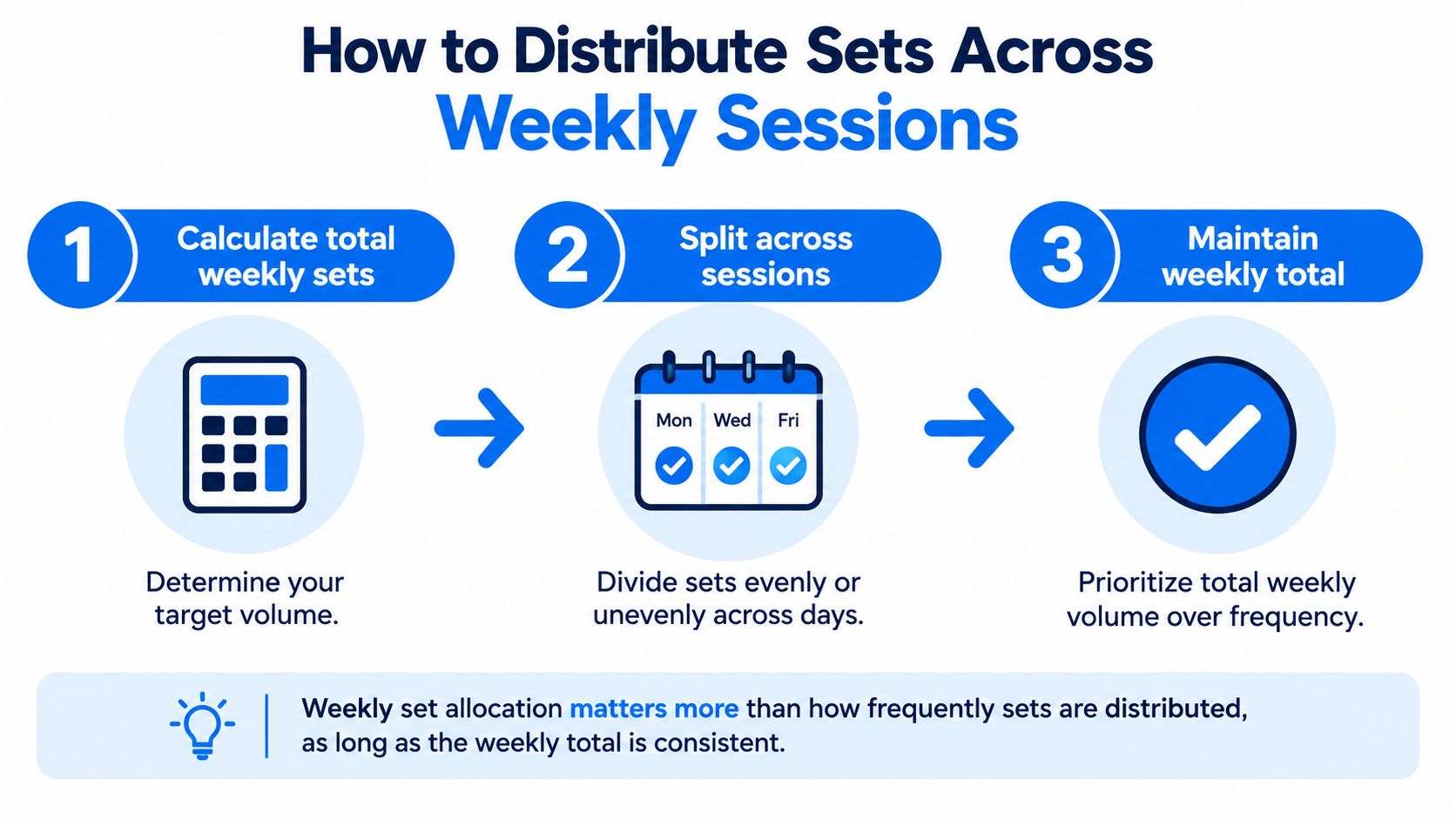
A Practical Way to Split Your Sets
For most lifters, training each muscle over two or three weekly exposures is the sweet spot for quality. If your target is 12 to 20 sets for chest, that might mean roughly 6 to 10 sets per session across two chest sessions. Doing all 20 in one marathon workout usually means your last sets are performed tired, with lighter loads and sloppier technique.
A Bayesian network meta-analysis adds useful nuance. It found that twice-weekly, higher-load, multiset training ranked highest for hypertrophy, while thrice-weekly multiset training ranked highest for strength. It also indicated that at least two sets or two sessions per week were highly likely to improve outcomes versus no training. So if strength is your priority, practicing a lift more often can help. If growth is the goal, two solid exposures usually cover it.
Choosing a structure you can repeat matters more than copying someone else's calendar, and understanding what a training split is helps you pick one that fits your available days. Full-body, upper/lower, and push/pull/legs can all deliver the same weekly volume. They just package it differently.
Choose fewer, longer sessions: This suits you if your weekdays are packed and you can protect two or three longer gym visits.
Choose more, shorter sessions: This suits you if fatigue kills your performance late in workouts or you want more technique practice.
Watch performance, not just the calendar: If your second weekly session for a muscle keeps getting weaker, you're not recovering between exposures, whatever the plan says.
Frequency is a scheduling tool, not a growth hack. It can't rescue a weekly total that's too low, and it can't make low-quality sets count double.
Adjust using what you observe. If soreness is gone, loads and reps are climbing, and you feel ready, your distribution is working. If you're still sore when the same muscle comes around again, spread the sets out more, move some to another day, or trim the total slightly.
Sample Weekly Training Templates
Templates make the numbers concrete. Use them as starting points, not prescriptions. Each one below shows how the same research range looks when it's mapped onto a real week.
Beginner Full-Body Template
Train three non-consecutive days per week. Each session includes a squat or leg press, a hinge or Romanian deadlift, a press, a row, and one direct arm exercise. Doing about three to four hard sets of each pattern per session lands most muscle groups near roughly 10 sets per week.
For example, three sets of bench press on three separate days gives your chest nine direct sets, and your pressing and rowing add overlapping work for triceps and biceps. That overlap is one reason beginners don't need large amounts of direct arm work early on. Keep one or two reps in reserve on most sets while your technique settles.
Intermediate Upper and Lower Template
Train four days, alternating upper and lower sessions. On upper days, pair a horizontal press with a row, then add a vertical press or pulldown and direct arm work. On lower days, combine a squat pattern, a hinge, a single-leg exercise, and calves. With six to eight sets per muscle each time it appears, most muscles land in the 12 to 16 set range across the week.
This structure suits busy adults because a missed day doesn't destroy the week. You still have another upper or lower session coming. Members who train at Empire Athletics, which offers 24/7 access and one-on-one personal training, sometimes use that kind of flexible four-day layout around shift work, though any gym schedule works the same way if you hit your totals.
Advanced Push Pull Legs Template
Train five or six days by rotating push, pull, and legs sessions so each muscle appears about twice weekly. Push days cover chest, front and side delts, and triceps. Pull days cover back, rear delts, and biceps. Legs days cover quads, hamstrings, glutes, and calves. Eight to ten sets per muscle per session puts you near 16 to 20 weekly sets.
If you like longer weeks, a structured 5-day workout plan to build muscle shows one way to organize that volume. Just remember that advanced here describes tolerance and consistency, not ambition. Jumping to six days before you can recover from four is a reliable way to stall.
Experience Level | Sets per Muscle Group per Week | Training Frequency | Sample Split |
|---|---|---|---|
Beginner | Around 10 to 12 | 3 days | Full-body |
Intermediate | Around 12 to 16 | 4 days | Upper and lower |
Advanced | Around 16 to 20 | 5 to 6 days | Push, pull, legs |
Notice what the table shows. Experience level mostly changes how much volume you aim for and how many days you use to deliver it. It doesn't change the underlying logic. You still count hard sets per muscle per week, you still progress load or reps over time, and you still adjust when recovery tells you to.
Pick the template closest to your current level and schedule, then run it long enough to collect real information. Switching templates every two weeks tells you nothing. Staying with one for several weeks while tracking performance tells you almost everything you need.
Common Mistakes in Counting Sets
Here's where the common approach goes wrong, and it's rarely about effort. It's about definitions. The phrase sets per muscle group sounds precise, but lifters count it in very different ways, as highlighted in a 2025 analysis of weekly volume in competitive physique athletes, which focused on quantifying weekly volume by muscle group and showed how difficult real-world volume accounting can be.
Direct Sets Versus Indirect Sets
A direct set targets the muscle as the main mover. A curl is direct work for your biceps. An indirect set trains the muscle as a helper. Rows and pulldowns are direct work for your back, but your biceps assist on every rep. Bench press is direct work for your chest, while your triceps and front delts help.
The same set doesn't give every involved muscle an equal stimulus, so counting it as a full set for all of them inflates your totals. A practical approach is to count direct sets first, then add a conservative fraction of overlapping compound work. For example, a beginner doing 12 direct chest sets plus substantial shoulder and triceps pressing may be giving the triceps a much higher total workload than the log suggests. That's often why someone's elbows feel beaten up even though their written arm volume looks modest.
Counting Sets That Shouldn't Count
Warm-ups don't count. Easy technique sets don't count. Sets stopped far from failure are questionable at best. Count only hard working sets where the last reps slowed down and you couldn't have done many more with good form. If you count everything, you'll conclude you're doing 20 sets when you're really doing 12 hard ones, and you'll add volume you don't need.
Do count: Working sets taken close to failure with controlled technique and a full, consistent range of motion.
Don't count: Warm-up sets, feeder sets used to find your working weight, and sets you stopped because you were bored or distracted.
Count partially: Compound sets where the muscle assists, such as triceps during pressing or biceps during rowing.
The recovery angle is the other half of this mistake. Evidence summarized in research on volume, failure, and recovery found no significant hypertrophy advantage for 20-plus sets versus 12 to 20 sets across most muscle groups, and it notes that training to failure can lengthen recovery. Stack high volume on top of constant failure training and your later sets get weaker, your next session suffers, and your extra work stops paying for itself.
More sets only help if you can recover from them and still perform well. Fatigued, sloppy sets are expensive and not very productive.
Two programs can list identical set numbers and feel completely different. That's why your own log, counted carefully, beats any generic chart. Count direct work, estimate indirect work conservatively, and let performance and soreness confirm whether the number is right.
Your Practical Action Plan
Start near the lower end of the 10 to 20 range this week. Write down your hard direct sets for each muscle, add a conservative estimate for indirect work, and see where you land. Most people find one muscle far above target and another below it.
Then hold that total steady for several weeks. Track your loads, reps, soreness, motivation, and how each session feels. If progress stalls while recovery stays good, add a small amount of volume to that muscle only. If performance drops or soreness lingers into the next session, hold or reduce instead.
Match the dose to the goal. Strength work may justify extra practice and volume because skill improves with repetition. Hypertrophy often progresses well on fewer high-quality sets done consistently. Research in healthy older adults even found that low-volume training substantially improved muscle size and lean mass, which is a useful reminder that high weekly set counts aren't mandatory for everyone.
Your age, training history, job, sleep, and stress all shape the right total for you. Chasing someone else's number ignores all of that. Consistent, well-counted, recoverable sets will outperform a bigger number you can't sustain.
If you'd like help turning these set targets into a program matched to your schedule and recovery, Empire Athletics offers 24/7 gym access in Leominster, Lunenburg, and Webster plus certified one-on-one personal training that builds your weekly volume around your goals. Visit Empire Athletics to find your nearest location, meet the coaching team, and start training with a plan you can track.