How to Clean Gym Equipment the Right Way
Learn how to clean gym equipment properly with step-by-step protocols for cardio machines, weights, benches, and mats, plus smart hygiene policies.

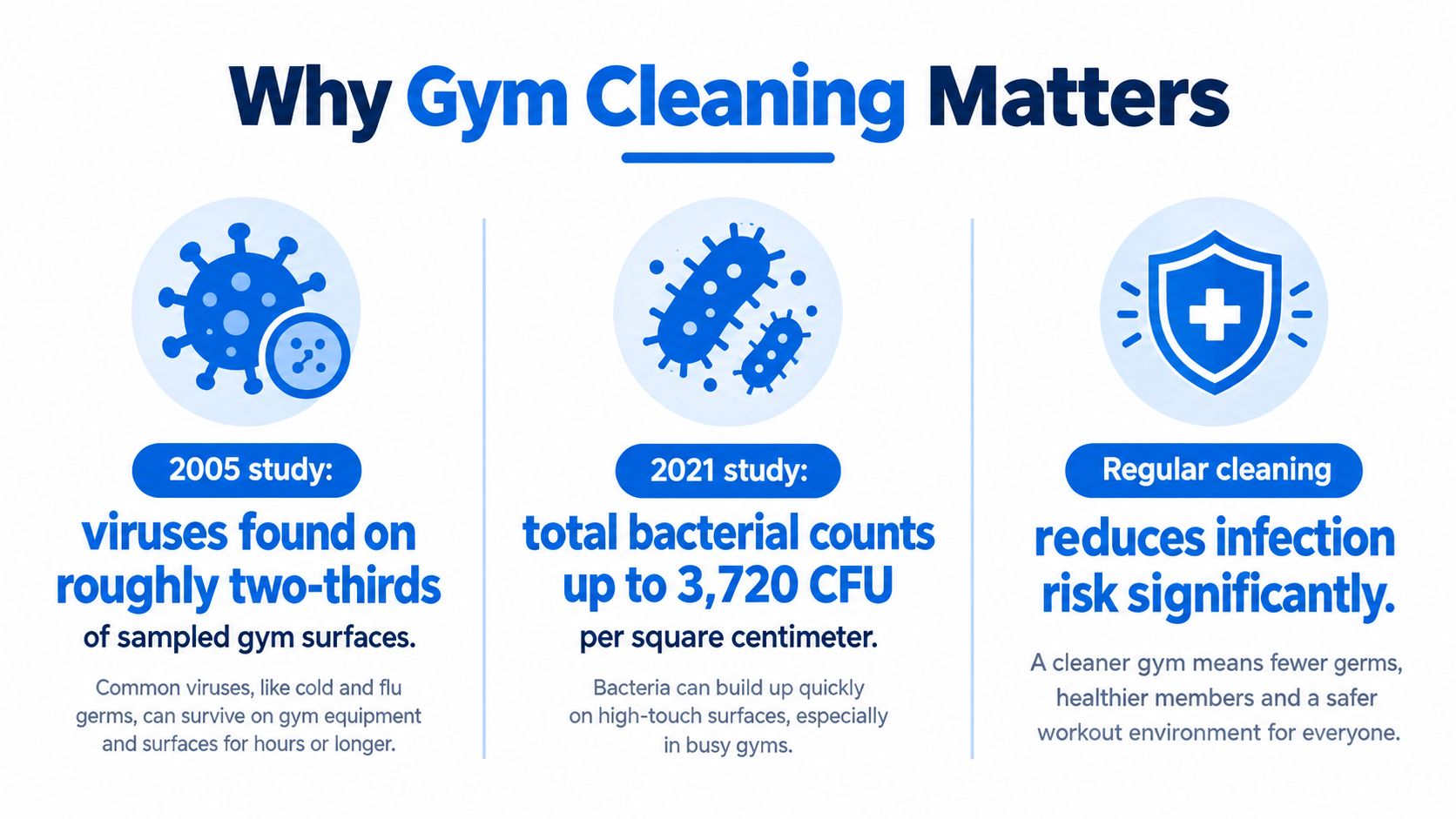
Viruses were found on 63% of sampled gym-equipment contact surfaces in a prospective study of exercise equipment. A bench can look dry, a dumbbell can look spotless, and neither appearance tells you whether the last wipe-down was effective. Learning how to clean gym equipment starts with treating it as shared equipment, not furniture that gets cleaned when it looks dirty.
Why Gym Cleaning Matters More Than Most People Think
A shared gym operates more like a continuously occupied workspace than a household. Members move between equipment, adjust seats, change cable attachments, and touch controls throughout the day. Cleaning only what looks sweaty leaves plenty of contact points outside the routine.
The study cited above found contamination on both resistance-training and aerobic equipment. That doesn't mean every contaminated handle will cause illness, and detecting microbes isn't the same as documenting transmission. It does mean that appearance alone isn't a useful hygiene standard.
Clean and disinfect are different instructions
Cleaning removes sweat, oils, and visible soil. Disinfecting uses an appropriate product to kill or inactivate the germs covered by its label. Those jobs overlap in some labeled products, but staff shouldn't assume that any wet wipe performs both.
The practical distinction matters after a busy training period. Removing a sweat film makes a bench visibly cleaner, but calling it disinfected requires the correct product and application procedure. Conversely, spraying disinfectant over accumulated soil skips the preparation that an effective treatment may require.
The sanitation priorities are summarized below.
Build around contact, not appearances
An operating plan should distinguish between surfaces members repeatedly handle and areas that need ordinary housekeeping. Give staff a route and clear responsibilities rather than a general instruction to keep the floor clean.
Follow the hands: Include grips, adjustment levers, attachment handles, and controls, not just large pads.
Follow the traffic: Add inspections after busy periods instead of assuming a quiet-looking room hasn't been used.
Follow the record: Document completed work and unresolved problems so the next staff member doesn't have to guess.
Practical rule: A pleasant smell and a shiny frame aren't evidence that the surfaces people touch received the right treatment.
When evaluating a facility through a gym free trial, ask staff how equipment cleaning works during unstaffed hours. A useful answer explains member supplies, staff checks, and how to report a problem, rather than pointing to a spray bottle.
The Universal Two-Stage Cleaning Workflow
Start with the product label and the equipment manufacturer's care instructions. If the disinfectant permits a surface but the equipment manufacturer prohibits that chemistry, find a compatible alternative. Staff shouldn't have to resolve that conflict while holding a dripping cloth beside a console.
The reason to take preparation seriously isn't theoretical. A sports-center investigation published in 2021 reported total bacterial counts of 390 to 3,720 CFU/cm² and E. coli levels of 550 to 1,080 CFU/cm² on sampled equipment. Those findings describe the tested facility, not every gym, but they reinforce why a cosmetic wipe isn't a complete protocol.
Remove soil before treating the surface
Use a compatible cleaner or detergent to lift sweat, oils, and visible residue. Work into accessible grip textures and around adjustment controls without forcing liquid into openings. Remove cleaner residue as directed before proceeding.
Keep clean cloths available so staff don't stretch a visibly dirty cloth across an entire equipment row. If you're using a combined cleaner-disinfectant, follow its specific instructions for precleaning and soil removal rather than assuming the combined name eliminates preparation.
This diagram shows the basic sequence.

Apply the disinfectant as a treatment
Choose an EPA-registered disinfectant with label directions covering the relevant surface and pathogen. Apply enough to achieve the prescribed coverage, then respect the wet contact time, the interval during which the surface must remain visibly wet.
Check wetness: If the surface dries before the interval ends, reapply according to the label.
Protect openings: Don't oversaturate switches, electrical ports, upholstery seams, or console edges.
Keep chemicals separate: Never mix cleaning products or improvise a stronger solution.
Finish correctly: Follow any required rinsing or drying directions before returning equipment to use.
A quick spray followed immediately by a dry towel may remove residue, but it doesn't establish that the labeled disinfection treatment happened. Schedule the process so equipment can remain unavailable while the product works. If the chosen product's instructions don't fit the available turnaround window, reconsider the product or the workflow, not the instructions.
Matching the Protocol to Cardio, Free Weights, Benches, and Mats
Choose products by surface compatibility, not by whether the bottle says gym cleaner. A console, a rubber-coated dumbbell, and an upholstered bench may sit beside one another while requiring different handling.
Console cleaning illustrates why application technique matters.

Cardio controls and free weights
For treadmills, bikes, and ellipticals, separate the screen from the rails and handles in your cleaning instructions. Use a soft cloth and a manufacturer-approved application method around electronics. Don't assume the rail disinfectant is screen-safe, and follow the machine's shutdown instructions where required.
A floor plan covering different cardio workout equipment should identify each machine's touched controls, not just its obvious handrails. Seat-adjustment knobs and resistance buttons belong on that list.
On free weights, focus on the handle and accessible grip texture. Remove buildup before applying a compatible disinfectant, and don't soak the weight or leave liquid pooled around joins. Rubber coating, painted metal, and exposed metal shouldn't automatically receive the same chemical.
Upholstery and mat materials
Bench pads need products explicitly permitted for their covering. Clean the seat, back pad, and adjustment hardware, but avoid saturating seams or exposed foam. Flag damaged coverings for assessment instead of repeatedly flooding them.
For mats and foam rollers, identify the actual construction before choosing a treatment. Don't assume a hard-surface disinfectant's claims extend to porous foam; use compatible detergent cleaning and only apply disinfectant where both the product label and manufacturer allow it.
Product families need the same scrutiny:
Neutral cleaners: Consider them for soil removal when the equipment instructions permit them. They aren't automatically disinfectants.
Registered disinfectants: Match the specific formulation to the surface, pathogen claim, and application method.
Chlorine dioxide or hypochlorous products: Evaluate the actual labeled product, not just the active ingredient. Never improvise dilution or extrapolate a study result to a different formulation.
Disinfectant guidance from the EPA describes product-dependent wet-contact intervals ranging from 30 seconds to 10 minutes. That variation is a purchasing consideration, but a shorter interval doesn't override material compatibility.
Use the video as supplementary visual context, while keeping the equipment instructions and product label authoritative.
Member Wipe-Down Etiquette That Actually Works
After a set, with someone waiting for the bench and your next exercise across the room, cleaning etiquette should be straightforward: remove your belongings, address the surfaces you used, and tell the next person if the equipment still needs time before reuse.
Don't turn someone else's impatience into a reason to wipe disinfectant dry. The member who comes next needs usable equipment, not an invisible promise that someone sprayed it.
Make the routine easy to follow
Before training, locate the facility's approved wipes or cleaning station and the designated waste bin. At a new gym, ask staff which products are intended for screens and upholstery. Don't substitute a personal cleaning spray whose compatibility nobody has checked.
Before use: Inspect handles, seats, and controls. If they're visibly soiled, clean them using the approved procedure or ask staff for help.
After your set: Address the surfaces your hands and body contacted, including adjustment handles you moved.
Before leaving: Follow the posted treatment and drying directions, dispose of used wipes in the designated bin, and return weights to accessible storage.
When something's wrong: Report an empty dispenser, damaged pad, or contaminated surface rather than leaving it for the next member to discover.
Returning weights matters operationally because staff and members need access to the handles. Leaving dumbbells under a bench makes a proper inspection and wipe-down less straightforward.
Don't confuse a quick task with a finished treatment
The hands-on part of a wipe-down can be brief; the required wait is separate. If another member approaches, explain that you've just applied the product and that the equipment isn't ready yet. Choose another station rather than using a surface that's still undergoing treatment.
Leaving a surface wet for the required interval is part of the job, not a failure to finish wiping.
For training outside staffed hours, learn the facility's reporting process in advance. A routine member wipe-down is appropriate for ordinary use, but members shouldn't be expected to improvise a response to blood or unidentified contamination.
High-Touch Surface Priorities for Staff
Staff need a priority order, not an instruction to give every square inch equal attention. Start with surfaces that receive repeated hand or body contact, then use actual traffic and inspections to adjust the route. The ranking should reflect how members use the room, not how impressive a machine looks.
CDC facility-cleaning guidance calls for cleaning visibly dirty surfaces before applying an appropriate EPA-registered disinfectant and maintaining the label-specified wet contact time. The operational task is to translate that requirement into product-specific instructions staff can follow consistently.
Rank the work by observed use
Put handles, grips, dumbbell handles, cable attachments, and frequently used controls at the front of the route. Include benches, seats, adjustment levers, and selector pins alongside them. Inspect locker-room touchpoints as a separate zone so equipment cleaning doesn't leave those shared surfaces unattended.
Lower-contact frames and decorative panels still need cleaning, but they shouldn't displace a dirty bench or repeatedly handled attachment. After busy periods, check the priority route again rather than assuming an earlier pass is still adequate.
Gym equipment cleaning reference
Use this as a planning matrix, then replace general directions with the approved product names in the staff procedure.
Surface | Contact Frequency | Product Type | Wet Contact Time |
|---|---|---|---|
Dumbbell handles and cable grips | Repeated handling between users | Compatible cleaner, then registered disinfectant permitted for the finish | Full product-label interval |
Bench seats and back pads | Body contact during use | Upholstery-approved cleaner and compatible disinfectant | Label interval without saturating seams |
Cardio rails and adjustment levers | Repeated hand contact | Cleaner and disinfectant permitted for the coating | Full product-label interval |
Touchscreens and consoles | Varies with member interaction | Manufacturer-approved screen treatment with applicable disinfectant claims | Follow compatible product directions |
Mats and foam accessories | Hand and body contact during use | Material-approved cleaner; disinfectant only where permitted | Only the interval specified for that surface |
Lower frames and covers | Usually less direct contact | Compatible routine cleaner; targeted disinfection when warranted | Applicable label interval if disinfecting |
More disinfectant isn't automatically better. The CDC's targeted-cleaning guidance doesn't support treating indiscriminate large-scale spraying as a substitute for properly addressing shared touchpoints.
Assign inspections, post-traffic cleaning, and a documented end-of-day disinfection route. In an around-the-clock facility, end of day should mean a defined sanitation checkpoint, not an assumption that use stops afterward.
Record the area, product, completion time, and any exception requiring follow-up. Empty supplies, damaged coverings, and equipment that couldn't be treated should reach the next responsible staff member, not disappear inside a checked box.
Responding to Sweat, Bodily Fluid, and Suspected Illness
A sweat film on a bench and blood on a handle shouldn't trigger the same response. Ordinary soil needs prompt cleaning; bodily-fluid contamination needs controlled escalation. Staff should know which situation they can manage under the routine procedure and which requires the facility's incident protocol.
The distinction is controlled handling, not applying more spray.

Keep contaminated equipment out of circulation
For visible sweat, pause use and follow the established cleaning procedure. For blood, unidentified bodily fluids, or concerning contamination associated with a skin lesion, prevent reuse and alert the designated staff member. Don't ask another member to solve it with a routine wipe.
Isolate the item: Make it clear that the bench, attachment, or machine isn't available.
Use the incident procedure: Trained staff should wear gloves and any other protection required by the product and facility protocol.
Choose the appropriate treatment: Follow the product's bodily-fluid instructions and relevant pathogen claims, including preparation and disposal requirements.
Document release: Record the response and return the item only after treatment and required drying are complete.
Maintain the baseline without diagnosing members
Staff shouldn't diagnose an infection from someone's appearance. Respond to the contamination, protect access to the affected equipment, and escalate uncertainty through the facility's established process.
CDC guidance for athletic facilities recommends cleaning shared athletic equipment after each use and allowing it to dry before reuse. It also emphasizes maintaining cleanliness whether or not an MRSA infection has been identified.
Escalation standard: If staff can't identify a safe, approved treatment for the contamination and material, keep the equipment unavailable until they can.
Building a Sustainable Cleaning Habit
A sustainable routine gives members a manageable responsibility and gives staff ownership of verification. Neither group can replace the other. Member wipe-downs address immediate use, while staff inspections catch missed surfaces, empty supplies, damaged materials, and incidents requiring trained handling.
Make the procedure visible
Post instructions that identify the approved product, intended surfaces, required treatment interval, and reporting method. Keep manufacturer exceptions accessible to staff instead of relying on memory. Place member supplies where they're easy to find without forcing people to walk through an active lifting area.
Use this checklist during your next workout or facility walkthrough:
Identify the touchpoints: Include what you adjust, not just what you sit on.
Check the instructions: Know which product belongs on the material.
Leave the required interval: Don't assume the application is the entire treatment.
Report exceptions: Flag contamination, unavailable supplies, or damaged coverings.
Confirm responsibility: Know how to reach staff or submit a report outside staffed hours.
Ask operational questions before joining
When comparing gyms in Leominster, Lunenburg, or Webster, ask to see the cleaning instructions members use. Ask how staff verify the high-touch route and what happens when equipment needs to be taken out of service.
The useful answer isn't that everything gets sprayed constantly. It's that the facility has a repeatable process, compatible products, clear responsibilities, and a way to handle exceptions. That's what makes cleaning workable across changing schedules without turning every workout into a sanitation project.
Empire Athletics offers around-the-clock member access, strength and cardio equipment, and certified personal training in Leominster, Lunenburg, and Webster. Visit to explore the training space, ask staff about equipment-cleaning instructions and after-hours reporting, and see how the facility fits your workout schedule.