8 Lower Ab Exercises for Stronger Core Control
Explore 8 lower ab exercise options with regressions, progressions, programming tips, and technique fixes for safer, more effective core training.

A single “lower ab exercise” won't reveal or isolate a hidden section of your stomach. The rectus abdominis is one continuous muscle, and an expert review explains that no exercise or device has been shown to selectively isolate its lower portion (Brookbush Institute review). Movements such as leg raises and reverse crunches can make the lower region feel highly involved because they demand pelvic control and trunk flexion, but that sensation isn't proof of separate lower-ab anatomy.
The better approach is to build control first, then add movement, resistance, and complexity. The progression below starts with exercises that teach you to hold your pelvis and spine in position, moves through supported and hanging leg-raise patterns, and finishes with loaded flexion and rotational work. Choose your starting point based on your current control, available equipment, and goal. If your back arches, your grip fails, or momentum takes over, regress the exercise rather than forcing the hardest variation.
1. Hanging Leg Raises
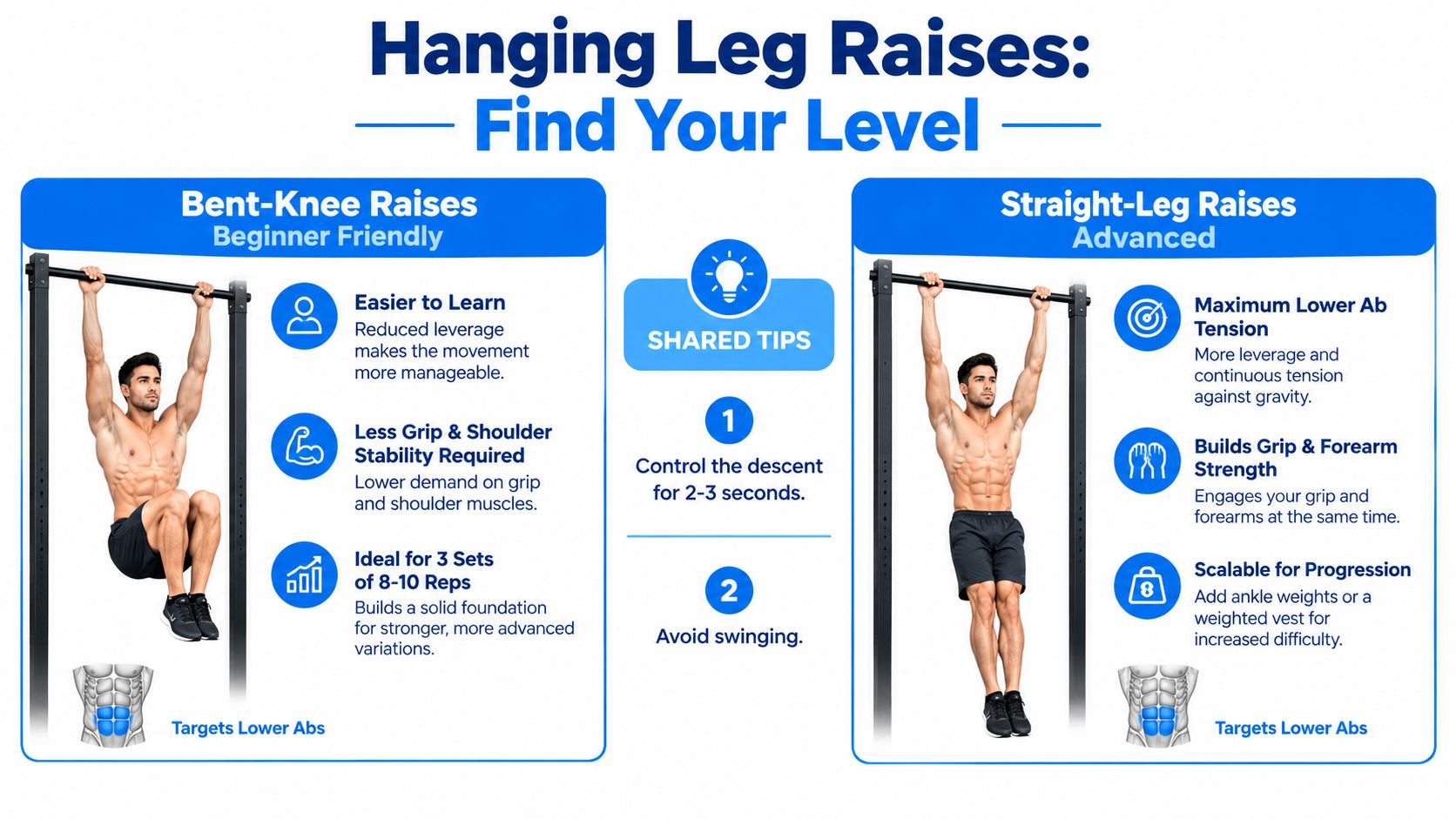
Hanging leg raises are a demanding choice for people who can support their bodyweight from a pull-up bar without excessive swinging. You hang with your arms extended, raise your knees or legs toward hip height, and lower them under control. The exercise challenges the rectus abdominis, hip flexors, grip, and shoulder stabilizers together, so it's best treated as a full-core movement rather than a magically isolated lower-ab drill.
Beginners should use bent-knee raises. Bring your knees up while gently curling your pelvis toward your ribs, then lower without letting your legs swing forward. Straight-leg raises increase the lever length and make the movement harder. Advanced trainees can add external resistance only after they can maintain a quiet torso and controlled range of motion.
Practical rule: If the descent becomes a drop, the variation is too difficult for productive training.
Coaching cues and progression
Start with three sets of eight to twelve clean repetitions, using bent knees if needed. Take roughly two to three seconds to lower each repetition, and begin the lift by moving your pelvis rather than kicking your legs. Progress by adding repetitions or range before adding weight. A practical schedule is two or three weekly sessions within a broader core routine, not an automatic daily challenge.
Hanging leg raises can strengthen the abdominal muscles, but they won't specifically remove fat from the lower stomach. A controlled study found that six weeks of abdominal exercise alone didn't reduce abdominal subcutaneous fat or other body-composition measures (the 2011 controlled study). For visible definition, pair strength work with an overall approach to body composition, such as the guidance in this body-fat reduction resource.
2. Cable Machine Low Pulley Crunches
A rope cable crunch gives you something bodyweight exercises can't provide as easily, measurable external resistance. Kneel facing a low pulley, hold the rope near your head, and curl your ribcage toward your pelvis while the cable remains under tension. The movement trains trunk flexion through the rectus abdominis, but it doesn't isolate the lower section of that muscle.
Set the rope so you can move freely without letting the cable pull your shoulders into an awkward position. Keep your hips mostly still. If your hips travel backward and forward with every repetition, you're turning the exercise into a kneeling hip movement instead of loading the trunk effectively.
Who should use it
Cable crunches suit lifters who want a straightforward way to increase resistance over time. A beginner can start with a light setting and learn the path of motion, while an experienced bodybuilder can use heavier resistance for lower-repetition work or moderate resistance for longer sets. The correct load is the one that lets you curl through the torso without yanking the rope or losing pelvic position.
Start conservatively: Use a load that allows eight to fifteen controlled repetitions.
Pause briefly: Squeeze at the bottom without collapsing into your hips.
Control the return: Let the cable pull you upward slowly instead of releasing tension.
Keep the neck relaxed: Your elbows can travel toward your thighs without forcing your head down.
The most common mistake is excessive forward leaning from the hips. Think about bringing the sternum and pelvis closer through abdominal flexion, then return to the starting position with control. Three sets performed two or three times weekly can fit well after larger strength exercises.
3. Decline Bench Sit-Ups
Decline sit-ups increase the challenge by placing your torso at a disadvantage against gravity. They may suit an intermediate trainee who already performs controlled floor or flat-bench sit-ups without back discomfort. The decline changes the difficulty of the whole movement, though it still trains the rectus abdominis as one continuous muscle rather than making a distinct lower portion work alone.
Begin with a flat surface or a shallow decline. Secure your feet so they don't slide, but don't use the foot position to launch your torso upward. Keep your hands across your chest or place them lightly behind your head. Pulling on the neck makes the repetition look easier while reducing the quality of the movement.
Make the pelvis part of the rep
At the top, finish with a controlled trunk curl instead of stopping as soon as your shoulders leave the bench. At the bottom, lower slowly and keep enough abdominal tension to avoid dropping onto the bench. A gentle pelvic curl toward the ribcage can help you stay connected to the abdominal movement, but it shouldn't become a forceful spinal jolt.
Use three sets of ten to fifteen repetitions as a general starting point, with two or three sessions per week if recovery is good. Add difficulty by increasing the decline gradually or holding a weight against your chest, not by rushing the tempo. The most limiting factor is often hip-flexor dominance. If your hips do most of the work or your lower back becomes uncomfortable, reduce the angle and shorten the range until you can control each phase.
People with existing back symptoms should choose a more supported option and seek qualified coaching before loading decline sit-ups. A trainer can assess whether the exercise fits your current movement capacity.
4. Captain's Chair Leg Raises
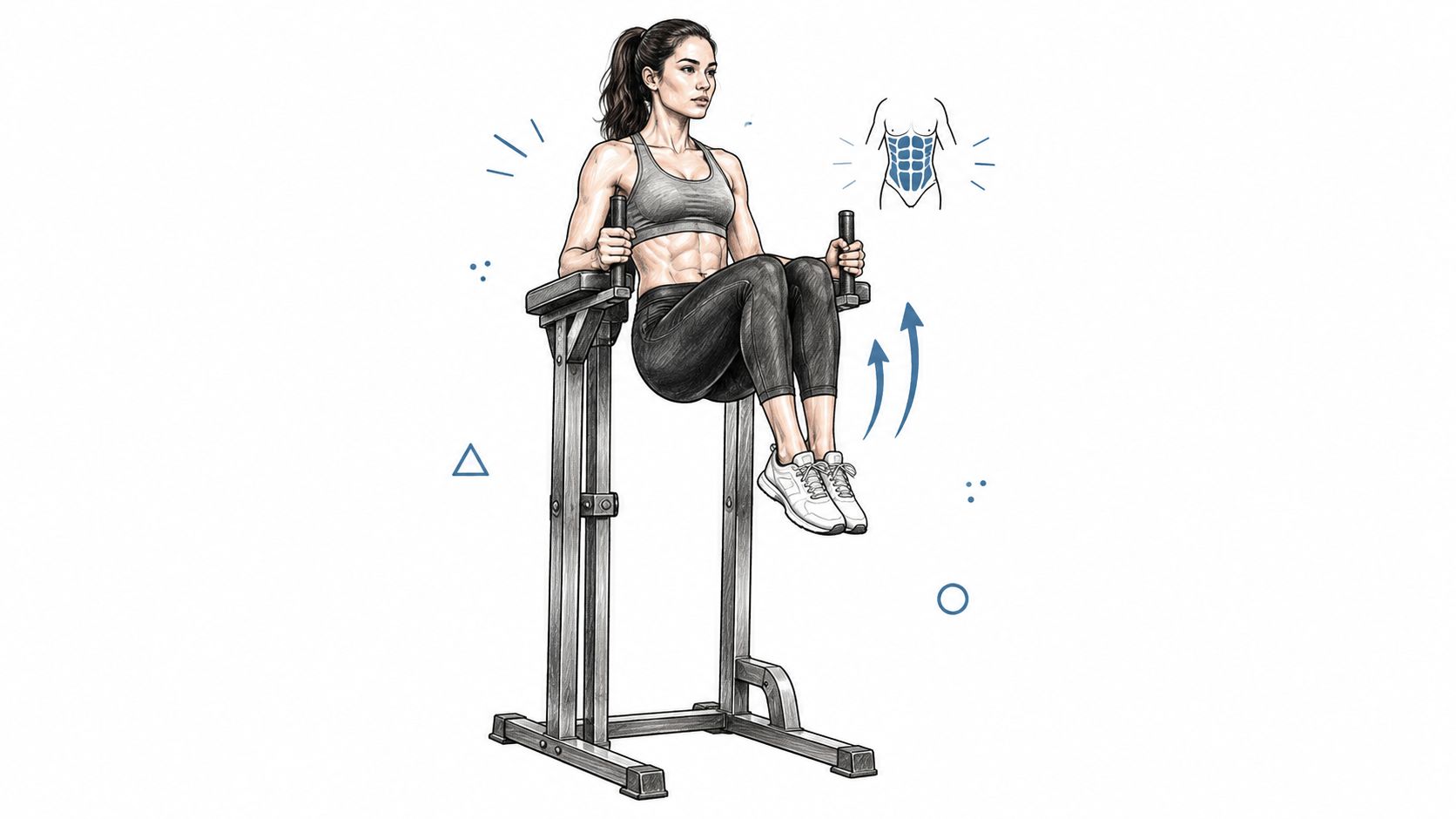
The captain's chair offers a useful middle ground between floor work and hanging raises. Your forearms rest on pads, your back is supported, and your legs move against gravity without requiring as much grip strength. That support makes it easier to focus on pelvic control and reduces the swinging that often ruins hanging variations.
Start with bent-knee raises. Lift the knees toward the torso, then add a small pelvic curl at the top rather than stopping when the thighs reach hip height. Once you can keep your shoulders down and torso stable, progress to straight-leg raises. The longer lever increases the challenge without requiring a new piece of equipment.
A supported route to stronger control
This variation works well for beginners who can't yet hang comfortably, as well as experienced trainees who want a lower-grip-demand leg raise. Use three sets of eight to fifteen repetitions, breathe out as the legs rise, and inhale as you lower. A two- or three-second descent keeps the exercise from becoming a series of quick knee lifts.
The most common technique error is leaning back and arching the lower spine. Keep your torso tall against the back support and avoid using the pads to shove yourself upward. If you can't control the descent, shorten the range or return to bent knees.
You can pair captain's chair raises with cable crunches for a combination of leg-driven pelvic control and loaded trunk flexion. They belong in a complete routine, not as a substitute for training the back, hips, and broader core.
5. Ab Wheel Rollouts
Ab wheel rollouts train your core to resist unwanted spinal extension as your arms travel away from your body. That makes them different from a traditional crunch. The rectus abdominis works with the deeper abdominal muscles, shoulders, hips, and back to keep your trunk from sagging.
Kneeling rollouts are the sensible entry point. Start with a short range, perhaps stopping well before your hips move forward or your lower back arches. From there, gradually travel farther while keeping your ribs and pelvis controlled. Standing rollouts require far more strength and should come only after you own the kneeling pattern.
Control the range, not the ego
Move slowly in both directions. Take roughly two to three seconds to roll out and a similar amount of time to return if you can maintain position. A failed rollout usually shows up as a dropped pelvis, flared ribs, or a sudden snap backward. Reduce the range immediately when one of those signs appears.
Regression: Use a wall or raised surface as a stopping point.
Base variation: Kneel and roll only as far as your spine stays neutral.
Progression: Extend the range gradually, then consider more demanding positions.
Programming: Place rollouts one or two times weekly if they create substantial soreness or fatigue.
The best rollout is the farthest controlled rollout, not the longest uncontrolled one.
The ab wheel is useful for strength development, but it's demanding enough that it shouldn't be treated as a high-repetition finisher after every workout. Pair it with easier exercises when you want more total abdominal volume. For guidance on selecting repetitions for muscle-focused training, see this rep-range guide.
A certified trainer can also check whether your current range is challenging your core or stressing your lower back.
6. Dead Bug Exercise
The dead bug looks simple because the floor supports your body. Its difficulty comes from maintaining that support while your arms and legs move in opposite directions. Lie on your back with your hips and knees bent, raise your arms, and slowly extend one arm and the opposite leg. Your task is to keep the pelvis and spine from shifting.
This is an excellent starting point for beginners, people returning to exercise, and athletes using a controlled warm-up before heavier core work. It doesn't require a machine, bar, or hanging grip. It also teaches the fundamental skill that many harder lower-ab exercises demand, resisting an arch in the lower back.
Build the pattern in small steps
Press your lower back gently into the floor without smashing it down or holding your breath. Begin with small arm and leg movements. As control improves, reach the leg closer to the floor or take the arm farther overhead. Only progress to longer-lever variations when you can keep the same pelvic position.
Ten precise repetitions teach more than a long set performed with the back arching.
Use three sets of ten repetitions per side as a practical framework, two or three times weekly. Move deliberately, pausing whenever you need to re-establish contact with the floor. If your back lifts, reduce the range, keep the knee more bent, or move only one limb at a time.
The most common mistake is chasing repetition count instead of position. A dead bug should feel like a control exercise, not a race. Anyone rebuilding movement after an injury should use a qualified professional to decide the range and loading that fit their situation.
7. Machine Abdominal Crunch
A plate-loaded or selectorized abdominal machine can make progressive resistance easier to manage. The seat and pads provide external support, allowing you to concentrate on trunk flexion rather than balancing your whole body. That makes the machine a practical choice for beginners learning abdominal loading and experienced lifters who want a repeatable finishing exercise.
Adjust the seat so the pad meets your mid-chest or the machine's intended contact point. Start with the lightest useful resistance and practice moving through the torso instead of pulling with the arms. Keep your hips and feet stable, and avoid forcing your lower back into an exaggerated position.
Use the machine as a measurable tool
Choose a load that allows eight to fifteen quality repetitions. Pause briefly in the shortened position, then take two to three seconds to return. The slow return matters because it keeps the resistance present rather than letting the stack or plate control the movement.
A machine crunch can suit someone training during an unpredictable schedule because the setup is consistent and quick. It's also useful when grip, balance, or shoulder stability limits hanging exercises. However, support doesn't eliminate the need for technique. If you lift your shoulders away from the pad, jerk the handles, or shorten every repetition, the machine's stability won't solve the movement problem.
Perform three sets two or three times per week, preferably after larger strength work. Don't assume daily training is automatically better. The abdominal muscles still need recovery, and the rest of your program should include bracing, hip control, and movements that challenge the sides and back of the trunk.
8. Landmine Rotational Chops
Landmine rotational chops add a standing, diagonal pattern to your core training. One end of a barbell is anchored, and you guide the free end across the body or from high to low while resisting the pull that wants to rotate your torso. The exercise involves the abdominal complex, hips, shoulders, and upper back, so it's broader than a direct flexion movement.
Start with an empty bar or very light load. Establish a stable stance, brace before the bar moves, and let the hips and upper body coordinate without aggressively twisting the lumbar spine. Your body should rotate as a connected unit rather than allowing the weight to yank your shoulders around.
Progress through control and symmetry
Use equal repetitions on both sides. A light load with a smooth path is more useful than a heavy bar that creates momentum. Athletes may use the exercise to connect lower-body force with upper-body movement, while beginners can treat it as a slow anti-rotation drill. Anyone returning from pain or an imbalance should have the pattern assessed before adding load.
Beginner option: Keep the range short and the bar close to the body.
Intermediate option: Increase the range while maintaining a quiet pelvis and neutral spine.
Advanced option: Add resistance or speed only when you can stop the bar under control.
Common error: Letting the shoulders whip the bar while the trunk loses its brace.
Include landmine chops once or twice weekly after foundational abdominal work. They complement, rather than replace, dead bugs, leg raises, and controlled flexion. If you're working around mobility restrictions or previous movement problems, Empire Athletics' corrective exercise programming can help match the variation to your current ability.
8-Way Comparison: Lower Ab Exercises
Exercise | Implementation Complexity 🔄 | Resource Requirements ⚡ | Expected Outcomes 📊 | Ideal Use Cases ⭐ | Key Advantages ⭐ | Quick Tip 💡 |
|---|---|---|---|---|---|---|
Hanging Leg Raises | High, strong core, grip & shoulder stability required | Pull-up bar; minimal equipment, on-site availability | 📊 ⭐⭐⭐ High lower-ab isolation, progressive overload potential | Intermediate→Advanced lifters, calisthenics, bodybuilders | Max lower-ab tension, builds grip, scalable with added weight | Start bent-knee, control descent, avoid swinging |
Cable Machine Low Pulley Crunches (Rope) | Low–Moderate, simple pattern but needs machine setup | Cable machine + rope attachment; commonly available | 📊 ⭐⭐⭐ Continuous tension, excellent for hypertrophy & definition | Beginners→Advanced targeting hypertrophy and aesthetics | Adjustable resistance, safe spine position, precise mind–muscle link | Keep hips fixed, squeeze at bottom, use 8–15 reps |
Decline Bench Sit-ups | Low, basic movement, watch for form errors | Decline bench; common gym equipment | 📊 ⭐ Moderate lower‑ab stress, good for high‑volume work | Beginners→Intermediates, accessible lower‑ab training | Easy progression via bench angle, simple to learn | Start at low angle, curl pelvis to ribcage, control descent |
Captains Chair Leg Raises | Moderate, easier than hanging, less momentum | Captain's chair/dip station; availability varies | 📊 ⭐⭐⭐ Strong lower‑ab activation with improved stability | Beginners→Intermediates, rehab‑friendly progression to hanging | Stable, reduces swinging, good progression bridge to hanging raises | Begin bent‑knee, stay upright, control descent 2–3s |
Ab Wheel Rollouts | High, technical, steep learning curve, high control | Ab wheel (or barbell), minimal space; very portable | 📊 ⭐⭐⭐ Exceptional full‑core strength, functional transfer | Advanced lifters and athletes seeking functional core strength | Engages entire core chain, high time‑under‑tension, portable | Start kneeling with small range, progress slowly by inches |
Dead Bug Exercise (Supine) | Low, very simple, low skill requirement | None, floor space only | 📊 ⭐ Moderate activation, excellent for stability & rehab | Beginners, rehabilitation, movement prep and core activation | Safe, teaches neutral spine and core bracing, scalable | Press lower back to floor, prioritize quality over reps |
Machine Abdominal Crunch (Plate‑Loaded) | Low, machine‑guided path, minimal technique needed | Ab crunch machine; common in commercial gyms | 📊 ⭐⭐→⭐⭐⭐ Good for isolated hypertrophy and controlled loading | Beginners, busy professionals, hypertrophy‑focused trainees | Easy progression, consistent resistance, safe when set up correctly | Adjust seat, control eccentric 2–3s, start conservative weight |
Landmine Rotational Chops (Anti‑Rotation) | Moderate→High, requires anti‑rotation mechanics | Barbell + landmine; not available at all facilities | 📊 ⭐⭐ Functional anti‑rotation strength, athletic carryover | Athletes, performance‑focused lifters, supplemental core work | Builds integrated core stability, dynamic movement pattern | Start light, keep neutral spine, perform balanced reps each side |
Build Your Lower-Ab Plan Around Progression
A strong lower-ab plan starts with the skill you can perform consistently. Dead bugs are the clearest entry point when you need to learn pelvic control and resist lower-back arching. The captain's chair gives you a supported dynamic option once you can control the dead bug pattern. A shallow decline bench can add challenge to trunk flexion, while cable and machine crunches provide a practical way to increase resistance in small, trackable steps.
Hanging leg raises and ab wheel rollouts belong later for many trainees because they expose weaknesses quickly. Hanging raises demand grip, shoulder stability, pelvic control, and enough abdominal strength to prevent swinging. Rollouts demand the ability to resist extension as the lever length increases. Landmine chops add another layer, requiring the trunk to manage rotation and transfer force through the hips and shoulders.
Use clean technique as your main progression rule. Add repetitions, range, resistance, or a more difficult position only when you can complete the current variation without momentum or compensation. If the lower back arches during a dead bug, shorten the reach. If the hips swing during a hanging raise, bend the knees. If a rollout causes your pelvis to drop, reduce the distance.
The anatomy matters because it changes how you judge results. The rectus abdominis isn't divided into separately trainable upper and lower muscles. A pilot EMG study found no significant activation difference between upper and lower rectus sites across the abdominal exercises it compared, and the authors reported that exercise choice affected total rectus loading more than regional isolation (the pilot EMG study). A larger analysis of sixteen abdominal exercises likewise found no significant difference between upper and lower rectus activation across the exercises tested, with the traditional crunch producing greater activation than several other movements (the larger EMG analysis).
That doesn't make exercise selection pointless. It means you should choose exercises for control, loading, range of motion, comfort, and progression, not for promises of isolated lower-belly fat loss. A 2022 meta-analysis summarized by this evidence review of the spot-reduction myth found that localized muscle training didn't reduce abdominal subcutaneous fat, waist circumference, or overall body fat. Train the muscles directly, support your broader body-composition goals with nutrition and full-body exercise, and give the process time.
Empire Athletics' certified one-on-one trainers can assess your form and help build a routine around your starting point, whether you're new to training, lifting seriously, managing a busy schedule, or returning after a movement limitation. With 24/7 access across its Central Massachusetts locations in Leominster, Lunenburg, and Webster, you can schedule core work when your week allows and use the available strength equipment to progress beyond a collection of random ab exercises.
Empire Athletics offers 24/7 access, modern strength and cardio equipment, certified one-on-one personal training, and flexible programming for members working on core control, strength, body composition, or performance. Visit Empire Athletics to find the Central Massachusetts location and training support that fit your schedule.