Protein Shake Before or After Workout: What the Science Says
Protein shake before or after workout — which actually builds more muscle? Evidence-based comparison, decision rules by goal, and timing windows that work.

The popular answer is that you must drink a protein shake within a narrow post-workout “anabolic window.” That advice is easy to remember, but it misrepresents what the evidence can support. The better question isn't “protein shake before or after workout?” It's “How does this shake fit my daily protein target, my training session, and the time until my next protein-rich meal?”
A shake taken before training can work as well as one taken afterward when daily protein intake is adequate. The practical difference appears when you train fasted, face a long gap before your next meal, or need a convenient way to distribute protein across a busy day. The useful answer is therefore a decision rule, not a universal clock time.
The Question That Actually Matters About Protein Shake Timing
The before-versus-after question is too narrow. Start with total daily protein, then assess the time between training and your next substantial protein-containing meal. Training volume also changes the scheduling problem. A demanding lower-body session may leave a longer gap before recovery nutrition than a short maintenance workout.
A randomized trial in resistance-trained men found no significant difference between taking protein before or after training over 10 weeks. Daily conditions were controlled, and each group avoided food for at least three hours on the opposite side of the workout. The findings support total daily intake over a fixed pre- or post-workout dose. The full trial report provides the direct comparison.
Practical rule: Use timing to manage the gap between meals, not to compensate for insufficient daily protein.
The broader evidence reaches a similar conclusion. A meta-analysis reported no meaningful difference in lean body mass from protein timing, with a standardized mean difference of -0.08, a 95% confidence interval from -0.398 to 0.244, no observed heterogeneity, I² = 0%, and p = 0.641 the evidence synthesis. When overall intake is sufficient, choosing before rather than after offers little practical advantage.
A shake two hours before training can therefore serve much the same role as one two hours afterward if the rest of the day's protein remains constant. The decision depends on the training window and the next meal: fasted sessions favor protein beforehand, evening sessions may favor a shake when dinner is delayed, and demanding lower-body sessions make a long post-workout gap more consequential. For a busy adult, the shake's main job is to keep daily protein distributed when a normal meal will not arrive soon.
How Muscle Uses Protein Around Training
Resistance training increases muscle's sensitivity to amino acids, while dietary protein supplies those building blocks. The workout creates a window of improved responsiveness, but muscle growth still depends on having enough protein available across the day.
The shake's timing matters less than its place in the full daily intake. High-quality protein such as whey can stimulate muscle protein synthesis around exercise. A practical serving is 20 to 40 grams, or approximately 0.25 to 0.40 grams per kilogram, depending on body size and the meal schedule. The whey protein research supports this range for strongly stimulating muscle protein synthesis in many adults.
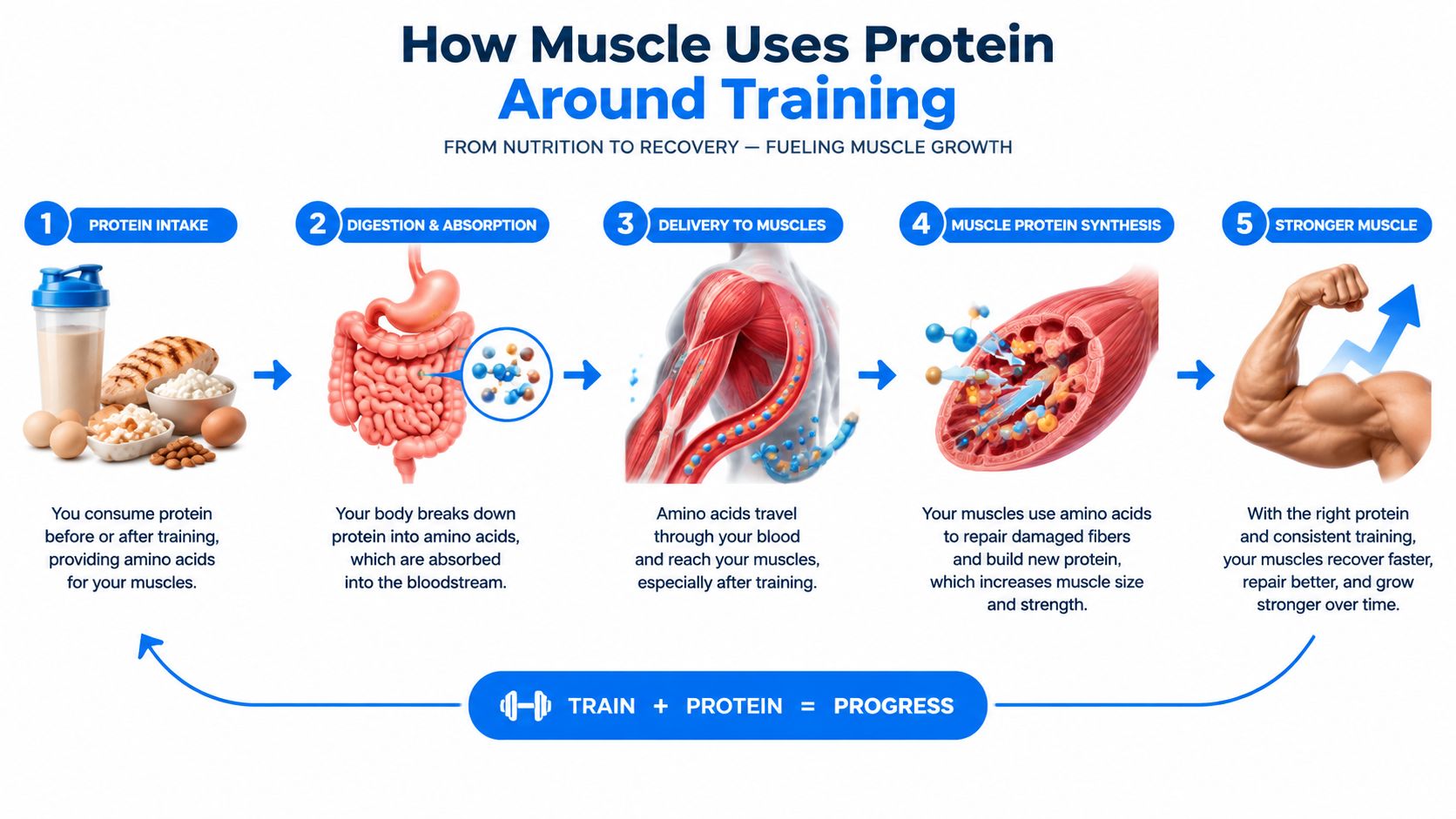
Protein delivery is a distribution problem
A shake provides a predictable dose without meal preparation. That makes it useful before training when the previous meal was small or distant, and after training when the next meal will be delayed. It does not become uniquely anabolic because it is consumed immediately after the final set.
Protein distribution also affects how practical the plan is. The whey protein research describes feedings placed roughly every three hours as a useful way to spread intake across the day. This is a scheduling guide, not an alarm requirement. A meal that arrives earlier still counts, and a large dinner should not have to carry the entire day's protein target.
Muscle remains responsive to protein well beyond the workout itself. A clinical review in the Journal of Orthopaedic & Sports Physical Therapy reported that this sensitivity lasts for at least 24 hours after training, which weakens the case for treating the post-workout minutes as a narrow deadline. The JOSPT review also discussed approximately 0.4 to 0.5 grams per kilogram of lean body mass before and after exercise, often within about four to six hours of one another, with meal size affecting the decision.
For fasted training, a shake beforehand supplies protein when no recent meal is available. For an evening session, it can cover the gap until dinner. After a demanding lower-body workout, it becomes more useful when the next substantial meal is several hours away.
“Enough” has three parts: adequate daily protein, a meaningful dose when a meal gap makes it useful, and a schedule you can repeat. The shake is a delivery tool, not a replacement for the full daily plan.
Before vs After on Muscle, Strength, and Recovery
The pre-versus-post debate promises a clear winner, but controlled evidence does not support one. In a randomized trial, resistance-trained men consumed protein either before or after training. With surrounding food conditions controlled, researchers found no significant difference in body composition or performance over the study period. Read the randomized timing trial for the study design and outcomes.
A later evidence synthesis reaches the same practical conclusion. When total protein was matched, consuming protein before training or within approximately one hour afterward did not produce a meaningful advantage for strength or hypertrophy. Across the trials, the acute timing window ran from roughly 15 minutes before exercise to about two hours afterward, according to the recent nutrition review. That range is wider than the old minute-by-minute gym rule, and the review places total daily intake ahead of peri-workout timing.
The result changes how the shake should be judged. Its value depends less on whether the label says “pre” or “post” and more on whether it improves protein coverage across the training window.
Outcome | Pre-Workout | Post-Workout | Difference with Daily Protein Matched | Evidence Source |
|---|---|---|---|---|
Lean body mass | Supports adaptation when daily intake is adequate | Supports adaptation when daily intake is adequate | No meaningful timing advantage | Randomized trial and evidence synthesis |
Strength | Effective when it fits the daily plan | Effective when it fits the daily plan | No consistent pre-versus-post advantage | Nutrient timing evidence |
Muscle protein synthesis | Provides amino acids during the exercise period | Provides amino acids during recovery | Depends more on amino acid availability than strict sequence | Whey protein research |
Recovery logistics | Useful before a long post-workout meal gap | Useful when the next meal is delayed | Depends mainly on schedule and tolerance | Clinical review |
The decision becomes clearer in three common situations. With fasted training, a pre-workout shake supplies protein when no recent meal is available. For an evening session, it can cover the interval until dinner. After demanding lower-body work, a post-workout shake is more useful when the next substantial meal is delayed.
A fed trainee who ate a protein-rich meal earlier faces a different choice. Either position can work, so digestion, convenience, and the next meal should determine the timing. The shake supports the daily plan; it does not replace adequate daily protein. If you are deciding what to eat after lifting, this guide to post-lifting nutrition can help structure the meal without turning its exact timing into a deadline.
A Simple Decision Rule Based on Your Next Meal
The useful question is not whether the shake comes before or after training. Ask instead: When will you next eat a substantial protein-containing meal? That meal gap, together with your total daily protein, usually determines the better choice.
If the next meal is at least two hours away, take approximately 20 to 30 grams of whey within about 60 minutes after finishing. This practical recommendation is consistent with the timing evidence reviewed here. If a protein-rich meal is due within two hours, the shake is optional. Move it before training if that improves digestion, convenience, or daily protein distribution.
Apply the rule to your schedule
Fasted early-morning training: A pre-workout shake fits when breakfast will be delayed. It provides protein during the training window without requiring a full meal before exercise. If breakfast follows promptly, training first and eating afterward is also reasonable.
Midday training: When lunch arrives within 60 to 90 minutes, eat lunch as planned rather than adding an automatic shake. Use the shake later if that meal falls short of the day's protein target.
Evening training: For a session at 6 to 8 p.m., choose a pre-workout dose, a post-workout dose, or a split serving based on dinner timing and sleep comfort. A forced immediate serving is unnecessary when daily intake is covered and dinner is close.
The rule stays easy to audit:
Daily target: Set total protein first.
Dose: Use approximately 0.25 to 0.40 grams per kilogram per feeding when a shake is needed.
Window: Place it within about two hours of training or alongside the nearest substantial meal.
After demanding lower-body work, favor the post-workout option when recovery food is delayed. That decision reflects the practical gap rather than a special lower-body requirement.
A shake can support body-composition planning when it replaces a poorly timed snack instead of adding calories automatically. For related nutrition and training considerations, see this guide to reducing body-fat percentage.
Matching Timing to Your Training Goal
The useful question is rarely whether the shake belongs before or after training. It is whether that serving improves your total daily protein intake, fits the training window, and closes a predictable gap. The same dose can serve different purposes for a hypertrophy-focused lifter, a shift worker, someone dieting, or an athlete completing demanding lower-body work.
Profile | Daily Protein Target | Pre-Workout Dose | Post-Workout Dose | Best Timing |
|---|---|---|---|---|
Hypertrophy-focused lifter | 1.6 to 2.2 g/kg/day | Place a dose where adherence is highest | Use it if the next meal is delayed | Whichever position improves daily distribution |
Shift worker | Use a consistent daily target across waking hours | 30 to 40 g when the next meal is unpredictable | Keep available as a backup | Anchor protein to waking hours and training |
Weight-loss client | Maintain the planned daily target during the deficit | Optional if a meal already precedes training | 30 to 40 g when it bridges a long gap | Use the shake instead of adding an extra snack |
Lower-body-focused athlete | Maintain the planned daily target | 20 to 30 g before demanding sessions | 20 to 30 g afterward when recovery food is delayed | Split around high-demand training |
For the hypertrophy-focused lifter, no special peri-workout ritual is required. Put the shake wherever it makes four or five daily protein feedings easier to complete. Adequate servings spread across the day remain the priority, as the earlier evidence on protein distribution indicates.
Shift workers need a plan that survives irregular meals. Anchor protein to waking hours rather than labels such as breakfast, lunch, and dinner. If a shift change could interrupt the next meal, a pre-workout shake reduces the risk of entering training without a reliable protein option.
During a calorie deficit, the shake should fill a known shortfall or replace a lower-protein snack. Adding it automatically can make calorie control harder. Current evidence does not establish that immediate post-workout intake uniquely preserves lean mass, while a predictable serving can make the planned diet easier to follow.
Heavy squat and deadlift sessions justify planning both sides of training when recovery food will be delayed. A pre-workout dose supplies protein during the training window, and a post-workout dose limits the time before the next substantial serving. Evidence for a specific lower-body timing advantage remains limited. A 2025 meta-analysis found that the small lower-body strength signal favoring pre-workout protein came from only two small studies with low certainty, so the current meta-analysis review does not support treating that finding as a firm rule.
Rep ranges and exercise selection still influence the session more directly than shake placement. This guide to rep ranges for muscle growth provides useful training context, but it does not replace the nutrition decision.
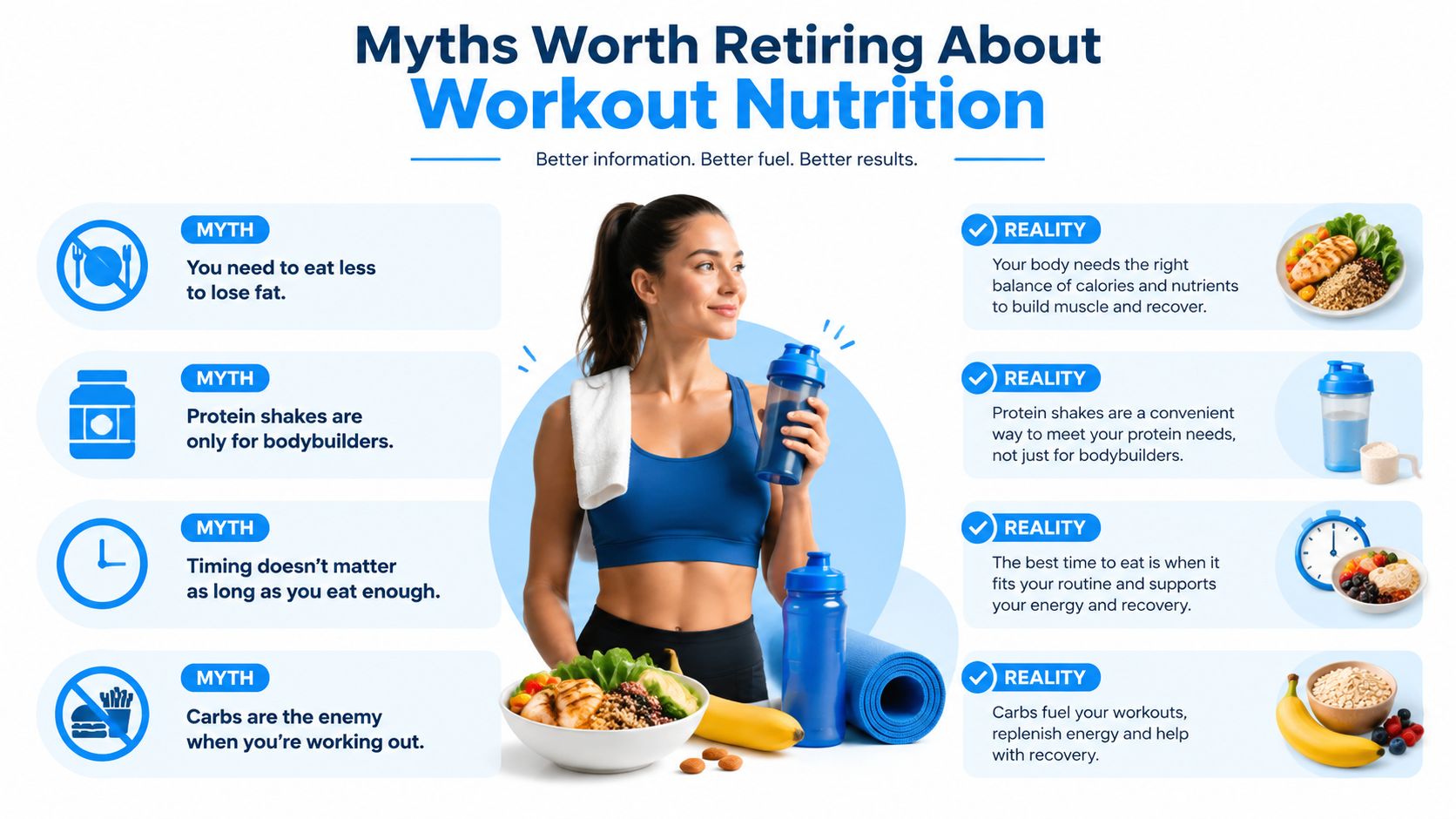
Myths Worth Retiring About Workout Nutrition
Myth one, the window closes after 30 minutes
Muscle does not stop responding when 30 minutes pass. The narrow anabolic-window model is too restrictive. Muscle remains responsive to protein for at least 24 hours after training, as explained in Read the clinical timing review.
The practical rule is to stop racing the clock. Place a shake before or after training according to your total daily protein, training time, and distance to the next meal.
Myth two, more protein always produces more growth
More protein does not automatically mean more muscle. The useful target is an intake that supports the day's goal and can be maintained consistently. A practical range for lifters is 1.6 to 2.2 grams per kilogram, based on the evidence reviewed for this topic.
That range is a planning guide, not a requirement to reach the upper end. Choose the amount that fits your appetite, food preferences, calorie plan, and training demand. A shake should cover a shortfall, not displace foods you enjoy or push total calories higher without a clear reason.
Myth three, fasted training automatically burns more fat
Training without food may increase fat use during the session, but that does not guarantee greater body-fat loss over time. The available evidence does not establish a universal fat-loss advantage for fasted training.
For an early session, use a pre-workout shake if the next meal is distant and liquid protein sits well. Skip it if eating causes discomfort, then use the next meal to close the gap. Evening lifters can apply the same rule in reverse: a shake after training makes sense when dinner is delayed, while an imminent protein-rich meal may make it unnecessary. Heavy lower-body sessions may justify planning both sides when recovery food will be unavailable, but that is a scheduling decision, not proof of a special timing effect.
A Sample Day With a Protein Shake Around Training
For a lifter training at 6 p.m. with dinner delayed until about four hours later, the useful question is not just whether protein belongs before or after exercise. It is whether the shake closes the day's longest protein gap without making the session uncomfortable. A 25 to 30 gram whey shake 60 to 90 minutes before training can cover that gap when liquid protein is tolerated well.
The rest of the day should provide most of the intake:
Breakfast: Eggs, Greek yogurt, and oats, providing roughly 40 grams of protein.
Lunch: Chicken with legumes and quinoa, providing approximately 35 to 45 grams.
Pre-workout: Whey mixed with water or milk, providing 25 to 30 grams.
Dinner: Salmon, rice, and vegetables, providing approximately 40 to 50 grams.
These are examples, not required recipes. Their purpose is to show protein distributed across the day rather than saved for the post-workout meal. If dinner arrives within two hours of training, move the shake after the session or leave it out. The next meal then does the work.
For intense or high-volume training, include a carbohydrate source in nearby meals. Rice, oats, fruit, potatoes, and quinoa can fit according to digestion and daily energy needs. Drink during training, and consider electrolytes when heat, sweat loss, or session demands make them appropriate.
A late-night trainer may choose cottage cheese or casein before sleep if a final meal feels comfortable and helps complete the day's intake. That is a practical option, not a requirement. Whey is also optional. Someone avoiding dairy can use a pea-and-rice protein blend as a general dietary alternative, provided the serving supplies enough protein for the person's plan and fits their food preferences.
Adjust portions for body size, appetite, and training demands. The sample is a schedule, not a prescription. Place the shake before or after training according to the next substantial meal, digestion, and whether the session leaves a meaningful gap to fill.
Putting It All Together
The practical answer is not simply before or after. Hit your daily protein target first, then place a 25 to 40 gram dose within roughly four hours of training, choosing the side that fits your next substantial meal. Contemporary evidence puts daily intake ahead of exact timing, with a practical benchmark of approximately 1.6 to 2.2 grams per kilogram per day for many lifters, as shown in the timing evidence. The shake is a scheduling tool, not a requirement attached to a specific minute.
Use this checklist:
Daily total: Have you planned enough protein for the full day?
Dose size: Will the serving provide approximately 0.25 to 0.40 grams per kilogram?
Meal gap: Is your next substantial protein meal more than two hours away?
Training tolerance: Does pre-workout protein feel comfortable?
Session demands: Will carbohydrates and fluids support a long or intense workout?
Adherence: Which option can you repeat on busy days?
For fasted morning training, take protein before exercise if breakfast will be delayed. If breakfast follows promptly, eating then is reasonable. For an evening workout, use dinner timing and digestion to choose before or after. A heavy lower-body session may justify placing both the shake and carbohydrate-rich food near training when the next full meal is distant, while the daily total remains the priority. On double-session days, use shakes to cover gaps that whole-food meals cannot reliably fill.
The decision is mainly logistical. Daily protein provides the foundation, and timing prevents avoidable gaps around demanding sessions. Choose the option that supports intake, digestion, recovery, and a schedule you can repeat.
Empire Athletics offers 24/7 gym access in Leominster, Lunenburg, and Webster, certified one-on-one personal training, and an on-site cafe serving coffee, smoothies, and protein shakes. Visit Empire Athletics to review the facilities and schedule options.