How to Build a Weight Loss Workout Routine for Beginners
A weight loss workout routine for beginners with weekly cardio, strength work, and a flexible 4 to 12 week plan.

You've probably heard the simple version: do your cardio, hit your weekly minutes, and the weight will come off. That advice isn't wrong about health, but it's incomplete about fat loss, and that gap is where most beginners get stuck. A better weight loss workout routine for beginners starts smaller, repeats well, and separates what exercise can do on its own from what also depends on food, recovery, and consistency.
Why Beginner Fat Loss Workouts Stall
You've been walking briskly for a few weeks. You're showing up, your breathing is up, your legs feel worked, and the scale barely moves. The natural reaction is to train harder every day.
Pause there. That reaction is based on a faulty assumption, that 150 minutes of moderate aerobic activity is a guaranteed fat loss prescription. It isn't.
What That Number Actually Is
That weekly target, plus muscle strengthening on at least two days, is a minimum health baseline. It tells you what supports general health. It doesn't promise that fat will drop if everything else stays the same.
The Centers for Disease Control and Prevention makes the distinction plainly. People who want to lose a substantial amount of weight or maintain a large loss may need more than 300 minutes weekly unless they also reduce calorie intake, as explained in CDC guidance on physical activity for a healthy weight. In other words, you have two levers, activity and intake. Pulling only the activity lever, and only to the minimum, leaves the energy balance largely unchanged.
The question isn't whether 150 minutes counts. It's whether 150 minutes, by itself, creates the deficit you're expecting.
Why More Cardio Isn't Always the Next Step
For busy adults and shift workers, jumping straight to a fixed 300 minute target often backfires. Sessions get missed, sleep gets squeezed, and a hard workout becomes an excuse to eat a lot more afterward. A flexible week you can repeat usually beats a perfect week you can't sustain.
The scale can also mislead you in the early weeks:
Water retention: New training, sore muscles, and higher food volume can hold extra water for days.
Menstrual cycle shifts: Weight can rise and fall across the month without any change in fat.
New muscle: Strength work can add lean tissue while fat comes down, leaving total weight flat.
None of these means your routine has failed. They mean a single weigh in is a poor judge. The more useful decision at this stage isn't to add punishing daily cardio. It's to lock in attendance first, then look at intake, sleep, and everyday movement outside your workouts.
Weekly Cardio and Strength Targets
Once you stop treating the health minimum as a promise, you can use it for what it's good for, a sensible starting range you build toward gradually.
The World Health Organization guideline sets adult aerobic activity at at least 150 minutes per week of moderate intensity work, with 300 minutes as the upper target for additional benefits, and it can be spread across the week in the WHO guideline on physical activity and sedentary behaviour. Moderate intensity here means brisk walking, steady cycling, or elliptical work where you're breathing harder but still working sustainably.

Turning Minutes Into a Real Week
You don't need to do those minutes in long blocks. The same guidance translates into practical shapes:
About 30 minutes on five days: A lunchtime walk or an after dinner walk most weekdays.
Roughly 22 minutes daily: Shorter, daily movement that suits an irregular schedule.
Three to five cardio sessions: Fewer, slightly longer sessions if daily exercise doesn't fit.
Choosing equipment you understand helps you keep that pace consistent, whether that's a treadmill, bike, or elliptical. If you're comparing options, this overview of cardio workout equipment choices shows how different machines support steady, moderate work.
Alongside cardio, plan muscle strengthening on at least two days per week. Those sessions should cover the major muscle groups, not just one area you want to change. Two full body strength sessions using machines, free weights, or body weight movements are enough to meet that requirement for most beginners.
Why Exercise Alone Doesn't Guarantee Loss
Exercise raises your energy expenditure. That's real, and it matters. But weight only drops when food and drink intake are also adjusted so you're in a calorie deficit over time.
The amount of activity needed for loss also varies a lot between people. Two beginners can do the same routine and see different results because their starting weight, daily movement, intake, and recovery differ. That's why starting with high intensity daily workouts is hard to defend. You'd be guessing at a dose, risking soreness and skipped sessions, before you've proven you can repeat a moderate week.
Build toward the range. Don't start at its ceiling.
A Repeatable Beginner Session Plan
A weekly total is useful, but you can't train a total. You train on specific days, for specific lengths of time, at an effort you can repeat.
Start with three weekly sessions. That's two full body resistance workouts separated by at least 48 hours, plus one or more brisk walking sessions, in line with the staged approach in the CDC Physical Activity Guidelines second edition. From there, you grow toward 150 to 300 minutes of moderate aerobic activity while keeping resistance training on at least two days.
What a Strength Session Looks Like
Keep it simple and complete. Choose six to eight movements using machines, dumbbells, or body weight, covering the legs, hips, back, chest, abdomen, shoulders, and arms. Do one to two sets of 8 to 12 controlled repetitions per movement.
Stop each set with roughly two to four repetitions still possible. Your last reps should feel demanding, but your form shouldn't break down. If you're twisting, bouncing, or holding your breath to finish, the load is too heavy for today.
For cardio, use the talk test. Your breathing is faster, but you can still speak in short sentences. If you can sing, it's probably too easy for moderate work. If you can't get a few words out, you've pushed harder than you need to as a beginner.
Sample Beginner Training Week
Day pattern | Session focus | Time | Effort cue |
|---|---|---|---|
Day A | Full body resistance, machines or dumbbells | 30 to 45 minutes | 8 to 12 reps, 2 to 4 reps left |
Day B | Brisk walking, cycling, or elliptical | 20 to 30 minutes | Talk test, short sentences possible |
Rest or easy walk | Recovery and everyday movement | As tolerated | Easy, conversational |
Day C | Full body resistance, same movements | 30 to 45 minutes | Same loads, cleaner technique |
Day D | Brisk walking | 20 to 30 minutes | Talk test |
Optional Day E | Extra walk if recovery feels good | 15 to 25 minutes | Easy to moderate |
Rest | No structured training | Off | Sleep and normal activity |
Notice what's not in that table. There's no daily punishment session, and the strength days repeat the same movements. Repetition is how you learn technique and notice progress.
How to Progress Without Breaking the Plan
Change one variable at a time. Add 5 to 10 minutes of walking per week, or add a repetition, or add a small amount of load. Don't add all three in the same week and then wonder why your knees ache.
Practical rule: If recovery and technique stay consistent for a full week, you've earned a small increase. If they don't, repeat the week.
The common error here is treating the health minimum as a guaranteed fat loss dose, then panicking when the scale is flat. That panic usually produces either far too much training or a large post workout meal that erases the deficit. A repeatable week avoids both traps.
Strength Moves That Protect Muscle
Cardio gets the attention in most weight loss advice because the calorie number on a machine screen is easy to see. Resistance training deserves equal planning because it's the part that helps you keep lean body mass while weight comes down.
Recent clinical guidance summarized in individualized exercise recommendations for weight loss supports resistance training during weight loss for exactly that reason, and it stresses matching exercise to your preferences, capacity, body size, and health status. That matching is what keeps you training instead of nursing an avoidable strain.

How Hard Should a Set Feel
You do not need maximal loads, and you do not need high intensity intervals to make progress. You also don't need to chase soreness. Soreness is not a measure of workout quality, especially when you're deconditioned or returning after a long break.
A good beginner set feels controlled for most reps, then challenging near the end, with your technique still intact. Building toward the right effort over several weeks also helps you understand the broader best rep range guidance for muscle growth without jumping to loads you can't control yet.
If a standard version of a movement isn't available to you right now, regress it rather than skipping the pattern:
Supported squats: Hold a stable surface or sit to a raised target you can stand from cleanly.
Machine presses: Use a guided path for chest and shoulder pressing while you build strength.
Inclined push ups: Place your hands on a bench or counter to reduce the load through your arms.
Controlled rows: Use a machine or supported dumbbell row and pause briefly as you pull.
These aren't lesser exercises. They're the right size of the same movement for your current joint tolerance and strength.
A Simple Progression Rule
Train each major muscle group two or three days per week. For many beginners that means working at roughly 60% to 70% of maximum resistance, which for middle aged and older beginners often looks like sets of 10 to 15 repetitions.
Use repetitions as your dial. Pick a load you can lift comfortably about 10 times with clean form. Over the following sessions, build toward 15 repetitions. When you can do that without your technique slipping, increase resistance by approximately 5% and start the climb again.
That's measurable progress even in a week when the scale doesn't move, and it's safer than adding weight because you feel you should.
How to Choose Gym Support That Fits
The best plan on paper fails if you can't get to it. For a Central Massachusetts beginner, the choice is usually between going it alone, depending on another person's schedule, or using a gym that removes those friction points.
Here's the current Empire Athletics site so you can see how its locations and services are presented.

Three Paths, Judged by What Matters
A written plan on your own: Cheapest and most flexible, but nobody checks your squat depth, your rowing form, or whether you showed up at all.
Training only when a friend is free: Social support helps, yet your routine collapses whenever their shift, childcare, or motivation changes.
A staffed gym with optional coaching: Predictable equipment, regressions on machines, and someone to adjust the plan when a movement doesn't suit your joints.
Judge each option by schedule flexibility, supervision, access to both strength and cardio equipment, help with mobility limits, and whether food is available right after training if that affects your routine.
In that comparison, Empire Athletics offers 24/7 access in Leominster, Lunenburg, and Webster, modern strength and cardio equipment, and certified one on one training covering weight loss, mobility, corrective exercise, and strength. Its trainers bring 20 or more years of combined experience, and the on site cafe serves coffee, smoothies, and protein shakes. The site references a 4.7 out of 5 member rating, which is useful context about member experience, not a promise of your results. If coaching is the missing piece, reviewing what to expect from the best personal training setup can help you ask better questions before you commit.
The short video below gives a sense of the training environment before you visit in person.
If you'll train consistently alone, a written plan may be enough. If your barrier is an unpredictable schedule or uncertainty about technique, around the clock access plus coaching solves a different problem than another exercise list would.
Tips for Tracking Real Progress
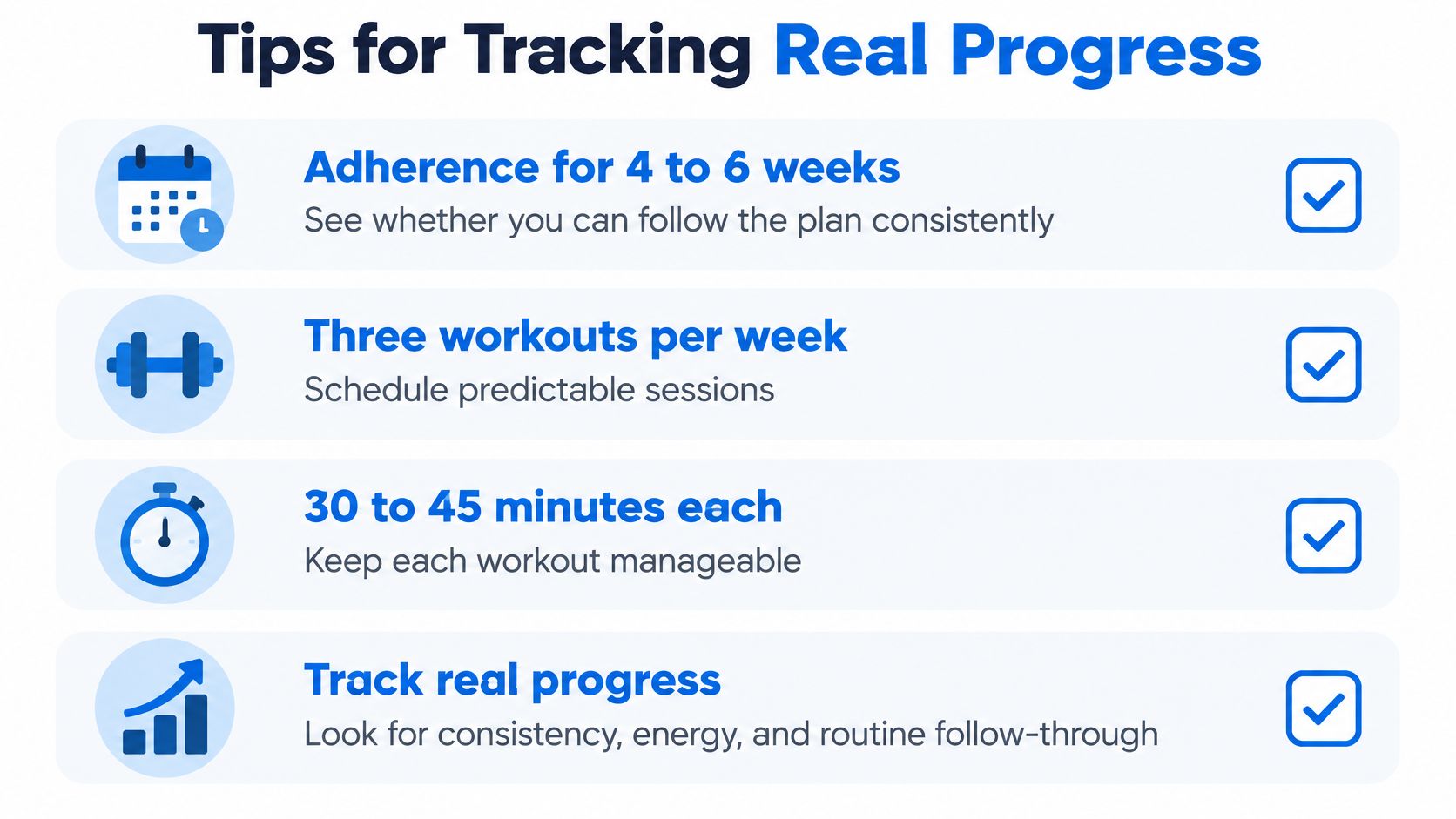
For your first four to six weeks, attendance is your primary benchmark. Not pounds lost, not calories burned in one session. Attendance.
That's because adherence is where beginner programs most often break. A 2025 systematic review of 21 exercise studies in adults with obesity found prescribed session adherence ranging from 18% to 99%, and programs offering only unsupervised guidance often achieved attendance at less than half of prescribed sessions, as reported in a 2025 systematic review of exercise adherence in obesity. Supervised, combined aerobic plus resistance programs with social support did better.
Build an Attendance First System
Schedule three 30 to 45 minute sessions at predictable times. Predictable matters more than perfect. A session after your shift on the same days each week beats a vague intention to train sometime.
Record four things, and keep the log boringly simple:
Completed sessions: Did you attend, yes or no.
Walking minutes: Total for the week, not just your longest walk.
Resistance loads and repetitions: Enough detail to repeat or progress the session.
Weekly body weight: Recorded the same way each time.
Only increase volume after you've completed at least 80% of planned sessions for two consecutive weeks. That rule protects you from building a bigger plan on top of an attendance problem.
Measure Trends, Not Single Days
Use a 7 day average body weight instead of reacting to one morning's number. Take a waist measurement every two to four weeks, at the same spot and time of day. Add performance markers you can see improving, such as repetitions completed, load lifted with clean form, or walking duration at the talk test pace.
Watch for these common pitfalls:
Starting at vigorous intensity: You feel heroic once, then miss the next three sessions.
Changing exercises every visit: You never practice anything long enough to get better at it.
Skipping resistance training: You lose the muscle protecting part of the routine.
Judging one weigh in: You make a big decision from the noisiest data you have.
If you develop joint pain, unusual shortness of breath, dizziness, or persistent fatigue, reduce intensity and get qualified medical or coaching guidance before progressing.
That stop rule isn't caution for its own sake. It's what keeps a small setback from becoming a full stop.
A Practical 12-Week Next Step
Honest expectations make the next 12 weeks easier to stick with. In trials lasting up to 12 months, aerobic activity of at least 150 minutes per week was associated with approximately 1% to 3% weight loss, an amount generally described as closer to weight maintenance than dramatic reduction, according to the review in the WHO guideline on diet and physical activity evidence.
Read that the right way. It doesn't mean exercise is pointless. It means exercise alone, at the minimum dose, is a modest tool for scale change, which is why your routine pairs it with intake changes and two or three weekly strength sessions. With resistance work in place, you can judge progress by technique, repetitions, walking duration, and how your clothes fit, not only by pounds.
A Simple Arc for the Next 12 Weeks
Weeks one through four: Protect attendance. Three sessions, same movements, talk test cardio, no heroics.
Middle weeks: Add walking minutes or one strength variable at a time, only after consistent completion.
Later weeks: Move toward the higher aerobic range only if recovery, joints, and food intake support it.
Notice the order. Consistency comes first, progression second, higher volume last. Reversing that order is how beginners end up exhausted, sore, and convinced they're the problem when the sequencing was.
Your next step this week is small and concrete. Pick three session times and put them in your calendar like appointments you don't move. If programming still feels uncertain, visit Empire Athletics in Leominster, Lunenburg, or Webster and match a beginner plan to your real schedule, including one on one coaching if you'd rather have someone set your starting loads and regressions with you.
A modest week you repeat for 12 weeks will teach you more, and change you more, than one exhausting week you never do again.
Empire Athletics gives beginners 24/7 access in Leominster, Lunenburg, and Webster, with modern strength and cardio equipment, certified one on one coaching for weight loss and mobility, and an on site cafe for coffee, smoothies, and protein shakes around your sessions. If you want a repeatable beginner routine fitted to your actual schedule, visit Empire Athletics to choose a location and book your first session.