8 Best Glute Workouts for Strength and Growth
Explore 8 best glute workouts with coaching cues, sets, reps, and progressions for building strength, muscle, and lower-body performance.

The best glute workout isn't a single exercise copied from social media. A hip thrust may create exceptional glute activation, while a squat can build the glutes alongside the thighs, and an RDL can challenge the posterior chain under stretch. The right choice depends on the stimulus you need, the equipment you have, your training experience, and how well you can recover.
Effective programming still rests on the basics: progressive overload, controlled technique, appropriate rep ranges, sufficient recovery, and exercise selection that matches your goal. A 2023 nine-week resistance-training study found similar gluteus hypertrophy from squat and hip-thrust programs, while squats produced more thigh growth, which shows why peak activation alone can't determine the best program (the controlled squat and hip-thrust study).
The eight approaches below separate glute training by stimulus, from heavy mechanical tension and posterior-chain loading to machines, conditioning, and periodization. Choose one primary direction, then add only the accessory work you can execute and recover from. Empire Athletics offers a practical setting for that process, with 24/7 access, varied strength and cardio equipment, and certified one-on-one coaching across its three Central Massachusetts locations.
1. Barbell Hip Thrust Progressive Overload Program
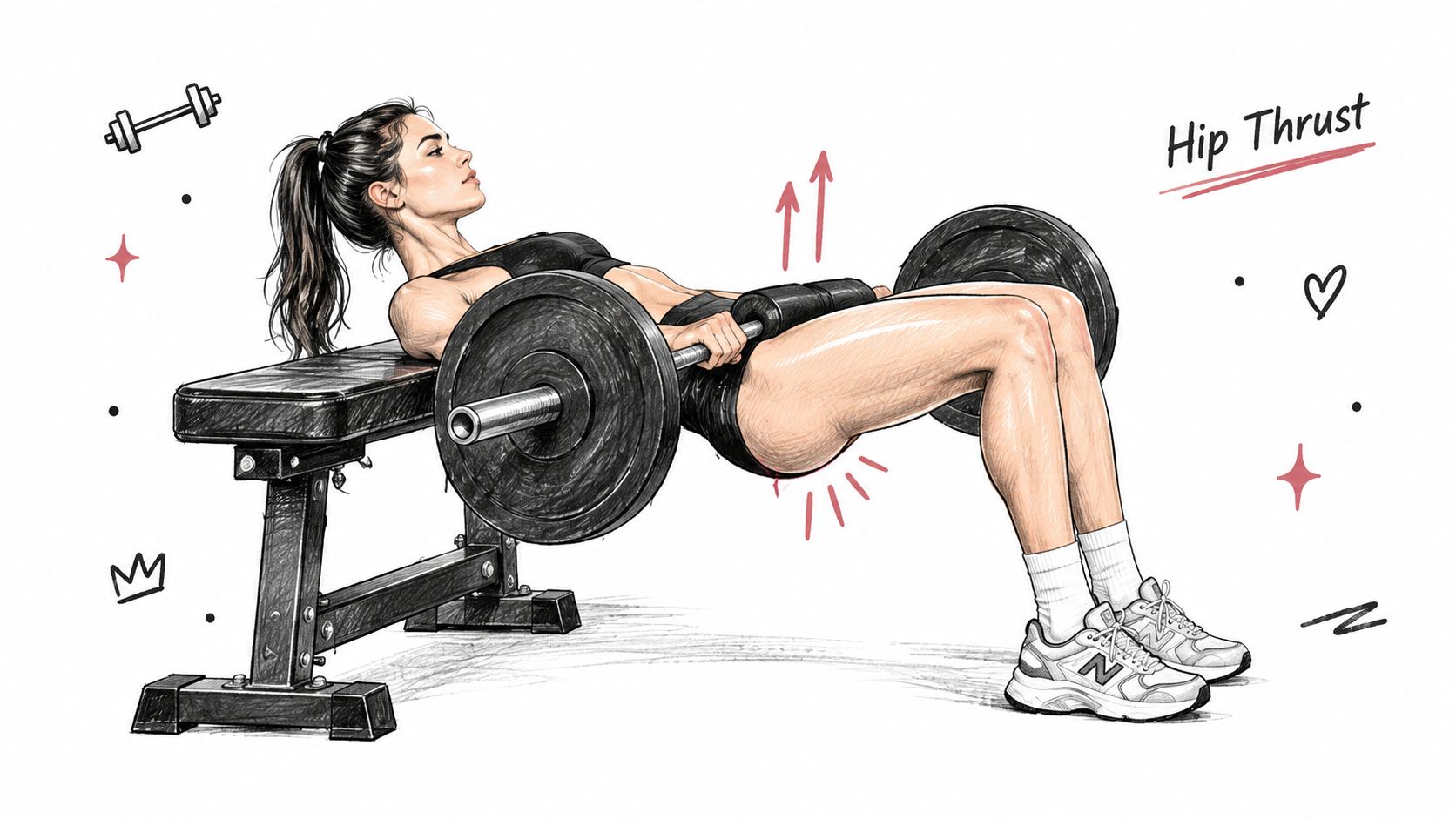
The barbell hip thrust is a strong starting point when your priority is glute-focused mechanical tension. It lets you load hip extension heavily while limiting the balance demands that can restrict other lower-body lifts. Earlier EMG research reported substantially higher glute activation in the hip thrust than the back squat, including 69.5% MVIC versus 29.4% for upper-glute activation and 86.8% versus 45.4% at the lower glute in one comparison (the hip-thrust and squat activation summary).
That evidence explains the exercise's popularity, but it doesn't mean activation guarantees superior growth. A later training study found similar glute hypertrophy from hip thrust and back squat programs despite higher sEMG during hip thrusts, and cautioned against treating EMG or a strong burn as direct measures of muscle growth (the hip-thrust and squat training study).
How to run it
Start with a load you can control without arching your lower back. Set your upper back firmly against the bench, plant your feet around hip width, and finish with your knees aligned over your ankles. At lockout, keep your ribs down, bring your pelvis under control, and pause while squeezing the glutes.
Use a workout log and progress through one variable at a time:
Load: Add weight only when every repetition reaches the same controlled lockout.
Repetitions: Keep the load stable while gradually completing more quality reps.
Technique: Improve the pause, range of motion, and pelvic control before chasing heavier numbers.
Coaching: Ask a certified Empire Athletics trainer to review your setup during your first sessions.
The hip thrust works well as the first lift on a glute-focused strength day. Pair it with an RDL or squat pattern rather than turning the entire session into variations of hip extension.
A short video demonstration can help you check bench height, foot placement, and lockout mechanics before loading the bar.
2. Squat-Based Glute Development Protocol
Squats are a better choice than many glute-only routines when you want glute growth plus complete lower-body strength. Back squats, front squats, goblet squats, and Bulgarian split squats train the hips and legs together, although the exact emphasis changes with stance, depth, torso angle, and load.
The squat group in the controlled 2023 study gained more thigh size while producing similar glute growth to the hip-thrust group (the squat and hip-thrust comparison). That makes squats especially useful for lifters who don't want larger glutes at the expense of balanced leg development.
Make the squat earn its place
Choose a stance that lets you reach a controlled depth without losing pelvic or spinal position. A slightly wider stance and modest toe turnout may feel more natural for some lifters, but forcing a prescribed angle can create unnecessary joint stress. Your feet, hips, and knees should work together rather than follow a universal template.
Use a squat variation that matches your experience:
Back squat: Best for loading the whole lower body when you have stable bracing and consistent depth.
Front squat: Useful when an upright torso and quad involvement fit your broader program.
Goblet squat: A practical teaching variation for beginners and lifters rebuilding movement quality.
Bulgarian split squat: Adds unilateral loading and exposes side-to-side control differences.
Practical rule: Depth only helps when you can own the position. Stop the descent before your pelvis tucks or your lower back compensates.
Before increasing load, have a trainer assess your squat mechanics and review the hip mobility exercises for squats. For hypertrophy, use a controlled moderate-repetition approach, then add a hip-extension movement or unilateral exercise to make the session more glute-specific.
3. Romanian Deadlift Posterior Chain Specialization
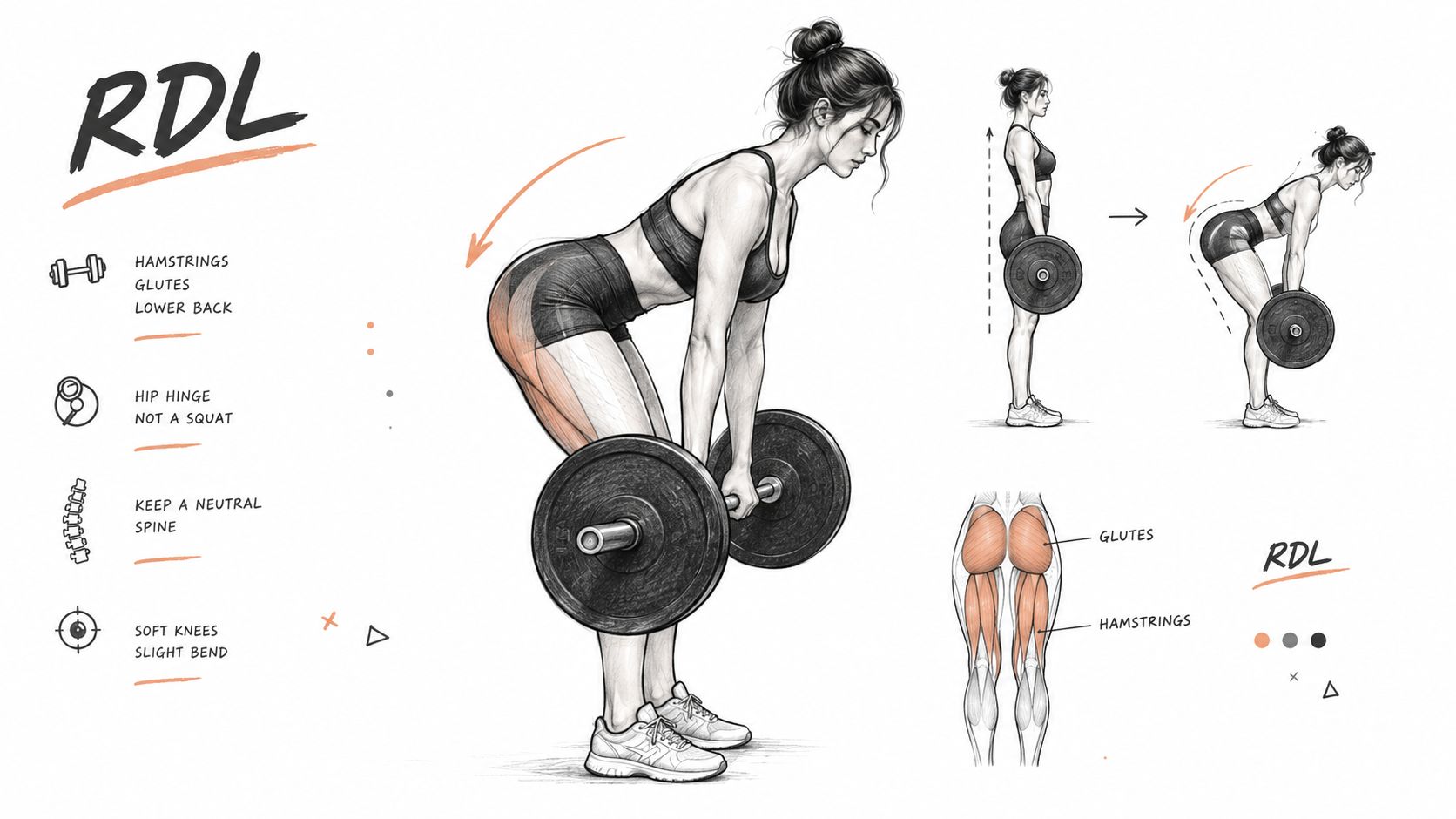
The Romanian deadlift is the clearest option here for lifters who want posterior-chain loading through a hip hinge. Compared with a conventional deadlift, the RDL keeps the bar close, limits knee travel, and maintains tension as the hips move backward. The glutes and hamstrings lengthen under load, which creates a different stimulus from the shortened-position emphasis of a hip thrust.
Begin with a light barbell or dumbbells. Stand with a soft knee bend, brace your trunk, and push your hips behind you while the weight travels close to your legs. Lower only as far as you can keep your spine and pelvis controlled. For many lifters, that may be around mid-shin or below the knee, but the correct depth is individual.
Use the stretch, don't chase the floor
The bottom position should be determined by hamstring tension and trunk control, not by whether the plates touch the ground. If your lower back rounds as you descend, you've gone beyond your usable range. Reverse the movement by driving the hips forward, then finish tall without leaning backward.
A useful RDL session can include:
Bilateral RDLs: Build the hinge with stable loading and consistent bar path.
Single-leg RDLs: Challenge balance and help reveal asymmetries.
Tempo repetitions: Slow the lowering phase to improve control without immediately adding weight.
Hamstring mobility work: Practice unloaded range on separate days without turning every session into aggressive stretching.
The RDL is demanding, so don't place it after exhausting high-volume hinge work. If your back becomes the limiting factor, reduce the load, shorten the range, or use dumbbells until the hip movement is repeatable. A certified trainer at Empire Athletics can assess whether balance, mobility, or bracing is limiting your single-leg version.
4. Glute-Focused Leg Press Hypertrophy Split
The leg press provides a stable way to train the lower body when heavy barbell loading isn't appropriate or when fatigue from balance and bracing would otherwise limit the set. A higher foot position and a slightly wider stance can increase the hip contribution for some lifters, but foot placement isn't magic. The machine's design, your hip structure, and your range of motion all affect the result.
Set your feet where you can descend enough to train the hips while keeping your lower back against the pad. If your pelvis rolls off the pad at the bottom, the range is too deep for the load or setup. Keep your knees tracking in line with your toes, and don't turn the lockout into a hard knee snap.
A machine-first growth session
Use a moderate load that allows smooth repetitions and a controlled lowering phase. The final repetitions should be challenging, but they shouldn't require shortened range, bouncing, or help from the safety handles. The leg press can then serve as the main lift while a hack squat or V-squat adds a second machine pattern with a different torso and knee angle.
For a practical session, organize the work like this:
Primary leg press: Controlled repetitions with consistent depth and foot pressure.
Secondary machine: A hack squat or V-squat performed with a lighter load and a full usable range.
Unilateral addition: A split squat or step-up if you need balance and side-to-side control.
Recovery check: Reduce total work if soreness affects your next lower-body session.
Machine training is not a shortcut around progression. Record the sled load, repetitions, depth, and tempo so progress means more than adding plates. This approach suits intermediate lifters, people returning from a break, and anyone who wants a lower-body stimulus without making barbell stability the main challenge.
5. Cable and Machine-Based Glute Isolation Circuit
Isolation circuits are useful when you need local fatigue, controlled contractions, and lower systemic demand. Cable kickbacks, pull-throughs, abduction machines, adduction work, and glute-focused presses can target the hips without requiring the same bracing skill as a heavy squat or RDL.
They shouldn't replace your primary strength lift if strength or maximum hypertrophy is the main goal. The circuit works best after compound training, on a lighter day, or during a planned reduction in heavy loading. Chasing the biggest pump can also lead to poor movement, so keep the load light enough to control every repetition.
Build the circuit around different actions
Start with a short general warm-up, then choose movements that don't all repeat the same hip angle. A simple circuit might include cable kickbacks, cable pull-throughs, abduction, and a controlled machine press. Pause briefly at the end of each contraction, but don't twist your pelvis or swing the stack.
Use these execution standards:
Cable kickback: Keep the pelvis square and move the thigh, not the lower back.
Pull-through: Hinge with a neutral trunk and finish by extending the hips.
Abduction: Move under control and stop before the pelvis shifts.
Machine press: Maintain stable contact with the pad and a repeatable depth.
Rest briefly between exercises, then take enough recovery between rounds to preserve form. Two or three rounds can provide useful accessory volume without burying the next heavy session. The circuit also fits a recovery week, when you want to maintain movement practice while reducing axial loading and coordination demands.
At Empire Athletics, cable stations and plate-loaded equipment make it easy to adjust resistance quickly. That matters when you want to compare contraction quality across exercises rather than force every movement into a heavy-load competition.
6. Kettlebell and Dumbbell Glute Training Protocol
Kettlebells and dumbbells make glute training flexible, athletic, and easy to fit around a busy schedule. This approach combines hip extension, unilateral control, power, and work capacity rather than isolating one muscle through a single machine. It's a strong option for shift workers, athletes, and beginners who need simple movements with clear coaching points.
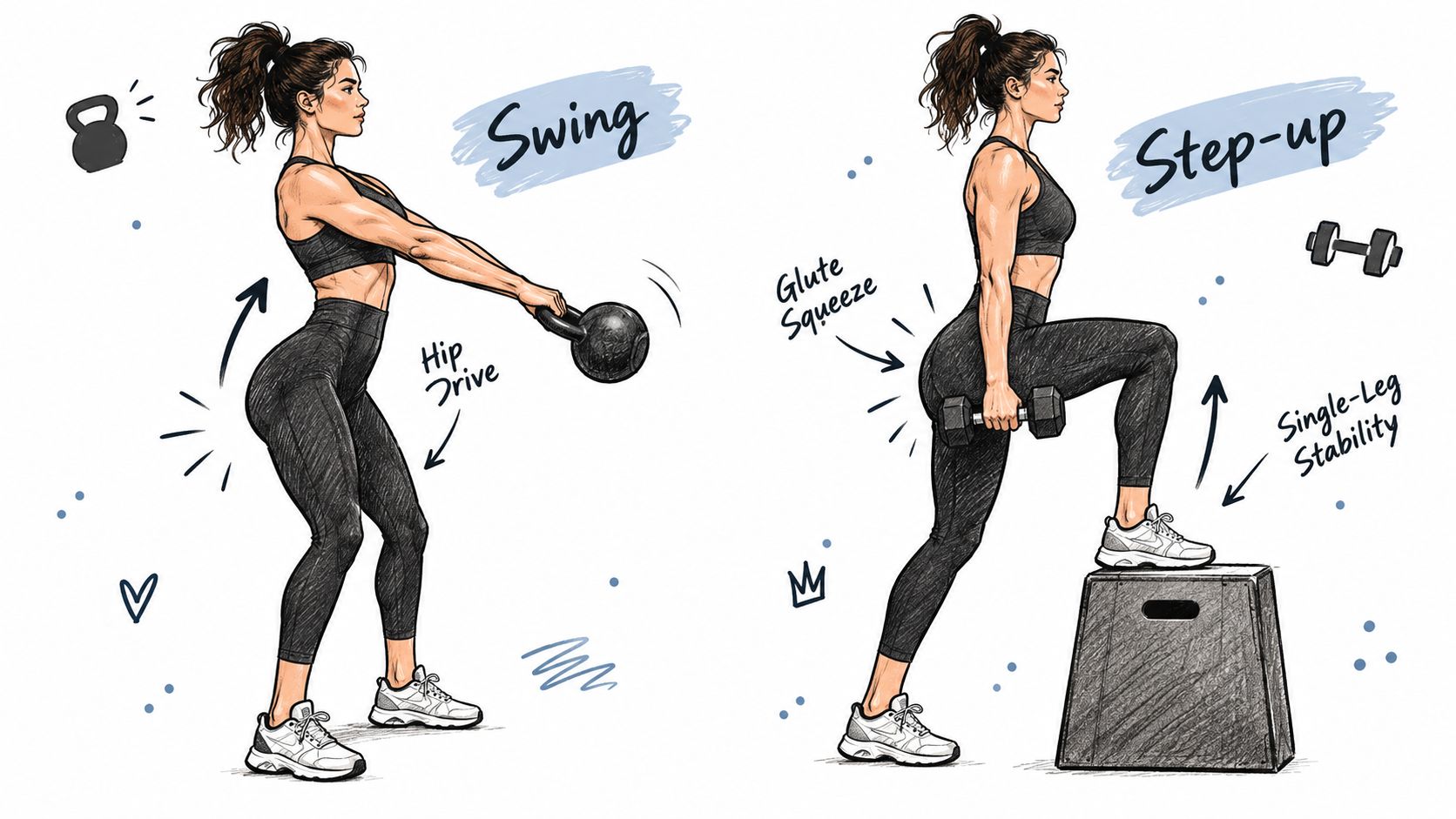
Kettlebell swings are the centerpiece, but they're a hinge drill, not a squat. The bell floats because the hips drive it forward. If your shoulders lift the weight or your knees dominate the movement, lower the load and rebuild the hinge.
A practical dumbbell and kettlebell session
Pair a power movement with controlled strength exercises:
Kettlebell swings: Use crisp hip extension and stop the set when the hinge loses speed.
Dumbbell step-ups: Choose a box height that lets you drive through the working leg without jumping from the floor.
Goblet squats: Hold the weight close, brace, and use a depth you can control.
Single-leg dumbbell deadlifts: Keep the hips level and use support if balance limits the glute stimulus.
The kettlebell training guide for fat loss can help you connect this style of training with broader conditioning goals. For swing sessions, prioritize technique and power over exhaustion. High-repetition work can quickly turn into a back-dominant movement when fatigue arrives.
A trainer can assess your hinge, swing timing, and step-up mechanics at Empire Athletics. That feedback is especially valuable when you train independently at unusual hours and want the flexibility of 24/7 access without sacrificing movement quality.
7. Stair Climbing and Incline Machine Metabolic Glute Builder
Stair climbers and incline treadmills are useful when your goal includes glute endurance, conditioning, and body-composition support. They won't replace progressively loaded hip thrusts, squats, or RDLs for a strength-focused program, but they can add repeated hip and knee extension with less technical complexity than barbell training.
Posture determines whether the equipment helps. On a stair climber, keep your torso tall and use the rails only for balance. On an incline treadmill, let the incline create the challenge rather than leaning heavily onto the handles. Drive through each step, maintain steady breathing, and stop before your stride becomes hurried or unstable.
Fit conditioning around strength
Use a moderate continuous effort when recovery is the priority. Intervals can work when conditioning is the goal, but hard efforts should be separated from demanding lower-body lifting if they reduce the quality of your strength sessions. A short stair-climber finish after lifting may be more practical than a long standalone session for someone with limited training time.
The treadmill workout guide for weight loss offers a useful framework for organizing incline work around a broader conditioning plan. Keep the progression gradual by changing only one factor at a time, such as incline, pace, duration, or interval difficulty.
This approach suits active recovery days, people who enjoy cardio, and lifters who want more work capacity. It isn't the right primary plan if your main objective is maximizing glute strength. Treat the machine as a conditioning tool, then protect the heavy work that provides your main overload stimulus.
8. Periodized Glute-Dominant Lower-Body Mesocycle
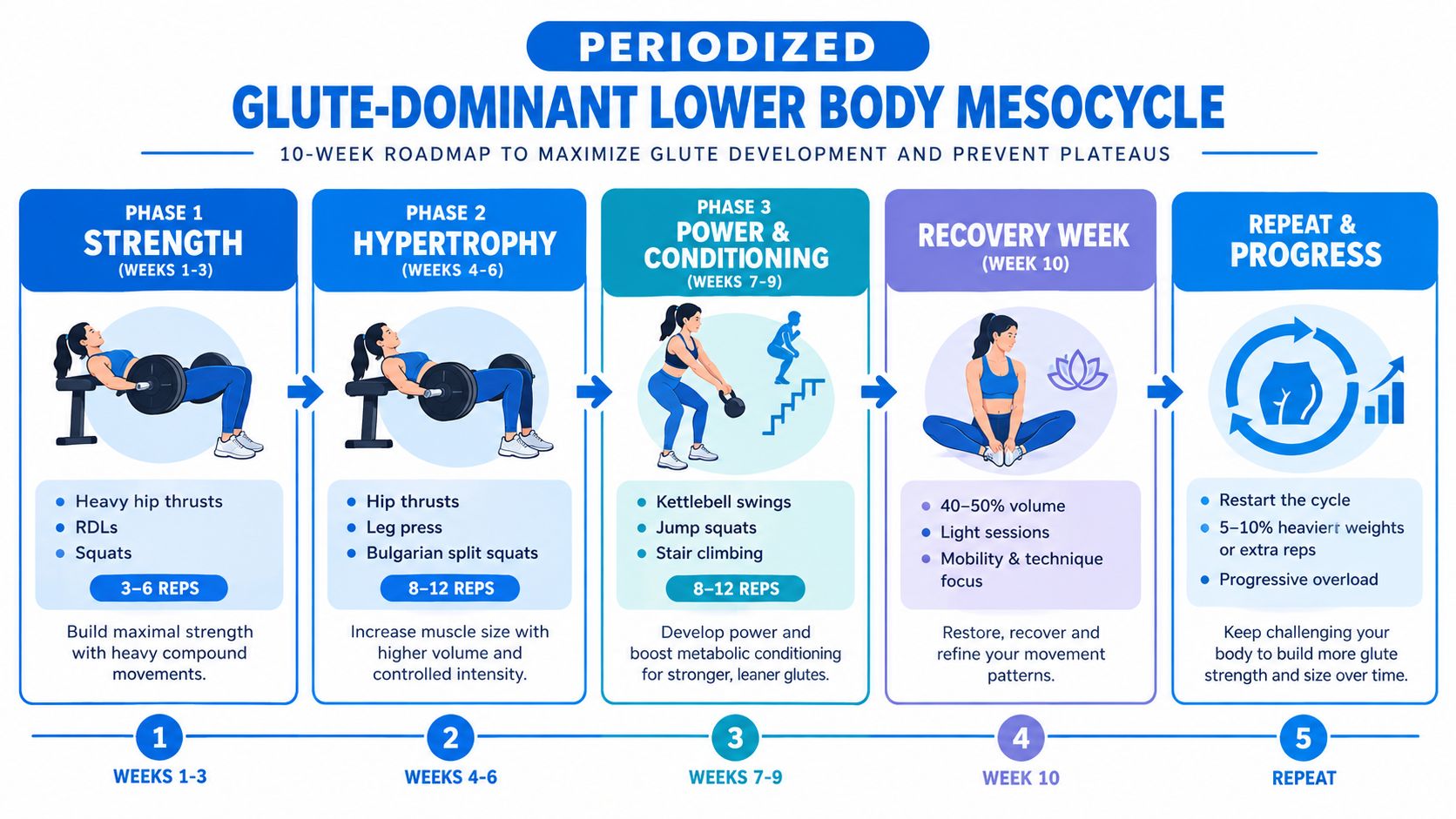
Periodization is the most sustainable choice for intermediate and advanced lifters who keep stalling with random exercise changes. Instead of trying to train every quality in every session, you rotate emphasis across strength, hypertrophy, power, conditioning, and recovery. The exercises can remain familiar while the load, volume, tempo, and effort change.
A coach can help establish your starting point and select movements that fit your injury history, schedule, and equipment access. A strength-focused phase might emphasize hip thrusts and RDLs with heavier sets, while a hypertrophy phase gives more room to leg presses, split squats, and machine work. A power phase can include swings or jumps, provided you already control the landing and hinge mechanics.
Keep the structure flexible
A useful cycle can include a strength block, a higher-volume growth block, a conditioning emphasis, and a reduction in workload. The exact calendar doesn't need to be rigid. If sleep, work stress, or soreness deteriorates, reduce sets or intensity before technique breaks down.
Track the details that guide decisions.
Load and repetitions: Record what you completed, not what you intended.
Perceived effort: Note whether the set felt controlled or forced.
Technique quality: Mark range of motion, balance, and lockout consistency.
Recovery status: Adjust the next session when soreness or fatigue changes movement quality.
The best long-term plan is the one that gives you a clear progression without forcing you to train through declining technique.
Don't stack all eight approaches into one week. Choose a primary strength or hypertrophy direction, then use one unilateral, isolation, or conditioning method to fill a specific gap. Empire Athletics trainers can help you build that structure, while the gym's 24/7 access and equipment variety make it easier to maintain consistency around real-life schedules.
8-Protocol Glute Training Comparison
Program | Implementation Complexity 🔄 | Resource Requirements | Expected Outcomes ⭐📊 | Ideal Use Cases 💡 | Key Advantages ⚡ |
|---|---|---|---|---|---|
Barbell Hip Thrust Progressive Overload Program | Moderate 🔄, requires 2–3 weeks to master form + consistent tracking | Barbell, bench, plates; in-gym setup | High glute hypertrophy & strength ⭐⭐⭐⭐⭐ 📊 measurable weekly progress | Glute-focused hypertrophy/strength; intermediate → advanced | Direct glute isolation, scalable, lower joint stress ⚡ |
Squat-Based Glute Development Protocol | Moderate–High 🔄, mobility and squat technique critical | Squat rack, barbell, plates, accessory machines | Broad lower-body mass & strength ⭐⭐⭐📊 with transfer to athletic performance | Foundational strength, beginners → intermediates, athletic development | Builds total leg mass and functional strength; versatile ⚡ |
Romanian Deadlift (RDL) Posterior Chain Specialization | Moderate 🔄, steep hinge learning curve for clean form | Barbell or dumbbells; space for hip hinge | Strong glute + hamstring development ⭐⭐⭐⭐📊; improved hinge mechanics | Posterior-chain emphasis, corrective work, mobility-limited lifters | Targets hamstrings/glutes directly; low knee stress; stability gains ⚡ |
Glute-Focused Leg Press Hypertrophy Split | Low–Moderate 🔄, learn foot placement and tempo | Leg press and supporting machines (hack, v-squat, smith) | High-volume hypertrophy and pump ⭐⭐⭐📊 with lower back protection | High-volume builders, those avoiding heavy barbells, rehab clients | Machine stability enables focused contraction and high volume ⚡ |
Cable and Machine-Based Glute Isolation Circuit | Low 🔄, simple circuit format, low technical demand | Cable stations, machines (abduction/adduction, leg press) | Strong aesthetic results and metabolic effect ⭐⭐📊 (pump-focused) | Time-efficient sessions, body recomposition, beginners | Fast 20–30 min workouts, low joint stress, high pump ⚡ |
Kettlebell and Dumbbell Glute Training Protocol | Moderate 🔄, skill needed for swings and unilateral control | Kettlebells, dumbbells, minimal space (home or gym) | Functional strength, power, conditioning ⭐⭐⭐📊 | Athletes, busy schedules, home training, unilateral imbalance work | Portable equipment, builds power and stability; flexible programming ⚡ |
Stair Climbing and Incline Machine Metabolic Glute Builder | Low 🔄, easy to program steady-state or intervals | Stair climber, incline treadmill, assault bike | Fat loss, glute endurance and conditioning ⭐⭐📊 | Cutting phases, cardio-focused members, active recovery | Low-impact calorie burn, cardiovascular + glute endurance gains ⚡ |
Periodized Glute-Dominant Lower Body Mesocycle | High 🔄, requires planning, tracking, and expertise | Full equipment variety + coaching for optimal progression | Maximized long-term strength & hypertrophy ⭐⭐⭐⭐⭐📊; plateau prevention | Advanced lifters, competitors, long-term progression plans | Balances strength, hypertrophy, power; reduces overuse risk; sustainable ⚡ |
Build Your Glute Plan Around One Clear Progression
Start by choosing the stimulus that matches your main goal. Use the hip thrust or squat approach if you want a strength-led lower-body plan, the RDL if posterior-chain loading is the priority, machines if stability and controlled volume matter, kettlebells and dumbbells if you need flexible athletic training, or conditioning equipment if endurance and body composition are central.
Begin at the lower end of the volume you can recover from. Record every load, repetition, and meaningful technique note. Add resistance or work only when you can preserve your range of motion, bracing, balance, and controlled tempo. A heavier set with a shortened range isn't automatically better than a lighter set performed correctly.
Your accessory choices should solve a problem. Use Bulgarian split squats or step-ups when unilateral control needs attention. Use cable work or machines when you want local fatigue without another demanding barbell lift. Use stairs or incline walking when conditioning supports your goals and doesn't interfere with lower-body recovery. Don't add movements because a workout list contains them.
Range of motion deserves individual attention. Go as deep as your hips, pelvis, and spine allow you to control, especially on squats and RDLs. A filmed set or a coach's feedback can reveal compensations that are difficult to feel while lifting. If the lower back takes over, reduce the load or range before progressing.
Recovery is part of the program, not an afterthought. Space demanding lower-body sessions far enough apart for performance to return, eat consistently, hydrate, and adjust training when work stress or sleep makes your normal workload unrealistic. Empire Athletics can support that process with certified personal training, 24/7 access, modern strength and cardio equipment, and Empire Cafe coffee, smoothies, and protein shakes at locations in Leominster, Lunenburg, and Webster.
The most effective best glute workouts aren't the flashiest ones. They're the sessions you can repeat, measure, refine, and recover from while gradually increasing the training demand.
Visit Empire Athletics to train with 24/7 access, modern strength and cardio equipment, and certified one-on-one coaching across Central Massachusetts. Choose a location in Leominster, Lunenburg, or Webster, and get practical support for building a glute plan that fits your goals and schedule.