How to Build Bigger Biceps That Actually Grow
Learn how to build bigger biceps with smart volume, exercise selection, and progressive overload. Actionable guide for faster, fuller arm growth.

You finish your arm workout with curls until your grip gives out, yet your sleeves look exactly the same a few months later. The problem usually isn't effort. It's that your program treats every curl as interchangeable, piles on fatigue without a plan, and gives the biceps no clear reason to keep adapting.
Bigger arms come from better decisions: enough productive weekly volume, exercises that challenge the muscle in different positions, controlled repetitions, and progression you can track. The goal isn't to find one magical curl. It's to build a repeatable system that develops both biceps heads while giving the brachialis and forearms enough attention to make the entire upper arm look thicker.
Introduction Why Your Biceps Stopped Growing
You finish curls with a full pump, log another hard session, and still see little change in your sleeves. A closer look often shows the actual problem: your weekly sets are scattered, your exercises repeat the same shoulder position, and your progression depends on effort rather than a defined target.
A curl can feel difficult while giving the biceps a weak growth stimulus. If your elbows drift, your torso swings, or the weight drops quickly, tension shifts away from the target muscle. Repeating that pattern for more sets mainly adds fatigue. Better programming separates productive work from work that only makes the session longer.
Start by answering three questions:
How much work are you completing? Count hard direct sets each week instead of estimating volume from soreness or the pump.
Where is the muscle challenged? A curl with the upper arm behind the torso loads the biceps in a different lengthened position from a curl with the arm supported in front.
How will you progress? Set a clear rule for adding repetitions, load, or occasionally another set.
A 2022 systematic review of resistance-training studies found that the most effective weekly volume for biceps brachii hypertrophy appears to be roughly 12 to 20 sets per muscle group, commonly spread across two weekly sessions. Workloads beyond about 20 weekly sets did not show clear additional growth benefits in the studies reviewed (systematic review of resistance-training volume and biceps hypertrophy). The review analyzed seven relevant studies and reported a favorable dose-response trend overall, while the practical target remained a moderate-to-high workload rather than endless curls.
Those figures are a starting range, not a mandatory prescription. Pull-ups, rows, and other pulling exercises already train elbow flexion, and recovery differs between lifters. Begin with an amount of quality work you can repeat, divide it across the week, and increase volume only when performance remains steady and recovery is good.
Exercise selection also affects regional hypertrophy. Changing curl angle and distributing weekly sets across lengthened and shortened positions can influence where the biceps receives its hardest work, not merely whether the muscle grows. That distinction matters when your arms gain strength without developing the shape or fullness you want.
Coach's rule: If you cannot name your weekly sets, your main progression target, and the reason for each exercise, your biceps plan is relying on enthusiasm instead of structure.
The useful target is repeatable progress, with enough variety in angle to train the muscle thoroughly and enough restraint to keep extra volume from becoming wasted fatigue.
How Biceps Growth Really Works
The biceps brachii has two heads that work together but don't experience every exercise in exactly the same way. The long head contributes to the outer contour and peak, while the short head contributes to inner-arm fullness. You can't completely isolate one head, but shoulder position, grip, and resistance profile can shift emphasis.
The brachialis sits beneath the biceps and contributes to upper-arm thickness. The brachioradialis, a prominent forearm muscle, assists elbow flexion and becomes more involved when you use a neutral or pronated grip. If your goal is an arm that looks larger from multiple angles, training only supinated curls leaves useful development on the table.
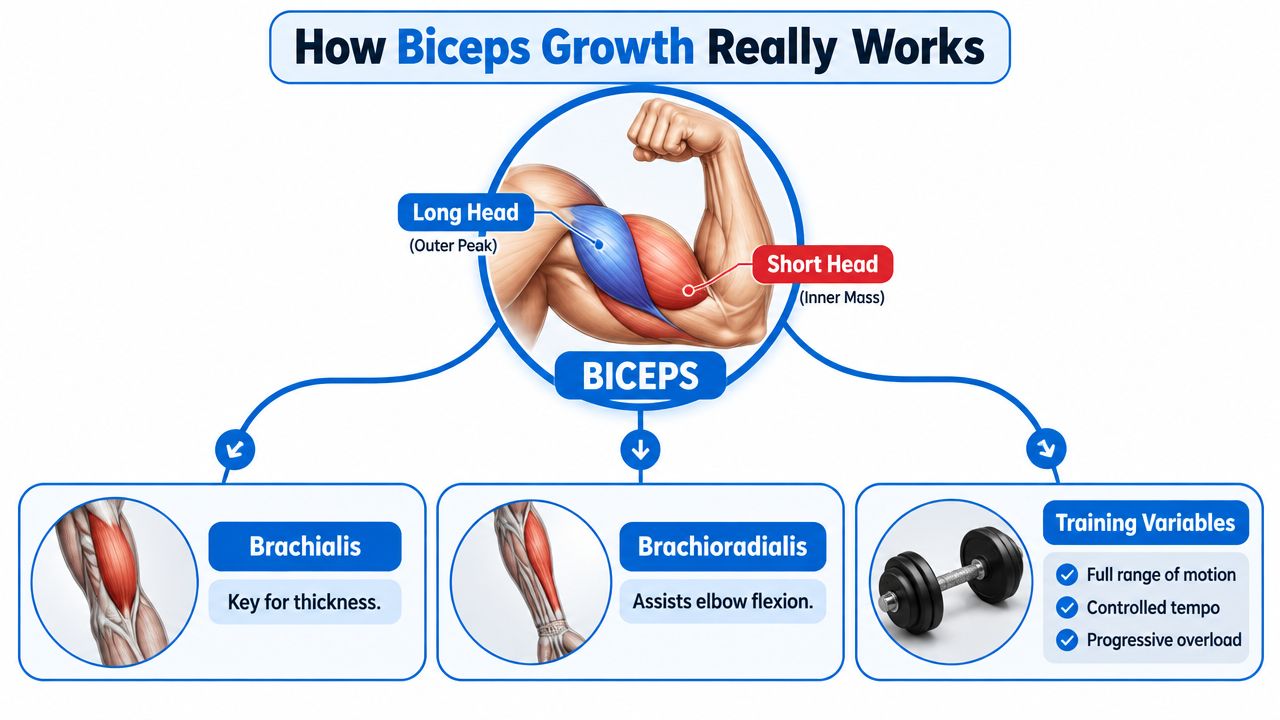
The three signals that matter
Mechanical tension is the force your muscles produce against resistance. You create it by lifting a challenging load through a controlled range of motion, not by chasing a sensation at any cost.
Volume is the amount of hard work you accumulate. For practical programming, count challenging sets in which the biceps is a limiting contributor. Sets performed far from failure may be useful for technique or warm-up, but don't confuse them with your main hypertrophy work.
Proximity to failure determines how demanding a set becomes. You don't need to turn every set into an ugly maximum effort, but your working sets should finish close enough to failure that the target muscle has been meaningfully challenged. As fatigue rises, reduce load or stop the set when you can no longer keep the intended position.
Range of motion matters because the biceps can be loaded at different lengths. Incline curls place the shoulder behind the torso, creating a pronounced challenge when the muscle is lengthened. Preacher curls support the upper arm in front of the body and make cheating more difficult, with a different resistance experience through the movement.
Why distribution beats the marathon arm day
A single session can leave your elbows and grip exhausted before later sets receive the same quality as earlier ones. Splitting work across the week lets you approach more sets with better control and gives the muscle time to recover before the next exposure.
Training frequency isn't magic by itself. Two poorly executed sessions won't outperform one well-designed session. The advantage comes from spreading useful work so you can maintain technique, effort, and progression. For a plain-language discussion of repetition selection, see this guide to the best rep range for muscle growth.
Choosing the Right Biceps Exercises for Complete Growth
Exercise selection should give each part of your arm work it can perform well. If heavy pulling already fills your program, adding more compound rows may let your back and hips limit the set before your biceps do. Use curls to control the resistance and distribute work across different shoulder positions and grips.
A 2023 controlled study examined regional biceps growth after a nine-week program in which 38 healthy women performed either incline curls or preacher curls, using 4 sets of 12 repetitions to failure, 3 times per week (controlled study of incline and preacher curls). The preacher-curl group showed a significant increase in the distal 70% region of the arm, with muscle thickness rising from 2.7 ± 0.43 cm to 2.94 ± 0.44 cm. Preacher curls are not automatically better for every lifter. The useful point is that the hardest part of an exercise can affect which region receives more of the training stimulus.

Match the curl to the job
Exercise | Best For | Resistance Profile |
|---|---|---|
Incline dumbbell curl | Challenging the long head in a lengthened position | Free-weight resistance with a strong demand near the stretched position |
Preacher curl | Strict execution and regional development | Upper arm supported in front, with a demanding lower-to-middle range |
Bayesian cable curl | Continuous cable tension with the shoulder behind the torso | Cable resistance that maintains tension as the arm moves |
Hammer curl | Brachialis and brachioradialis contribution for arm thickness | Neutral grip with less supination demand |
Chin-up variation | Combining elbow flexion with a heavier compound pull | Bodyweight resistance shared across the back and arms |
Incline curls create a clear challenge while the biceps are lengthened. Keep your shoulder against the bench and stop short of turning the bottom position into painful joint stress. Starting with the shoulder behind the torso may place more emphasis on the long head, while the entire biceps still contributes.
Preacher curls support the upper arm and reduce torso movement, so poor control is harder to conceal. Place them after a longer-length exercise when you want strict, deliberate repetitions and a different regional stimulus. Their lower-to-middle range can also make them useful for lifters who struggle to keep tension during standing curls.
Bayesian cable curls maintain resistance through more of the movement than many free-weight variations. Set the cable behind you, keep the upper arm still, and allow the elbow to extend without letting the shoulder roll forward.
Hammer curls add thickness-focused work through the brachialis and brachioradialis. They complement supinated curls rather than replace them, giving your weekly exercise menu a different grip and elbow-flexion demand.
Chin-ups combine elbow flexion with a heavy back movement. Keep them if you can control the descent and feel the biceps contributing, then follow them with a curl when you want the arms to work without the back becoming the limiting factor. For complete growth, rotate lengthened, supported, cable, neutral-grip, and compound options according to the regional emphasis your current plan lacks.
Your Weekly Plan for Bigger Biceps
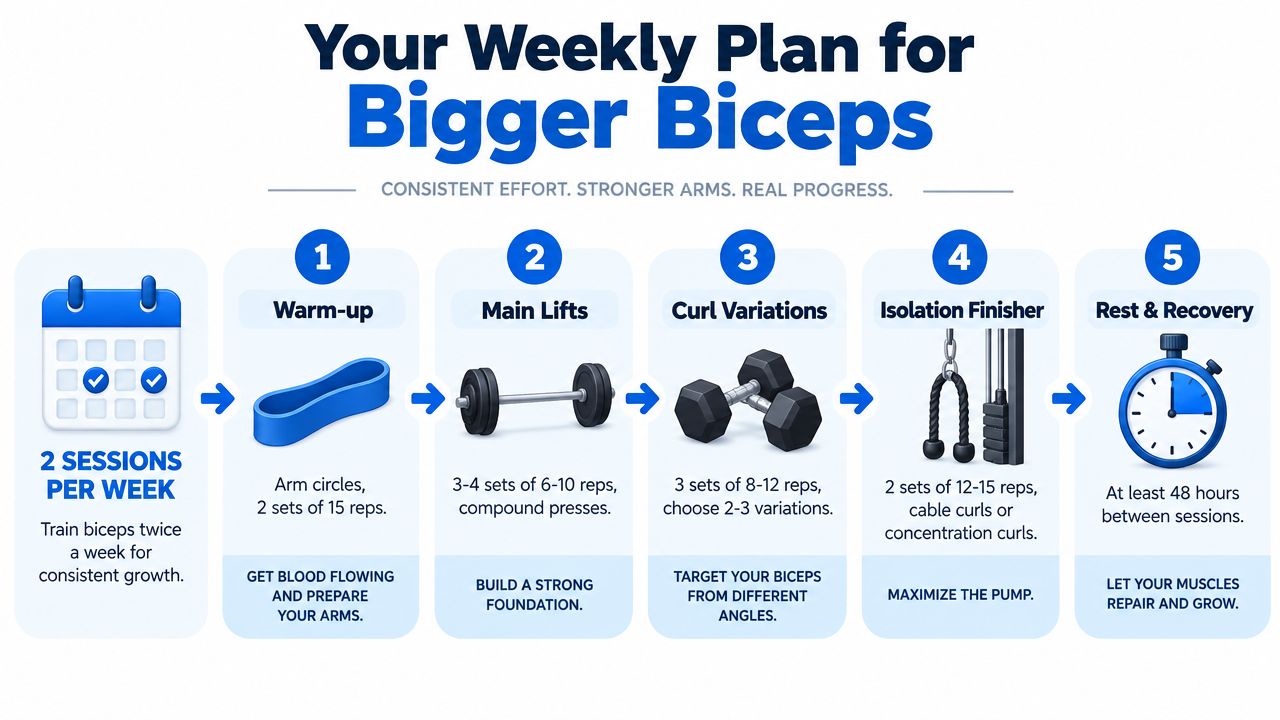
A busy back day followed by a long arm marathon usually produces tired curls, not better biceps. Start with two biceps-focused sessions per week, separating direct work so each session has enough quality effort. A practical weekly target is 12 to 20 sets, while reviewed evidence found no clear extra growth beyond about 20 sets in the studies examined (reviewed weekly-volume evidence).
Use the lower end when rows and pulldowns already tax your elbows and elbow flexors, or when you are new to structured training. Move upward only if performance improves and recovery stays reliable. Evidence-based volume guidance also places a practical session ceiling around 6 to 8 hard sets, with a wider weekly range of roughly 12 to 24 sets across two or three training days (evidence-based set-volume guide). These are boundaries for planning, not a reason to force in extra work.
A two-day structure
Session A, lengthened emphasis
Incline dumbbell curl, 3 sets of 8 to 12 repetitions
Supinated cable curl, 3 sets of 10 to 15 repetitions
Hammer curl, 2 to 3 sets of 8 to 12 repetitions
Session B, supported and shortened emphasis
Preacher curl, 3 sets of 8 to 12 repetitions
Bayesian cable curl or standing cable curl, 3 sets of 10 to 15 repetitions
Reverse curl or hammer curl, 2 to 3 sets of 10 to 15 repetitions
This arrangement spreads regional stress across the week. Session A gives the biceps more work while lengthened, whereas Session B uses supported and shortened-position curls. Keep both exposures if complete development is the priority, then adjust the set count according to which region and position your current plan undertrains.
If your back workout comes first, place curls after rows and pulldowns, then keep the exercise menu compact enough to protect execution. On an arm day, alternating biceps and triceps movements can preserve output, provided the pace does not turn every set into rushed conditioning. For a time-limited schedule, adapt these principles through 30-minute workout routines by selecting fewer movements and keeping rest periods deliberate.
How to progress without overshooting
Choose a repetition range for each exercise. Keep the load unchanged until every prescribed set reaches the top of that range with consistent form. Then make the smallest practical increase and build the repetitions again.
Track four details:
Load: Record the dumbbell, barbell, or cable setting.
Repetitions: Log every working set, not only the strongest one.
Execution: Note whether the range and control stayed consistent.
Recovery: Watch for falling performance, persistent elbow irritation, or soreness that disrupts the next session.
A single easy workout does not justify another set. Add volume only when performance has stabilized, recovery remains good, and the current workload no longer gives you a clear way to progress. If repetitions decline across several sessions, reduce fatigue before adding work.
Technique Tips and Accessory Work That Accelerate Results
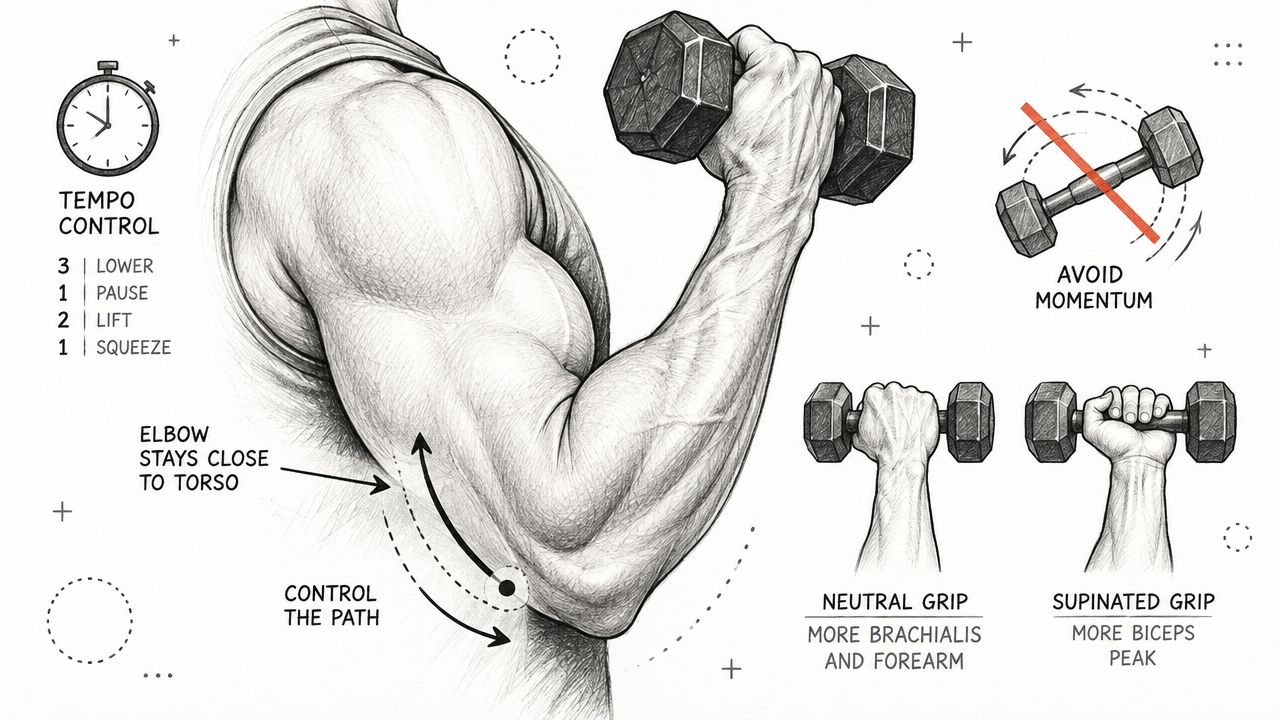
A good exercise becomes a poor biceps builder when your joints and momentum take over. Start each curl by setting your ribcage, bracing lightly, and keeping the shoulder quiet. The elbow doesn't need to be welded to your side in every variation, but it shouldn't drift because the weight is too heavy.
Make every repetition repeatable
Use a controlled lowering phase and reach a consistent bottom position without relaxing into the elbow. At the top, squeeze without rolling the shoulder forward. If you have to lean back to start every repetition, lower the weight until the first rep looks like the last.
Small grip changes have a purpose. A fully supinated grip lets the biceps contribute strongly to elbow flexion and forearm supination. A neutral grip gives hammer curls their brachialis and brachioradialis emphasis. A pronated grip, as used in reverse curls, can be useful for forearm development but may require less load.
Your upper arm should stay stable enough that the biceps remains the prime mover. On incline curls, let the shoulder remain behind the torso instead of pulling the elbow forward. On preacher curls, avoid dropping aggressively into the bottom position. On cable curls, step far enough from the stack to maintain tension without turning the movement into a body lean.
Execution cue: Choose a load that lets you control the stretched position. The bottom of the rep is where rushed lifters usually surrender the stimulus.
Accessory work should support the main plan, not bury it. Hammer curls are the obvious addition when upper-arm thickness and neutral-grip strength need attention. Reverse curls can complement them, but don't treat every forearm movement as direct biceps volume. If your elbows already feel beat up, use a cable or dumbbell variation that allows a more comfortable wrist path rather than adding intensity techniques.
Recovery makes the plan usable
The biceps also works during rows, pulldowns, and chin-ups, so assess your entire pulling workload before adding direct sets. Eat enough to support training, include protein-rich foods across your meals, stay hydrated, and protect sleep. The exact nutrition strategy depends on your body size, goals, appetite, and total activity, so don't copy a rigid meal plan without considering those variables.
A trainer can also help identify shoulder or elbow positions that repeatedly irritate you. Empire Athletics offers certified one-on-one personal training alongside strength equipment and corrective-exercise support, which can be useful when you need a program adapted to your movement history rather than a generic arm routine. For additional movement-focused guidance, see the corrective exercise program resource.
Use the following video as a visual reference for controlled curl execution. Watch the elbow position and the path of the dumbbell, then compare those details with your own repetitions.
Start Building Bigger Biceps With Consistency
A bigger arm comes from a plan you can repeat, measure, and adjust. Each week should provide hard work through more than one curl angle, while your log shows whether performance is improving.
Begin with two weekly sessions and distribute direct work across different positions. Include a lengthened-position exercise, such as an incline or Bayesian curl, alongside a supported or shortened-position movement, such as the preacher curl. Add a neutral-grip curl when arm thickness is a priority. Your total should reflect pulling exercises, training experience, and recovery, rather than chasing fatigue alone. Earlier volume guidance places many lifters in roughly 12 to 20 sets per week (biceps volume review).
Record the load and repetitions for every working set. Add weight or repetitions only when your technique remains consistent. Changing the curl angle can also shift where growth is emphasized, so vary resistance profiles with a purpose rather than collecting exercises. The regional-growth findings cited earlier support this approach (regional hypertrophy study).
Give the routine enough time to produce a clear trend. Weekly program changes make progress difficult to judge; months of steady training and small improvements give you usable feedback. If elbow discomfort appears, pulling performance drops, or repetitions decline repeatedly, reduce or redistribute the workload instead of forcing more curls.
Empire Athletics offers 24/7 gym access in Leominster, Lunenburg, and Webster, strength equipment, certified one-on-one personal training, and an on-site cafe with coffee, smoothies, and protein shakes. Visit Empire Athletics to find a location or coaching option for consistent biceps training.