How to Warm Up Before Lifting Weights: The Complete Guide
Master how to warm up before lifting weights with routines for strength, hypertrophy, and mobility. Includes timed progressions and trainer tips

An effective warm-up should take five to fifteen minutes, moving from easy activity to specific, light-to-moderate sets of the main lift. For a bench press, one evidence-based progression used about 6 repetitions at 40% of the planned training load, followed by 6 repetitions at 80% before the working sets.
You may be standing at a rack in Leominster before sunrise, trying to decide whether your first squat set should count as preparation or training. Or you may be walking into Empire Athletics late at night after a long shift, feeling stiff, distracted, and tempted to load the bar immediately. In both situations, the answer isn't a marathon of stretching or cardio. You need a short sequence that raises readiness, rehearses the movement, and adds weight without creating fatigue.
The most useful way to think about how to warm up before lifting weights is simple: prepare the person and the lift in front of you. Your warm-up should make the first work set feel organized, not exhausting. It should also adapt to the exercise, your training goal, and how ready you feel that day.
Why Your Warm-Up Should Not Feel Like a Sweat Session
Sweating doesn't prove that you're ready to lift. A warm-up prepares your nervous system, joints, muscles, movement pattern, and attention for the task ahead. A few minutes of easy cycling or rowing can help you feel less stiff, but the barbell sets usually provide the most relevant preparation because they rehearse the exact lift you'll perform.
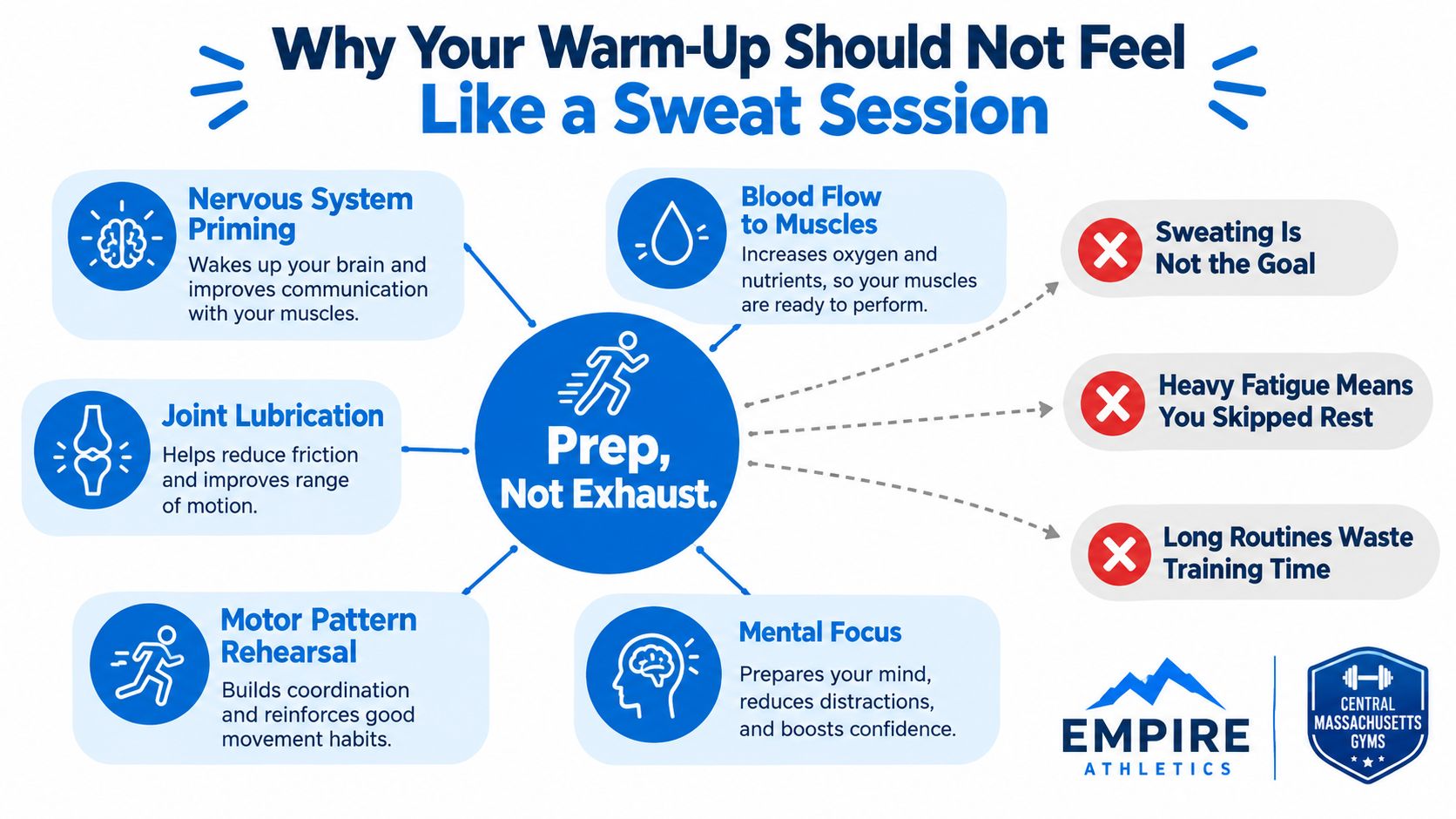
Jumping straight to your planned working load asks your body to solve several problems at once. You have to find your stance, brace correctly, control the range of motion, and produce force against a load you haven't handled that day. Even if you complete the set, rushed mechanics can leave repetitions slower and less consistent than they needed to be.
Use a simple readiness sequence
Start with easy movement if your body feels cold or sluggish. Then use dynamic movements that match the joints and positions of the lift. Finish with progressively heavier sets of the exercise, reducing repetitions as the load rises.
A practical sequence looks like this:
General movement: Use a bike, rower, or brisk walk when you need to raise circulation and reduce stiffness.
Dynamic preparation: Move through the ranges your session demands, such as shoulder circles before pressing or controlled bodyweight squats before barbell squats.
Specific loading: Practice the lift with the bar or a very light load, then add weight in controlled jumps.
Readiness check: Look for crisp technique, stable positions, and a bar speed that doesn't feel forced.
Practical rule: A warm-up should leave you more capable of lifting, not more tired from exercising.
The time of day changes your starting point. An early-morning lifter may need more gradual movement before the first loaded squat, while a late-night lifter may need a deliberate mental reset after work. Neither person needs to copy a fixed routine. Start where your body is today, then let clean movement and perceived readiness determine when you progress.
The Four Steps Every Lifter Warm-Up Needs
A good warm-up moves from broad preparation to the exact demands of the first lift. In a 24/7 gym like Empire Athletics, that matters even more. The member training before sunrise often needs a longer on-ramp than the member coming in after a physically active day, but both still need the same four-part structure.

Start broad, then become specific
Step one is general circulation. Use a bike, rower, treadmill, or a brisk walk for a few minutes if you feel cold, stiff, or half-awake. Keep the effort low. You should step off feeling looser, not like you already started conditioning work. If you come in warm and alert, this step can stay short.
Step two is dynamic mobility. Match it to the first lift instead of running through a random checklist. Squats usually need hips, ankles, and trunk control. Bench work usually needs the shoulders, upper back, and a stable pressing position. Use active reps and controlled ranges of motion, because long passive stretching at this point often gives you time without giving you much lift-specific return.
Step three is movement rehearsal. Take the main exercise with the empty bar or a very light load and practice the details that affect the session: setup, brace, foot pressure, bar path, and range of motion. Small adjustments show up here. A stance that felt fine last week may feel off at 5 a.m., and a grip that works in the afternoon may need a quick reset late at night after a long workday.
Let the barbell finish the job
Step four is specific loading. Add weight through a few progressively heavier sets while dropping reps as the load climbs. This is the part that prepares you to produce force under the conditions that matter for the day. In the controlled warm-up study, specific warm-up work increased first-set mean propulsive velocity from 0.64 to 0.68 m/s in the squat and from 0.47 to 0.52 m/s in the bench press, with statistically significant effects in both exercises.
That does not mean every lifter needs an elaborate ramp or a heavy single before work sets. It means the barbell should do the final preparation. If the next set looks sharper, feels more stable, and moves with better timing, the ramp is doing its job. If bar speed falls off, positions start drifting, or the last rep of a warm-up set turns into a grind, you went too far.
Watch the movement demonstration below for a visual example of controlled preparation before lifting.
Strength Warm-Ups Versus Hypertrophy Warm-Ups
You can spot the difference fast on a 24/7 gym floor in Central Massachusetts. The member walking in for heavy triples before sunrise does not need the same ramp as the member squeezing in a chest-and-back session after a long shift. Both need to be ready. They do not need the same amount of build-up.
A strength session asks for precise output on a main lift, often early in the workout and often at a load that exposes every setup mistake. That changes the trade-off. Give yourself more practice with heavier weights, keep the reps low as the bar climbs, and treat each warm-up set like a rehearsal for the first work set.
Strength-focused preparation
For squat, bench press, deadlift, or overhead press, start light, establish position, then move up in clear steps toward the day's working load. One moderate technique set usually helps. After that, one or two short heavier exposures are enough for most lifters. The last warm-up set should sharpen timing and confidence, not drain either one.
I coach this a little differently depending on the lift. Squats and deadlifts usually benefit from a steadier climb because force production and position can fall apart fast if you jump too quickly. Bench and overhead press often need less total warm-up volume, but they still benefit from a couple of purposeful jumps so the first work set does not feel like the introduction to the movement.
The practical rule is simple. The heavier and more technical the top set, the more specific the ramp should be.
Hypertrophy-focused preparation
Hypertrophy work needs a shorter runway. Prepare the first compound lift with care, then get more economical as the session moves on. If your pressing muscles, hips, or upper back are already warm from earlier work, a full rebuild before every machine or accessory exercise usually wastes energy you would rather spend on productive sets.
That matters even more in a busy 24/7 environment, where people train at all hours and recovery is not always perfect. A late-night member chasing muscle gain does better with a smooth transition into work sets than with five extra warm-up sets out of habit.
Training priority | Practical warm-up emphasis |
|---|---|
Strength | More gradual loading, fewer repetitions as weight rises, close attention to bar speed |
Hypertrophy | Efficient technique rehearsal, enough local preparation, preservation of working-set energy |
Both goals | Clean movement, no grinding, and adjustments based on readiness |
If your goal is size, keep the warm-up in service of the sets that drive growth. For a useful breakdown of the best rep range for muscle growth, use the same standard here. Prepare enough to move well, then save your effort for the work that counts.
Warm-Up Examples for Squat, Bench, Deadlift, and Overhead Press
You walk into a 24/7 gym at 5 a.m. or after a long shift at night, load the bar, and the same rule applies. Warm up for the weight you plan to lift today, not for a number you hit months ago. That keeps the ramp useful for newer lifters, people coming back after time off, and experienced members whose sleep, stress, or recovery can change from session to session. Use these examples as templates and adjust the jumps to match the day.
Squat
Start with the empty bar and make those reps count. Dial in stance, brace, descent, and depth before you chase load. From there, add a light set for about 3 to 6 repetitions, then one or two heavier sets of about 1 to 3 repetitions before the first work set. Squats usually need a more patient climb than upper-body lifts because more joints and positions have to stay organized under load.
If the bottom position feels crowded, fix that before loading it harder. A few targeted drills from these hip mobility exercises for squats can clean up the pattern fast. Empire members training on their own at odd hours do well with a simple test here. If depth and balance improve after a brief mobility drill, keep moving. If not, lower the jump and take another technical set.
Bench press
Bench warm-ups should feel sharp, not drawn out. Use the empty bar to set your upper back, grip, foot pressure, and touch point, then move to a moderate load and finish with a brief heavier exposure before the work sets.
A practical example is 6 repetitions at 40% of the planned training load, then 6 repetitions at 80%, followed by the final build into working weight. The point is not to copy those numbers every session. The point is to arrive at the first work set with a repeatable bar path and fast, clean reps.
Deadlift
Begin with a light hinge pattern, then pull from the floor with a load that lets you own the start position. As the bar gets heavier, let the reps drop. That keeps the warm-up specific without draining your grip, back, or brace before the sets that matter.
In a busy Central Massachusetts gym, this matters because plenty of lifters train before work, after work, or between responsibilities. Deadlifts punish rushed setup more than they reward extra warm-up volume.
Overhead press
Use a light bar or dumbbells to find a stacked ribcage and pelvis, steady hand position, and a straight path overhead. Then add a moderate set and, if the session calls for it, one brief heavier exposure. If the shoulder does not feel right, clean up the setup and lower the load.
Across all four lifts, stop once the movement is consistent. Good warm-up sets build the next set. They do not spend it.
Timing Your Warm-Up Across Early Morning and Late Night Sessions
A 24/7 gym gives you scheduling freedom, but your body won't feel identical at every hour. The right adjustment is usually small. Extend the general movement and technique portions when you feel stiff, and shorten them when you already feel physically prepared.

Early sessions
An early lifter may arrive with joints that feel less mobile and attention that hasn't fully settled on the training task. Start with easy cyclical movement, then spend a little more time rehearsing the first position. Don't chase a sweat. The goal is to make the first loaded repetition feel familiar.
Use the bar to assess the day. If your squat depth, bench setup, or deadlift start position becomes consistent quickly, progress to loading. If it remains awkward, add another light technique set rather than jumping straight to the planned weight.
Late sessions
Late-night training can bring a different problem. You may be physically warm from the day but mentally foggy after work or a night shift. Use a short, predictable sequence that narrows your attention to the lift. A few controlled setup drills and specific ramp sets often do more than an extended cardio routine.
A consistent warm-up is useful because it gives your body a repeatable entry point, even when your schedule isn't consistent.
If fatigue is the main issue, read guidance on exercising when tired and adjust the session. Warm-up sets can reveal whether you need to reduce the day's load, change the exercise, or proceed as planned. They shouldn't be used to override pain, severe exhaustion, or poor control.
How Warm-Ups Fit Into the Empire Athletics Routine
A warm-up works best when it belongs to a routine you can repeat. For Central Massachusetts members training before work, between shifts, or after family responsibilities, access matters because a rushed schedule can tempt you to skip preparation entirely. Empire Athletics offers 24/7 access at locations in Leominster, Lunenburg, and Webster, along with modern strength and cardio equipment for different training goals.
Certified one-on-one personal training can make the preparation more specific. A coach can identify whether your squat warm-up needs ankle and hip mobility, whether your pressing setup needs shoulder and upper-back work, or whether a previous imbalance calls for corrective exercise. That keeps mobility connected to the lift instead of turning it into a collection of unrelated drills.
The on-site Empire Cafe also offers coffee, smoothies, and protein shakes for members who want convenient pre- or post-workout nutrition. Food and beverages don't replace a warm-up, but removing extra errands can make it easier to arrive with enough time to prepare and train without rushing.
A practical routine might look different at each location, but the principle stays the same:
Enter with a plan: Know your first lift and its intended working load.
Prepare only what matters: Match general movement and mobility to that lift.
Use coaching when uncertain: Ask for help when technique, pain, or mobility changes your normal sequence.
Protect training time: Finish the warm-up ready to work, not depleted.
Common Warm-Up Mistakes and How to Fix Them
At a 24/7 gym, this shows up in predictable ways. The 5 a.m. lifter tries to wake up with too much cardio. The late-night member adds extra sets because the bar feels heavy after a long day. Both miss the point. A warm-up should make the first work set look and feel more organized, not turn the start of the session into another workout.
The biggest mistake is treating preparation like conditioning. Long bike intervals, high-rep bodyweight circuits, and too many empty-bar sets can leave you warm but flat. Keep the general work easy. Save your energy for the lift that matters.
Using the same sequence for every exercise causes problems too. Squats usually need a more careful build because the pattern asks for bracing, hip position, and stable foot pressure under load. Bench and overhead press often need fewer total reps, but cleaner setup work. Deadlift warm-ups should groove the hinge and brace without becoming a back-fatigue contest.
Watch for these signs that your warm-up needs fixing:
Your repetitions slow down: Cut a set or lower the reps before the work starts to drag.
Your setup changes between repetitions: Drop the load and practice the position again.
You feel sweaty but not coordinated: Replace extra cardio with lift-specific movement.
You add weight by habit: Base jumps on the day's working load and how you are moving.
You feel pain rather than normal stiffness: Stop pushing through it and get qualified help.
Very light, low-rep prep is not automatically enough either. Bench often improves with a clear loading progression, while squats can respond better to a more assertive final warm-up jump. At Empire Athletics, the right answer depends on the lift, the hour, and how you are moving that day. Judge readiness by bar speed, technical consistency, and perceived readiness. Then start the work sets.