How to Lose Back Fat and Tone Your Upper Body
Learn how to lose back fat with a practical plan built around nutrition, posterior chain strength work, cardio, and weekly progress tracking that actually shows

The most popular advice about how to lose back fat is also the least useful: do endless rows, pulldowns, or “back fat” circuits until the bulge disappears. Training your back can build muscle, improve posture, and create a sharper upper-body shape, but it can't force your body to withdraw fat from that exact area.
Visible change comes from reducing total body fat while preserving the muscle underneath. That requires a sustained nutrition strategy, progressive resistance training, enough aerobic work, and a way to judge progress when the scale doesn't immediately cooperate. It also requires understanding whether you're looking at adipose tissue, compressed bra-line tissue, posture, or a muscular back that appears thicker from certain angles.
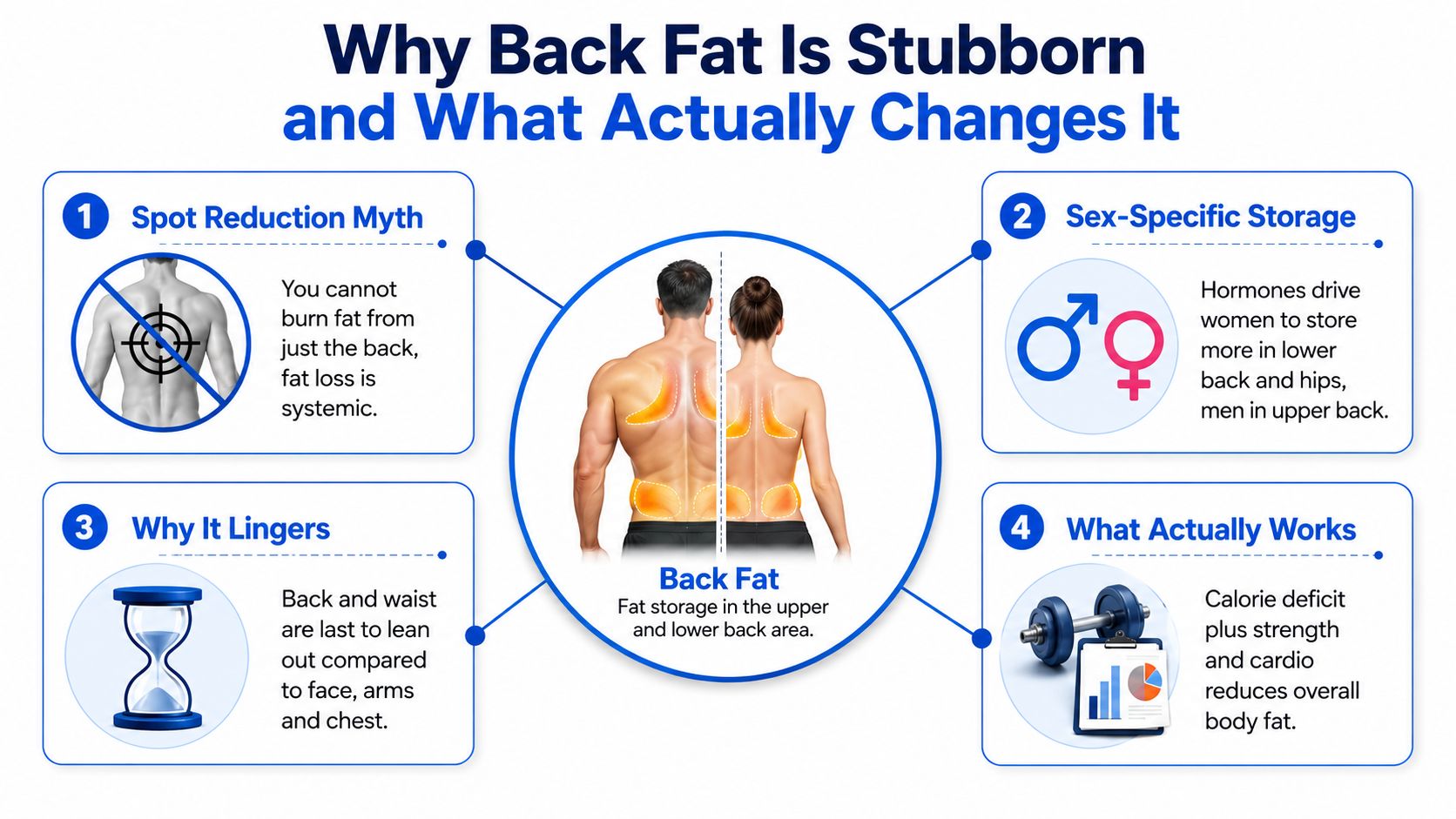
Why Back Fat Is Stubborn and What Changes It
Spot reduction is the first myth to discard. Training a muscle improves its strength and shape, but it does not direct fat loss to that exact area. Rows can build the back, yet they do not function as a local fat-burning switch. Fat loss follows the body's overall energy balance, so back definition requires lowering total body fat while keeping the muscle underneath (exercise protocols and obesity guidance).
The back is often stubborn because fat distribution is uneven. Genetics, sex-related hormonal patterns, and personal storage tendencies affect whether fullness shows first around the upper back, bra line, flanks, or lower back. The face, arms, or chest may look leaner before the back and waist change. That pattern reflects normal distribution, not proof that your plan has failed.
Week by week, read the trend rather than one visual check. If your waist, weight trend, and consistent photos are changing while the back looks similar, the area may be lagging. If nothing changes across several weeks, review execution before adding more back exercises.
Separate fat from shape and compression
A fold at the back can have several causes. A bra-line bulge may include skin and tissue compressed by a band or tight clothing. Rounded upper-back posture can push the area outward, while developed lats can add width that resembles thickness from the side. Loose skin after substantial weight loss is a separate concern, and exercise cannot remove it in the same way it can improve muscle tone.
Check the area in a relaxed stance, then gently retract your shoulder blades without forcing them downward. A substantial contour change suggests posture or positioning is contributing. A soft fold that remains across different clothes, stances, and lighting is more consistent with fat tissue being part of the picture.
Practical rule: Judge your back with consistent photos and measurements, not one tight shirt or mirror angle.
The route that changes appearance is whole-body fat loss paired with resistance training. Guidance commonly recommends 150 to 300 minutes of moderate-intensity activity per week, with some guidance placing 200 to 300 minutes weekly in the range that may support more clinically significant weight loss of at least 5% of body weight (medical and exercise guidance). A 2023 study found localized training could affect body-fat measures in a trained abdominal region, but that finding does not replace systemic fat loss or show that back exercises selectively remove back fat (2023 abdominal exercise study).
Build the Nutrition Foundation for Visible Back Definition
Your back won't look more defined if the calorie deficit is so aggressive that you lose the muscle creating its shape. It also won't change if your weekday intake is controlled but weekends erase the deficit. Start with a moderate target of roughly 300 to 500 calories below maintenance per day. Because no verified source in the available evidence supports that exact range, treat it as a practical coaching framework rather than a clinical statistic, and adjust it using your weekly trend.
Estimate maintenance from body weight, activity, and recent weight history. Then keep the plan stable long enough to evaluate it instead of changing calories after every weigh-in. Protein is the anchor. A useful coaching range is 1.6 to 2.2 grams per kilogram of body weight, but this specific range isn't established in the supplied verified data, so individuals with medical conditions or a history of disordered eating should work with a qualified professional.
Use meals that protect training quality
Build three or four meals around a clear protein serving, vegetables or fruit, and a slow-digesting carbohydrate. Place a substantial meal before training when possible, then include protein and carbohydrates afterward to support recovery. For ideas on constructing that post-training meal, use this practical guide to what to eat after lifting weights.
A simple daily structure might look like this:
Metric | Target | Notes |
|---|---|---|
Calories | Moderate deficit | Base intake on maintenance and weekly trend weight |
Protein | Consistent serving at every meal | Choose poultry, fish, eggs, dairy, tofu, legumes, or lean meat |
Fiber-rich foods | Include vegetables, fruit, beans, and whole grains | Helps meals stay satisfying |
Carbohydrates | Concentrate more around training | Support lifting and cardio performance |
Alcohol and liquid calories | Keep tightly controlled | Weekend intake can undermine weekday consistency |
The back-specific trap isn't one magical food. It's repeated excess intake that hides inside alcohol, sweetened drinks, desserts, and highly processed foods. High-fructose diets shouldn't be described as directly targeting upper-back fat without stronger evidence, but frequent calorie-dense choices can make the deficit disappear regardless of where your body stores fat.
Track adherence. Include cooking oils, restaurant meals, drinks, bites while preparing food, and the large Saturday meal. If hunger is high, increase food volume with vegetables, potatoes, fruit, lean proteins, and broth-based meals before cutting training volume or chasing a harder deficit.
Strength Training for a Tighter, Stronger Back
A tighter-looking back requires two changes at once: less fat over the torso and enough muscle in the lats, traps, rhomboids, spinal erectors, and rear delts to create visible structure. You cannot choose where fat leaves first. The back often looks unchanged for several weeks, then becomes noticeably leaner as overall fat loss accumulates. Compare relaxed photos, bra-line tissue, and posture under the same conditions rather than judging one mirror angle.
Resistance training also protects the shape you are trying to reveal. A 2025 meta-analysis of 22 studies found that adding resistance exercise during diet-induced weight loss produced greater fat-mass reduction, with an SMD of −0.36 and a 95% confidence interval of −0.49 to −0.23, while preserving fat-free mass, with an SMD of 0.40 and a 95% confidence interval of 0.18 to 0.61 (2025 resistance-training meta-analysis).
Use this four-day structure if recovery, sleep, and schedule support it. If four sessions are unrealistic, keep the exercise order and reduce the number of training days. Do not cram missed workouts together.
Heavy compound days
Monday, heavy day A
Weighted row: 4 sets of 6 to 10
Pull-ups or lat pulldowns: 4 sets of 6 to 10
Romanian deadlift: 4 sets of 6 to 10
Face pull: 4 sets of 6 to 10
Friday, heavy day B
A second row variation: 4 sets of 6 to 10
Pull-up or pulldown variation: 4 sets of 6 to 10
Romanian deadlift or another hip-hinge variation: 4 sets of 6 to 10
Face pull: 4 sets of 6 to 10
Start with general movement and several lighter ramp-up sets before the first demanding lift. Rest 90 to 120 seconds between heavy sets. Keep rows and hinges controlled. If your torso swings or your lower back takes over, reduce the load and restore the intended pulling path.
Higher-repetition density days
Tuesday, upper-back accessory day
Chest-supported row: 3 sets of 12 to 20
Single-arm dumbbell row: 3 sets of 12 to 20
Band pull-apart: 3 sets of 12 to 20
Reverse fly: 3 sets of 12 to 20
Wednesday, posterior-chain accessory day
Chest-supported row: 3 sets of 12 to 20
Single-arm dumbbell row: 3 sets of 12 to 20
Band pull-apart: 3 sets of 12 to 20
Reverse fly: 3 sets of 12 to 20
Rest 45 to 60 seconds on accessory work. Add a short arm and rear-delt finisher once weekly, such as curls, rope pressdowns, and another controlled rear-delt movement. It can improve the V-taper silhouette, but it cannot replace a calorie deficit or correct posture-related changes in how the back appears.
Use double progression. Keep the same load until every set reaches the top of its rep range with clean form. Then increase the load modestly and rebuild from the lower end. For guidance on choosing repetitions, read this guide to the best rep range for muscle growth.
A demonstration can help you check setup and pulling mechanics before adding weight:
Cardio That Accelerates Fat Loss Without Burning Muscle
Cardio helps create the weekly energy expenditure needed for fat loss, but more isn't automatically better. The most useful arrangement keeps resistance training as the priority and adds aerobic work that you can recover from. Combined resistance and aerobic exercise tends to produce better regional adiposity outcomes than resistance training alone, while exercise can also affect fat stores through mechanisms beyond calorie restriction (systematic review of resistance and aerobic exercise).
Start with conversational aerobic work
Use two to three zone 2 sessions of 30 to 45 minutes as a practical starting point. Choose an incline treadmill, stationary bike, elliptical, or brisk outdoor walk. The talk test is sufficient: you should be able to speak in complete sentences, although you shouldn't feel as if you're sitting still.
This easy pace gives you repeatable volume without adding the same fatigue as frequent intervals. It can also be easier to fit around heavy rows and Romanian deadlifts. If you need equipment ideas, compare options in this guide to cardio workout equipment.

Add intensity carefully
Use one or two short HIIT sessions of 8 to 15 minutes on non-consecutive days, and keep them away from your hardest posterior-chain sessions. The infographic's suggested interval block is longer, so treat it as an alternative progression rather than stacking both approaches in the same week.
Fasted cardio isn't a requirement. It can be useful if you prefer training before breakfast and your performance stays steady. It becomes counterproductive when it causes dizziness, poor lifting, excessive hunger, or later overeating. Have a small carbohydrate and protein meal first when fasted work reduces output.
Watch for interference between endurance fatigue and strength progress. If rows, hinges, and pulldowns are improving while your energy remains stable, maintain the schedule. If your legs and lower back stay sore, reduce HIIT first, not your foundational lifting.
Tracking Progress and Adjusting When Results Stall
The scale is useful, but it cannot identify whether you lost fat, retained water, or preserved muscle. Review several signals on a fixed schedule so one noisy reading does not dictate your next decision. Back fat is often among the last areas to look different, so a steady waist trend with stable strength can represent progress before photos show a clear change.

The four measurements that matter
Weekly average weight: Weigh daily under similar conditions and average the readings. This reduces the effect of sodium, carbohydrate intake, digestion, menstrual-cycle fluctuations, and hard training.
Bra-line waist measurement: Measure at the same level each time, keeping tape tension consistent. Do not compress the tissue. If the fold changes mainly with posture or bra pressure, rather than with the broader waist trend, it may not represent fat loss.
Rear-view photos: Take front, side, and back photos every two weeks with matching lighting, distance, clothing, and posture. Use a relaxed stance. Compare the bra line, waist contour, and shoulder position, since posture can make the back appear leaner or fuller without a meaningful change in tissue.
Strength log: Record rows, pulldowns, pull-ups, hinges, and accessory work. Stable or improving performance during a deficit supports the case that you are retaining muscle, even if scale weight briefly pauses.
Use a 14-day review cycle
Do not change the plan after one flat week. Review two weeks of weight averages, measurements, photos, hunger, recovery, and training records.
Weight trends down and strength holds: Keep calories and training steady.
Weight stalls for two weeks while strength climbs: Hold calories at maintenance and add one zone 2 session.
Weight and strength both stall: Reduce 150 to 200 calories, starting with carbohydrate portions. Treat this as coaching guidance, not a verified clinical result.
Resistance training can preserve fat-free mass without materially changing scale weight, as noted earlier in the meta-analysis. Its reported between-group body-mass difference was about −0.32 kilograms, so a stable scale does not automatically mean a stable physique. A salty restaurant meal can increase water retention without creating meaningful fat gain. Wait for the trend before reacting, and adjust only when several measures point in the same direction.
Your 12-Week Plan to Lose Back Fat
The plan works when each part supports the others. Nutrition creates the conditions for fat loss, strength training preserves and develops the upper body, cardio adds manageable expenditure, and tracking tells you whether the combination needs adjustment.
Repeat this weekly schedule
Day | Training | Execution focus |
|---|---|---|
Monday | Heavy posterior chain | Rows, pull-ups or pulldowns, Romanian deadlifts, and face pulls |
Tuesday | Zone 2 plus upper accessories | Conversational cardio, then chest-supported rows, pull-aparts, or rear delts if recovery allows |
Wednesday | Posterior-chain accessories | Higher-repetition rows, single-arm work, reverse flyes, and controlled trunk work |
Thursday | HIIT plus core | Short intervals, then bracing and anti-rotation exercises |
Friday | Heavy posterior chain | Repeat the heavy structure with planned load or repetition progression |
Saturday | Longer zone 2 or active recovery | Walk, cycle, or use another low-impact option at an easy pace |
Sunday | Off | Keep normal movement, but prioritize recovery |
Keep the nutrition target at a practical 300 to 500 calorie daily deficit and use 1.6 to 2.0 grams of protein per kilogram as a coaching target during this cycle. Those figures aren't provided as verified study outcomes in the supplied evidence, so adjust them to your health status, preferences, and professional guidance rather than treating them as universal prescriptions.
Review the dashboard at week 2 to catch adherence problems, at week 6 to assess the trend and strength balance, and at week 10 to decide whether the final block needs a small adjustment. At week 12, repeat the full photo, waist, weight-trend, and strength audit. Don't compare a relaxed first photo with a posed final photo.
If progress is moving faster than your recovery, increase food slightly or reduce cardio before strength performance suffers. If progress plateaus early, verify portions, weekend intake, missed sessions, sleep, and measurement consistency before cutting more food. Restart the cycle with the same exercise pattern, updated loads, and a new baseline. Back fat often changes later than other areas, so the timeline should guide your decisions, not dictate panic.
Empire Athletics offers 24/7 gym access, modern strength and cardio equipment, and certified one-on-one personal training at locations in Leominster, Lunenburg, and Webster, Massachusetts. If you want help applying this nutrition, lifting, cardio, and tracking framework to your schedule, visit Empire Athletics and discuss a customized plan with the training team.