What Muscles Does the Rowing Machine Work
Discover exactly what muscles does the rowing machine work across every stroke phase. Build strength, fix technique, and program effective workouts today.

A rowing machine works roughly 80 to 85 percent of the body's main muscles, with the legs driving first, the core stabilizing the transfer, and the upper body finishing the stroke. It trains the quads, hamstrings, glutes, back, arms, and trunk together, but they don't all work equally hard at the same moment.
So, what muscles does the rowing machine work most, and why do so many people feel it in their arms when the legs should be doing the heavy lifting?
Watch members use a rower for the first time and you'll often see the same mistake. They bend the elbows immediately, yank the handle toward the chest, and treat the machine like a seated biceps curl. The handle moves, the monitor records effort, and the stroke still looks busy, but the strongest part of the movement is missing.
A good rowing stroke is a sequence, not a simultaneous tug. The legs push against the footplate, the trunk transfers that force, and the back and arms complete the connection to the handle. The details matter because changing the order can shift fatigue into the lower back, forearms, or biceps without making the stroke more productive.
The Real Muscle Story Behind Every Rowing Stroke
The simplest way to understand rowing is to follow the force from the floor to the handle. At the catch, your knees are bent, your arms are long, and your torso leans slightly forward. Your quads are loaded in a position that lets them push the seat away from the footplate. Your trunk braces so the force doesn't disappear through a collapsed spine.
The drive begins with the legs. Knee extension brings the quadriceps into the movement, while hip extension from the glutes and hamstrings continues the push as the legs straighten. The trunk acts like a rigid bridge, allowing force from the lower body to travel through the hips and torso rather than leaking through excessive movement.
Only after the lower body has done its work should the arms bend. The lats, rhomboids, rear deltoids, biceps, and forearms then guide the handle into the finish. This is why rowing isn't best described as an arm exercise, even though the arms are visible at the end of every stroke.
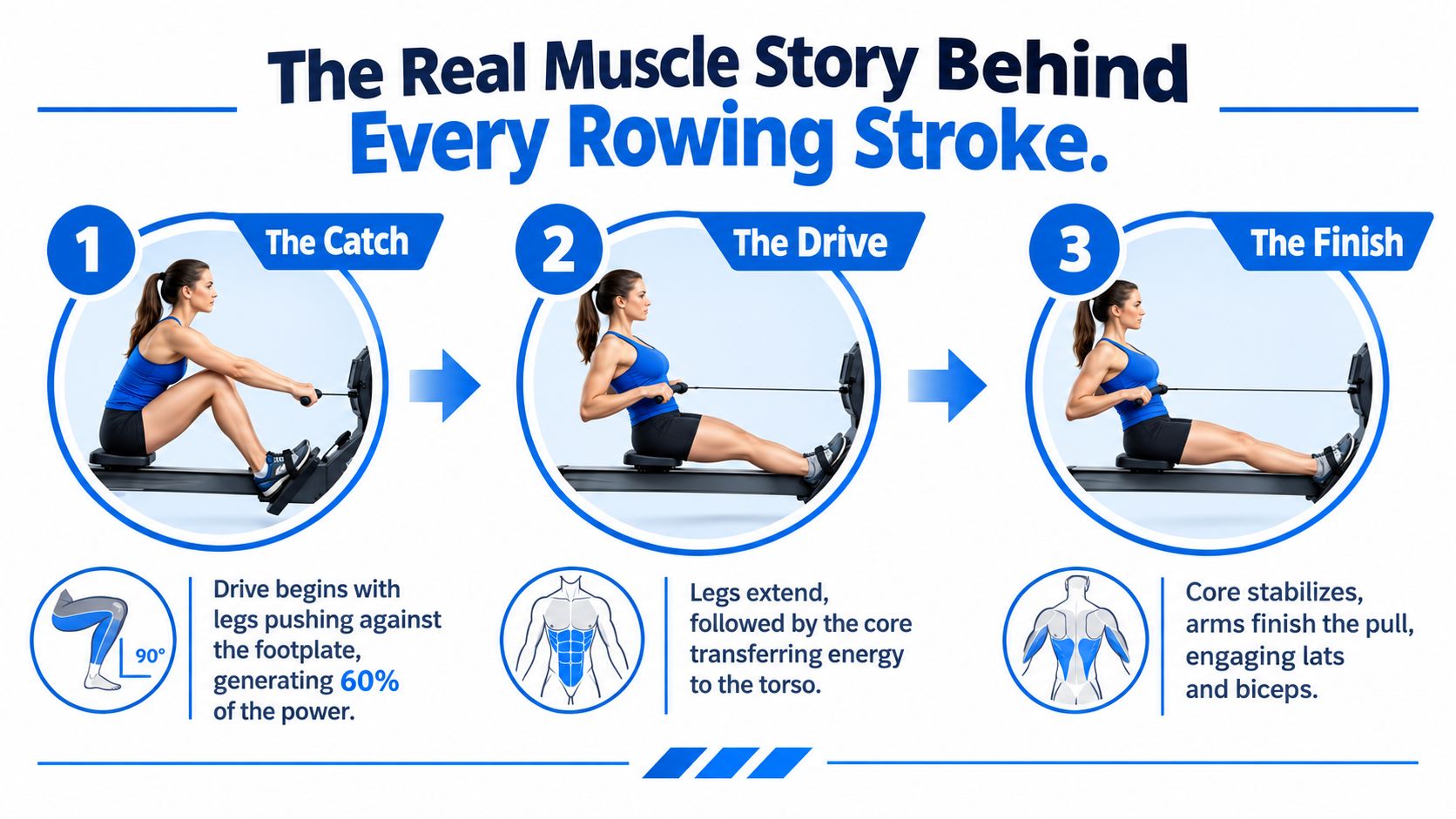
The sequence determines the emphasis
Research on elite rowers has found strong activity in the leg and trunk muscles throughout the rowing cycle, including the rectus femoris and biceps femoris. The study also examined hip and trunk activation on two commonly used ergometers, reinforcing that the movement is coordinated through the lower body and torso rather than isolated at the handle. The electromyography research on elite rowing provides useful context for that force transfer.
Technique changes the experience quickly. Pull early with the arms and your biceps and forearms complain first. Open the back before the legs have pushed and your lower back may absorb movement that should have come from the hips. Keep the handle connected to a stable trunk and the row feels more like a powerful leg press followed by a controlled pull.
Practical rule: Think “push the machine away” before you think “pull the handle in.”
The rower still trains the upper body, but the upper body finishes a movement that the legs initiated. That distinction is the foundation for understanding each phase.
Muscles Worked During the Drive Phase
The drive is the propulsive portion of the stroke. It begins at the catch and ends when the legs are extended, the torso has opened, and the handle reaches the body. The muscles don't switch on in a perfectly isolated sequence, but the joint actions give you a reliable map of who contributes most.
First comes knee extension
At the catch, the quadriceps are loaded across the bent knee. As you push into the footplate, the vastus lateralis, vastus medialis, and rectus femoris help extend the knee. These muscles create the first obvious movement of the seat and establish the momentum that the rest of the body will transmit.
Keep the arms straight during this opening portion. Straight elbows let the legs apply force without turning the handle into a premature curl. If the elbows bend before the knees have begun to open, the arms become a brake on the movement and the lower body can't express its strength efficiently.
The hips continue the drive
As the knees extend, the glutes and hamstrings contribute through hip extension. The biceps femoris and semitendinosus are part of the hamstring group that supports this action, while the glutes help open the hips and bring the torso from its forward angle toward a tall position.
The calves also work against the footplate, helping maintain contact and contribute around the ankle as the leg drive develops. Their role isn't to replace the quads and glutes. They help finish a connected push through the foot rather than acting as the main engine.
Electromyography research on rowing ergometry has reported high activation in the quadriceps and hamstrings during the propulsive phase. The rowing biomechanics research published in Sports supports the practical coaching cue that the stroke starts with knee extension and hip extension, not arm pulling.
The trunk transfers force
The erector spinae helps maintain the torso position as the hips open. It shouldn't jerk the body backward or create a dramatic lean. Its job is to keep the trunk organized while the hips and legs produce movement.
The lats and upper-back muscles also begin to connect the arms to the torso before the final pull. They help keep the shoulders controlled and the handle path stable. At this point, the back is acting more as a force transmitter and stabilizer than as the primary mover.
A useful internal cue is to feel pressure through the feet, a steady torso, and relaxed elbows. The harder part of the stroke should feel like a coordinated leg and hip push, not a frantic attempt to yank the handle.
Muscles Worked During the Finish and Recovery
The finish changes the job of the upper body. By the time the handle approaches the lower ribs, the legs have extended and the torso has opened. The back and arms now complete the pull, while the abdominal muscles help control the position of the trunk.
The finish is a controlled upper-body contribution
The latissimus dorsi draws the upper arm toward the torso. The rhomboids and middle trapezius help control the shoulder blades, and the posterior deltoids contribute as the arms move behind the body. The biceps flex the elbows, while the forearms maintain the connection to the handle.
That doesn't mean you should throw the shoulders backward or pull the handle high toward the neck. A compact finish, with the handle arriving around the lower ribs and the torso leaning back only slightly, keeps the force directed into the flywheel. Excessive layback adds movement without giving the upper body a better mechanical position.
The rectus abdominis helps control the trunk near the finish and during the transition into recovery. Research examining trunk and posterior-chain mechanics describes the erector spinae as contributing to trunk extension early in the drive, while the rectus abdominis helps control flexion near the finish and recovery. This biomechanics paper on rowing force transfer explains why the trunk functions as both stabilizer and connector.
Recovery is active, not empty time
The recovery reverses the stroke in a deliberate order. First, the arms extend. Then the torso hinges forward from the hips. Finally, the knees bend and the seat moves toward the catch. This sequence clears the handle path and gives the flywheel time to keep moving while you prepare the next drive.
During the return, the hamstrings and glutes help control the hips, while the trunk muscles keep the spine organized. The abdominals help resist uncontrolled extension and flexion. The muscles aren't producing the same outward force as they do during the drive, but they still manage position and deceleration.
Rushing the recovery causes several predictable problems. The knees rise before the hands pass, the handle has to travel around the legs, and the lower back rounds to compensate. The row then becomes shorter and less coordinated, even if the stroke rate rises.
Use a calm return and keep the shoulders away from the ears. Let the hands move away before the knees come up. A controlled recovery protects the shape of the next catch and prevents the lower back from becoming the place where poor timing gets stored.
How Technique Changes Muscle Emphasis
A rowing machine doesn't automatically distribute work evenly. Your setup, grip, resistance, and timing can make the same machine feel like a leg-driven conditioning tool or an awkward upper-body pull.
Compare the common adjustments
A standard grip with a neutral wrist and a relaxed hand usually allows the legs, hips, trunk, and back to work in sequence. The handle travels toward the lower ribs, and the shoulders remain controlled. This setup supports a balanced stroke because it doesn't ask the arms to create force before the lower body has moved.
A higher or heavier-feeling setup can increase demand on the forearms and upper trapezius, particularly if you respond by squeezing harder and shrugging. It doesn't automatically build bigger arms. If the increased resistance causes you to shorten the leg drive or bend the elbows early, the adjustment has reduced the quality of the movement.

Match the adjustment to the problem
If your quads barely feel involved, check the catch position first. Shins that move too far forward or a chest that collapses can prevent you from pushing effectively through the footplate. If you feel the row mainly in your lower back, reduce the amount of layback, brace the trunk, and let the hips open after the legs have started the drive.
If your forearms and biceps fatigue immediately, soften the grip. Hold the handle securely without crushing it, keep the wrists straight, and delay the elbow bend until the legs have nearly completed their push. Your hands should connect the body to the handle, not compensate for poor sequencing.
Use the resistance setting to support repeatable technique rather than to prove strength. A setting that feels heavy but forces you to rush, shrug, or shorten the stroke is less useful than one that lets you maintain pressure through the legs and control the recovery.
For conditioning, prioritize smooth leg drive and consistent rhythm. For upper-back development, keep the finish controlled and the shoulder blades organized. Neither goal requires turning the row into a dramatic arm pull.
Rowing for Conditioning, Strength, and Muscle Growth
Rowing is best treated as a conditioning movement with meaningful strength-endurance demands, not as a complete replacement for resistance training. It repeatedly loads the quads, glutes, hamstrings, trunk, lats, and upper back, so it can make those areas work hard while your cardiovascular system is also under pressure.
That combination is valuable. A rower gives time-crunched trainees a way to train the posterior chain and aerobic system in one movement. It also offers a low-impact alternative to repeated running for people who tolerate seated training better.
The limitation appears when the goal changes from general fitness to targeted hypertrophy. Repeated rowing contractions can support muscle development, especially in the legs and back, but the movement doesn't provide the same focused loading for the chest, front shoulders, triceps, or isolated arm growth. This overview of rowing machine workouts from Everyday Health makes the broader distinction clear, rowing strengthens several major regions without being a primary hypertrophy exercise for every muscle.

What rowing can replace
Rowing can cover a substantial conditioning need and provide repeated work for the legs, hips, trunk, and pulling muscles. It can also serve as a warm-up before strength training, a finisher after lifting, or the main training mode in a conditioning-focused session.
It shouldn't automatically replace squats, hinges, presses, or dedicated pulling exercises if those movements match your goal. A person trying to grow the chest still needs a pushing pattern. Someone trying to build maximal leg strength needs resistance work that permits more focused progression than a repeated stroke.
For a broader comparison of cardio equipment and training options, see this guide to cardio workout equipment.
Build around the gap
Pair rowing with exercises that train what the stroke underemphasizes. Push-ups, pressing variations, and direct triceps work can address the pushing muscles, while squats, deadlifts, split squats, rows, and pulldowns can provide more deliberate strength loading.
The practical answer to “will rowing build muscle?” is therefore conditional. It can strengthen and develop the muscles that drive and transmit the stroke, but visible growth depends on the broader training plan, the challenge applied, recovery, and whether the rower is being asked to do a job it wasn't designed to do.
Programming Cues and Session Templates
Good programming starts with the muscle emphasis you want, then chooses a pace and structure that preserve the stroke. Stop chasing output when your knees lift before the handle clears, your lower back rounds, or your arms begin pulling before the legs.
Goal | Format | Key Cue |
|---|---|---|
Conditioning | Repeated hard efforts with easy rowing between them | Drive firmly with the legs, then recover calmly |
Aerobic endurance | Continuous steady rowing at a sustainable effort | Keep the torso quiet and breathing controlled |
Power development | Short, forceful pulls with generous recovery | Make each drive connected, not rushed |
Technique practice | Easy rowing with deliberate pauses or lighter resistance | Rehearse legs, hips, then arms |
For a beginner, technique practice should come before aggressive intervals. Start with easy strokes and learn to keep the arms long while the legs initiate the drive. Once that sequence remains consistent, add harder efforts without letting fatigue turn the stroke into a curl.
An intermediate trainee can use intervals to challenge conditioning while keeping the recovery controlled. Hard work should feel repeatable, not like a series of disconnected maximal pulls. For endurance, maintain a pace that lets you keep the same stroke shape from the first minute to the last.
Strength-focused gym members should place rowing where it doesn't undermine their primary lifts. A hard row before heavy lower-body training may reduce the quality of the leg work, while a moderate row after lifting can build conditioning without taking over the session.
Use this guide to rep ranges for muscle growth when organizing the resistance-training work that complements rowing. The rower can train repeated force production, but targeted muscle growth still benefits from exercises where load, range of motion, and fatigue are easier to control.
Putting It All Together for Safer, Stronger Rowing
The answer to what muscles does the rowing machine work is broad, but the order is specific. The quads and other leg muscles initiate the drive. The glutes and hamstrings help extend the hips. The trunk keeps the force connected, and the lats, upper back, biceps, and forearms finish the handle movement.
A member who says, “I only feel rowing in my arms,” usually doesn't need more resistance. They need better timing. The first correction is to keep the arms straight while pushing through the footplate. The next is to open the hips before drawing the handle in. Only then should the finish become an upper-body pull.
Use these checks on your next session
At the catch: Keep the chest lifted, the spine controlled, and the handle close enough that the knees won't block it.
During the drive: Push through the feet before bending the elbows. Let the seat move because the legs are working.
At the finish: Bring the handle toward the lower ribs without shrugging or leaning excessively backward.
During recovery: Send the hands away first, hinge the torso forward, then bend the knees.
When fatigue arrives: Reduce force or pace before technique collapses. More effort isn't useful if it changes the movement into a back or arm pull.
Core training can help you maintain the trunk position that rowing demands, but it shouldn't be used as a reason to round aggressively on the machine. Add complementary work such as the exercises in this guide to lower-ab exercises, then practice transferring that control into the stroke.
Set the machine so you can repeat clean reps, record how the drive feels, and adjust only one variable at a time. If you can't identify whether the legs, hips, trunk, or arms are creating the movement, book a qualified coaching session and have your stroke watched from the side. Consistent technique will give you more from rowing than a heavier setting ever will.
Empire Athletics offers 24/7 access to rowing machines, modern strength equipment, and certified one-on-one personal training at locations in Leominster, Lunenburg, and Webster. Visit Empire Athletics to train your rowing technique with a plan that supports conditioning, strength, and muscle growth.